Arguably no guitarist has stepped into Allan Holdsworth’s shoes since the Yorkshireman’s sad death in 2017 – hardly surprising since he was one of the greatest, most original voices on the instrument.
But if anyone can get close to recapturing Holdsworth’s compositional magic, it’s keyboard player Steve Hunt who toured/recorded with the guitarist between 1988 and 1995 and wrote two bona fide Allan classics – ‘Dodgy Boat’ and ‘Joshua’.
Hunt’s new album Changes features guitarist Tim Miller and three key Holdsworth collaborators: drummers Chad Wackerman and Gary Husband, plus bassist Jimmy Johnson. It’s a feast of interesting chord voicings and strong melodic statements. It doesn’t hurt that Miller is clearly a devotee of Holdsworth, a fluid, elegant player with a similar tone and legato approach, but obviously way off the unpredictable, effervescent brilliance of Allan. No shame in that…
This is heavy, intricate, epic music, decidedly nearer the prog/rock end of fusion than the jazz. Opener ‘Falling’ is a superb composition with lots of Holdsworth chord voicings, interesting modulations and a memorable melody. ‘Sevens’ seems inspired by Allan’s ‘The Un Merry Go Round’, with another great melody and beguiling ‘add-9’ modal flavour, plus a classic Husband drum solo also echoing that Holdsworth piece.
The title track is a moving, melancholy solo Hunt piece performed on various synths, while ‘Inverted’ features some ingenious chord voicings and a superb Moog solo from the composer. ‘Emergence’ is catchy with a lovely crisscrossing feel alternating between 4/4 and 6/8 time, while the closing ‘Next’ may be the most Holdsworth-ish melody of the whole album (and foregrounding a strong Joe Zawinul flavour during the solo section).
There are a few minor gripes – Changes has a slightly ‘whooshy’/over-compressed quality, and the drummers occasionally sound similar, never a problem when they shared studios with Holdsworth during the late 1980s and 1990s. And Miller’s two compositions – ‘Aerial Route’ and ‘Chrysalis’ – are less essential, lacking Hunt’s melodic sense, though the former tune has a brilliant Johnson bass solo which explores every inch of the instrument.
But overall this is a really strong, cohesive, consistent album, and this writer’s favourite ‘fusion’ record since John McLaughlin’s Is That So? from 2019. It’s also essential listening for fans of Holdsworth, McLaughlin, Husband and Wackerman.
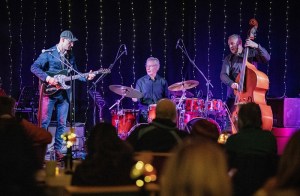
Pop musicians make comebacks all the time – in jazz or jazz/rock, it’s almost unheard of.
Reading King Crimson/Yes/Genesis/Earthworks drum legend Bill Bruford’s fine autobiography, there was no doubt he’d had his fill of the music business when he officially retired from performance on 1 January 2009 (his last headlining gig took place the previous July).
Away from the kit, in recent years he’s achieved a PhD from the University of Surrey, curated an excellent YouTube channel and released the occasional reissue or compilation, the latest of which is The Best of Bill Bruford.
But, as they say in sporting circles, you’re a long time retired. So it’s thrilling to report that Bruford is making tentative steps back to public performance – in a recent interview he described his return to playing as ‘explosive, unexpected, and very sudden’.
He turned up at the John Wetton tribute gig last year, performing ‘Let’s Stick Together’ alongside Phil Manzanera and Chris Difford, and now he’s joined up with his old drum tech, German ex-pat guitarist Pete Roth, plus bassist (usually on acoustic but here on electric) Mike Pratt, for some low-key trio gigs.
His recent show at the 606 was the busiest your correspondent had seen Chelsea’s treasured jazz club for years. Roth’s website describes his music as ‘jazz without borders’, and it’s a pretty good summary – they generally avoid fusion clichés like the plague, sounding more like John Abercrombie’s organ trio than anything Bruford recorded with Allan Holdsworth.
His kit was a return to his youth – two tom-toms, angled snare, two cymbals. And he still has that prodigious, propulsive technique on the hi-hats and ride cymbal, even if his snare drum no longer particularly has that distinctive ‘clang’.
‘Billie’s Bounce’ featured Bruford’s trademark figures between the tom-toms and snare drum, and Roth’s organ patch and octave pedal were a novel touch. ‘How Insensitive’ developed from a freeform rubato opening into an Abercrombie-esque mood-jazz piece, though Pratt’s strident bass seemed a little out of place.
‘If Summer Had Its Ghosts’, first recorded by Bruford with Eddie Gomez and Ralph Towner, meshed odd-time fun with the blues, Roth’s guitar at its more Scofield-like. ‘Summertime’ came with a tricky vamp which Pratt and Roth rushed somewhat – never a problem for Bruford, while a section from Dvořák’s Symphony No. 9 was a slowburn success. Meanwhile band composition ‘Trio of Five’ (or was it ‘Fun’?) was another attractive if a little harmonically inert, vamp-based piece in their favourite 5/4.
Though there were times when Bruford seems to have lost a little of the fluidity of old, it seems churlish to judge a performance thus when the performer and loyal crowd are having so much fun.
The trio play at the Oxford Spin club later this month, and for some other selected dates next year – don’t miss. What an unexpected pleasure to see Bruford back.
Many happy returns to Mr Cobham who turned 80 this week. His drum mastery continues to inspire.
Movingtheriver pretty much learnt to drum by listening to Mr Cobham’s Spectrum, David Sanborn’s (RIP) Hideaway, Steely Dan’s Aja and a few more. His playing was sheer class, something to aim for. There was always an emphasis on technical excellence and good tuning – but the most important thing was the music, the groove.
I was fortunate enough to study with Mr Cobham at the Guildhall School of Music circa 2000. Unforgettable memories.
To celebrate his 80th birthday, here are five key moments from his 1980s. The early part of the decade saw Mr Cobham forge a new life in Switzerland, whilst fronting various bands featuring the likes of Mike Stern, Don Grolnick and Gil Goldstein. Then came the short-lived, controversial tenure in John McLaughlin’s revamped Mahavishnu Orchestra (explored in my book) which nonetheless produced some great music, and then a high-profile return to the solo career via Dave Grusin and Larry Rosen’s GRP Records.
5. Drum Clinic (Part 6), BBC TV, 1982 (?)
Here’s where it all started for movingtheriver. My dad caught it totally by chance on BBC2 and luckily recorded it onto a VHS. It blew the minds of many British drummers including Level 42’s Phil Gould who was reportedly present at the filming.
4. Billy Cobham/Herbie Hancock/Ron Carter: ‘Eye Of The Hurricane’, Lugano, Switzerland, 1983
A period when Billy embarked on various brilliant European collaborations. Still one of the most exciting, propulsive trios I’ve ever heard in acoustic jazz.
3. ‘The Dancer’ (1985)
If memory serves, I was given Mr Cobham’s Warning for my 13th birthday, alongside Joni Mitchell’s Dog Eat Dog and Steely Dan’s The Royal Scam. What a day that was. I still love this album and am glad I kept the vinyl.
2. ‘The Debate’ (1986) Warning’s followup Power Play didn’t quite have the impact of his GRP debut but Billy’s drums have arguably never been better recorded.
1. Live In Cannes (1989)
A recent find this, worth watching for a rare look at Billy playing timbales (during the first song) and also his fine hookup with percussionist Nippy Noya.
Give the only sensible Christmas present this year – the new book ‘John McLaughlin: From Miles and Mahavishnu to The 4th Dimension’, from the chap who brought you 2021’s ‘Level 42: Every Album, Every Song’.
Get informed, keep entertained, stay fashionable and slob out the modern way! Satisfaction guaranteed for you, your friends or family!
Get 30% off the list price by ordering directly on the Rowman & Littlefield website and entering discount code RLFANDF30 at the checkout (available as an eBook too).
Otherwise of course there are many other buying options – all the details here.
The reviews are in:
‘A must-have in every aspiring musician’s personal library.’ Billy Cobham
‘A wonderful insight into a true innovator and colossus of the guitar.’ Mark King (Level 42)
‘Scrupulously researched… A fluent career overview.’ **** MOJO, December 2023
‘The most comprehensive overview of McLaughlin’s career to make it into print thus far.’ **** Shindig!, January 2024
‘Enthralling… Details the many album releases in a highly readable style… Informative and thoroughly enjoyable, it’s easy to recommended this book.’ Jez Rowden, The Progressive Aspect
‘Phillips is the perfect guide through McLaughlin’s byzantine discography, his training enabling him to keep pace with the guitarist’s baffling mastery of time signatures, his passion earning to the trust of anyone still reeling from the early Mahavishnu Orchestra.’ *** Record Collector, December 2023
‘Comprehensive and thoroughly researched, Phillips’ book is a revelation. A must-read for guitar aficionados and McLaughlin devotees.’ Bill Milkowski, author of ‘Jaco’ and ‘Michael Brecker’
‘Riveting… Meticulous storytelling… The book is not just a narrative, it’s a visual feast.’ Jazz In Europe
‘A compelling study of the man, his music and his marvellous creative legacy.’ JazzViews
‘Paints the fullest picture yet of the guitarist’s life.’ Jazzed
‘Thorough and impassioned… The first book to fully illuminate the least-appreciated, least-documented periods in the extraordinary career of this wondrously free-spirited, prolific, perpetually questing artist.’ Booklist
Matt’s new book ‘John McLaughlin: From Miles and Mahavishnu to The 4th Dimension’ is available now and can be ordered via the links below.
‘A must-have in every aspiring musician’s personal library.’ Billy Cobham, Mahavishnu Orchestra drummer
‘A wonderful insight into a true innovator and colossus of the guitar.’ Mark King, Level 42 bassist/vocalist
‘Scrupulously researched… A fluent career overview.’ **** MOJO, December 2023
‘The most comprehensive overview of McLaughlin’s career to make it into print thus far.’ **** Shindig!, January 2024
‘Comprehensive and thoroughly researched, Phillips’ book is a revelation. A must-read for guitar aficionados and McLaughlin devotees.’ Bill Milkowski, author of ‘Jaco’ and ‘Michael Brecker’
‘Riveting… Meticulous storytelling… The book is not just a narrative, it’s a visual feast.’ Jazz In Europe
‘Paints the fullest picture yet of the guitarist’s life.’ Jazzed
‘Thorough and impassioned… The first book to fully illuminate the least-appreciated, least-documented periods in the extraordinary career of this wondrously free-spirited, prolific, perpetually questing artist.’ Booklist
It’s an exhaustive look at John’s catalogue, live career and spiritual life, with an introductory note by Robert Fripp, testimonials from Mark King, Billy Cobham and Bill Milkowski, interviews with key collaborators and lots of exclusive photographs. I cover John’s early sessions with David Bowie and Donovan, his remarkable sideman work with Tony Williams and Miles Davis, the fabled solo career fronting The Mahavishnu Orchestra and Shakti and various projects alongside the likes of Sting, Jeff Beck, Herbie Hancock and Carlos Santana.
If you’ve enjoyed this website in any capacity, please consider buying this book and getting it to the toppermost of the poppermost… Thank you!
Late July 1976: if you were a British jazz/rock fan, all roads led to the legendary Hammersmith Odeon in West London.
The Billy Cobham/George Duke Band opened three nights of music, followed by John McLaughlin’s Shakti and then the headliners Weather Report. The encores often featured members of all three fusion supergroups.
So how apt that a reformed Shakti should appear at the same venue almost exactly 47 years on. And what a relief that they chose the Hammersmith Odeon (it’ll always be the Odeon to me, I can’t call it the ‘Apollo’…) to kick off this hugely anticipated 50th anniversary tour rather than the predictable Barbican or Royal Festival Hall. Accordingly, this was not your usual ‘jazz’ crowd after a little ‘culture’ – it was a vocal, refreshingly multicultural audience.
An attempt to marry ‘Western’/blues-influenced timbres with both North/South Indian rhythmic/melodic approaches, Shakti released three albums between 1976 and 1978, then reformed as Remember Shakti in 1998 for three more tours and subsequent live albums.
For this iteration, promoting brand new album This Moment, 81-year-old guitar master McLaughlin was joined by regular collaborators Zakir Hussain on tabla, Shankar Mahadevan on vocals and Selvaganesh Vinayakram on sundry percussion, plus youthful new recruit Ganesh Rajagopalan on violin.
There was combustive interplay on the opener ‘5 In The Morning, 6 In The Afternoon’, McLaughlin going back to his youth with some potent blues licks, bringing to mind his playing on Miles’s ‘Right Off’. Is he using an amp again, after years of firing his guitar straight through the PA?
An exquisite ‘Zakir’ came with heartfelt words from John to his friend. ‘Anna’, described as a ‘golden goldie’ by Hussain, featured flawlessly-played classical Indian lines and a brilliantly fluid solo from Rajagopalan.
John’s guitar gained a little more distortion in time for the violinist’s composition ‘Mohanam’, and by the middle of the gig he was in his element, dropping in references to ‘Lila’s Dance’ and Lee Morgan’s ‘The Sidewinder’. New track ‘Bending The Rules’ even saw John inject a lick from his 1980s classic ‘Florianapolis’. ‘Sakhi’ and ‘Lotus Feet’ were very touching, and some incendiary konnakol percussion duels closed the show on ‘Finding The Way’.
There was light and shade, fury and meditation at this excellent gig – the only downside was the incessant filming with mobile phones. Is there no privacy/immediacy at these larger concerts? The Shakti story continues. Who would have predicted that five years ago? Their tour continues through Europe and into the US during August. Don’t miss.
The sad death of soprano/tenor sax titan Wayne Shorter has inspired many column inches but, reading most of the obituaries, you might be forgiven for thinking that he was completely dormant during the 1980s.
Nothing could be further from the truth, even if he took more of a backseat in his ‘day job’ co-leading Weather Report (though still contributed brilliant compositions, of which more later).
Your correspondent has to declare a large interest. Wayne’s music was part of my DNA from early doors, probably courtesy of the memorable tunes ‘Harlequin’ and ‘Palladium’ on WR’s Heavy Weather and beguiling ‘The Elders’ and ‘Pinocchio’ on Mr Gone which my dad played throughout my childhood.
By 1985, I was all-in. Wayne was my E.T. and my Monk, Virgo Rising, delivering nuggets of brilliance straight into my burgeoning musical brain. WR’s Sportin’ Life made a huge impression, featuring his majestic composition ‘Face On The Barroom Floor’.
Then Wayne’s contributions to Joni Mitchell’s music started to register – there were many highlights throughout the 1980s, from ‘Be Cool’ and ‘Love’ on Wild Things Run Fast to ‘A Bird That Whistles’ on Chalk Mark In A Rainstorm.
Then Wayne’s solo album Atlantis hit. Strange to report though, apart from the opening ‘sweetener’ ‘Endangered Species’, I failed to really ‘understand’ this dense, intricately arranged record of acoustic chamber fusion for about 20 years. The penny finally dropped and I’m bloody glad I persevered.
Phantom Navigatorcame hot on its heels. Like his friends and bandmates Miles and Herbie Hancock (and inspired by his commitment to Human Revolution), Wayne was tired of improvising over ‘jazz’ rhythms and standard songforms, branching out into symphonic/through-composed material utilising synthesizer and sampling technology.
But of course it sounded completely unlike anyone else. ‘Condition Red’ was an immediate brain-blower, and again this most misunderstood/underestimated album has proved a sleeper classic.
Ditto 1988’s Joy Ryder, with the extraordinary ‘Someplace Called Where’ featuring Dianne Reeves, brilliant ‘Over Shadow Hill Way’ and some fantastic Hancock/Geri Allen/Darryl Jones/Nathan East/Terri Lyne Carrington interplay throughout.
The 1980s Columbia albums get fairly short shrift in critical circles these days but Wayne played several compositions from that era – ‘Atlantis’, ‘Over Shadow Hill Way’, ‘Joy Ryder’, ‘Endangered Species’, ‘The Three Marias’ – right through to the 2010s.
Then there were the intriguing 1980s guest spots and side projects: he acted memorably in ‘Round Midnight’ and contributed to gorgeous ‘The Peacocks’ and brilliant ‘Une Noche con Francis’ (duelling with Dexter Gordon) on the Oscar-winning soundtrack album.
There was a moving guest performance on Toninho Horta’s ‘Ballad For Zawinul’ from the guitarist’s Diamond Land album (still not available on streaming platforms at time of writing) and the memorable team-up with pianist Michel Petrucciani and guitarist Jim Hall on Power Of Three.
Wayne also contributed a fine solo to Stanley Clarke’s ‘Goodbye Pork Pie Hat’ and played beautifully throughout Buster Williams’ 1988 album Somethin’ Else. (Chime in below if I have missed any other great Wayne 1980s guest performances.)
Wayne ended a fruitful decade recording The Manhattan Project’s excellent self-titled live Blue Note album at Chelsea Studios, NYC, in December 1989 alongside Clarke, Petrucciani and Lenny White (c’mon Universal, get this on streaming platforms). He plays some marvellous stuff throughout, particularly on Jaco Pastorius’s ‘Dania’, new composition ‘Virgo Rising’ and a reversioned ‘Nefertiti’.
Then there was the live work. Wayne toured the UK regularly between 1985 and 1988. I think I saw him four times during the decade, and each concert was fascinating.
There was a Weather Report gig at the Dominion Theatre in summer 1984, a poorly-attended solo gig at the Logan Hall on 25 October 1985 (‘lack of promotion ’, someone said to my dad) and a really weird all-nighter at the Town & Country Club on 4 April 1987 when Wayne’s sci-fi fusion stopped the jazz dancers in their tracks,
Then there was a gig with Carlos Santana at the Royal Festival Hall on 13 July 1988 of which I can’t remember much apart from a few hippies in the front row loudly saluting every note Carlos played, and Ndugu Chancler’s absurdly-high cymbal setup. (There was also apparently a solo Wayne gig at The Astoria in April 1988 which for some reason I missed.)
I would study him and his sidemen (and, notably, sidewomen: his 1980s bands featured no less than five women, Marilyn Mazur, Geri Allen, Tracy Wormworth, Renee Rosnes and Carrington), fascinated and enthralled by the originality of his music and playing.
Farewell to a master, a talisman, an enlightened being. Nam myoho renge kyo.
Further listening: check out my Wayne playlist which outlines some key tracks of his career.
The heart always beats a little faster when there’s news of a ‘previously unreleased’ Miles project. And if it’s from the 1980s, even better.
The era is still one the least understood/lauded periods of Miles’s work, despite the stellar efforts of George Cole.
It also has not been served well posthumously, particularly by his final label Warners; in recent years there has been the weirdly undercooked/incomplete Rubberband project, and the appallingly-mastered/incomplete Warners Years box set.
So hopes were high for Sony’s new Bootleg Series 7, which takes in the years 1982 to 1985 and looks at the sessions that made up the (classic) albums Star People, Decoy and You’re Under Arrest. The packaging looks OK:
But what about the music? Before his death, Teo Macero, producer of many epochal Davis albums and also Star People, was very critical of the ‘complete sessions’ boxes that appeared after Miles’s demise. It’s safe to say he would not like this either.
We essentially get a collection of long studio jams, featuring the occasional familiar section – generally the best bit of the jam, expertly filleted by Teo. He really earned his money during this era of Miles music. There are also some alternative versions of You’re Under Arrest material, a few full-length, unedited versions of released tracks and one or two outtakes such as ‘What’s Love Got To Do With It’.
The full, unedited versions of ‘Freaky Deaky’ (Darryl Jones’ first recording with Miles) and ‘Katia’ (before Miles took his razor blade to John McLaughlin’s remarkable solo) are well worth hearing. Marcus Miller plays a brilliant bass solo on ‘Remake Of OBX Ballad’. There’s also a really strange duet featuring trombonist JJ Johnson and Miles on keyboards.
Unlike some of the previous Bootleg Series albums, there’s a lack of interesting studio chatter, which would have enlivened things (though there is the occasional brief Miles interjection). And there are still tracks that refuse to leave the vaults, such as the version of Nik Kershaw’s ‘Wild Horses’.
Disc one just contains too many formless jams, with Mike Stern, Miles and Bill Evans struggling to put together cogent solos (despite Al Foster’s beautiful drumming), and basically the band is crying out for John Scofield’s arrival in autumn 1982. He brings immediate relief, from both a soloing and compositional perspective. The live disc is serviceable and quite well recorded, but certainly not one of the best nights from the 1983 tour.
Essentially, we learn three things from the very uneven Bootleg Series 7: Scofield was a vital addition to Miles’s band and prolonged his career, Miller was Miles’s best bass player of the 1980s and Macero did a great job on Star People. But we probably knew all of that already.
So, basically, it’s another opportunity missed. I’ll stick to the original albums, with one or two exceptions. But you gotta check it out if you’re a fan of Miles’s 1980s music. George Cole covers the box in a lot more detail here.
Eddie Gomez’s excellent late-1980s albums Mezgo (later rereleased as Discovery) and Power Play were recorded for the Japanese arm of the Epic label.
Bassist/composer Gomez is probably best known for his stellar sideman work with pianists Bill Evans and Chick Corea, as well as being a co-founder of jazz/fusion supergroup Steps Ahead, but his solo work sometimes goes unheralded.
Perhaps most relevantly, both albums feature some of saxophonist Michael Brecker’s best-ever recorded work. And they are crucial items in drummer Steve Gadd’s discography too.
1986’s Mezgo is mainly a trio album, Gomez on bass and keys, Gadd on drums/percussion and Brecker on saxes and EWI. It’s a stunning potpourri of styles, starting with the Weather Report vibe of ‘Me Too’, calling in at the fast bebop number ‘Puccini’s Walk’ (poorly covered by Corea not once but twice!) with some superb Gadd, and ending with a very moving version of Henry Purcell’s ‘Cello Sonata In G Minor (1st Movement)’.
Power Play, released the following year, had more concessions to commercialism, with some romantic ballads featuring syrupy alto sax from Dick Oatts and a few Latin-style groovers featuring Jeremy Steig on flute.
But the title track was a stunner, featuring double drums from Gadd and Al Foster. There was also a superb duet with guitarist Jim Hall, ‘Amethyst’, and an excellent fast bop track ‘West 110 St.’ featuring Foster and Brecker.
Both of these albums are highly recommended, especially on physical formats.
‘A game of two halves’ is a common expression in football, but it can apply to albums too.
We all know albums which have one good side and one bad one (I’ll throw in The Seeds Of Love, Fulfingness’ First Finale, Music Of My Mind, The Colour Of Spring for your consideration…).
The Cult Of Metheny has ensnared many, and puzzled just as many. But As Falls Wichita fell smack bang in my favourite era of Pat’s music (between American Garage and Song X), and represented a real change of scene.
Side one’s 20-minute title track delivered a full-on prog/fusion masterwork, ably assisted by Lyle Mays in classic-synth heaven (Prophet 5, various Oberheims, Roland CR-78 and Linn LM-1 drum machines), always totally recognisable, and at a time when polyphonic playing had just become possible. He was rapidly becoming a Joe Zawinul for the 1980s.
‘As Falls Wichita’ may be the most ‘rock’ music released on the ECM label during the 1980s, with the possible exception of David Torn’s 1987 record Cloud About Mercury. It also seems dangerously ambitious. Then again, the whole album was recorded in just three days! Lesser musicians could have taken a month to record this track alone.
Apparently chiefly written to play over the PA system before Metheny Group concerts, it’s pure headphone music. The enigmatic title (apparently nicked, with permission, from an unreleased Steve Swallow composition) and superb album cover certainly help.
The track plays out like a good movie (its working title was ‘Apocalypse When’). It’s more John Carpenter than Keith Jarrett. You might even describe it as cathartic, dammit.
(Another reason for its success may be the complete lack of instrumental solos. Pat doesn’t get any solo space at all – he just plays some unobtrusive bass, chiming 12-string electric and a little six-string. All sounds are textural and in the service of the whole piece.)
A superb live version was featured on the 1983 Metheny Group album Travels. And those who remember the Christian Dior ‘Fahrenheit’ adverts in the late 1980s may be familiar with a small excerpt of the track:
But back to that ‘album of two halves’ thing. Sadly, side two of As Falls Wichita is New-Age sludge. Ponderous and flabby, it’s fuel to Pat detractors, but probably loved by acolytes.
‘September Fifteenth’, a tribute to Bill Evans (named for the date of the great jazz pianist’s death in 1980) is the chief culprit. A closing, out-of-tune version of ‘Amazing Grace’ doesn’t help. It’s music for tired Apple executives, and sounds like it was recorded in the last afternoon of the three days.
But As Falls Wichita was an unexpected smash by ‘jazz’ standards: the album got to #1 on the Billboard Jazz Charts and quickly became Metheny’s biggest seller to date.
So happy 40th birthday to the classic title track. Pour yourself something tall, tune in, drop out, get the headphones on, lie on the floor and crank it up. It’s a trip, man…

 Arguably no guitarist has stepped into Allan Holdsworth’s shoes since the Yorkshireman’s sad death in 2017 – hardly surprising since he was one of the greatest, most original voices on the instrument.
 Pop musicians make comebacks all the time – in jazz or jazz/rock, it’s almost unheard of.


 The sad death of soprano/tenor sax titan Wayne Shorter has inspired many column inches but, reading most of the obituaries, you might be forgiven for thinking that he was completely dormant during the 1980s.


 movingtheriver.com