
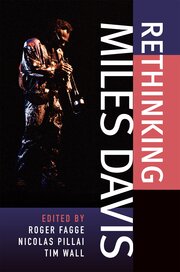
 In the blizzard of books, articles and tribute albums released to celebrate Miles Davis’s recent centennial, here’s one of the more interesting – though extremely flawed – items.
‘Rethinking Miles Davis’ is a new academic work from Oxford University Press which looks to reassess Miles’s legacy, character and, particularly, his 1980s music.
The tone is set by Tony Whyton’s first chapter entitled ‘Miles Behind’, which starts with a disclaimer: ‘The following chapter focuses on the work of a misogynist and serial abuser of women. Any pleasure derived from the study of Miles Davis should be considered in direct relation to these acts.’
Whyton moves on to claim that, especially in light of the #MeToo movement, we need to ‘think about Miles differently’ and move towards a new kind of jazz appreciation in general.
Essentially it asks us to strip away Miles’s ‘romantic’ myth (the Prince of Darkness, the baddest mother****er, etc.) and focus on reality, informed by other articles about Miles’s battery of women, from Pearl Cleave to Eric Nisenson and Miles’s autobiography itself.
In essence, Whyton is asking oft-considered question of whether we can/should separate a great artist from their deeds – Miles, Picasso, Michael Jackson, Eric Gill or Dali . The short answer may be ‘yes’, but Whyton attempts to persuade that this is a false position.
(Maybe a more interesting question is whether our propensity to ‘forgive’ an artist their deeds is dependent on one’s ‘hierarchy’ of their supposed evils – it’s interesting to survey the above list again…).
It’s a noble pursuit, but seems in vain – this writer is pretty sure lovers of Miles’s work can quite easily separate his musical nous from his sometimes highly questionable actions*.
But there’s much better stuff in ‘Rethinking Miles’. Nicolas Pillai looks at Miles’s appearances on TV and in videos, and the various references to his work which appear in movies. There’s very interesting, original information regarding his ‘Miami Vice’ guest appearance and collaboration with Spike Lee on the ‘Tutu Medley’ video.
Some errors suggest shoddy proofreading and/or research though – he mistakenly credits Mike Gibbs with directing ‘The Miles Davis Story’. It was Mike Dibb. And he rather blithely describes Miles as ‘acting the pimp’ on the cover of You’re Under Arrest, apparently failing to consider Ian Carr’s assertion that he’s dressed in the attire of a ‘Spanish dancer’.
Another interesting section is Pedro Cravinho’s work on tracking Miles’s visits to Portugal over the years, and how that country’s press treated him during his tours.
Elsewhere Roger Fagge’s chapter investigating Miles’s posthumous Doo-Bop album and exploring jazz’s flirtations with hip-hop is engaging and well-researched, with some new insights into the project and an analysis of how Kendrick Lamarr, J Dilla and Robert Glasper bring jazz into their music.
But by far the best – and simplest – section of the book is William Ellis’s collection of Miles-referencing ‘One LP’ photos, featuring Marcus Miller, Terence Blanchard, Eddie Henderson, Mike Stern and others discussing the effect Miles’s music had on their lives and careers.
Elsewhere Tim Wall’s looks at Tutu‘s position in Miles’s discography, its relationship to the work of Prince and Madonna, and Miles’s decision to sign for Warner Bros.
There’s an unfortunate section looking at Tutu’s place in the pantheon of ‘smooth jazz’, spending far too much time on Warner Bros’ ‘fusion’ legacy, and there’s a rather poor exploration of Marcus Miller’s pre-Tutu session career, describing Donald Fagen as a ‘soft rock king’ and Dave Grusin as a ‘jazz instrumentalist’!
Wall also fails to locate another of Miller’s key influences in putting together Tutu: Herbie Hancock’s Speak Like A Child (which Hancock himself claims was influenced by Gil Evans! So everything comes full circle…).
There’s also only the briefest mention of Miller’s pre-Tutu solo albums, particularly 1983’s Suddenly, where he had already rehearsed a fusion of drum machine and real drums, and also worked at combining synth bass and bass guitar.
Wall also inexplicably compares Tutu to Byrne & Eno’s My Life In The Bush Of Ghosts, Herbie Hancock’s Future Shock and Material’s Memory Serves, and rather over-eggs the album’s influences from Prince and Madonna (only one track on Tutu shows any kind of Prince influence – the closing ‘Full Nelson’).
It seems that most critics are unable to spot that Tutu is an extremely original piece of work, more reflecting Miller’s outstanding compositional abilities and Miles’s good instincts than anything else.
But Wall’s article does outline Tutu‘s mixed critical reaction, particularly from the jazz and (American) rock press, but fails to acknowledge the reception it received in the UK, where it was mainly greeted as a funk or even pop album.
The October 1986 edition of The Face magazine reviewed it alongside David Sylvian, Loose Ends and Human League, and also named Tutu as its seventh best album of 1986, alongside Prince, Anita Baker, Iggy Pop, The Smiths, Janet Jackson, Run DMC, Cameo and Talking Heads.
There are other strange omissions – co-producer Tommy LiPuma is mentioned only once (the author also has apparently/curiously never read Ben Sidran’s biography of the Tutu co-producer) and he also fails to acknowledge that it was LiPuma – not Miller – who reportedly first played Scritti Politti’s ‘Perfect Way’ to Miles.
Wall also supplies a chapter trying to understand better Miles’s ‘shock’ signing for Warner Bros after almost 30 years on CBS, but fails to add much to Paul Tingen, Ian Carr and George Cole’s exemplary work on the matter. And again there are a few odd factual errors, including describing Elvis Costello as an ‘icon of American popular music’!
Will L Finch writes about Miles’s work on the ‘Dingo’ soundtrack alongside Michel Legrand, as well as his appearance in that film. But he misspells trumpeter Chuck Findley’s name, though does include some interesting work on Legrand and the musical antecedents for his soundtrack.
Finally, there’s also a chapter on Miles’s arrangers by Wall and musician/writer Bobbie-Jane Gardner, looking at his collaborations with Gil Evans, George Avakian, Miller and LiPuma.
So, while patchy and error-strewn, ‘Rethinking Miles Davis’ will be a vital addition to any fan’s library. The chapters on Portugal and Miles’s TV appearances certainly offer new material, and even the more humdrum sections will provide food for thought, if not a total ‘rethink’ of Miles’s career.
*But certainly it can be a (refreshing?) shock in our somewhat cossetted age to revisit even Miles’s most ‘media-friendly’ TV appearances, like ‘The Arsenio Hall Show’ or ’60 Minutes’. He seems brutally honest and totally unpolished compared to the relatively ‘coached’ personalities of today. But this writer’s suggestion to the general fan would be to ignore those pieces of footage completely. And while his Autobiography may signal general feelings about musicians, friends and events, it’s full of factual inaccuracies. In short, all of Miles’s public utterances should probably be taken with a huge pinch of salt.



 Playwright, actor, activist and poet Harold Pinter, who died on Christmas Eve 2008, would have been 90 years old today.
