Frank Gambale Live! 30 Years On

I’ll never forget it. Circa 1990, I was on holiday with my parents in Kent, near the Cliffs of Dover.

A summer storm was chucking it down. Holed up inside, I flicked through some French music stations on my longwave radio.

Suddenly I heard this absolutely ridiculous guitar playing – deafeningly loud, hysterical, but totally precise, with great phrasing and notes that spluttered out in absurdly wide intervals.

The tone was heavily distorted but the feel was closer to jazz/rock than metal. And the rhythm section didn’t sound too shabby either.

By this time, I had heard Allan Holdsworth, Paul Gilbert, Yngwie Malmsteen, John McLaughlin, some pretty outrageous guitarists, but this was different. Who the hell was it? I strained my ears and just about heard the French DJ utter the words ‘Frank Gambale’.

Yes, it was the Italian-Australian wunderkind, the man who introduced so-called ‘sweep picking’ to a wider audience than before. And the album was revealed to be Live!, released 30 years ago this week and recorded at LA’s jazz/rock haven The Baked Potato on 21st August 1988.

What was really weird was that I had heard Gambale with the Chick Corea Elektric band before this, and even seen them live a few times, but he seemed pretty anonymous in that band.

Not here. To this day, ‘Credit Reference Blues’, ‘Fe Fi Fo Funk’, ‘Touch Of Brasil’ and ‘The Natives Are Restless’ sound like guitar landmarks.

But he was way more than a chops phenomenon – he’s an excellent composer too, clearly influenced by Chick Corea and Larry Carlton but with some moves all of his own.

The album also introduced me to the fantastic Joey Heredia on drums, a completely original player who can do fiery jazz/rock, spicy Latin and Police-style rock, sometimes all in the space of one tune. And the excellent keyboard player Kei Akagi was moonlighting with Miles Davis while playing some sh*t-hot stuff on this album.

Frank Gambale Live! was a key artefact in the golden age of shred guitar, and it gained him some crossover success with metal fans and lots of coverage in guitar magazines.

Sadly his solo career refused to fire after this release, with only moments of 1990’s Thunder From Down Under subsequently holding much interest for me, but this was a sporadically brilliant live jazz/rock album – and one of the best. (It has to be said, there’s not much competition – Larry Carlton’s Last Nite, Weather Report’s 8:30, Jeff Beck With The Jan Hammer Group Live!, Mahavishnu’s Between Nothingness And Eternity, and…er…)

Narada Michael Walden: Looking At You, Looking At Me/The Nature Of Things/Divine Emotion

Singing drummers: the ’80s were chock-a-block with ’em.

But Narada seems a somewhat forgotten example, at least compared to the far more popular Phil C, Don H, Stevie W and Sheila E.

Yet he started the decade as the one you’d probably have put your money on, ending the ’70s as he did with an impressive run of R’n’B hits.

Narada had of course started his music career as a jazz/rock drumming tornado in the second incarnation of John McLaughlin’s mighty Mahavishnu Orchestra, going on to record famous fusion sides with Jeff Beck, Weather Report, Tommy Bolin, Alphonso Johnson and Jaco Pastorius.

During the ’80s, he was one of the most in-demand producers on the planet, helming Whitney Houston’s ‘I Wanna Dance With Somebody’, Aretha Franklin/George Michael’s ‘I Knew You Were Waiting For Me’ and Starship’s ‘Nothing’s Gonna Stop Us Now’. But his solo career was somewhat in limbo during this period, so it’s fascinating to check out a new, nicely-appointed three-album survey of his 1983-1988 output.

Looking At You, Looking At Me (1983) is the best of the three albums, but a frustratingly inconsistent record. Listening to the superb title track, you’d think he might have found hit his true metier, a languid, luxurious, West Coast pop/jazz, similar to the kind of music Al Jarreau or Manhattan Transfer were making at the time.

But an OK duet with Angela Bofill, passable cover of ‘Reach Out (I’ll Be There)’ and sick drum-machine/horn workout ‘Shake It Off’ aside, the rest of the album is fairly unmemorable R’n’B with occasional virtuosity from guitarist Corrado Rustici and bassist Randy Jackson.

The followup, 1985’s Nature Of Things, is even more problematic, sounding mainly like a kind of soft R’n’B version of the ‘Top Gun’ soundtrack, with way too many synth-based ballads. But Divine Emotion (1988) was a partial return to form, led by the effervescent title track (with one of the great ’80s basslines) which gave him a timely UK hit. Narada had obviously been prompted into action by his highly successful production work – his vocals and arrangements have never been better.

But while Divine Emotion sounds like a million dollars, there are still issues on the songwriting front. Put simply, only the title track, ‘But What Up Doh’ and closer ‘We Still Have A Dream’ have memorable hooks (the latter also features some brilliant jazz/rock kit work from Narada).

One wonders what might have happened if he had hooked up with some great ‘pop’ songwriters like Kenny Loggins, Rod Temperton, Michael McDonald, Carole Bayer Sager or even Burt Bacharach at the outset of the decade rather than relentlessly ploughing his own furrow; ‘Looking At Me, Looking At You’ offers tantalising possibilities.

But looking at his career as a whole, it’s all turned out fine – Narada’s always been one of the coolest, most talented musician/producers around, and apparently he’s a joy to work with.

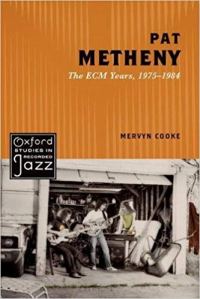
Book Review: Pat Metheny (The ECM Years 1975-1984) by Mervyn Cooke

You know the guy: long, bushy hair, beatific grin, jeans, sneakers, long-sleeved T-shirt, usually rhapsodizing intensely via some kind of guitar gizmo.

Despite his many stylistic detours, Pat Metheny is a brand all right, and his music inspires a devotion and attendant sales profile that has rarely – if ever – been afforded to ‘jazz’ musicians.

If you – like me – aren’t always enamoured by the bulletproof sincerity of his stage presentation (in Gary Giddins’ memorable words, he ‘intones plush melodies with excessive sobriety, as though the notes were transmitted directly from God’ – the main reason why I’ve always preferred his stuff on record rather than live…), it’s beyond doubt that Metheny is one of the great guitar soloists.

Mervyn Cooke’s superb new book ‘Pat Metheny: The ECM Years, 1975-1984′ sheds light on the first – and, for me, best – decade of the guitarist’s recording career, when he was the famous European jazz label’s top turn.

It’s an academic study, though never boring and certainly never predictable, with close attention played to Pat’s guitar styles, musical history, tunings, key collaborators (loads of new stuff about Jaco, Charlie Haden, Michael Brecker, Gary Burton and Lyle Mays here), equipment, album cover designs and inspirations.

There are fascinating details, like Metheny’s obsession with flat ride cymbals (hence his deliberate placement of drummers onstage, ride cymbals always in close proximity to his left ear) and his singular band-leading philosophies. There are solo transcriptions and quotes from archive interviews.

Cooke also shrewdly compares Metheny’s studio work in this era to that of Weather Report’s, drawing parallels between both acts’ meticulous sculpting of ‘spontaneous’ musical performances and attempts to concoct ‘through-composed’ – rather than vamp-based – material.

Metheny fans will love ‘The ECM Years’, as will anyone who has even the faintest interest in guitar trends of the last 40 years. It also serves as a rich biography of ECM Records in its early years, with numerous revelations about label boss Manfred Eicher.

Reading the book sent me running back to choice cuts from Pat’s early albums that I liked during my teenage years – Bright Size Life, American Garage, 80/81, As Falls Wichita, So Falls Wichita Falls, Travels, Rejoicing, First Circle, Song X.

Revisiting As Falls Wichita in particular has been somewhat of a revelation. (Prog fans: check out side one. It’s a cinematic masterpiece, analysed in great detail by Cooke.)

Mervyn Cooke’s ‘Pat Metheny: The ECM Years, 1975-1984’ is published by Oxford University Press.

Stanley Clarke: The Message

Stanley’s music first grabbed me sometime in the mid-’80s.

It was the bassist/composer’s incredible 1974 self-titled album featuring Tony Williams on drums, Jan Hammer on keyboards and Bill Connors on guitar.

Clarke remains a hero – I still greet his new albums with some enthusiasm and his career seems to have enjoyed a new lease of life over the last 10 years or so.

2006’s Toys Of Men was a huge return to form, and releases since then have been prolific if less impressive.

Which brings us to Stanley’s new album, The Message. It continues his tried-and-tested formula: some sh*t-kickin’, symphonic jazz/rock, vocal-based R’n’B, acoustic interludes with a classical bent and brief novelty curios featuring some guest star or other (this time Doug E Fresh on rapping and human beatbox).

On previous classics like School Days and If This Bass Could Only Talk, the formula worked a treat. But this time, besides the typically great playing, there are a few issues – with Stanley’s production, compositions and ‘message’.

The opener ‘And Ya Know We’re Missing You’ is a tribute to all of the following: Al Jarreau, Ndugu Chancler, Tom Petty, Chuck Berry and Larry Coryell. It sounds suspiciously like a demo, complete with distortion and rudimentary ‘slap in E’ groove. Sure, he can pay tribute to whoever he likes in whichever way he deems suitable, but this seems a really uncommitted two minutes of music.

A re-tread of the Return To Forever classic ‘After The Cosmic Rain’ also emphasises the problem with contemporary production. The new one sounds hemmed in, dried out, panicky. Drummer Mike Mitchell must take some of the blame too – he has perfected the lightning-fast single-stroke rolls but they get boring very quickly. It doesn’t help that he tunes his drums to choking point.

There are substantial pieces of music here: the title track, ‘The Rugged Truth’ and ‘The Legend Of The Abbas And The Sacred Talisman’ are great compositions which bear comparison with Stanley classics like ‘Light As A Feather’, ‘Life Is Just A Game’ and ‘Song To John’.

The acoustic-bass take on Bach’s Cello Suite is gorgeous too, but a few other tracks are beyond help – the treacly ‘Lost In A World’ and ‘To Be Alive’ irritate, while only Stanley knows what’s behind ‘Combat Continuum’, a nutty futuristic spoken-word/fusion piece about impending war.

What a shame. It could have been a classic, but The Message has 5/10 written all over it. It’s definitely one for filleting on streaming services though, and I’m sure the music will come alive in concert.

The Message is out now on Mack Avenue.

Nick Mason: Fictitious Sports

Who are the luckiest musicians in rock?

Which players have made the megabucks peddling middling-at-best instrumental skills and generally keeping their heads down? Mick Fleetwood, John McVie, Eric Clapton, Phil Selway, Adam Clayton?

Nick Mason would probably have to be in that list too. But then you wonder if the Pink Floyd sticksman has hidden talents – after all, he’s produced the Damned, Robert Wyatt, Gong and Steve Hillage.

Good musicians seem to really like and respect him and he has always seemed one of rock’s gentlemen.

He was at it again in 1979 when he was offered a ‘vanity’ record deal during some Pink Floyd off-time. He didn’t have any particular plans, so asked esteemed jazz arranger/keyboardist Carla Bley if she could help out.

She had some songs prepared that she’d written for her punk band Penny Cillin And The Burning Sensations. Mason and Bley managed to quickly gather a rock snob’s dream team (Wyatt on vocals, Chris Spedding on guitar, cover designers Hipgnosis, record label Harvest) and record in Bley’s basement (Mason also apparently wanted Yul Brynner to be the singer, but he turned it down…).

It all led to his one and only solo album Fictitious Sports, eventually released in 1981. It’s a fascinating, intermittently brilliant project that borrows from art-pop, prog, new-wave rock and even musical theatre to produce something pretty original (hardly surprising if one delves into Bley’s ouevre with any depth).

On the superb, disquieting ‘I’m A Mineralist’, Wyatt rehearses a Peter Gabriel-style blanked-out vocal and Bley inserts some witty Philip Glass Einstein On The Beach-style tomfoolery and a few general pokes at minimalism.

And she doesn’t scrimp on the silly but menacing lyrics either: ‘Just the thought of ironing gives me spasms of lust’, ‘Mother used to try to meddle in my affairs’, etc…

‘Do Ya’ is a highly original, witty evocation of a crumbling relationship, reminiscent of something from Robert Fripp’s Exposure, with Wyatt sounding like he’s at the end of his tether. It could almost be the soundtrack to one of those Bruce Nauman man/woman video art pieces.

There are loads of other treats littered throughout, and even an odd Floyd/Kate Bush-style symphonic rock piece (‘Hot River’). Mason adroitly leaves the clever stuff to Bley, generally only picking up the sticks during the riff sections.

But it’s the best thing I’ve heard him do, with the exception of Syd-era Floyd. An interesting beginning – and end – to an almost fictitious solo career, and a great set for Robert Wyatt completists.

John Abercrombie: Getting There 30 Years On

Maybe John Abercrombie was the Andy Murray of jazz guitarists.

People say Murray was ‘unlucky’ to be playing tennis at the same time as Federer, Djokovic and Nadal; Abercrombie was arguably ‘unfortunate’ to have been forging a career at the same time as Pat Metheny, Mike Stern, John Scofield and Bill Frisell.

But a superb career he forged all the same. Starting out as somewhat of a John McLaughlin imitator playing unhinged jazz/rock with Billy Cobham and Dreams on ‘some of the worst fusion albums ever made’ (his words), by 1974 Abercrombie had settled into a long, intriguing career on ECM Records, where he could pursue all his interests, from acoustic guitar duos with Ralph Towner to organ trios with Jan Hammer and Jack DeJohnette.

But one of his best bands was this mid-1980s outfit with ex-Bill Evans/Lyle Mays sideman Marc Johnson on bass and legendary Peter Erskine on drums, often augmented by Michael Brecker on sax too.

Abercrombie was getting heavily into the guitar synth around this time, while also using loops and ethereal keyboard patches to beef up the studio sound.

’86’s Current Events was a fine ‘blowing’ record but followup Getting There – released 30 years ago this month – was arguably Abercrombie’s most commercial album. It’s big and bold but definitely no ‘fusion’ sell-out, and it distills its ideas into relatively short, concise statements.

It’s also somewhat of a rarity for the ECM label in that it’s not produced by Manfred Eicher – Lee Townsend is in charge here, assisted by James Farber.

The epic title track is loud and proud, almost approaching avant-rock with Erskine absolutely lamping his drums and a hysterical, exciting set of screaming guitar-synth solos. It gets near the approach of David Torn’s sometimes raucous Cloud About Mercury album.

Ethereal, gentle and gorgeous ‘Thalia’ (composed by Vince Mendoza) and ‘Chance’ are ambient/jazz masterpieces with shades of Mark Isham’s work.

Classic ballad ‘Remember Hymn’ initially sounds like a re-harmonisation of Sibelius’s ‘Valse Triste’ but slowly becomes a vehicle for Brecker’s haunting tenor. The latter also cleans up on the raucous two-chord blowout ‘Furs On Ice’, reminiscent of Johnson’s Bass Desires band, with Erskine at his most Elvin Jones-like.

Getting There predictably received a somewhat muted critical reaction (but did get a three-star review in Q Magazine). I wasn’t bothered about that – having been recommended Abercrombie by a guitar player friend, I bought it sight unseen from HMV Oxford Street on vinyl a few weeks after it came out. It’s still my favourite album by the guitarist.

But it would be the last time Abercrombie dipped his toe into ‘rockist’ waters – he quickly regrouped to continue his ever-eclectic, increasingly gentle career, and, to the best of my knowledge, never picked up the guitar synth again…

John McLaughlin: Music Spoken Here 35 Years On

All great artists with any kind of career longevity have very distinct periods, and John McLaughlin is no exception.

Apart from his mid-’60s output, the early 1980s (let’s face it – the whole of the 1980s… Ed.) is probably his least understood/appreciated era.

McLaughlin had moved to France and formed a new band occasionally known as The Translators featuring a top-class American drummer (Tommy Campbell) and otherwise French unit including his new paramour, the outrageously talented keyboardist Katia Labèque.

His music too had turned away from electric jazz/rock and moved towards a gentler fusion of jazz, classical, blues, flamenco and Latin music, centred around the acoustic nylon-string guitar.

I was a major John completist in the late ’80s/early ’90s but didn’t have a clue Music Spoken Here even existed until chancing upon a vinyl copy in the Shepherds Bush Music & Video Exchange. You’d be hard pushed to find it in any jazz reference book these days; it’s virtually been written out of his discography. Some would say with good reason, but to these ears it’s one of the nuttiest, most piquant albums of John’s career.

At times you can feel him edging again towards the Mahavishnu reunion which happened a few years later in ’84, reaching for the Les Paul on a few cuts and pushing the drums and synths higher in the mix. But in its own way, and considering what else was going on in the jazz world at the time (Wynton, Branford and the Young Lions traditionalists) Music Spoken Here is as shocking an album as The Inner Mounting Flame.

‘Blues For LW’ is the album’s centrepiece, a thrilling, richly-chorded tribute to the Polish activist Lech Welesa with a neat quote from Miles Ahead and completely insane Chick Corea-meets-Rachmaninoff synth solo. ‘Honky Tonk Haven’ is brilliant too, a cacophony of early hip-hop beats, modal keyboards and a killer guitar/synth melody line borrowed from the Shakti track ‘Get Down And Shruti’. You’ve gotta think that Miles would have dug it.

The cover of Egberto Gismonti’s ‘Loro’ may be taken a tad too fast but the arrangement kicks ass. Elsewhere, the album is full of sunny, fresh, cosmopolitan grooves, with frequently outrageous guitar and keyboard playing – the latter way too high in the mix though.

Music Spoken Here was another two fingers up to the purists of the music world, and another artistic success. It reached #24 on the US jazz album chart, a reasonable return but not exactly a big hit for an artist of his magnitude. It’s crying out for a remaster though, one of the muddiest-sounding records of McLaughlin’s career.

Next stop for John was a tour with The Translators, an excellent studio album with Al Di Meola and Paco De Lucia, and then the aforementioned return to Mahavishnu, reuniting with Billy Cobham. Needless to say, that would be another hard sell for the critics…

Larry Carlton: Last Nite 30 Years On

In a previous piece about Robert Cray, I talked about ‘touch’ guitarists, those whose sounds are almost entirely in their fingers and not dependent on pedals or amps.

Larry Carlton is certainly one of them. He played some of the great guitar of the 1970s with Steely Dan, The Crusaders, Michael Jackson and Joni Mitchell, his sound characterised by a deceptively ‘sweet’ take on the blues, alongside elements of jazz and rock. In the early ’80s, he put out some fine studio albums including Sleepwalk and Friends, but ’87’s Last Nite was his first official live release.


And what an album. In 1987, I was a big fan of his playing with Steely Dan but had never heard any of his solo stuff. A glowing review of Last Nite in Q Magazine sent me scuttling off to my local Our Price. Recorded on 17th February 1986 at the Baked Potato club in North Hollywood, the album is Larry uncut, blowing on a mixture of originals and jazz standards, with no thought of commercial or airplay potential.

It’s hard to think of another guitarist who could cover such a stylistic range so effortlessly. He kills on the slow blues, tears up the fast Texas-style shuffle, delivers deliciously ‘out’ fusion on the title track and swings his ass off on ‘All Blues and ‘So What’, though with a pleasingly piercing tone as opposed to the warm sound favoured by most ‘jazz’ players.

He’s also endlessly melodic, producing memorable phrase after memorable phrase. But don’t be fooled by the beatific expression and cream jacket – he isn’t afraid of throwing in some pretty wacky modal curveballs too.

Another key aspect of Last Nite is Carlton’s band. He uses the cream of the LA studio scene – John ‘JR’ Robinson on drums, Abe Laboriel on bass, Alex Acuna on percussion – and brings them right out of their comfort zone. Apparently they didn’t know ‘So What’ and ‘All Blues’ were on the setlist until Larry called them.

JR in particular is a revelation, sounding like he’s been cooped up in the studio for far too long. And who knew he could swing like he does on the jazz cuts. Keyboard player Terry Trotter also impresses with his rich voicings and empathetic accompaniment.

Sadly, Last Nite turns out to be a bit of an anomaly in Larry’s discography, marking the beginning of an era when he was veering more and more towards a much smoother studio sound. But he’s always ripped it up in the live arena and has spent a lot more time on the road in his later years.

Happy birthday to a true guitar classic.

David Sanborn: A Change Of Heart 30 Years On

On 17 July 1986, Tampa-born sax great David Sanborn broke off from a European tour to guest with Miles Davis and band at the Montreux Jazz Festival.

Though obviously nervous, Sanborn acquitted himself well, getting stuck in with some tasty modal solos and prompting many Miles smiles. Hopefully the performance would bode well for Sanborn’s next studio recording.

Unfortunately not. Sanborn made some fine albums during the 1980s – Hideaway, Voyeur, As We Speak, Straight To The Heart – but A Change Of Heart was not one of them. It was the kind of over-produced, under-composed, unfunky ‘fusion’ record that Tutu should have killed off once and for all.

I bought it on cassette when it came out, proudly showing it off to a cool family friend who had previously introduced me to loads of great music. I hoped he would be impressed by my purchase. He turned his nose up, mumbling something about ‘Bloody muzak…’ Harsh but fair, at least when it comes to most of A Change Of Heart.

The opening two Marcus-written-and-produced tracks – ‘Chicago Song’ and ‘Imogene’ – deliver a quality that the rest of the album never even remotely approaches. Miller was in constant demand around this time and presumably couldn’t commit to the whole album. ‘Imogene’ is a classic ballad with a haunting fretless bass melody and beguiling bridge, while ‘Chicago Song’ transcends its simple melody with an irresistibly funky rhythm section and biting Hiram Bullock guitar bridge.

The rest of A Change Of Heart seems designed for the latest Don Simpson movie or an episode of ‘Miami Vice’. Syndrum overdubs and unsubtle Fairlight samples prevail alongside ugly synth sounds and flimsy melodic motifs, without a whiff of jazz or R’n’B. Producer/synth players/writers Ronnie Foster, Philippe Saisse and Michael Colina toil away fruitlessly and even Sanborn’s licks don’t stick.

Sanborn toured A Change Of Heart extensively with a great band featuring Bullock and Dennis Chambers on drums, even popping up on primetime UK music show ‘The Tube’ playing Michael Sembello’s smooth-jazz ballad ‘The Dream’. He was clearly at his commercial peak (the album made the top 100 in the US and UK) but the creative rot would prevail to the end of the ’80s. He got back on track with the release of 1991’s Another Hand.

Steve Khan’s Backlog: Interview & Album Review

backlog_esccov_hires600Steve Khan, one of jazz’s most underrated and distinctive guitarists, made two fine fusion albums during the 1980s: Eyewitness and Casa Loco.

His unique chord voicings, intriguing melodic sense and subtle use of effects have also illuminated work by The Brecker Brothers, Steely Dan, Billy Cobham and Joe Zawinul.

Khan’s other solo albums across a 40-year career showcase his enormous versatility, from overdubbed guitar tributes to Thelonious Monk (Evidence) and jazz trios (Headline, Let’s Call This) to large fusion ensembles featuring the likes of Steve Gadd, Don Grolnick, Michael Brecker and David Sanborn (The Blue Man, Arrows).

Khan has also become well known as a master-interpreter and reharmoniser of non-guitar jazz compositions by the likes of Andrew Hill, Herbie Hancock, Wayne Shorter, Ornette Coleman, Lee Morgan and Randy Brecker. His new collection Backlogthe third in a Latin Jazz triptych following Parting Shot (2011) and Subtext (2014), continues to plunder the songbooks of his favourite composers.

steve_khan

The album kicks off with the killer one-two of Monk’s ‘Criss Cross’ and Greg Osby’s ‘Concepticus In C’. The former is inspired by the late great pianist Kenny Kirkland’s Latin version which first appeared on his fine 1991 debut album.

Says Khan, ‘It’s a wonderful arrangement and so good that it’s hard to escape its influence. It took me years to find a way to do the tune in a way where I could put my own stamp on it. As everyone already knows, I love Monk’s compositions and have recorded many of them. I happen to feel that Monk’s tunes have a way of fitting into a Latin context, as if they were made to be interpreted in that style.’

The Osby tune was played by Khan during their tenure together in the New Sound Collective band; the guitarist clearly relishes arranging his version of ‘Concepticus’ on Backlog, adding a funky Joe Zawinul flavour to the tasty harmonies and quirky rhythmic concept.

‘Latin Genetics’, composed by Ornette Coleman and first appearing on his In All Languages album, features a fine guest spot from Randy Brecker on trumpet.

On first listening, it seems a light, almost joyous piece of music, but Khan has a different take on it: ‘It’s funny to me that people see this tune as being so happy – I actually see it as a rather dark piece of music, one with many sinister and even humorous qualities.’

Backlog‘s other Coleman cover version is ‘Invisible’, featuring Bob Mintzer on sax, originally recorded in 1958: ‘It comes from one of his earliest albums, Something Else!!!!, featuring an acoustic piano,’ says Khan. ‘Every time I hear this tune, I feel that Ornette’s playing and improvisational concepts are a bit constricted by having the chord changes applied so literally. There seems to be an absence of space. So, in my interpretation, though there are chord changes, both Bob and I play pretty much unaccompanied, and that’s really how I like it.’

Elsewhere on Backlog, Khan reimagines the music of Stevie Wonder, his father Sammy Cahn, Johnny Mandel, Bobby Hutcherson and Andrew Hill.

Clearly a labour of love, Khan wonders whether it will be his final album: ‘When I recorded Parting Shot, for reasons of the health and condition of my left hand, I thought that was going to be the final album. Then when I decided that I felt well enough to record Subtext, I was even more certain that that would be the final album. But, as 2015 unfolded, I came to the simple conclusion that I just do not feel alive unless I am creatively involved in the formation of new music. So, while I can still do it, I had to do everything possible to record. Can I foresee ever being able to self-finance another recording of my own again? I don’t want to utter the word “never” in conjunction with such a thought, but honestly, I really don’t know. With the release of any new piece of work, there is always hope for better days and better times, but this remains to be seen…’

Backlog is out now on ESC/Tone Center.

Read the full interview with Steve at his website.