I was a fan of most things jazz/rock as a teenager, scuttling off to HMV or Virgin in central London to buy the latest John McLaughlin, Mike Stern, Steps Ahead, John Scofield, Bireli Lagrene or Miles.
Whilst Pat Metheny was never a favourite, I dug American Garage and 80/81, and always had a soft spot for Lyle Mays’ keyboard playing. His 1987 debut album featured a fantastic band (Bill Frisell, Marc Johnson, Billy Drewes, Alex Acuna and Nana Vasconcelos) and promised a lot for the future.
1988’s Street Dreams didn’t disappoint. It is to some extent a big-budget ‘vanity project’, full of guest appearances and experiments, but it’s all the better for that and virtually impossible to categorise. Recorded exclusively at the Power Station in New York, Street Dreams has the range and ambition of some key pop albums of the era. It also for the most part avoids the new-age sentimentality that Metheny is sometimes prone to.
Street Dreams was a real Walkman album, creating a movie in one’s mind. To this day, I seldom listen to a tune in separation; I have to check out the whole thing in one sitting. ‘Feet First’ sounds like an outtake from Donald Fagen’s Nightfly with the vocals taken off (and features some classic Steve Gadd); ‘August’ and ‘Hangtime’ are superb tone poems featuring tasteful work from Frisell, Johnson and Peter Erskine.
‘Before You Go’ is space-age muzak with sprawling orchestrations out of the Claus Ogerman book, and ‘Possible Straight’ is cracking big-band jazz with some great drumming by Steve Jordan.
The title track is just bonkers and has to be heard to be believed. It takes in elements of prog rock, minimalism (with its Reich-influenced marimba), New Age textures and a playful, Hermeto Pascoal-style Latin workout with Mays’ piano at its most Keith Jarrett-like.
Compared to the sterility of most major-label jazz releases these days, Street Dreams still sounds pretty fresh, even if it is a touch lighter than what passes for jazz/rock in 2015.
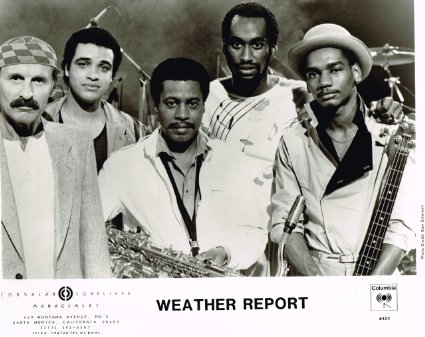
Sportin’ Life represented the second career peak for Weather Report after Heavy Weather.
Featuring the incredible rhythm section of Victor Bailey on bass and Omar Hakim on drums, the band’s penultimate album showcased a line-up that had been building up a real head-of-steam since their debut on 1983’s Procession.
It’s not clear whether Zawinul named the album after the character in Gershwin’s Porgy And Bess but it wouldn’t be a surprise. The vitality of the music on offer here belies the fact that co-leaders Joe Zawinul and Wayne Shorter were aged 53 and 52 respectively when it was recorded.
Hakim was playing with David Bowie, Sting and Dire Straits while making this album, and he brought undeniable star quality to Weather Report.
Zawinul, Cinelu, Shorter, Hakim and Bailey
Sportin’ Life blew my mind when it came out in ’85. I was already a huge fan of Jaco-era Weather Report and could hear how their music had influenced my other favourites Level 42, Sting and Joni Mitchell, but this was something else altogether. And to say my drumming was influenced by Omar’s playing would be a gross understatement.
While Zawinul is very much in charge on Sportin’ Life (‘Hot Cargo’, ‘Indiscretions’ and ‘Ice Pick Willy’ are basically solo pieces), Wayne has returned to his best form, ex-Miles percussionist Mino Cinelu gets a lot of space and sounds as inventive as ever and Hakim has become a beautifully tasteful drummer. Bobby McFerrin and two other vocalists also contribute intriguing musical colours.
‘Corner Pocket’ may be the best-ever Weather Report album-opener, and that’s saying something. Over a superb drums-and-bass groove (possibly influenced by Trouble Funk/Chuck Brown?), Zawinul delivers a typically arresting, swinging melody and unhinged synth solo. The rhythm section gear-change when Shorter tears into his tenor break is perfectly judged.
‘Face On The Barroom Floor’ is a wonderfully enigmatic Shorter ballad featuring possibly the composer’s finest soprano playing on a Weather Report album. He lets rip here with some impassioned blowing over Zawinul’s moody synths with an uncharacteristically wide vibrato reminiscent of Sidney Bechet.
The cover of ‘What’s Going On’ is funny and touching with Omar’s delicious half-time shuffle deftly moving between sticks and brushes.
Cinelu’s delightfully Santanaesque ‘Confians’ closes with another joyous Shorter soprano solo, one of his most resplendent in latter-period Weather Report.
It’s a shame there wasn’t much of an American audience for this kind of jazz in ’85, especially since Sportin’ Life represented a new high for Weather Report.
Unfortunately the band didn’t tour the album – their last major tour came around the release of ’84’s Domino Theory. I saw them at the Dominion Theatre in London and vividly recall the intense interplay between Zawinul and Hakim.
Shorter and Zawinul would soon go their separate ways but not before leaving us with this last classic. Dig it.
I first heard brilliant English guitarist John McLaughlin on record as a very impressionable 15-year-old when stumbling across the unsettling, brilliant ‘Dance Of Maya’, by his Mahavishnu Orchestra. I was instantly excited and intrigued.
But Adventures In Radioland, the second album from the ’80s reincarnation of Mahavishnu,was released in probably the least-heralded era of John’s music, a time when jazz and fusion seemed to be going in diametrically opposite directions and decent record deals were hard to come by.
With hindsight, it seems the mid-’80s popularity of Pat Metheny was having a huge influence on many instrumentalists and John was no exception; the decade was full of guitarists utilising synthesizer technology and looking to Brazilian songforms for inspiration (an obvious example is Al Di Meola’s Soaring Through A Dream).
But McLaughlin’s take on Metheny was far more raunchy, rooted in bebop and the blues (though the bridge of ‘Floriannapolis’ sounds suspiciously like Metheny’s ‘James’). And what a shocking record Adventures In Radioland was coming from a mainstream jazz artist, a two-finger-salute to the Young Lions neo-bop boom represented by the Marsalis brothers et al.
John seemed to be going out of his way to annoy the jazz purists but in doing so produced some material of worth. Like some of the best fusion music of the ’80s, its deceptively slick production obscures some pretty radical improvisations.
Is the album title wishful thinking? Is this John’s idea of ‘smooth jazz’, designed for radio play? If so, he must be living in a parallel universe because this is one of the weirdest albums of his career.
But, as he said himself in a 1996 interview with Guitar Player magazine, ‘Without madness or fantasy, music’s boring’. This album sure ain’t boring, especially if you’re a guitar fan, but devotees of The Inner Mountain Flame may struggle a bit…
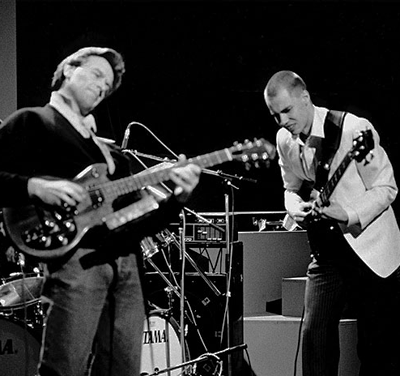
John McLaughlin and Jonas Hellborg
Opener ‘The Wait’ luxuriates in pleasant synth washes and a gorgeous chord sequence for a while before McLaughlin grabs the Les Paul and unleashes one of his most intense solos over quite a funky little R’n’B bass vamp.
‘The Wall Will Fall’ fuses a gargantuan blues riff with nutty Simmonds drums fills, and McLaughlin’s furious solo over high-speed bebop changes is both funny and exhilarating.
‘Florianapolis’ initially steers dangerously towards Metheny territory with its breezy, major-chord cod-Latin groove and nasty DX7 synth sounds. But before you know it, McLaughlin has ripped into an absolutely outstanding acoustic solo, full of rhythmic/melodic risk-taking.
‘Jozy’ is a dramatic, swinging tribute to Joe Zawinul, beautifully marshalled by drummer Danny Gottlieb with some outstanding fretless bass work from Jonas Hellborg. ‘Gotta Dance’ comes on like a fusion Mr Bungle, rattling through mellow acoustic guitar, big-band jazz, Mark King-style slap bass and industrial drums all in the space of four minutes.
‘Half Man Half Cookie’ is even weirder, a kind of post-Scritti Politti pop/funk groove interrupted by yet another incongruous big-band interlude from a multi-tracked (or sampled?) Evans.
But your proclivity for this album will probably be based on your acceptance of the mid-’80s Big Drum Sound. It certainly features some absolutely superb music. McLaughlin regrouped after Adventures and played the nylon-string acoustic exclusively for a few years – make of that what you will.
In the mid-’80s, artists such as The Rippingtons and Spyro Gyra took the classic fusion sound, sweetened it, added touches of light gospel and soul and repackaged it as yuppiefied chill-out music, jazz for people who hate jazz. And they made a killing.
But a different kind of ‘smooth jazz’ had emerged a decade before, in the late ’70s and early ’80s, a mixture of AOR, jazz harmony, classic fusion and Yacht Rock. It was the soundtrack for driving West on Sunset, decadent, expensive-sounding music full of dreamy Fender Rhodes playing and tasty grooves.
Musicians and arrangers such as Johnny Mandel, Jerry Hey, Tom Scott, Jeff Porcaro, Larry Carlton, Abraham Laboriel, Quincy Jones, George Benson, David Sanborn, Harvey Mason, Jay Graydon and David Foster thrived in this era when state-of-the-art production fused with jazz-tinged songwriting to create the missing link between Steely Dan and Earth, Wind & Fire.
The unofficial headquarters of the sound was The Baked Potato, a nightclub in Studio City, LA, and one of the key musicians was guitarist Lee Ritenour (ironically one of the figureheads of the late-’80s Smooth Jazz scene proper).
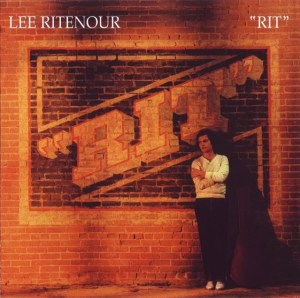
His 1981 album Ritis a classic of its kind alongside George Benson’s Give Me The Night, Larry Carlton’s Friends, David Sanborn’s Hideaway, Casino Lights, Randy Crawford’s Secret Combination and Steely’s Gaucho.
This sort of music was America when I was 13 or 14. In my daydreams, I was scooting along the West Coast in a Pontiac, top down, loud music playing, palm trees – you know the drill. Had I been watching too much ‘Knight Rider’ and ‘Moonlighting’ and listening to too much Steely Dan? Quite possibly…
Although early Ritenour albums had been tricksy fusion, more in line with what George Duke or Alphonso Johnson were doing, Rit saw him concentrate on collaborations with gifted Stevie-meets-Fagen vocalist/songwriter Eric Tagg.
To this writer’s ears, George Michael very definitely checked out Mr Tagg. The track ‘Is It You’ got to #15 in the singles charts and features one of the great middle-eights of the era:
Drum fans will enjoy Rit too; the great Jeff Porcaro plays a blinding shuffle on ‘Mr Briefcase’ (another single from the album) and produces a classic rock performance on ‘Good Question’.
MTV broadcast the videos of ‘Mr Briefcase’ and ‘Is It You’ during its first day on air (1 August 1981), When things get too mellow, Ritenour always seems to know when to insert a spicy solo (in the days when he delivered high-octane jazz/rock playing a la Santana or Larry Carlton).
The instrumentals are an appealing mixture of early ’80s technology (Linn LM-1 abundant) and the sparky funk of Abe Laboriel’s bass playing and Don Grusin’s soulful Fender Rhodes.
And Jerry Hey’s horn arrangements are instantly recognisable and a great addition. I don’t think it’s an exaggeration to say that Rit was an influence on Thriller (compare Rit’s ‘Just Tell Me Pretty Lies‘ with Jacko’s ‘Baby Be Mine’) and various other Quincy productions later in the decade.
In 1979, Stanley recordedthe sprawling double I Wanna Play For You which had some brilliant moments but also veered uncomfortably towards disco.
It also featured some outrageous live recordings which suggested he was going in a more ‘rock’ direction, mainly thanks to the sonic possibilities opened up by putting his Piccolo bass (tuned a fifth higher than a standard bass, A to C rather than E to G) through various effects pedals (see correction in the comments section below).
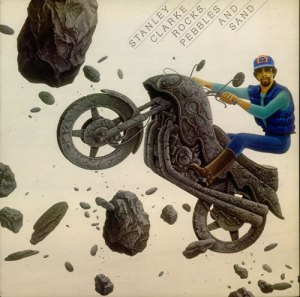
But how would Stanley start off the ’80s? On Rocks, Pebbles and Sand, he thankfully pushed the rock and prog-fusion rather than disco.It also really helps that it sounds very much like a ‘band’ project, apart from funk curio ‘We Supply’ which belongs on a different album altogether.
And what a band it is – Simon Phillips on drums, Charles Icarus Johnson on guitars and Steve Bach on keys. Phillips in particular is a perfect foil for Clarke with his meaty grooves and superchops. Though he was obviously coming from Billy Cobham with his prodigious double-bass playing, expansive tom fills and open-handed style (see below), his grooving on ‘Story of a Man and a Woman Part 2’ is just perfect.
Rocks, Pebbles and Sand‘s opener ‘Danger Street’ sounds like Stanley has been listening to The Who and Van Halen with its big drums, raucous guitar and gargantuan riff. Subtle it ain’t (and one can take or leave Stanley’s vocals), but it really works, mainly due to the mastering and mix – Rocks is one of the best-sounding albums of the era alongside Steely’s Gaucho, Lee Ritenour’s Rit and Zappa’s Sheik Yerbouti.
The duet vocals on ‘Underestimation’, ‘You/Me Together’ and ‘A Story of a Man and a Woman’ might put some people off, but isn’t that female voice familiar? A glance at the liner notes reveals a credit for one ‘Marcy Levy’ on vocals. It turns out to be none other than Marcella Detroit of Shakespeare’s Sister fame, an LA session singer in another life who had recorded and toured extensively with Eric Clapton (co-writing ‘Lay Down Sally’) before working with Stanley.
The funk/disco track ‘We Supply’ sticks out like a sore thumb but features a superb bassline from Louis Johnson and a hilarious spoken word intro from album engineer Dennis MacKay, proclaiming, ‘We supply all your funky needs!’ in the poshest voice you’ve ever heard. Git down and boogie with Dennis…
Stanley had a mixed ’80s to say the least, with a fair few misses but some big hits as well. Rocks is definitely one.
EXCLUSIVE! Level 42’s Mark King speaks to movingtheriver.com about his classic solo album Influences, released by Polydor in July 1984.
MP: Can you just briefly summarise the story behind Influences? Was it your idea or did Polydor come to you?
MK: I was signed to Polydor Records via Level 42 and had a young, heavily-pregnant wife and needed to buy somewhere to live. This was back in 1981 I hasten to add, so Influences showing up in 1984 was really down to my tardiness in addressing the fact that I had taken the advance (£5,000) and, apart from delivering a single ‘Freedom‘, had somehow neglected to fulfil my contractual obligations! Polydor were actually very sweet about it and just before the agreement was due to expire gently reminded me that I needed to deliver an album.
You’ve talked about having loads of ideas in the tank for the album but how did you piece them all together on ‘The Essential’? Did you have to demo all the different sections before recording?
I may have exaggerated the ‘loads of ideas in the tank’ bit, but when push came to shove I booked a few days at Chipping Norton Studio and dived in. The opening piece ‘The Essential’ began on the studio Hammond B3 which Mike Vernon informed me had been used on the Focus album Moving Waves. I’m no keyboard player, but I fired her up and just hit the notes. Next I programmed the drum machine with a pattern so I could lay down some bass and guitar, and the riff and melodies just wrote themselves really. I was jamming with myself I guess, ha! Anyway, that’s how all the sections came to be, and in the twinkling of an eye I was 20 minutes into the album.
What was it like getting back into drumming again for the album? ‘There Is A Dog’ is an amazing tour-de-force.
Ta. I never stopped drumming, that’s what I love to do!
Did you put your bass and guitar parts down with a drum machine first and then overdub your drums? Or did you record your drums first?
I laid the bass and drum box down first. I had an Oberheim DMX drum machine that sounded awful but was a great writing tool because you could programme some pretty accurate drum parts that were in time! You have to remember that these were early days in digital technology, so ears weren’t so tuned in to accurate tempo, but I loved the idea of being able to f*ck about all over the groove and lean on the drum box because it had the time nailed. I laid the drums down next, Gretsch incidentally. Speaking of time, the guy with the greatest meter I know is Gary Husband. He IS a human machine… The guy is a phenomenon with tempo. Never shifts. The Level 42 track ‘Take Care Of Yourself’ was a first take at The Summerhouse Studio played on some Ddrums. That is AWESOME! The great Bill Cobham quote sings to mind: ‘You are either in time or you are out of time.’ I’m usually out.
How did you come to work with producer Jerry Boys? ‘The Essential’ features some really effective edits and cross-fades between the different sections.
Jerry was a good friend and had engineered some Level 42 stuff, which is how we had met of course, and Polydor were keen for me to involve a third party to keep an eye on me as I was three years overdue already, so Jerry was the perfect choice. A really good engineer, plus I respected his opinions. I probably did a lot of the edits myself. I certainly did for the Level 42 stuff.
How did Drummie from Aswad come to play on ‘Clocks Go Forward’? That track has a lovely feel.
Aswad were working in the studio next door and I bumped into Drummie in the corridor. I had just been running over the parts for ‘Clock Go Forward’ with Mike Lindup so I had no hesitation in inviting Drummie in to play with us. The Gretsch kit I had hired had only just shown up in the studio, and there was no stool…aaaargh! But this didn’t faze Drummie at all; he just pulled up a plastic studio chair and got stuck in. The studio floor was highly-polished parquet and it was quite funny watching him sliding around as he played, hahaha! The song is called ‘Clocks Go Forward’ because that was the day we recorded it on.
You play some great lead guitar on Influences – who are your favourite players apart from John McLaughlin?
Cheers. I love JM of course, but Clapton, Hendrix, Gary Moore and Bill Connors are all in there somewhere. So many, really. I love Al Holdsworth too and working with him on Guaranteed was a real privilege.
You played a lot of Influences at an amazing Ronnie Scott’s gig a few years ago – what was it like playing it live?
A lot of fun actually. I was so chuffed at how the guys were able to recreate the sounds for me. Nathan (King) in particular was fantastic on all the guitar parts. It didn’t feel like we were playing music from nearly 30 years before, and having not listened to any of it since then I was quite proud of what I had created way back when.
Thanks, Mark!
Find out much more about Mark and Level 42 at level42.com
More about my history with Influences below.
Some of these basses and guitars were used during the making of ‘Influences’…
Even though I’d been a huge Level 42 fan from the day I bought A Physical Presence in 1985, I didn’t even know Influences existed until two or three years after its initial release. I came upon a cassette copy in a ramshackle shop near the Swanage seafront while on a family summer holiday. It would be an understatement to say I couldn’t get it onto the hi-fi quickly enough.
And it didn’t disappoint. The sharp crack of the snare drum on opener ‘The Essential’ led me to believe that Level’s Phil Gould was behind the kit. But a quick look at the album credits blew my mind: Mark was playing all the drums, guitars and bass? Yep. Influences takes the ‘one-man-band’ ethos and runs with it. Not for a second does one rue the lack of a conventional band; this music swings, snaps, crackles and pops.
With a few decades’ more listening experience, I now hear some of the ingredients that went into the Influences brew – Chick Corea’s Latin excursions, Spectrum-era Billy Cobham, Mahavishnu and also Stanley Clarke’s mind-bending prog/fusion – but Mark’s musical voice also comes through loud and clear. ‘There Is A Dog’ could almost have graced Return to Forever’s Light As a Feather album. ‘Clocks Go Forward’ and ‘Picture On The Wall’ are in a Level style and wouldn’t have sounded out of place on True Colours or Standing In The Light.
To date, Mark has not returned to such unhinged jazz/rock outside of the Level 42 ‘day job’ (apart from a fabulous gig at Ronnie Scott’s in 2012), but this is one of the great British fusion albums, or fusion albums period. Influences also deserves a place alongside Innervisions, Lewis Taylor’s self-titled debut and Prince’s Sign O’ The Times in the pantheon of great one-man-band albums.

 I was a fan of most things jazz/rock as a teenager, scuttling off to HMV or Virgin in central London to buy the latest John McLaughlin, Mike Stern, Steps Ahead, John Scofield, Bireli Lagrene or Miles.




 movingtheriver.com