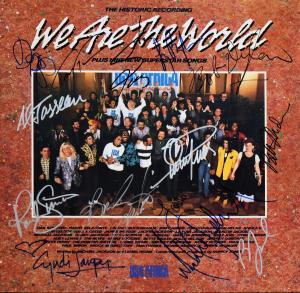
USA For Africa: We Are The World @ 40

Released 40 years ago this month and officially the fastest-selling single in American music history, USA For Africa’s ‘We Are The World’ shifted over 20 million copies and raised a huge amount of money for African famine relief.

Co-written by Michael Jackson and Lionel Richie during a few sessions at the former’s house in Encino, the song divides opinion but only the hardest heart could fail to be moved by its recording (even if one can definitely feel the vibe of some major agent/star power – no arriving in the manager’s battered old car for this lot…).

It brought together a fairly astonishing cast list of the great and good. And, inadvertently, it also arguably represented a last gasp for classic 1980s R’n’B and yacht rock.

The basic track was recorded at Kenny Rogers’ Lion Share Studios on 22 January 1985 with king-of-the-cross-stick John ‘JR’ Robinson on drums, bassist Louis Johnson and pianist Greg Phillinganes, closely monitored by a huge press corps, co-producers Quincy Jones and Michael Omartian and engineer Humberto Gatica. According to Robinson, all the musicians were sight-reading a chart and a click track was used, and they didn’t do more than two takes.

A few days later, Lionel sat down with Quincy and vocal arranger Tom Bahler to prep who would sing which lines (the decision was also made to mainly record vocals live and ‘in the round’ with no or at least very few ‘punch-ins’, unlike ‘Do They Know It’s Christmas’). All the major vocalists were then sent a copy of the basic track featuring Jackson’s guide vocal and with an enclosed letter from Lionel.

The featured singers then assembled at A&M Studios at around 9pm on Monday 28 January, most arriving after the American Music Awards (which Richie hosted). Notable absentees: Madonna (who was apparently bumped in favour of Cyndi Lauper), Prince (check out Duane Tudahl’s superb book for the details), George Benson, Dolly Parton, Donna Summer, Michael McDonald, Pat Benatar, Rod Temperton, Stevie Nicks, Joni Mitchell, Billy Idol? And is it odd that Smokey Robinson didn’t sing a solo line?

The complete footage of the recording session is still fascinating. We see how some of the biggest names in music history found different ways of preparing. Steve Perry waits for his line with eyes shut, looking down, listening intently. Diana Ross does just the opposite.

Bob Geldof gives a stirring pep talk and Stevie Wonder brings in two Ethiopian women to address the singers, moving many to tears. It’s hard not to be touched by Stevie, Kenny Rogers, Dionne Warwick, Diana, Steve Perry, Ray Charles and Cyndi Lauper’s vocals. But Harry Belafonte, Ray Charles, Bob Dylan and Bruce Springsteen seem to get the most respect from the assembled stars.

Other observations: Brucie – who had finished the latest leg of the Born In The USA tour the night before – looking like Judd Nelson in ‘The Breakfast Club’. Al Jarreau struggling throughout. Lionel the team player. Stevie giggling like a naughty schoolkid when Quincy gets annoyed. James Ingram hiding behind Kenny Rogers after a boo-boo.

Paul Simon twice saying to Rogers: ‘Can I help?’ Lauper sharing vocal tips with Kim Carnes. MJ holding hands with Diana and Stevie. Quincy and Stevie rehearsing with Bob Dylan. Stevie and Ray Charles using their braille machine. Quincy reading the score as he conducts the soloists, and his witty asides: ‘Who you gonna call?’ etc.

It looks like they recorded the first half of the song first (up to and including Daryl Hall) and then spent some time on the middle eight with Huey Lewis, Lauper and Carnes.

How does it sound now? Phillinganes’ piano playing is a pleasure to hear, typically tasty and gospel-inflected. But the track is inundated with synths – no less than four players are credited, including David Paich and Steve Porcaro from Toto – and probably why it reminded many of a Pepsi ad.

And it’s odd that the song features no guitar, though Prince offered to play a solo – Quincy reportedly told Prince’s manager Bob Cavallo: ‘I don’t need him to play guitar, we got f*ckin’ guitars’!
MTV @ 40: The Videos That Made MTV

By summer 1984, Frank Zappa was already decrying the MTV clichés in his ‘Be In My Video’ single (‘Pretend to be Chinese/I’ll make you wear red shoes’!).

But, away from the familiar tropes, there were trailblazing videos that set MTV on its way during the formative years. Either technically or thematically, these clips laid the groundwork right up until the end of the 1980s.

Of course they are kind of familiar, but watching them all the way through brought some interesting surprises, and even an unexpected lump in the throat area during the opening of ‘Borderline’ and denouement of ‘Take On Me’…

9. Musical Youth: ‘Pass The Dutchie’ (Dir. Don Letts, released September 1982)

The first ever video shown on MTV by a Black artist. This was a huge bone of contention in MTV’s early days, not helped by their regular, disingenuous rebuttal: ‘We only play rock’n’roll’. Don Letts’ joyful film put a spanner in the works, placing the lads in front of the Houses Of Parliament, the supposed ‘postcard’ vision of London, a tribute to the influence of Black culture in the UK and a stark message to the powers that be. Letts also created a huge hit in the process, reaching #1 in the UK and #10 in the USA.

8. The Police: ‘Every Breath You Take’ (Dirs. Kevin Godley & Lol Creme, released 20 May 1983)

Strongly influenced by Gjon Mili’s 1944 short ‘Jammin’ The Blues’, this was the video that catapulted Synchronicity‘s album sales into the stratosphere and gave the band a UK and US #1. Apparently directors Godley and Creme were pretty blitzed throughout most of the filming – according to the latter, ‘The first thing we’d do when we arrived on set was roll a reefer.’ Sting was reportedly no shrinking violet either, pointing to himself and telling the directors, ‘Keep the camera on the money’!

7. ZZ Top: ‘Gimme All Your Lovin’ (Dir. Tim Newman, released August 1983)

Randy Newman’s cousin Tim helmed all of ZZ’s key videos (and Randy’s excellent ‘I Love LA’) and he masterminded this much-imitated, endlessly-rewatchable classic, giving the band a new lease of life and a lasting image as kind of ‘mythical rockers’ (apparently influenced by his reading of Joseph Campbell). But it was ZZ manager Bill Ham who laid down the law to Newman, offering two directives: ‘Use the car (Billy Gibbons’ 1933 Ford coupe) and put some girls in it.’

6. Cyndi Lauper: ‘Girls Just Want To Have Fun’ (Dir. Edd Griles, released 6 September 1983)

Cyndi’s thing was inclusivity, and she delighted in showing a woman of every race in the video. It has echoes of John Waters’ aesthetic and the early Devo and B-52s videos, but this had a whole different vibe, apparently inspired by Lauper’s love of Jacques Tati’s 1958 film ‘Mon Oncle’.

5. Michael Jackson: ‘Thriller’ (Dir. John Landis, premiered December 1983)

‘Billie Jean’ opened the door for so many Black artists but this was pure box office and a delicious comedy/horror. Famously Michael headhunted director John Landis after watching ‘An American Werewolf In London’, giving him just one brief: ‘Can I turn into a monster?’ Landis was not interested in music videos but did like the idea of making a theatrical short. The video changed the game completely, and it’s arguable whether the dance routines have ever been bettered. It premiered on MTV on 2 December 1983 and reportedly doubled Thriller’s album sales within a few weeks of its first showing. It’s still absolutely thrilling.

4. Van Halen: ‘Jump’ (Dir. Pete Angelus, released December 1983)

Of course Metal acts were starting to make waves before this, with impactful videos by Twister Sister and Def Leppard, but ‘Jump’ laid down all the future ‘live on stage’ clichés, with balls on. Hair Metal became huge after this, and MTV adored the likes of Warrant, Winger and Bon Jovi, but none could ever match this song or Diamond Dave’s natural showmanship.

3. Madonna: ‘Borderline’ (Dir. Mary Lambert, released February 1984)

Lambert had only directed one video (Tom Tom Club’s ‘As Above So Below’) before getting her dream job on this breakout Madonna single. Madonna and Lambert discussed the video’s plot for two days in the former’s minimalist bolthole on the Upper East Side with Madonna insisting there be a Hispanic influence, necessitating moving the shoot to downtown Los Angeles. This is reportedly the first video to use black-and-white footage combined with colour; Madonna’s manager Freddy DeMann supposedly went ballistic on viewing the final cut but of course it became a video cliché, gave Lambert a successful career and Madonna her breakthrough song.

2. Lionel Richie: ‘Hello’ (Dir. Bob Giraldi, released February 1984)

Apparently director/scenarist Bob Giraldi was driven half mad by Lionel’s terminal lateness onto the set. For his part, Lionel was very sceptical about the bust. Apparently he finally plucked up the courage to approach Giraldi about it: ‘Bob, that bust does not look like me.’ There was a pregnant pause. Finally, Bob said, ‘Lionel… She’s blind.’

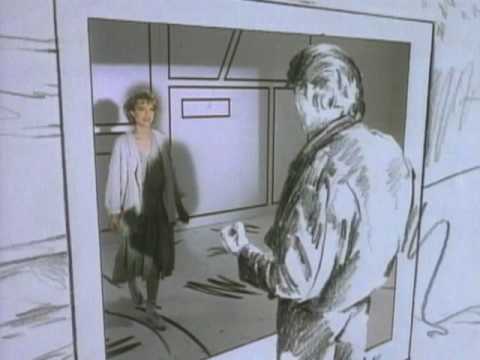
1. A-ha: ‘Take On Me’ (Dir. Steve Barron, released September 1985)

The song had completely flopped on its original release, so WEA gave Steve Barron a blank cheque to make a memorable video and get a hit. Working alongside rotoscope animator Michael Patterson, who did 1,800 drawings for the shoot, Barron was heavily influenced by Ken Russell’s 1981 movie ‘Altered States’. Barron knew he could make it work when the image of an animated hand reaching out of a comic book popped into his head whilst he was bored shooting a Toto video. Apparently singer Morten Harket and lead actress Bunty Bailey fell in love during filming, becoming almost inseparable. ‘By take four, they would carry on holding hands even when we’d cut,’ remembered Barron. Aided by the video, ‘Take On Me’ became the band’s only US #1.

Further reading: ‘I Want My MTV’ by Rob Tannenbaum and Craig Marks