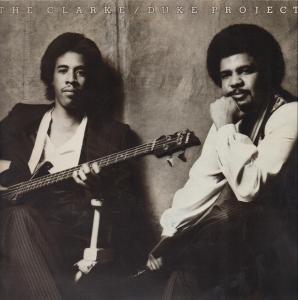
The Clarke/Duke Project

stanley_clarke__george_duke-the_clarke__duke_project(epic)This one really divides people. The Clarke/Duke Project probably could and should have been a lot better given the talent involved and their stellar track record.

But the album shouldn’t be judged by jazz standards – by the early ’80s, these two protagonists of ‘fusion’ realised that jazz/rock had hit a massive dead end.

A fresh approach was called for. Earth, Wind & Fire’s effortless blending of funk, soul, disco, jazz, Latin and rock offered a new direction to all kinds of musicians, including Clarke and Duke.

So, leaving any kind of jazz credibility at the door, our heroes embraced their inner George Clintons, Frank Zappas and Stephen Bishops to make a really weird but occasionally enjoyable album of funk, disco, AOR and cheesy soul balladry (it’s surely up there in the ‘least classifiable albums of the ’80s’ list). In short, this was Stanley and George’s Tin Machine – you were either for or against.

My schoolfriend Seb and I were huge Stanley fans, but even we eyed this with some trepidation when we came across it around 1989. It had a pretty dodgy reputation even by ’80s Stanley standards. It’s certainly neither artists’ best work, but it’s worth a listen.

So, straight in at the deep end. It’s fair to say that most John Coltrane and Dexter Gordon fans will struggle with the ‘Louie Louie’ cover… But Clarke and Duke deliver great solos and the vocal jiving is good value.

Clarke’s ‘I Just Want To Love You’ is a minor disco/soul classic with a great bassline (later appropriated for Kylie’s ‘Spinning Around’). ‘Touch And Go’ is very pretty in a post-‘Sailing’ kind of way while the vapid ‘Sweet Baby’ miraculously delivered a big US hit (#19). The closing ‘Finding My Way’ is effective and quite unique in its way, a kind of pomp-funk/rock epic with a cool descending bridge and interesting structure.

stanley-clarke-george-duke-the-clarke-duke-project-02

JR Robinson’s ultra-solid, ultra-dry drums are very high in the mix and sometimes feel like they need a bit of air. Clarke impresses with a huge range of basses, guitars, sitars and cellos (and some very Santana-ish Piccolo lead bass playing) while Duke sticks mostly to squelchy synth basslines, acoustic piano and an occasional bit of trademark Mini Moog.

The album sounds very stripped back to modern ears and has a slightly ‘demo’ feel to it, but it was a hit. Two further collaborations followed, lasting into the early ’90s.

One thing’s for sure – Stanley and George were great friends until the latter’s death in 2013, and you can really hear it in the music they made together.

The Dude Abides: Johnny Guitar Watson’s Love Jones

johnny guitar watsonWhen it comes to the arts, ‘nobody knows anything’, as screenwriter William Goldman famously claimed.

But the music biz sure knows a good formula when it sees one. And in the late-1970s and early ’80s, formulas didn’t come much more successful than Johnny Guitar Watson’s.

His fusion of funk, blues, disco, jazz and R’n’B even gave Parliament/Funkadelic and Earth, Wind & Fire a run for their money. He was simply one of the coolest musicians ever to walk the planet.

A Texan blues master who influenced many guitarists including Frank Zappa (the two would collaborate regularly in the ’70s and ’80s), Watson relaunched his sound with Ain’t That A Bitch in 1977, a superb marriage of hilarious lyrics, double-tracked vocals, cool Stevie/Sly/Curtis grooves, ambitious horn arrangements and searing guitar solos. It was a big success and Watson spent the rest of the ’70s repeating the formula with minor variations and, to be honest, diminishing returns.

Ain’t That A Bitch hooked me right away. My dad had a knackered old cassette copy which came in a really horrible silver-and-yellow design, but for some reason I was fascinated by it. There was something seriously dodgy about the cover photo, title and…everything, really. But then I listened to it. By the late ’80s, I was getting into Sly, Stevie and The Isleys, so Bitch fitted in like a dream and became an essential soundtrack to summer 1989.

On 1980’s Love Jones, Johnny expanded his sound to include influences from P-Funk, gospel, bebop, bossa-nova, Afro-beat, hip-hop and even country, and the result is one of the weirdest but most interesting albums of his career. A lot of it sounds very rushed, as if his mind wasn’t really on the job, but that sometimes works in its favour!

With hindsight, Johnny should be included alongside Sly, Prince, D’Angelo, Stevie and Lewis Taylor as one of soul music’s finest multi-instrumentalists – on his great albums of the 1970s and early ’80s, he plays all the keyboards, bass, guitars and some drums, as well as producing and arranging.

His keyboard playing gives guys like Ramsey Lewis and Les McCann a run for their money, and he even once recorded a whole album of piano/vocal ballads, 1963’s I Cried For You.

Love Jones kicks off with the infectious ‘Booty Ooty’, powered by the great, unsung drummer Emry Thomas, which adds a touch of P-Funk to Johnny’s classic horn-driven sound.

The title track is a fairly cheesy soul ballad, while ‘Goin’ Up In Smoke’ continues his strand of state-of-the-nation political funk/blues tunes which began with Ain’t That A Bitch‘s title track in ’76. ‘Close Encounters’ is just plain odd, a bossa-nova with some funny lyrics about a mistaken love affair – ‘It was close encounters of the wrong kind’!

His update of ‘Lone Ranger’ is a classic, featuring some outrageous vocal scatting and some nutty electric piano and bass solos. The gospel curio ‘Jet Plane’ has a criminally-out-of-tune bass, badly-recorded keyboards and amateurish drums (presumably played by Johnny), but it still works.

Ditto the seriously weird ‘Children Of The Universe’, a country-rock coming-of-age piece which sounds like The New Seekers backing Sly Stone.

But Love Jones‘s centrepiece is of course the mighty ‘Telephone Bill’, oft cited as one of the first rap tracks. In 1994, Watson was asked if he had anticipated the hip-hop movement:

“Anticipated? I damn well invented it! And I wasn’t the only one. Talkin’ rhyming lyrics to a groove is something you’d hear in the clubs everywhere from Macon to Memphis. Man, talkin’ has always been the name of the game. When I sing, I’m talkin’ in melody. When I play, I’m talkin’ with my guitar. I may be talkin’ trash, baby, but I’m talkin’!”.

Yessir, but more importantly the track features his best guitar solo on record, an amazing mash-up of bebop, blues and funk.

Compared to the lush, meticulously-arranged Ain’t That A Bitch, Love Jones sounds like a series of demos but it still works, like pretty much all of Johnny’s music. He carried on touring and recording right through to his death in 1996. I wish I’d seen him play live. See ya, Johnny.

Ray Parker Jr.: Woman Out Of Control/Sex And The Single Man

Years before his huge hit ‘Ghostbusters’, Ray had played guitar on some great albums of the ’70s (Stevie’s Talking Book and Innervisions, Rufus/Chaka Khan’s Rags To Rufus,  Harvey Mason’s Funk In A Mason Jar, Marvin’s I Want You, Leon Ware’s Musical Massage), not to mention sessions with the likes of Boz Scaggs, Barry White, Tina Turner, Herbie Hancock and Bill Withers.
He also enjoyed a few big hits as part of Raydio before going solo in ’82. Either side of ‘Ghostbusters’, he put out two interesting albums which are now released as a good-value two-fer by Cherry Red/Soulmusic.com.

’83’s Woman Out Of Control unleashes a kind of feminist funk with various tracks unashamedly taking the laydeez’ side in the battle of the sexes, creating something pretty original. ‘Electronic Lover’ and ‘Invasion’ also rock the kind of psych-synth-funk sound that Prince and his contemporaries were tapping into at the time.

85’s Sex And The Single Man, the post-‘Ghostbusters’ album, ups the stakes with a lot more fuzz-toned lead guitar and also some weird synth-pop fun on ‘Girls Are More Fun’ and ‘I’m A Dog’. ‘One Sided Love Affair’ is an amusingly-shameless ‘Hello’ rewrite and there’s some cracking Cameo-style funk/rock on the title track.

‘Men Have Feelings Too’ demonstrates more of his rhythm-guitar mastery. I was going to say that his playing sounds very Prince-influenced but it’s the other way round; check out this masterclass for the evidence. The albums were only minor hits – apparently Arista boss Clive Davis wasn’t blown away by their modest chart placings and was slow to return Parker Jr.’s call when contract-renewal time came around.

While it’s true that there’s nothing as immediate or hook-laden as ‘Ghostbusters’ on these two records, they’re definitely worth reappraising and make nice companion pieces to Miles Davis’s You’re Under Arrest, Cameo’s She’s Strange, Prince’s Purple Rain and The Time’s Ice Cream Castle. Ray’s still going strong too, playing festivals and turning up on the occasional session.

N.B. Parker Jr. has recently been subject to an out-of-court settlement regarding the similarity of ‘Ghostbusters’ to Huey Lewis And The News’ ‘I Need A New Drug’. Judge for yourself…

Marcus Miller: Suddenly

marcus miller

I first became aware of Marcus when I saw him playing bass with Miles Davis at the trumpeter’s Hammersmith Odeon ‘comeback’ gig in ’82.

He quickly became one of my bass heroes a few years later when I was bowled over by his contribution to Miles’ Star People album.

Marcus’s name came up again recently when I was talking to someone about great multi-instrumentalists. In the soul/funk/R’n’B world, obviously there’s Stevie, Prince, Lewis Taylor and Sly.

Marcus’s 1983 debut Suddenly almost puts him up there with that esteemed company too, though in the final analysis it suffers from a lack of top-quality material.

Marcus has put it on record that he was first inspired to play music by Michael Jackson and Stevie, and Suddenly was his first attempt to enter their world of quality soul/funk/R’n’B songwriting.

He’d certainly paid his dues for Warner Bros Records by 1983, producing, composing and/or playing bass with David Sanborn, Donald Fagen, Joe Sample, Roberta Flack, Grover Washington Jr. and Claus Ogerman, so a Warners solo debut was always on the cards.

Marcus-Miller

You can hear elements of ZAPP, Gap Band, The Time and Cameo on Suddenly, and if Marcus doesn’t quite establish himself as a genuine ’80s funk contender, there are a myriad of great grooves and musical touches to enjoy.

He pretty much plays all instruments, getting in selected guests (drummers Harvey Mason and Yogi Horton, Vandross, Sanborn, Mike Mainieri) to add spice here and there.

By his own admission, Marcus is not a great singer, his voice rather light and uncertain, but his bass and keyboard playing, songwriting and arranging really save the day.

‘Lovin’ You’ is uplifting pop/funk with a classic bassline, while ‘Just What I Needed’ features some great Richard Tee-like, gospel-tinged piano from Marcus. And his piccolo bass solo on ‘Much Too Much’ had me checking the sleevenotes in vain for the presence of late great guitarist Eric Gale.

‘Just For You’ was previously recorded by David Sanborn on the classic Voyeur album, but here it gets a nice new vocal treatment.

It’s telling though that the closing instrumental ‘Could It Be You’ is by far the most successful track, featuring Miller’s fabulous fretless bass solo. It was later covered excellently by Dizzy Gillespie on his 1984 Closer To The Source album.

Story Of A Song: Chaka Khan’s ‘And The Melody Still Lingers On’ (1982)

Jazz regained some ground in the ’80s.

After a chastening period in the late-’60s and ’70s when rock pretty much swept all before it, major labels took a renewed interest in established jazz acts and underground movements flourished (no wave, acid jazz, harmolodic funk, neo-bop). Wynton Marsalis, Miles, Courtney Pine and Loose Tubes even put jazz back on primetime TV.

But when Chaka Khan recorded ‘And The Melody Still Lingers On (Night In Tunisia)’, the dramatic centrepiece of her What Cha’Gonna Do For Me album, she arguably set the whole revival in motion.

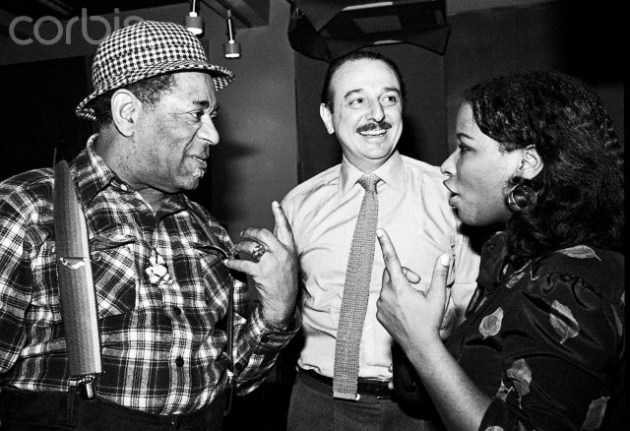
Dizzy Gillespie, Arif Mardin and Chaka Khan

Dizzy Gillespie, Arif Mardin and Chaka Khan, Atlantic Studios 1981

It was producer Arif Mardin’s idea, his mind wandering during a flight between New York and LA. The album was one song short – so how about a tribute to the bebop masters of the ’40s using the crème de la crème of the early ’80s soul/R’n’B/jazz session players? They could use Dizzy Gillespie and Frank Paparelli’s 1942 bebop classic ‘A Night In Tunisia’ as a template.

Chaka loved the idea. Mardin hoped to find a lyricist but deadlines were pending so he tackled it himself with Chaka adding the final touches. Mardin made a demo of the arrangement which cheekily inserted Charlie Parker’s famous 1946 alto break.

Charlie Parker in 1946, photo by Ted Giola

Charlie Parker in 1946

A lengthy chart was quickly made up (resembling a ‘Chinese laundry list written in cuneiform’, according to Mardin) which included eight spare bars for the insertion of the Parker lick.

The musicians – Casey Scheuerell on drums, David Foster and Ronnie Foster (no relation) on keys, Abe Laboriel on bass and Paulinho Da Costa on percussion (mostly heard on shaker in the first verse and congas in the second) – were booked and smashed the tune in one take.

Herbie Hancock later contributed a brilliant synth solo. Chaka then added her sublime vocals. Her four-part big-band harmonies and spine-tingling ad-libs bring the song right up to date.

But there was still space for an opening head melody and a solo in the final verse. Dizzy had been sent the demo by Mardin with a note asking him to contribute.

But the bebop legend replied that he would be on tour and so couldn’t make the recording session – but he suddenly arrived two days before the album’s mastering date at New York’s Atlantic Studios to add his part. The track was complete.

Chaka and Mardin attempted to repeat the trick a few years later with ‘Bebop Medley’ but it lacked the finesse of this timeless classic.

Prince: The Family @ 30

the family

I’ve bought this album (still unavailable on streaming platforms at the time of writing) on almost every format since I found a cassette copy in the early ’90s, back when it was a pretty rare groove.

The Family came out during my favourite Prince period. He was embracing jazz, fusion, psychedelia, classic rock and even modern classical, mainly prompted by his collaboration with the very excellent Wendy and Lisa but also other associates Sheila E, saxists Eric Leeds and Eddie M and string arranger Clare Fischer.

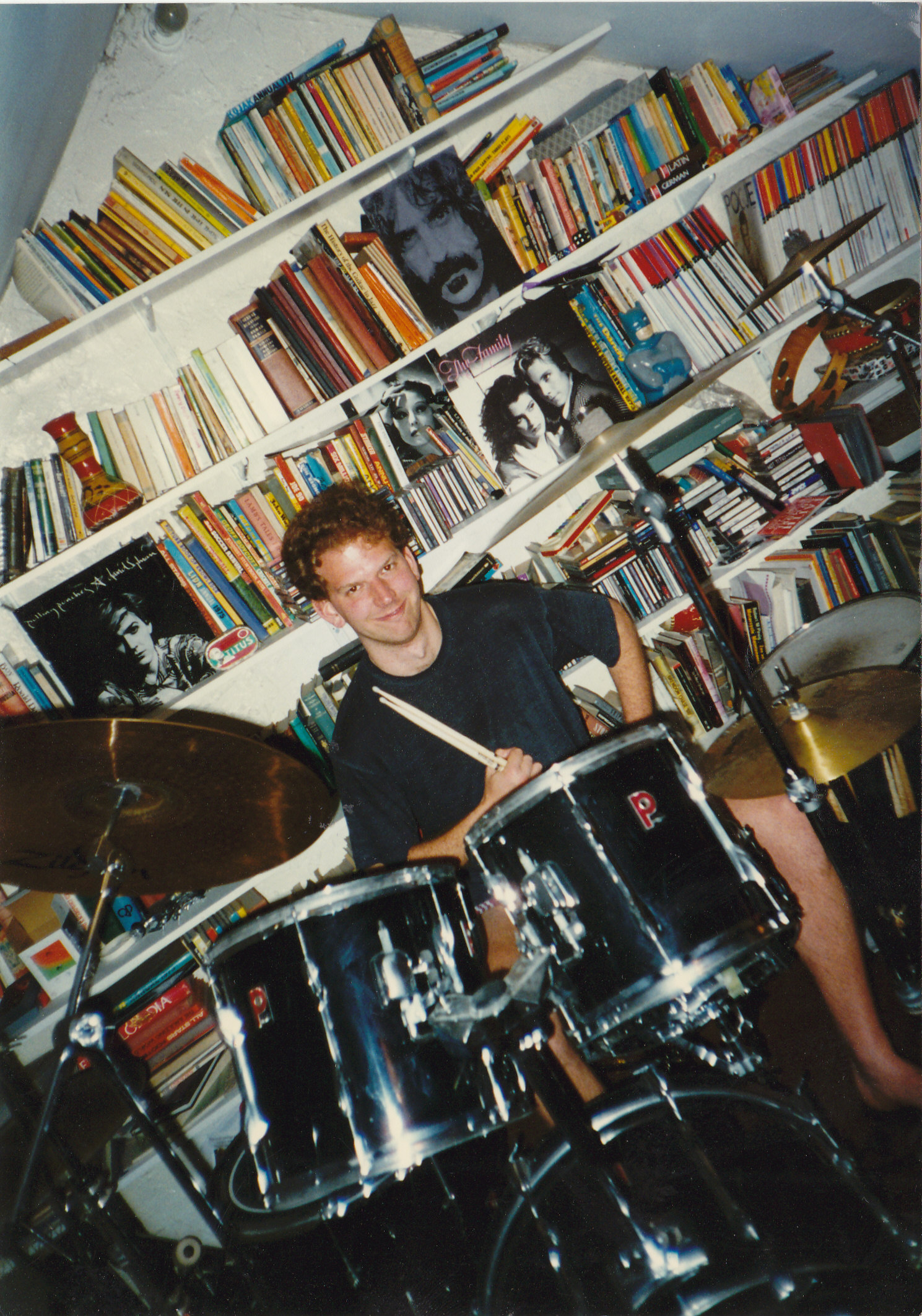
The author with The Family in background, summer 1991

This was my soundtrack to summer ’91. I instantly loved the retro Hollywood glamour of the cover artwork and the way it chimed with the whole Parade/Under The Cherry Moon concept.

The Family slipped out on Paisley Park Records in summer ’85 (just three months after Prince’s Around The World In A Day) to a very low-key critical and commercial reception. These days, the album is known mainly for including an early version of ‘Nothing Compares 2 U’.

But it’s full of far superior fare to that such as the killer opening funk medley, classic near-hit ‘The Screams of Passion’, charming pop of ‘Desire’ and especially instrumentals ‘Yes’ and ‘Susannah’s Pyjamas’ where Prince indulges in some fantastic Sly Stone-meets-Miles bass, guitar and drum grooves. This is the album that led Tutu producer Tommy LiPuma to recommend Prince to Miles as a possible collaborator and it’s easy to hear why.

The Family was put together by Prince when the first incarnation of his massively successful offshoot project The Time split up in the summer of 1984. The band’s keyboardist/vocalist Paul Peterson (renamed St Paul by Prince), drummer Jellybean Johnson and vocalist/dancer Jerome Benton were summoned to Prince’s house along with his then-fiancee (and sister of Wendy) Susannah Melvoin and Leeds.

A band concept was quickly ad-libbed by Prince, who, according to engineer David Rivkin (reported by Per Nilsen in his superb Prince: The First Decade book), issued them with the directive: ‘We gotta go after some of that Duran Duran money!’

the family

But what they ended up with was far from Duran Duran music. Prince wrote all the songs (except ‘River Run Dry’), played all instruments on the basic tracks and sang all the guide vocals.

Peterson and Melvoin painstakingly replaced Prince’s scratch vocals (and apparently took dance and acting lessons!), Leeds added his trademark baritone, tenor and flute and Fischer provided deliciously non-linear string arrangements.

Prince’s ‘no bass’ philosophy (as famously heard on ‘When Doves Cry’ and ‘Kiss’) seems well to the fore on The Family. I still have in my possession a cassette of demos from the album featuring Prince’s phenomenal bass playing on ‘High Fashion’ and ‘Mutiny’, presumably deleted at the last minute.

The Family was released without much fanfare or marketing. After just one gig at First Avenue in Minneapolis (rare footage of which was recently removed from Youtube), the project was put on hold when Prince recruited Melvoin, Benton and Leeds for his Under The Cherry Moon movie.

Peterson was put on a retainer, but, tired of waiting around for Prince to get back from filming in the south of France, served his notice by phone call. According to Per Nilsen, Prince was flabbergasted, believing that The Family’s time wasn’t far away and that St Paul was jumping ship too soon.

And, in a way, he was right – The Family album just won’t go away. At the request of Roots/D’Angelo/Erykah Badu drummer Amir ?uestlove Thomson, a long-time fan, the four-piece minus Prince delivered a mesmerising comeback performance at a pre-Grammys bash in 2007.

And then in 2012 a full-length album Gaslight was released under the new name fDeluxe (with considerable contributions from Wendy and Lisa) and a successful world tour followed (including a great Jazz Cafe gig in London). It proves that this band was much more than a Prince side project and are a pretty formidable funk/soul act in their own right.