Alan Clarke’s films generally go straight into the ‘once seen, never forgotten’ file.
Features such as ‘Scum’ and ‘Rita, Sue And Bob Too’ courted huge controversy while his groundbreaking TV work including ‘The Firm’, ‘Psy Warriors’, ‘Elephant’, ‘Road’ and ‘Made In Britain’ shone a light on the darker corners of the Thatcher years to devastating effect.
Those films and many others adorn the superb new BFI box set ‘Disruption’ which gathers all his television work made between 1978 and 1989 – including David Bowie’s remarkable turn as Baal, Bertolt Brecht’s anti-hero, adapted by Clarke and John Willett from the 1918 play.
Though it wasn’t exactly a frequently-performed work, British theatre audiences were treated to a Peter O’Toole star turn during the early 1960s, just after the actor’s Oscar-winning appearance in ‘Lawrence Of Arabia’.
For some reason, ‘Baal’ was scarcely mentioned in Bowie obituaries as one of his more successful screen performances, a serious oversight. Bravely broadcast by BBC One at 9:25pm on Sunday 2 March 1982 (cosy Sunday night viewing it wasn’t), it was filmed at Television Centre (W12 8QT!) during the summer of 1981, just after Bowie had recorded ‘Under Pressure’ with Queen.
According to producer Louis Marks, Bowie jumped at the chance to portray the ultimate street punk, and was already a fan of Clarke’s work. He was also reportedly completely undemanding, modest and eager to please on set, requesting only a car and bodyguard and receiving the standard BBC fee.
Bowie could also hardly look less ‘star-like’ in ‘Baal’, with his battered teeth, dark eyes, ratty beard, grimy face and dishevelled clothes; he completely embodies the role of the amoral troubadour. Clarke captures him mostly in long shot with very lengthy takes in the classic alienating Expressionist style, but the camera positively adores Bowie’s Baal with his alligator grin, dangerous sexuality and moments of sudden violence.
He also delivers several plainsong ballads straight to camera in strident, superb voice, accompanying himself on banjo. The subsequent Baal EP, re-recorded at Hansa Studios with added instrumentation, even got to #29 in the UK singles chart, Bowie’s last release for RCA.
‘Baal’ makes for fascinating viewing these days and you only wish the Beeb would take such chances again. Critics of the time were pretty scathing about Bowie’s performance but their comments make for fairly amusing reading these days.
It’s scarcely believable to think that only a year after ‘Baal’ was broadcast, Bowie was rocking the zoot suit and peroxide blond quiff for the Let’s Dance media offensive. It’s also virtually impossible to think of another star of such magnitude who would dare take on such a bleak, singular project. A true artist.
Further reading: ‘Alan Clarke’ edited by Richard Kelly
Nigel Planer as Den Dennis, playing with Bad News at Castle Donington, 16 August 1986
If you were a British teenager in the mid-’80s, ‘The Young Ones’ and ‘The Comic Strip Presents’ were pretty much required viewing.
In fact, it’s hard to imagine that period without them. They fused comedy and music with anarchic zeal and have endured as bona fide TV classics.
Nigel Planer was an integral part of both groundbreaking shows, working alongside Ade Edmondson, Dawn French, Jennifer Saunders, Ben Elton, Rik Mayall, Alexei Sayle, Peter Richardson and many more.
He brought the world such classic characters as the perennially-prickly hippy Neil and Den Dennis, heavy metal’s unluckiest guitarist. Since then, Planer has appeared in countless quality TV productions, written several books and plays and starred in the hit musicals ‘We Will Rock You’, ‘Evita’, ‘Chicago’, ‘Wicked’, ‘Charlie And The Chocolate Factory’ and ‘Hairspray’.
He’s also worked on several BBC Four music documentaries and is currently revisiting an early interest in songwriting. I began my chat with Nigel by asking him about his musical influences.
MP: There was a great punky energy about the early days of The Comic Strip troupe, but I’m guessing your own musical tastes weren’t rooted in punk. Did you play in bands before becoming a pro actor?
NP: I was more into psych-folk and new-age jazz stuff. I didn’t so much play in bands but I did make a bubblegum pop record with my brother Roger, and I had a publishing deal for my songs which were sort of sub-Nick Drake, soft, liberal, poetic things.
We all loved your portrayal of Neil in ‘The Young Ones’ (I think I still have ‘Neil’s Book Of The Dead’ somewhere…), but how much of that character was yours and how much of it Ben Elton and Lise Mayer’s?
Well, the original Neil comes from a show I wrote and performed with Peter Richardson and Pete Richens called ‘Rank’. Many of the characters later to appear in Comic Strip films stem from this show. We first did it at the Roundhouse and then on tour with various bands. We were trying to be like Alberto y Los Trios Paranoias or The Fabulous Poodles, if anyone remembers them. We ended up more like a Mike Leigh play with a rock band in it. When we made our double act, Neil came along with us and so he was my character in the ‘Young Ones’ setup. He was mostly my character but Ben and Lise made him more stereotypically hippyish.
Your cover of Traffic’s ‘Hole In My Shoe’ got to #2 in July 1984! Any good memories from Neil’s ‘pop’ period?
It was an incredible experience, to be a pop star all of a sudden without having to take the consequences of that decision because I was in character. I learned that I would hate to be a pop star.
Who or what was your inspiration for the brilliant Den, the hapless rhythm guitarist from The Comic Strip’s ‘Bad News Tour’ and ‘More Bad News’?
I’m afraid Den Dennis comes from deep inside my soul…
You famously played the 1986 Monsters Of Rock festival at Castle Donington with the News, how was that? The festival was probably at its peak during that time.
It was our first gig. We were terrified. It looks pretty good in the film – you see all the usual spoof documentary gags, we argue, get ready for the gig, go up the stairs onto the stage. And then in one panning shot you realise it’s real, there are actually 40,000 people there baying for our blood and throwing bottles of urine at us. The compere (Tommy Vance) had to wear a helmet and face guard, but we just walked out there like idiots.
‘Bad News Tour’ famously appeared on British TV long before ‘This Is Spinal Tap’ was released. Have you ever met any of the Tap guys? Are they aware of ‘Bad News Tour’?
I think both ideas were in germination at the same time. Funny how things happen like that. I never met any of them but have a huge admiration.
In Ade’s Comic Strip film ‘Private Enterprise’, you play this great character Derek, a bow-tied, extremely effete A&R man. It’s a brilliant portrayal of a lot of those public school types who got into the music biz in the late-’70s and early-’80s. Was Derek based on anyone you knew?
Not really. I didn’t think of him as a public school type, I just came up with this weird voice. A lot of the time things are just done on instinct and it’s best not to work it out too much. I did feel I knew the kind of person he should be, ie it wasn’t exactly a stretch.
In later Comic Strips, there were cameos and musical contributions from the likes of Jeff Beck, Kate Bush and Lemmy. Any printable memories of working with them?
We used to do this gag where one of us, probably Ade, would turn down volume on his guitar and mime, and out would come the most amazing solo. Then out from behind a speaker would walk Brian May, Jeff Beck or whoever we’d managed to con into doing the solo. Then Ade would stop and shout at the guitar hero: ‘I paid you a fiver to stay behind that speaker, you bastard!’ At The Marquee, we did it not once but twice – after coming out, Brian then turned down volume on his guitar and out walked Jeff. Jimmy Page did the gag with us once too, but I can’t remember where we were playing. Ah, memories… I do remember an early morning filming call in a hotel in Devon on a Comic Strip film. There had been a lot of drinking the night before. I’d gone to bed early, being a professional ‘actor’ you know, but others had stayed up trying to keep up with Lemmy. The next day at 6am, I get down to the lobby for pick-up time – none of the cast are there, not even the runner nor the driver. In fact, the only other person turning up on time for work, with his lines learned, was Lemmy.
You’ve been in the original casts of several very popular West End musicals (‘Charlie And The Chocolate Factory’, ‘Hairspray’, ‘We Will Rock You’) in the last ten years or so – what are the challenges of singing live night after night?
It’s a slog doing eight shows a week on a raked stage. Lots of injuries and physio and the like. The singing is the nice bit. One is also fighting boredom on a grand scale. It’s hard to stay cheerful. But on ‘We Will Rock You’, I remember thinking to myself: ‘Shut the f*** up, you are about to go on in front of 3,000 people and sing a beautiful song with a band of incredible musicians handpicked by Queen and then do about 20 minutes of jokes and make everyone laugh and you’re complaining?’ I’m good at complaining. Ben used to call me Niggle Complainer.
In recent years, you’ve been the go-to voiceover guy for music documentaries on BBC4 – do you enjoy them and are there any more in the pipeline?
None in the pipeline at the moment unfortunately, but they are a really, really good gig. You get to sit for a day listening to all this brilliant music and hear some people talking who maybe meant a lot to you when younger. I particularly enjoyed ‘Blues Britannia’ which I thought was very interesting. The idea that the Brits re-imported the Blues back to America where it was dying.
What are you up to at the moment? A little bird told me you’re working on a music project alongside the acting…
I have a couple of musical projects at the moment. One is a stage musical I have written with Hannah-Jane Fox and Andrew Holdsworth who I met in the ‘We Will Rock You’ days. We’re trying to place it in a theatre now. It’s not usual musical theatre fare. It’s heavy-rock/pop based, a very dark gothic horror story called ‘She Devil’! The other is a psych-folk band called Rainsmoke I have formed with my musician brother Roger and a guy called Chris Wade who is behind the Dodson And Fogg albums. We have one song up on Bandcamp now, and are hoping to finish the album by the new year. Most of the songs are based on all those songs I wrote in the early 1970s when I was a young, green, poet-type guy.
Thank you Nigel.
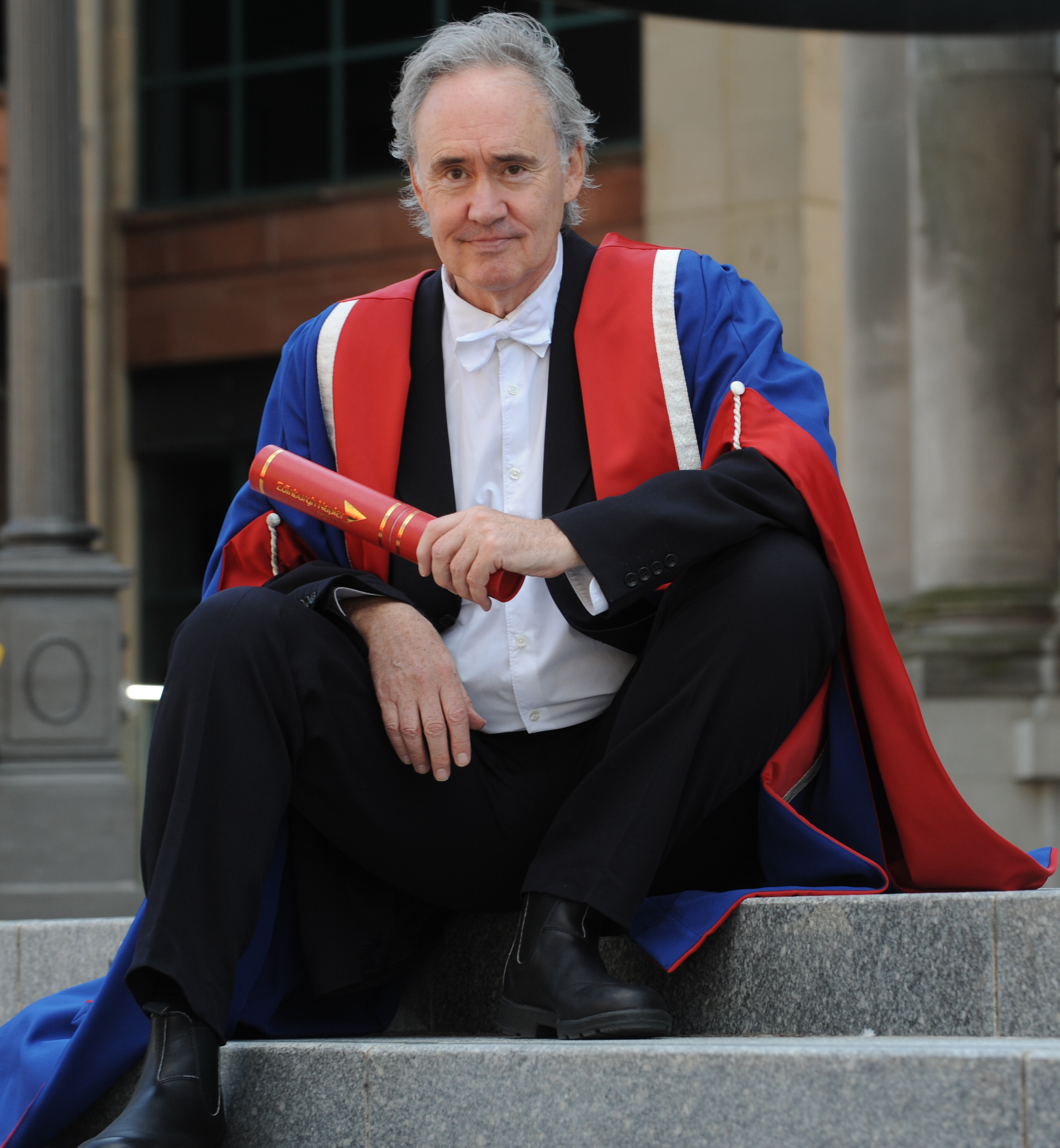
Nigel receiving his Honorary Doctor of Arts degree from Edinburgh Napier University in 2011
His comeback album Midnight Love, released in October 1982, was a certified hit, with decent sales, good PR and an attendant single ‘Sexual Healing’ that was building up quite a Grammy buzz.
But there were plenty of other problems brewing: in his rather paranoid state, Marvin believed that pretenders to his throne like Teddy Pendergrass, Frankie Beverly (whom Marvin had mentored early in his career), Lionel Richie and Michael Jackson were cashing in on his style and sound. The latter had even taken to wearing aviator shades and ‘military’ garb.
Elsewhere, Marvin’s relationship with his father had hit a new low. Bitter and resentful, he considered physically ejecting Father from the family home but decided instead to stay away completely.
The other problem was cashflow. Marvin was spending so much money on ‘extras’ that he had been forced to give up his houses in Bel Air and Palm Springs. Despite all this, in the first few months of 1983, Marvin reminded the music world of his luminous genius and, against all the odds, provided a few career high-points.
Broke and entering an introspective period, he found himself spending quite a lot of time at his sister Sweetsie’s pad. It was there, on Saturday 12 February 1983, that he got together with chief musical collaborator Gordon Banks to cook up a version of the national anthem that he would sing the next day before the National Basketball Association’s All-Star Game.
Despite the last-minute planning, there was no margin for error: Marvin’s performance would be broadcast live on national TV. He not only pulled it off – he smashed it out of the park. Only Marvin could have come up something so singular. His huge respect for the athletes ensured that he raised his game accordingly.
Funky, spiritual, heartfelt and yet controversial, it was a triumphant reading of ‘The Star Spangled Banner’, and one of the highlights of his career.
Less than two weeks later, on 23 February, there was another personal milestone for Marvin when he was awarded his first Grammy awards at the Shrine Auditorium in Los Angeles.
That the Best Male Vocal and Best Instrumental Performance awards were ‘only’ in the R’n’B category scarcely mattered. He had moved out from behind his Grammy nemesis Lou Rawls’ shadow and finally gained the acceptance of his peers, something that was extremely important to him. His speeches were heartfelt and touching.
His performance of ‘Sexual Healing’ was not an unqualified success (it was 10 or 15 BPMs too slow and Marvin seemed slightly uncomfortable), but it’s still essential and moving stuff.
Another very happy moment happened a few months later when Marvin appeared with Gladys Knight and the Pips on another TV special. According to David Ritz’s classic book ‘Divided Soul‘, Marvin and Gladys argued backstage about whose version of ‘I Heard It Through The Grapevine’ to do. He finally deferred to her, but still turned in another joyous and brilliant performance.
Then, on 25 March 1983, the Pasadena Civic Auditorium hosted the ‘Motown 25’ anniversary concert, most famous for Michael Jackson’s spellbinding reading of ‘Billie Jean’. Marvin once again defied expectations and provided one of the highlights of the evening.
Though looking somewhat haggard, his blues/gospel piano playing and philosophical pronouncements on the value and history of black music were nothing less than captivating. His subsequent performance of ‘What’s Going On’ was perhaps perfunctory in comparison, but still essential viewing.
Tougher, tragic times were to come over the next year, but for a few months in early 1983, Marvin was seeing a lot of his professional dreams come true. No one could take that away from him.
Maybe your band were given a rollocking live on children’s TV or you turned up for a late-night interview slightly the worse for wear and made a bit of an arse of yourself thinking no one would be watching anyway.
Alas. It’s all retained for posterity on YouTube, and some smart aleck was poised with his finger on the VCR record button, primed for just such an indiscretion.
Some of these clips (parental discretion advised) I remember watching live, others have shown up occasionally on ‘TV Hell’-type compilation shows over the years, but they all make for great – if sometimes uncomfortable – viewing.
9. Five Star on ‘Going Live’, 1989
No, the Essex Jacksons were never the critics’ favourites, but this rhetorical question from a young caller may well have had more of a detrimental effect on their career than any NME scribe ever could.
8. Jools Holland interviews Andy Summers, 1981
Jools turned up in Monserrat while The Police were recording the Ghost In The Machine album, and he managed to ridicule their erstwhile guitarist’s demonstration of funk guitar (at 5:30). You must admit, Julian had a point…
7. Matt Bianco on ‘Saturday Superstore’, 1984
Yep, another nightmare phone-in situation, a subgenre full of guilty pleasures (from 1:00 below).
6. All About Eve on ‘Top Of The Pops’, 1988
The infamous appearance during which singer Julianne Regan and guitarist Tim Bricheno were blissfully unaware of the song’s playback in the studio. Cue lots of schoolyard sniggering, but the Eve had the last laugh – their single rose UP the charts the following week.
5. BA Robertson interviews Annabella Lwin, 1982
The singer/presenter comes seriously unstuck when broaching the gender issue with Bow Wow Wow’s superbly-spikey frontwoman (I say ‘woman’ – she was only 16 at the time…).
4. Grace Jones attacks Russell Harty, 1980
An intractable Grace is seriously miffed by Russell’s back-turning.
3. Shakin’ Stevens attacks Richard Madeley, 1980
Humour is clearly the animus here, but the sight of a lagered-up Shakey throttling the grannies’ favourite is still quite something.
2. Dexys Midnight Runners on ‘Top Of The Pops’, 1982
Did someone at the BBC really think the song was an ode to Scottish darts player John ‘Jocky’ Wilson rather than soul legend Jackie? Or was it a pisstake? (It was a pisstake and apparently Kevin Rowland’s idea… Ed.) I love the juxtaposition of Kevin’s intensity and Jocky’s grinning mush.
1. Wayne Hussey on ‘The James Whale Show’, March 1990
Just into the 1990s, but what the hell. The Mission mainman seems to have wandered into the studio after a long night on the razzle, but he met his match with the confrontational Mr Whale.
In the ’80s, there was no shortage of pop coverage to inspire conversation in the playground, whether it was Boy George’s first appearance on ‘Top Of The Pops’, Michael Jackson’s ‘Thriller’ video or Matt Bianco being verbally abused live on children’s TV.
Of course it really helped that there were only four terrestrial channels to choose from, breeding a feeling of community and sense of occasion.
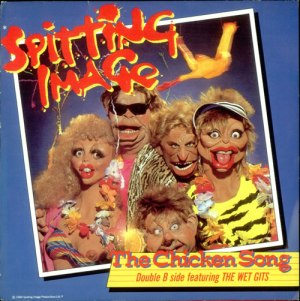
But one TV show absolutely guaranteed to get the creative juices flowing and rescue many a depressing Sunday evening was ‘Spitting Image’.
Just a cursory look at a show from its mid-’80s peak leaves one stunned at the craftsmanship and production values on offer, especially as they only had a few days to write, build and shoot each episode. There were some good musical spoofs too, composed by Philip Pope, fresh from UK comedy classic ‘Not The Nine O’Clock News’ and his parody band The Hee Bee Gee Bees, who even managed a few hits in the early ’80s.
‘Spitting Image’ also featured some memorable Phil Collins, ZZ Top and Madonna skits, and they even managed to rope Sting in to re-sing this. But ‘We’re Scared Of Bob’ is full of surprises and surely the best spoof. Its sheer potency is still a shock to the system. You also suspect that Sir Gandalf was watching, so unmissable was the programme in the mid-’80s.
Why isn’t there anything like this around now? Oh, lack of money and talent, probably. A show like ‘Spitting Image’ also highlights the paucity of genuinely interesting musical (and public) figures these days.
Yep, it’s M-M-M-M-Max, scourge of celebrities everywhere and purveyor of surreal one-liners, bizarre stream-of-consciousness meanderings and often-quite-obscure music videos.
Max was created in 1985 by Annabel Jankel (sister of Ian Dury-collaborator Chaz), Rocky Morton and George Stone as rather eccentric, attention-grabbing ‘talking head’ to present videos on the burgeoning Channel Four.
Brilliantly played by Matt Frewer, who apparently had to endure over four hours in the make-up chair before each day of filming, Max was born in a one-off drama shown on Channel Four in 1985.
He then returned to front two series of ‘The Max Headroom Show’ in 1985 and 1986. The show then moved to the US for two series shown in ’87 and ’88.
People probably either loved or hated Max but I was an immediate fan. I even bought the book. Large swathes of his monologues are indelibly etched on my memory. Even today, I can’t hear the words ‘Sebastian Coe’ without thinking of Max’s unique delivery.
I also discovered some good music and vids on his shows too, including Peter Gabriel’s live version of ‘I Don’t Remember’, The Redskins’ ‘Bring It Down’, Donald Fagen’s amazing ‘New Frontier’ vid (directed by Jankel and Morton) and Sid Vicious’s terrifying ‘My Way’ (how did that get onto pre-watershed TV?).
Most of the press attention was aimed at the state-of-the-art computer graphics, the incredible make-up job and bizarre speech patterns. But, apart from the music vids, what immediately hooked me was his smarmy, gleeful piss-taking. He was kind of a mixture of Fletch and Johnny Rotten. There was also a touch of Dan Aykroyd/Chevy Chase’s smarmy Weekend Update newsreaders on ‘Saturday Night Live’.
Though the show had three regular writers – David Hanson, Tim John and Paul Owen – Frewer apparently improvised a large part of Max’s ramblings. I always assumed Max’s ‘cool guy’ persona was coming from Steve Martin but Frewer claims that he based Max’s shtick on Ted Knight’s hilariously hammy portrayal of Ted Baxter in ‘The Mary Tyler Moore Show’.
Possibly the sections of the show which have the most relevance now are Max’s interviews with stars like Sting (see below), Boy George and David Byrne. Years before Dennis Pennis, he was hilariously detached, if not downright dismissive of their celebrity status. I loved the way he ridiculed Sting’s new ‘jazz’ direction.
Later on, the tables were turned as Max found himself being interviewed on primetime chat shows by David Letterman and Terry Wogan. He calls Letterman ‘Davey-doo’ throughout and seems to be slowly driving him to distraction.
I had a few episodes on video for many years but chucked them out a while ago – a big mistake, as there’s still no sign of a UK DVD. Long live Max!
My favourite music show still is and probably always will be ‘The Tube’, which ran on Friday nights between 1982 and 1987 and was presented mainly by Jools Holland and Paula Yates.
Though Jools has found his niche presenting the very successful ‘Later…’ series for BBC1, I preferred the more youthful, risky, ‘uncut’ Holland (who was given a hefty slap on the wrist when he famously trailed the show one week by saying people who watched it were ‘groovy f***ers’!) and he had a great chemistry with the intelligent, funny and sexy Paula.
From week to week, you could never guess what you were going to see. There were live bands, star interviews, specially-filmed videos, on-location featurettes and weird bits of alternative comedy usually involving Rik Mayall in various degrees of drunkenness.
Some of it was great, some of it was OK and some of it was crap, but you couldn’t take your eyes off it. It helped launch some careers (Twisted Sister, Fine Young Cannibals, Frankie Goes To Hollywood, Terence Trent D’Arby) and relaunch others, and you could see every type of music on the show – Metal, Goth, Funk, Fusion, Indie, Pop, Soul – all in the spirit of discovery without any pandering reverence or bourgeois pretension.
And though the show featured many huge names, it also embraced up-and-comers: if your band was any good, had some fans and a decent plugger, you were on. And there was a bar on the set too. Here are a few clips from ‘The Tube’ that have stuck in the memory:
5. The Bangles – ‘Manic Monday’
Check out the creepy guy at the front staring straight at Susanna Hoffs throughout, almost blocking the camera. Full marks to the girls for giving the (Prince-penned) song their all despite a dumbstruck Newcastle crowd. Tight harmonies.
4. Billy Mackenzie interview, 1985
One of those great, weird, un-PR’d interviews that popped up now and again. A post-‘Party Fears Two’ Billy is clearly taking the piss throughout, in the nicest possible way, and it also shows how The Tube wasn’t scared of going out into the ‘provinces’ (Dundee in this case).
3. Cocteau Twins – ‘Pink Orange And Red’
Great haircuts, great voice, great guitar sound and underwater bass. The golden age of goth/pop.
2. Blancmange – ‘Living On The Ceiling’
Good hair again, and someone or something is making singer Neil Arthur struggle to keep a straight face throughout.
1. Prefab Sprout – ‘Cruel’
This little Bacharach-influenced bossa nova was my first glimpse of the marvellous Prefab.

 Alan Clarke’s films generally go straight into the ‘once seen, never forgotten’ file.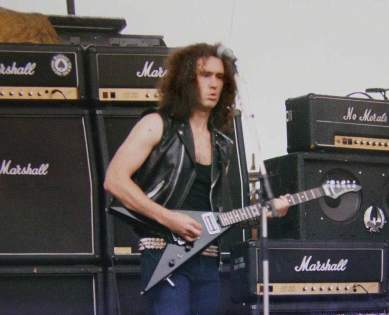

 There’s no escape these days.
  In the ’80s, there was no shortage of pop coverage to inspire conversation in the playground, whether it was Boy George’s first appearance on ‘Top Of The Pops’, Michael Jackson’s ‘Thriller’ video or Matt Bianco being verbally abused live on children’s TV.
  Yep, it’s M-M-M-M-Max, scourge of celebrities everywhere and purveyor of surreal one-liners, bizarre stream-of-consciousness meanderings and often-quite-obscure music videos.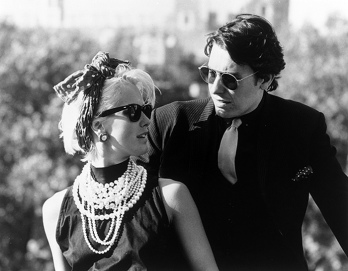
 movingtheriver.com