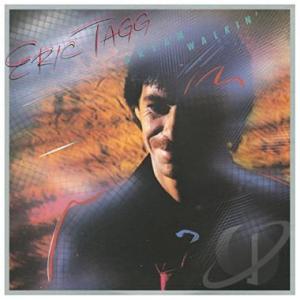
Eric Tagg: Six Of The Best

Probably best known for his work with guitarist Lee Ritenour on the Rit and Rit 2 albums, Tagg possesses a soulful, velvety voice, pitched somewhere between Stevie Wonder and Donald Fagen (some have also drawn comparisons to David Pack and George Michael).

To these ears, his compositions also sound superior to a lot of similar material. He released three solo albums in the ’70s/early ’80s, the best of which (Dreamwalkin’) was produced by Ritenour.

Tagg was born in Chicago but spent his formative musical years in Holland singing with Dutch bands Rainbow Train and Beehive. Gravitating to LA in the mid-’70s, he embarked on a solo career and joined Ritenour for their successful double act.

But over the last 30 years he’s slowly retreated from public life, mainly devoting himself to writing Christian songs from his Texas base. Let’s go back to that golden time for West Coast music, the early ’80s, and focus on six of Eric’s best from the era.

Warning: the following tunes may contain soothing harmonies, cool chords, smooth melodies…

6. ‘Marianne (I Was Only Joking)’ (1982)
Subtle, mellow composition with a superb vocal, from Tagg’s ‘Dreamwalkin‘ solo LP.

5. ‘Is It You?’ (1981)
Released as a single under Lee Ritenour’s name in April 1981, it reached the dizzy heights of #15 on the US pop charts. A classic slow jam with one of the best middle-eights of the ’80s.

4. ‘Promises Promises’ (1982)
Funky bit of pop/soul with Bill Champlin on back-ups. Wouldn’t have sounded out of place on The Dude or even Thriller.

3. ‘Mr Briefcase’ (1981)
A classic drum performance from Jeff Porcaro on another single from Rit.

2. ‘Marzipan’ (1982)
This gorgeous slice of pop/soul, with a winning set of chord changes in the verse, was recently covered (pretty well) by US neo-soul crooner Eric Roberson.

1. ‘Just Another Dream’ (1982)
Another richly-chorded delight with more than a hint of ‘My Cherie Amour’ about it. Sublime keyboard work from David Foster, a sax solo from Tom Scott and a great arrangement.


Book Review: Uncharted (Creativity And The Expert Drummer) by Bill Bruford

Recently, for work, I’ve had the pleasure of hanging out a bit with Paddy Spinks, the man charged with keeping King Crimson together in the 1980s.

Chatting about that mighty musical unit recently, he said that Bill Bruford had been the ‘natural showman’ of the band.

So it was a bit of a surprise to read Bruford’s words about the latter part of his distinguished drumming career in the introduction to fascinating new book ‘Uncharted’: ‘I dreaded performance to the point where…I was unable to function meaningfully. Performance had become incomprehensibly difficult and insuperably so.’

‘Uncharted’ is Bruford’s detailed voyage through the psychology of performance, performance anxiety and drumming creativity. He sets out his objectives clearly: ‘I want to suggest some answers to some fundamental questions about drummers. What do we do and why do we do it? Is there anything creative about it? What are drummers for, if not to be creative?’

He provides some answers himself and also garners opinions from a variety of respected players including Peter Erskine (Weather Report, Kate Bush, Steely Dan), Chad Wackerman (Frank Zappa, Allan Holdsworth) and Cindy Blackman-Santana.

‘Uncharted’ is most assuredly an academic book, the fruits of a University of Surrey PhD, so it probably won’t surprise any Bruford fans to learn that it features no drummer jokes. But it’s never less than gripping, with fascinating titbits dropped in here and there about a distinguished career in music.

The book shines a light on the current state of the recording world, with pithy comments about the rise of the ‘bedroom’ musician and ‘stay-at-home’ drummer sending in his/her parts via email or Skype.

Bruford laments the lessening of time that bands spend together in the rehearsal room these days, often due to financial constraints, rightly commenting that music as complex and nuanced as Yes or King Crimson could only have been produced via lengthy band ‘woodshedding’ sessions.

There are striking observations on the merits or otherwise of ‘playing to your audience’, especially from Erskine: ‘I don’t really give a f**k about the audience. You can quote me on that!’, and also a couple of amusingly barbed Bruford comments about playing double drums with another of the UK’s greatest players. Hint, hint…

Despite its occasional longeurs, ‘Uncharted’ is a fascinating, forensic look at creativity and collaboration, with reverberations that go far beyond the world of music.

‘Uncharted: Creativity And The Expert Drummer’ is published by the University Of Michigan Press.

Memorable Gigs Of The 1980s (Part Two)

Check out the first selection of memorable gigs here.

9. David Sanborn Band/Al Jarreau @ Wembley Arena, November 1984
We were sitting high up behind the stage with a great view of two of the great modern American drummers: Steve Gadd (with Sanborn) and Ricky Lawson (with Jarreau). To be honest, my parents and I left in the middle of Al’s set but Sanborn was fantastic with Marcus Miller and Hiram Bullock running amok on the huge Arena stage. The saxophonist was at his commercial peak here and probably could have headlined the show.

8. Marc Almond @ The London Palladium, 12 October 1986
I have no idea why I was at this gig but it was a genuine eye-opener. Almond was long past his pop fame and seemed to be acting out his own private, Berlin-inspired drama. Looking at the footage today, I’m still not sure if it’s brilliant or total sh*te.

7. Miles Davis @ Hammersmith Odeon, 21 April 1982
I remember someone shouting ‘Turn the guitar down!’ Poor Mike Stern wasn’t the critics’ flavour of the month and Miles was obviously exceptionally ill, but the gig was unforgettable. One of my first and very best. I saw Miles three or four times during the ’80s but this was the bomb for sheer atmosphere and occasion.

6. Robert Palmer @ Hammersmith Odeon, 25 September 1988
There really isn’t anyone around these days like the much-missed Robert with his gravelly voice, weirdly cosmopolitan compositions and ever-present smirk. He had a highly-drilled, sh*t-hot band with him at the Hammie Odeon too featuring Frank Blair on bass and Eddie Martinez on guitar. The gig started with a five-minute Dony Wynn drum solo which fair blew the minds of my brother and I.

5. Yes/No People @ Limelight, 9 September 1986
I think this gig was part of what was then known as the Soho Jazz Festival. There was a lively crowd of ‘jazz revival’ hipsters and rare-groove fans – this was my first taste of an underground scene that was quickly building momentum. DJ Baz Fe Jazz kicked off with some Blue Note post-bop (yes, people actually danced to that stuff) and then Yes/No People featured Steve Williamson on sax and the cracking Mondesir brothers (Mark and Mike) rhythm section. The band only lasted a year or so but nearly dented the charts with their ‘Mr Johnson’ single.

4. John McLaughlin/Mahavishnu Orchestra @ Hammersmith Odeon, 12 July 1984
The sign on the door said ‘Billy Cobham will not be appearing’ – heartbreaking to me at the time (McLaughlin apparently dumped Billy just a week before the tour). But Danny Gottlieb sat in with some style and John rattled off some outstanding licks in black shirt and black headband. It was bloody loud too. It was the first time many British fans had seen him since Mahavishnu Mark 1 days and as such there was a big hippie turnout.

3. Bill Withers @ Hammersmith Odeon, 18 September 1988
From memory, Bill spent most of the gig sitting at the front of the stage, talking about his life and career while Pieces Of A Dream accompanied with gentle jazz/funk. Bill wore a sweater and golfing slacks and seemed incredibly old, more Val Doonican than Sly Stone.

2. Weather Report @ Dominion Theatre, 26 June 1984
The duels between keys man Zawinul and drummer Omar Hakim were spellbinding. This was clearly the dog’s b*ll*cks. Well, it was better than Duran Duran anyway. Omar’s huge shades, trash-can cymbal and big grin linger in the memory.

1. Level 42 @ Wembley Arena, 12 January 1989
Level again, but this time for all the wrong reasons. We were in the back row of the dreaded Arena, and the band were flogging their substandard Staring At The Sun album. The audience reaction to the ‘new stuff’ was distinctly subdued. After a contractually-obliged encore of ‘The Chinese Way’, Mark King returned to the stage alone. ‘You ‘ad a good night?’ he bawled. The audience erupted. ‘Well, you can all go and f**k off home then’, deadpanned the thunder-thumbed one. Reply – and further encore – came there none…

Bubbling under:

Mike Stern/Bob Berg Band @ Town & Country Club, November 1989

Will Downing @ Hammersmith Odeon, 20 November 1988

Coltrane Legacy (Alice/Ravi Coltrane, Reggie Workman, Rashid Ali) @ Logan Hall, 10 July 1987

Ry Cooder @ Hammersmith Odeon, 27 May 1982

Bill Frisell @ Town & Country Club, 24 April 1989

Ornette Coleman/Prime Time @ Town & Country Club, 28 August 1988

Were you at any of these concerts? Let us know your memories.

Memorable Gigs Of The 1980s (Part One)

Mark King of Level 42, Hammersmith Odeon, 13 November 1985

The London live music scene was buoyant in the 1980s.

There was a gig on pretty much every corner. You could see a Goth band, a pub-rock band, a reggae band, a psychobilly band, a soul band – sometimes all on the same bill.

Places like The Rock Garden in Covent Garden, Swan and King’s Head in Fulham, Clarendon in Hammersmith, Red Lion in Brentford, Astoria in Soho and Mean Fiddler in Harlesden are quite understandably still revered by music fans of a certain age.

There were brilliant nightclubs too: The Bat Cave, Dingwalls, Wag, Blitz, Limelight, Marquee. Let’s be thankful that, as we write, a handful of legendary venues from that era survive (The Half Moon in Putney, Ronnie Scott’s, Roundhouse, Scala, Borderline) and long may they last.

Here are a few gigs that still loom large (all in London unless otherwise stated). I hope they spark some memories of your own. Eagle-eyed readers will notice that I pretty much camped out at the Hammersmith Odeon in the late ’80s – well, it was my local, and it seemed like almost everyone came through that brilliant venue…

9. Frank Zappa @ Wembley Arena, 18 April 1988
Yessir, Frank was in town for the first time in four years. I was a new fan and very excited to see him live. His guitar was insanely loud and very trebly. The reggae version of ‘Stairway To Heaven’ was particularly memorable. Lots of onstage banter and political rhetoric. Lots of old-school hippies in the stalls. What a treat.

8. The New York Jazz Explosion (Roy Ayers/Tom Browne/Lonnie Liston Smith/Jean Carn) @ Hammersmith Odeon, 24 February 1985
I’d never heard of any of these guys when my dad offered me a ticket but I’m bloody glad I went. Lonnie started the show with some prime, instrumental, Rhodes-driven jazz/funk, then Roy played some old favourites and quite a lot from his In The Dark album. I don’t remember much about Jean or Tom but Roy blew me away (I’ve seen him at least five times since). The Odeon was packed and a very raucous crowd made a lot of noise in those glorious days when almost every famous US soul star played there. A real eye-opener.

7. David Sylvian @ Hammersmith Odeon, 30 May 1988
It was pretty much the first sight of David since Japan’s split and there was a genuinely exciting atmosphere in the old venue. Lots of screaming girls and a large Goth contingent. An unsmiling, slight and pale Sylvian silenced them by playing keys for the first few ethereal instrumentals (with hindsight, very reminiscent of Bowie’s ‘Stage’ tour a decade earlier). Fantastic band: David Torn, Mark Isham, Steve Jansen, Ian Maidman, Richard Barbieri.

6. Art Blakey @ Ronnie Scott’s, 26 January 1989
Ronnie’s hosted a lot of the bona fide jazz greats in those days. My dad took me to a see a fair few but catching Bu was a revelation. His sheer presence was memorable and his press rolls made the walls of the club shake. The suited-and-booted band, including top-notch Brit pianist Julian Joseph, were excellent too.

5. It Bites @ Brunel University, ? March 1988
My schoolmate Nigel had played me this band’s debut The Big Lad In The Windmill and I was becoming a massive fan when we got a lift out to darkest North-West London just before the release of their second album Once Around The World. They played in the low-ceilinged students union bar (scene also of The Sex Pistols’ final UK gig in December 1977, trivia fans…) and it became one of the most outstanding pop gigs I saw in the ’80s. A terrifyingly tight band – ‘coming at you like a f***in’ juggernaut’ as singer/guitarist Francis Dunnery said recently – with humour and chops. And a cracking version of ‘New York, New York’ in the middle of ‘Once Around The World’ to boot.

4. Level 42 @ Hammersmith Odeon, 13 November 1985
They were finally making the big pop breakthrough with World Machine but still had one foot in their jazz/funk ‘roots’ – this era was an exciting mix of both approaches. These boys were going places but were still quite naughty/rough’n’ready with it. Sadly this was the peak of the original four-piece band, but it was another brilliant, noisy, sweaty night at the Odeon.

3. John Scofield @ Half Moon Theatre, Docklands Festival, Sept 1988?
This took place at a makeshift venue in the back-end of nowhere within Thatcher’s huge Docklands development. It was a long car ride from West London into a strange wasteland. I had wanted to see this band since Blue Matter had come out a year earlier and accordingly watched drummer Dennis Chambers like a hawk throughout. From memory, he in turn eyeballed me throughout. His playing was pretty mindblowing from 10 yards away.

2. Wendy & Lisa @ Town & Country Club, 25 April 1989
It was a hot, sweaty night at the T&C, and the nearest to seeing Prince in such a small venue (which does a great disservice to Wendy and Lisa’s excellent playing and songwriting, but there you go). There was a genuine star quality to the (almost all-female) band and a very cool clientele – everyone was clocking a peak-fame Sinead O’Connor at the bar. The gig delivered the promise of summer and some cracking music too.

1. Animal Logic @ Town & Country Club, 25 May 1989
Back in the late ’80s, you only really gleaned info about musicians from magazines. When Rhythm – the now-defunkt UK monthly – printed that Stewart Copeland and Stanley Clarke were doing a gig in North London, we just had to be there. It was a surprise to say the least. There had literally been no sign of Copeland in the UK since The Police and the crowd seemed to be entirely composed of their fans – a huge roar erupted when Stewart’s kit was rolled onto the stage. Unfortunately the songs weren’t great but the atmosphere was.

Prince’s Lovesexy: 30 Years Old Today

Why is Lovesexy probably Prince’s least-heralded, least-mentioned album of the 1980s? Even Dirty Mind, Controversy and Batman seem to get a better rap these days.

The cover photo said it all – this was Prince’s ‘spiritual rebirth’ album, and you were either in or out.

Lovesexy was also a response to his alleged dabbling with psychedelic drugs (apparently taking place on 1 December 1987) that shook him to his core, and also a response to the highly sexualised, uncharacteristically angry Black Album. He once said, ‘I realised that if I released that album and died, that’s what people would remember me for. I could feel this wind and I knew I was doing the wrong thing…’

So Prince shelved The Black AlbumLovesexy was the speedily-recorded, musically-rich antidote. It’s one of the most challenging albums of Prince’s career but also one of the most rewarding. From the opening synth chords and Ingrid Chavez’s brief ‘poetry’, it’s clear that this is something pretty special. And different.

The horn arrangements are downright loopy throughout. Discordant, dissonant. Instruments are layered to sometimes disconcerting effect. Comparisons to Zappa are not inappropriate. Prince also dials in a lot of his spiritual concerns, with God competing against the Devil (or ‘Spooky Electric’), the purity of the spiritual life competing against the sins of the flesh. With a few jokes.

For many, including saxophonist Eric Leeds, the result was a bit of a mess: ‘I thought it was going to be a great album, but when I heard the final mixes, I was very disappointed. I thought he had completely over-produced the music…’

But the savvy so-and-so that Prince was, he was also careful to throw in three of his most irresistible, ‘throwaway’ pop tunes – ‘Alphabet Street’, ‘Dance On’ and ‘I Wish U Heaven’ – and one of the finest ballads of his career, ‘When 2 R In Love’.

At once scary, profound, silly, funny, romantic and outrageous, Lovesexy still sounds fantastic 30 years on. It was Prince’s first UK #1 album and spawned probably the best tour of his career.

The Cult Movie Club: Moviedrome

Watching ‘Halloween 2’ (1981) on the big screen the other night brought back lots of memories.

Apart from generating a few more good scares than I was expecting, it also reminded me of the very real excitement of the late-night cult movie. ‘Moviedrome’ wasn’t a cult movie but a series of cult movies transmitted on Sunday nights by the Beeb between 1988 and 2000.

Pre-internet, there was a real curiosity to this collection of lost classics. Your parents had gone to bed. It was just you and the TV. What forbidden wonders were about to be unfurled. ‘Moviedrome’ was initially presented by director Alex Cox (‘Sid And Nancy’, ‘Walker’, ‘Repo Man’), and just a glance at the running order of the first two series should excite movie fans of a certain hue:

1988:

The Wicker Man
Electra Glide in Blue
Diva
Razorback
Big Wednesday
Fat City
The Last Picture Show
Barbarella
The Hired Hand
Johnny Guitar
The Parallax View
The Long Hair of Death
Invasion of the Body Snatchers (1956)
The Fly (1958)
One From The Heart
The Man Who Fell To Earth
The Good, The Bad and The Ugly
One-Eyed Jacks

1989:

The Man With The X-Ray Eyes
Jabberwocky
D.O.A.
The Thing From Another World
The Incredible Shrinking Man
California Dolls
THX 1138
Stardust Memories
Night of the Comet
The Grissom Gang
The Big Carnival (Ace in the Hole)
Alphaville
Two-Lane Blacktop
Trancers
The Buddy Holly Story
Five Easy Pieces
Sweet Smell of Success
Sunset Boulevard

Many of these films are etched upon my brain 30 years on, particularly ‘THX 1138’, ‘Electra Glide In Blue’,  ‘The Man With X-Ray Eyes’, (‘Pluck it out! Pluck it out!’), ‘Five Easy Pieces’ and ‘The Parallax View’.

In later series, they showed uncut UK premieres of ‘Bad Timing’, ‘Scarface’ and ‘Pulp Fiction’, amongst others. Checking in to watch ‘Moviedrome’ on a Sunday night gave you the feeling that you were a member of a very small but select club.

Cox’s introductions were highly original bits of film criticism in themselves, with his arch sense of irony and keen eye for detail (bit-part actors, weird editing, striking set design). He even had the audacity to present his own movie ‘Walker’ during the series.

Later Mark Cousins brought a more serious tone, an intriguing accent and also some intelligent, subtle analyses. Watching a few of these intros just make me want to watch the movies again. If only there was such a widely-seen yet distinctly ‘cult’ film club as ‘Moviedrome’ these days.

Book Review: A Message To Our Folks (The Art Ensemble Of Chicago) by Paul Steinbeck

If the 1980s saw the full flowering of PR and image’s influence on the music world, it’s sometimes forgotten that jazz was an unlikely beneficiary of this trend too.

The Art Ensemble Of Chicago, that important unit whose line-up went unchanged for almost 30 years until trumpeter/co-founder Lester Bowie’s death in 1999, were a massive live draw during the early ’80s, particularly in France, where they were welcomed more like rock stars than avant-garde jazzers. Image and stage presentation were undoubtedly big factors.

Paul Steinbeck fine new biography of the band ‘A Message To Our Folks’ is a scholarly, forensic study, tracing their origins from the South Side of Chicago through their controversial move to Paris in 1969, return to the States in 1971 and commercial peak in the early 1980s.

He analyses key albums, talks to living members and dissects the Ensemble’s cultural importance. Despite the sometimes frivolous onstage ‘antics’, musically the collective was as serious as your life, to borrow the title of Val Wilmer’s groundbreaking book.

Drummer Don Moye remembers Bowie taking him aside after his successful audition and saying: ‘Don’t even mess with us or get any more involved if you can’t commit to playing Great Black Music at a very high level, becoming famous and taking our place in the history of jazz.’ The stakes were high.

They were ahead of their time with the use of slogans, labelling their sound Great Black Music to distinguish it from jazz; according to Bowie, ‘Never before were we even allowed the dignity of selecting a name for our own music.’ They also described their music as ‘Ancient To The Future’.

The band would pick up various celebrity fans: in 1975, Bowie took a trip to Nigeria and became Fela Kuti’s ‘guest of honour’ when he wowed him with an impromptu trumpet solo: ‘I played this blues… After I played a couple of choruses, Fela said, “Stop. Somebody go get this guy’s bags. He’s moving in with me…”‘

David Bowie also famously employed his namesake for the Black Tie White Noise album as did Danny Wilson for their acclaimed debut Meet Danny Wilson.

Don Moye in 2017

The Art Ensemble Of Chicago would also open doors for other instrumental groups with their onstage presentation, verging on dramatic performance – face paint and stage personas were the norm at a time when ‘jazz’ was becoming extremely bland.

‘Message To Our Folks’ is a fairly brief, fairly serious but highly effective biography, a must for general fans and a good companion piece to other key books on Free Jazz: ‘As Serious As Your Life’, Graham Lock’s ‘Forces In Motion’ and Ben Watson’s ‘Derek Bailey’.

‘A Message To Our Folks: The Art Ensemble Of Chicago’ is published now by The University Of Chicago Press.

The Redskins: Bring It Down

I first heard The Redskins’ ‘Bring It Down (This Insane Thing)’ circa 1985 on ‘The Max Headroom Show’ and was seriously impressed.

Listening back more than 35 years on, there are shades of early ’80s punk/funk: Gang Of Four, 23 Skidoo, A Certain Ratio, plus a bit of Dexys/Jo Boxers, courtesy of the spicey horn arrangements.

The lyrics seem fairly revelant in a post-Grenfell world and feature somewhat of a classic opening line, parodying Prime Minister Harold Macmillan’s famous 1957 speech: ‘You’ve never had it so good/The favourite phrase of those who’ve always had it better…’

The band’s break-up as announced in the NME – click to enlarge

The band are a solid, funky little unit and I like singer Chris Dean’s chuckling Melle Mel homage and general swagger – it’s a classic ’80s vocal performance. His Afro-beat-flavoured rhythm guitar playing is pretty good too.

Their Wikipedia entry claims that The Style Council’s Steve White plays drums on this but it doesn’t particularly sound like him. The Redskins burned fairly brightly for four years, starting out as an NME-approved indie act and then graduating to a major-label deal in the classic ’80s style.

They split up after their Anti-Apartheid tour of 1986. ‘Bring It Down’ was their one and only UK top 40 single – a fairly poor return when such blue-eyed-soul inanities like The Blow Monkeys’ ‘It Doesn’t Have To Be This Way’ were just around the corner.

Where are they now? Who knows? No reunion. No sell-out. One near-hit.

Nick Mason: Fictitious Sports

Who are the luckiest musicians in rock?

Which players have made the megabucks peddling middling-at-best instrumental skills and generally keeping their heads down? Mick Fleetwood, John McVie, Eric Clapton, Phil Selway, Adam Clayton?

Nick Mason would probably have to be in that list too. But then you wonder if the Pink Floyd sticksman has hidden talents – after all, he’s produced the Damned, Robert Wyatt, Gong and Steve Hillage.

Good musicians seem to really like and respect him and he has always seemed one of rock’s gentlemen.

He was at it again in 1979 when he was offered a ‘vanity’ record deal during some Pink Floyd off-time. He didn’t have any particular plans, so asked esteemed jazz arranger/keyboardist Carla Bley if she could help out.

She had some songs prepared that she’d written for her punk band Penny Cillin And The Burning Sensations. Mason and Bley managed to quickly gather a rock snob’s dream team (Wyatt on vocals, Chris Spedding on guitar, cover designers Hipgnosis, record label Harvest) and record in Bley’s basement (Mason also apparently wanted Yul Brynner to be the singer, but he turned it down…).

It all led to his one and only solo album Fictitious Sports, eventually released in 1981. It’s a fascinating, intermittently brilliant project that borrows from art-pop, prog, new-wave rock and even musical theatre to produce something pretty original (hardly surprising if one delves into Bley’s ouevre with any depth).

On the superb, disquieting ‘I’m A Mineralist’, Wyatt rehearses a Peter Gabriel-style blanked-out vocal and Bley inserts some witty Philip Glass Einstein On The Beach-style tomfoolery and a few general pokes at minimalism.

And she doesn’t scrimp on the silly but menacing lyrics either: ‘Just the thought of ironing gives me spasms of lust’, ‘Mother used to try to meddle in my affairs’, etc…

‘Do Ya’ is a highly original, witty evocation of a crumbling relationship, reminiscent of something from Robert Fripp’s Exposure, with Wyatt sounding like he’s at the end of his tether. It could almost be the soundtrack to one of those Bruce Nauman man/woman video art pieces.

There are loads of other treats littered throughout, and even an odd Floyd/Kate Bush-style symphonic rock piece (‘Hot River’). Mason adroitly leaves the clever stuff to Bley, generally only picking up the sticks during the riff sections.

But it’s the best thing I’ve heard him do, with the exception of Syd-era Floyd. An interesting beginning – and end – to an almost fictitious solo career, and a great set for Robert Wyatt completists.

Donald Fagen: Century’s End 30 Years On

Almost 30 years ago to the day, my brother arrived home from a Richmond shopping spree bearing strange cargo – a new Donald Fagen 12” single.

To say that this was a surprise would be an understatement. After all, it was six years since The Nightfly and the late ’80s were generally a Steely Dan wasteland apart from occasional guest spots (China Crisis, Rosie Vela, Love And Money, Yellowjackets).

‘I think we felt that a lot of the energy was missing so we kind of sat out the ’80s,’ Fagen once said.

But, in his book ‘Eminent Hipsters’, he went further, talking about ‘falling apart like a cheap suit’ towards the end of the decade, with panic attacks, antidepressants and shrinks abundant.

But at least he didn’t need the money – ‘What supported me was that when CDs came out at the beginning of the ’80s, people had to buy the albums again.’

Fagen’s movie-producing cousin Mark Rosenberg headhunted him to come up with some music for the film version of Jay McInerney’s celebrated yuppie-in-peril book ‘Bright Lights Big City’. Fagen was typically reluctant but apparently swayed by the quality of McInerney’s writing.

There was also something distinctly Steely-esque about this tale of a disillusioned twentysomething’s descent into a drug-addled, paranoid New York hell. So Fagen fashioned his version of the movie, co-writing the lyric with Timothy Meher.

There are touches of ‘Bonfire Of The Vanities’ and ‘Wall Street’ in there. AIDS too, and ‘American Psycho’ was of course just around the corner.

The opening scene finds our hungover hero lamenting the roar of the Monday-morning garbage trucks. Cut to the floor of the NY Stock Exchange, where our yuppie daydreams about a conquest of the female variety: ‘We cut to this blonde/Dancing on a mirror/There’s no disbelief to suspend….

The image brilliantly conjures up Marilyn Monroe on the subway grate. Madonna should also probably come to mind. ‘She’s the concept, more or less, of love in the city at century’s end…

Nothing and nobody is real – it’s all pose and high-concept. There’s no hope for redemption either: ‘Nobody’s holding out for heaven‘. Greed is good. But then the mystery blonde is using her ‘pirate radar’ to find a likely escort or – even better – a minor celebrity to latch onto.

But no-one materialises, so you’ll do, although you know you’re only the second choice. But still: ‘Let’s get to the love scene, my friend‘…

Musically, ‘Century’s End’ is yet another brilliant Fagen concoction, initially based around a typical minor vamp and groovy half-time shuffle groove shepherded by Yellowjackets’ ‘Jim’ Haslip on bass and drummer Leroy Clouden (submerged in one or two different bits of rhythm programming).

Michael Brecker and Lew Soloff lead the horn section, and the raft of uncredited backing vocalists sounds like it might include Patti Austin. Gary Katz co-produced the song at Chelsea Sound.

Fagen’s vocals have rarely been better – check out his phrasing in the chorus. The 12” and CD also came with ‘Shanghai Confidential’, a neat little fuzak instrumental starring Marcus Miller on bass and Steve Khan on guitar.

The movie, starring Michael J Fox, stiffed. The casting didn’t help. But ‘Century’s End’ seems to be a bit of a guilty secret in Fagen’s discography, ripe for rediscovery…