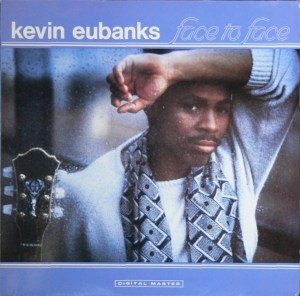
Kevin Eubanks: Face To Face @ 40

You know you’re doing something right when the boss takes an interest.

GRP Records was just coming into its own when label co-founder Dave Grusin co-produced, arranged and played keyboards on brilliant guitarist Kevin Eubanks’ fourth solo album Face To Face, released 40 years ago this month.

Part of the so-called Young Lions generation, Eubanks’ first major gig had been with Art Blakey. His playing was a turbo-charged fusion of Wes Montgomery, George Benson and John McLaughlin, and by 1986 he was a seriously hot property.

Face To Face remains probably his best solo album to date and one of GRP’s best too – but it’s still not on Spotify and bloody hard to find on CD… It apes the kinds of albums Verve and CTI were making in the 1960s with Montgomery and Benson, mainly jazz, Latin and pop covers with rich string arrangements and high production values.

But this one also benefits from some fantastic bass playing from Marcus Miller and Ron Carter (but hardly any drums – Buddy Williams is almost inaudible and the rhythmic energy comes from the percussion, guitar and bass).

As the 1980s progressed, mastering engineers were looking for new ways to push the bass front and centre in the mix, and here Miller obliges with one of the hottest slap tones ever committed to vinyl – the version of Stevie Wonder’s ‘Moments Aren’t Moments’ and title track are almost comical examples.

Grusin writes a new middle eight for the Bacharach/Bayer Sager classic ‘That’s What Friends Are For’, inspiring an absolutely brilliant Eubanks solo, while Carter and the guitarist duet beautifully on Charlie Parker’s ‘Relaxin’ At Camarillo’ and Montgomery’s ‘Trick Bag’.

Elsewhere the delicious version of Antonio Carlos Jobim’s ‘Wave’ may be its best cover version bar none. The three Eubanks originals are cool too, marrying his love of bebop, funk and McLaughlin. The mixture of his steel-string acoustic guitar and Miller’s bass is original and exciting.

Sadly Face To Face proved a bit of a false dawn in terms of Eubanks’ tenure on GRP and subsequent solo career, though his brief period on Blue Note in the 1990s has some fans. He also spent a long time on TV in Jay Leno’s ‘Tonight Show’ band, and guested fruitfully with artists like Dave Holland, Greg Osby and Will Downing.

But arguably his solo career has been hampered by a lack of memorable original compositions, not a problem on Face To Face. Happy birthday to one of the great guitar albums of the 1980s.

Book Review: The Ballad Of Tommy LiPuma by Ben Sidran

What exactly does a record producer do? Of course the role covers a multitude of aspects but generally falls into two categories – the techie or the psychoanalyst.

Tommy LiPuma was definitely in the latter camp, a five-time Grammy winner, label boss (courtesy of his cult imprint Blue Thumb) and bona fide music fan who worked in the upper echelons of the biz for nearly 60 years (he died in 2017).

A cursory look through his credits reveals a natural collaborator with good taste and good ears, via key albums by Bill Evans, Michael Franks, Randy Newman, George Benson, Randy Crawford, Dr John, Antonio Carlos Jobim, Miles Davis (who, along with co-writer Marcus Miller, named the track ‘Tomaas’ after him), Natalie Cole, Diana Krall, Paul McCartney and Willie Nelson.

Ben Sidran’s hugely enjoyable ‘The Ballad Of Tommy LiPuma’ is the first biography of the producer, and it’s hard to think of anyone better qualified to tell his story.

Sidran’s a veteran singer/songwriter and pianist who has recorded over 30 solo albums (including a few for Blue Thumb) and written some key music tomes too, including the superb ‘Talking Jazz’, and he interviewed LiPuma extensively for the book.

The fast-moving, entertaining early sections come over a bit like ‘The Godfather Part II’ rewritten by Lord Buckley. LiPuma’s rite of passage takes him through Mob-riddled Sicily, to grim, industrial Cleveland where shoe-shining and hairdressing seem like his destiny.

But a long period recuperating from injury delivers to him the power of jazz, specifically Charlie Parker and Dizzy Gillespie’s miraculous bebop excursions.

LiPuma thus finds his true calling, and a brief career as a jobbing sax player leads to a short period as promotions man par excellence.

But he quickly realises that production is his true metier, and embarks on a glittering career that takes him from MOR vocal acts (The Sandpipers, Claudine Longet) to classy jazz-related roots and pop projects.

Cue a succession of amusing, fast-moving anecdotes: a fabulous section on the making of George Benson’s Breezin’, an amusing trawl through Rio with a blasted Jobim, a voyage to Planet Miles via the Tutu album, a surreal encounter with Willie Nelson, interesting sections on breaking Michael Franks and Diana Krall and finally all the recent machinations of the Universal Music Group.

‘The Ballad Of Tommy LiPuma’ is warm, witty and resolutely un-PC, initially a portrait of the music biz’s bygone Wild West era featuring an engaging roll call of shysters, hucksters and hipsters, but also encapsulating the whole history of modern recording techniques and philosophies.

It’s a great companion piece to Seymour Stein’s autobiography. There’s a lot about the business, but it’s always shot through with humour and an emphasis that, finally, music is about people.

It’s also a valuable historical document too as it’s hard to believe there’ll be any space for these kinds of hands-on, ‘daddy’ producers in the future.

Thankfully Sidran doesn’t scrimp on the musical detail – there’s a lot of sage advice for aspiring producers and arrangers alike.

Perhaps the key takeaway from the book is music’s healing power. As LiPuma writes to a friend, ‘I might have been on my own at times but I was never alone. When you’re blessed with the love of music, you are never alone.’

‘The Ballad Of Tommy LiPuma’ is published by Nardis Books.