Pop quiz: what do the following tracks have in common? Beach Boys’ ‘Good Vibrations’, Derek and the Dominos’ ‘Layla’, Steely Dan’s ‘Rikki Don’t Lose That Number’, Frank Zappa’s ‘Apostrophe’, Minnie Riperton’s ‘Inside My Love’, The Incredible Bongo Band’s ‘Apache’ and Carly Simon’s ‘You’re So Vain’.
They all feature drummer/percussionist Jim Gordon, who between the mid-‘60s and mid-‘70s was probably the most recorded and celebrated studio drummer in the world (declaring an interest here too: movingtheriver basically learned how to play drums by copying Gordon’s playing on Steely’s Pretzel Logic).
He brought pinpoint time-keeping, smooth grooves, razor-sharp song sense and technical mastery to the kit, but was also a deeply troubled individual whose schizophrenia – exacerbated by drug and alcohol issues – ultimately led to a tragic and shocking crime. He was incarcerated for murdering his mother on 3 June 1983, and died in prison during 2023.
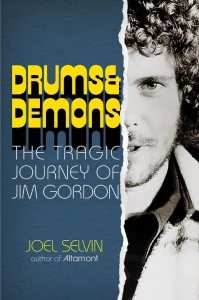
But how did this good-looking, popular, all-American kid end this way? As experienced rock journo and author of ‘Altamont’, ‘Monterey Pop’ and ‘Sly and the Family Stone: The Oral History’, Joel Selvin is perfectly placed to tell this dark tale, and he honours both Gordon’s victim(s) and the drummer himself with a sober, unflinching account.
With the counsel of Gordon’s friends, family members and associates, Slavin outlines his meteoric rise to the top of the music business, the first half of the book featuring entertaining, detailed accounts of work with various Beatles, the Everly Brothers, Joe Cocker, Frank Zappa, Brian Wilson, Jackson Browne and Carly Simon. (The section on Gordon’s tenure with Eric Clapton is particularly illuminating and shocking – the guitarist does not come out well at all…)
The second half descends into very murky waters. There’s shocking evidence of Gordon’s physical abuse of singer/songwriter Rita Coolidge (and his and Clapton’s refusal to give her songwriter credit for ‘Layla’) and great detail about his struggles to get help for schizophrenia and addiction problems.
In fact ‘Drums & Demons’ is an absolute eye-opener with regard to schizophrenia, the voices inside Gordon’s head (tragically, mostly his mother’s) apparently denying him food, amongst other things, and moderating all aspects of his lifestyle.
And if Selvin never quite technically explains why Gordon was such a drum hero (Jim Keltner, Andy Newmark and Jeff Porcaro were huge fans/advocates), the passion for his subject and respect for the drum community as a whole come through loud and clear.
‘Drums & Demons’ joins Bill Milkowski’s ‘Jaco’ and Rob Chapman’s ‘Syd Barrett: A Very Irregular Head’ in the upper echelons of books about gifted, unwell musicians finding themselves alone when the circus has left town. It also perfectly outlines the boom and bust of the studio session scene.
Although at times a difficult, disturbing read, it’s gripping and slickly-written, and highly recommended.
Michal Urbaniak (violinist with Miles Davis/Lenny White/Jaco Pastorius etc.)
Antony Price (designer for Bryan Ferry, Robert Palmer, David Bowie etc.)
Luis Jardim (Seal/Annie Lennox/FGTH/Grace Jones/George Michael percussionist and, according to Steve Lipson, he also played bass on ‘Slave To The Rhythm’…)
Hermeto Pascoal
Damien Thomas (‘Twins Of Evil’/’Tenko’/’Shogun’/’Pirates’ actor and movingtheriver’s uncle)
Jellybean Johnson (drummer and guitarist with The Time/The Family/Janet Jackson etc.)
Nicky Katt (‘Dazed And Confused’/’Insomnia’ actor)
Roy Ayers
Tony Roberts (‘Annie Hall’/’Play It Again Sam’/’Hannah And Her Sisters’/’Serpico’ actor)
Andy Bey
Tony Slattery
Rob Reiner
Richard Darbyshire (Living In A Box co-founder/vocalist/songwriter)
Clem Burke
Chris Rea
Diane Keaton
Martin Parr (photographer)
Patricia Routledge
Sheila Jordan
Peter Jason (‘They Live’/’Prince Of Darkness’/’In The Mouth Of Madness’ actor)
Brigitte Bardot
Dave Ball (Soft Cell keyboardist/co-founder)
James Prime (keyboardist with Deacon Blue/John Martyn)
Robin Smith (cricketer)
Joan Plowright
Lalo Schifrin
Sly Stone
Rick Buckler (Jam drummer)
David Thomas (Pere Ubu frontman)
Sam Moore (Sam & Dave)
Mike Ratledge (Soft Machine co-founder)
Diane Ladd
Pauline Collins
Eddie Palmieri
D’Angelo
Biddy Baxter (‘Blue Peter’ editor)
Chuck Mangione
Steve Cropper
George Wendt (Norm in ‘Cheers’)
David Lynch
Gene Hackman
Brian Wilson
Andy Peebles (radio presenter and writer, the last Brit to interview John Lennon)
Terence Stamp
Chris Jasper (Isley-Jasper-Isley keyboardist/songwriter and solo artist)
Phil Upchurch
Alex Wheatle (writer, activist and London legend)
Roberta Flack
Prunella Scales
Claudia Cardinale
Marilyn Mazur (percussionst/vocalist with Miles Davis/Jan Garbarek/Wayne Shorter etc.)
Flaco Jimenez (accordionist with Ry Cooder/Bob Dylan)
Drew Zingg (guitarist with Donald Fagen/Boz Scaggs/David Sanborn/Marcus Miller)
Barry McIlheney (Smash Hits/Q/Empire writer)
Simon House (Bowie/Thomas Dolby/Japan/Hawkwind violinist)
Rick Derringer
Dill Katz (bassist with Barbara Thompson’s Paraphernalia/District Six/Ian Carr’s Nucleus)
Henry Jaglom (film director)
John Robertson (footballer)
Ed Williams (‘Ted Olson’ in ‘Police Squad’ and the ‘Naked Gun’ movies)
Harold ‘Dickie’ Bird (cricket umpire)
Roy Estrada (Little Feat/Mothers Of Invention bassist)
Wishing all movingtheriver.com readers a happy and healthy 2026, with loads of cash.
The general critical consensus is that Tonight represents the nadir of David Bowie’s career, the only true stinker in his discography.
It’s been described as a quickie cash-in on the Let’s Dance formula, a concession to his new ‘Phil Collins’ audience and a charity album for Iggy Pop. Only three years after its release, Bowie himself was virtually disowning it.
But it’s a fascinating, occasionally superb collection by arguably the greatest album artist in rock history. David tries out a lot of styles and gets away with most of them. And it could have been a lot worse.
So I’m putting it squarely alongside Heathen, Black Tie White Noise, David Bowie, both the Tin Machine studio albums, hours… and several others in the prodigious second tier of DB albums.
In the summer of 1984, Uncle David was competing with the shiny British New Pop acts of the era – Duran, Wham!, Culture Club, Thompson Twins, Nik Kershaw, Howard Jones, Frankie, Bananarama – and to some extent beating them at their own game: Tonight went straight in at number one in the UK album chart.
But writer Nicholas Pegg made an interesting point aboutitssound in his superb ‘Complete David Bowie’: David was apparently more taken with the ‘straight’, poppier artists of the era than the edgier acts such as Bronski Beat, The Smiths, The Cure, Marc Almond etc etc.
Tonight took five weeks to record, two weeks longer than Let’s Dance. It was tracked in Quebec, Canada during May 1984, only a few months after the end of the ‘Serious Moonlight’ tour.
Lenny Pickett’s Borneo Horns were retained from the live dates and there were some holdovers from the Let’s Dance sessions: Omar Hakim on drums, Carmine Rojas on bass, Sammy Figueroa on percussion.
But Nile Rodgers wasn’t asked back to co-produce (it’s oft forgotten that David was also a great producer). It was a decision that apparently baffled and disappointed Rodgers. Instead, ex-Heatwave bassist Derek Bramble was brought in on the strength of his work with Lynx, David Grant and Jaki Graham.
He probably hoped he would be the new Nile, but it wasn’t to be. He played some great bass, guitar and synths on the basic tracks but was given the boot only a few weeks into the project. Police/XTC/Peter Gabriel/Genesis man Hugh Padgham – initially only employed as the engineer – was asked to finish off the album as co-producer.
Hugh has since expressed dismay at the choice of songs, saying that a few new Iggy/Bowie compositions were left unfinished (perhaps later used for Blah-Blah-Blah) because Bowie ‘couldn’t be bothered’ to finish them.
It’s hard to disagree – if ‘God Only Knows’, the title track and ‘I Keep Forgettin’ had been replaced by some new tunes, Tonight could have been a corker.
But it ain’t bad. And the critics all pretty much loved it at the time. It may have been a huge shock if you were brought up on Ziggy Stardust and Hunky Dory, but I came in around Scary Monsters. It seemed a natural progression.
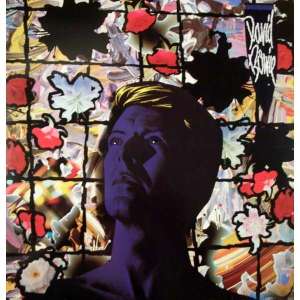
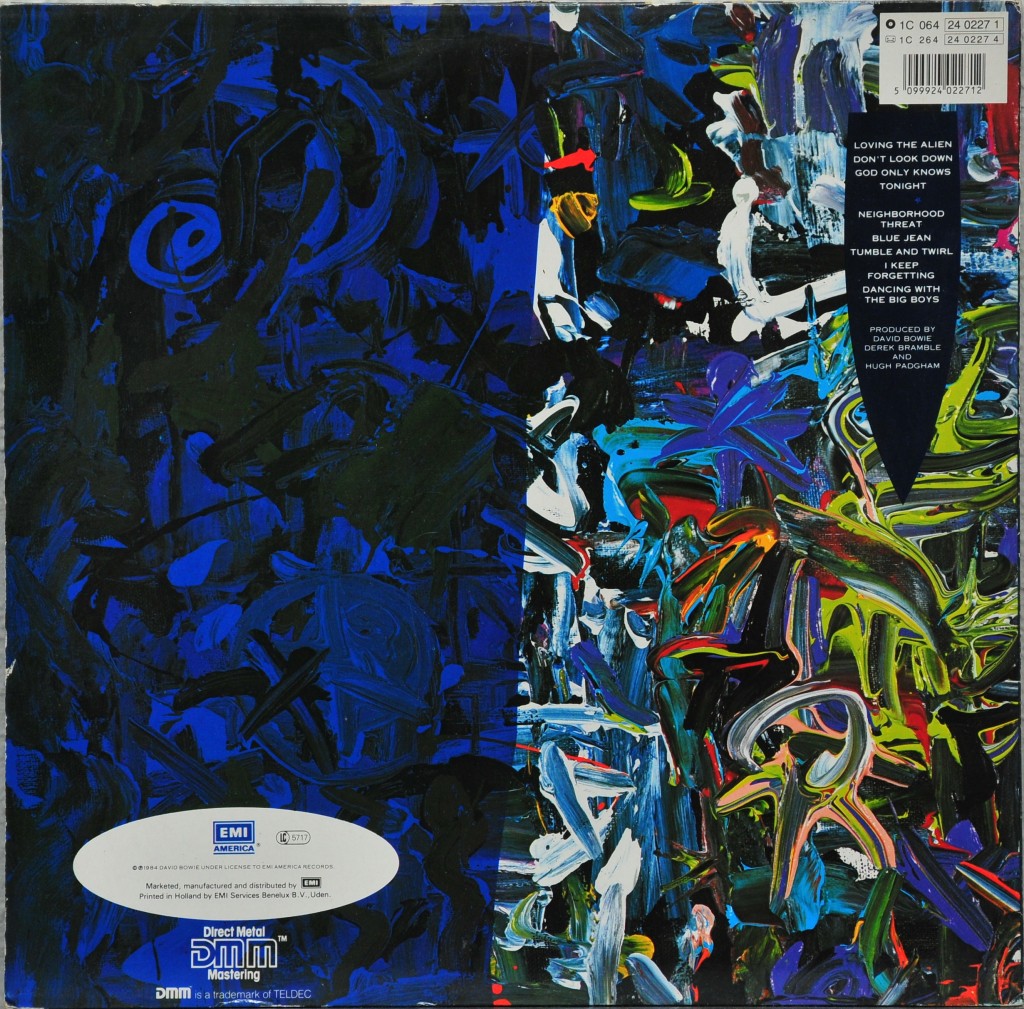
Mick Haggerty’s sleeve design splits opinion too – it’s either a witty Gilbert & George pastiche or a garish bit of mid-’80s tastelessness. Judge for yourself. Oh, and get the 1990 Rykodisc version of Tonight if you can find it rather than the 1999 EMI remaster.
Interesting reggaefied cover of a track from Iggy’s album New Values. Featuring a sublime David vocal, some excellent Bramble bass and a gorgeous horn/synth arrangement embedded in the mix, reminiscent of Gil Evans’ soundworld. Play loud.
3. ‘God Only Knows’
A great David vocal though very curious MOR arrangement of this Brian Wilson composition. Cavernous drums, soaring strings and acoustic guitar high in the mix. Fascinating though only really defensible if viewed as a kind of Scott Walker homage.
4. ‘Tonight’
Shorn of the shock heroin-overdose intro heard on the original from Iggy’s Lust For Life album. But it’s hard to defend this rushed, underwhelming filler which flopped as Bowie’s 1984 Christmas single. Even Omar sounds out-of-sorts on this. But let’s cut them some slack – David helped save Tina’s career. According to her, David dragged the bigwigs of Capitol Records out to see her perform live in New York against their wishes, prompting them to re-sign her.
5. ‘Neighbourhood Threat’
This perky techno-rocker, also originally from Lust For Life, features a fine vocal from David in ‘cyborg’ mode and brilliant drumming from Omar. It works very well but sounds unlike anything else on Tonight. Weirdly, Bowie dismissed it in 1987, saying ‘it wasn’t the right band to do that song. It sounded so tight and compromised.’
6. ‘Blue Jean’
A brief, harmless bit of ‘sexist rock’n’roll’ in Bowie’s words, a portrait of a woman he fancied in a magazine ad. Padgham works his magic on Omar’s drums, there’s some window-shaking sax from Lenny Pickett and Bowie borrows Iggy’s baritone. The first single from the album, it reached UK #6 and US #8 and featured a watchable but very silly long-form video directed by Julien Temple, shown in UK cinemas as support feature to ‘A Company Of Wolves’.
7. ‘Tumble And Twirl’
Another album highlight, co-written by David and Iggy, it’s an effective slice of tropical swing/funk with Mark King’s (uncredited) bass in Stanley Clarke mode, Guy St Onge’s cheery marimba, some sparkling 12-string guitar from Alomar and funny ‘muzak’ bridge with soothing backing vocals. Also some amusing lyrics inspired by Iggy and David’s vacation in Java.
8. ‘I Keep Forgettin’’
The album’s low point, where its ‘happy’, summery, positive feel comes truly unstuck. Electric drums fizz unpleasantly, David hams it up to little effect and the arrangements are more Pebble Mill than Muscle Shoals.
9. ‘Dancing With The Big Boys’
Another Iggy/Bowie co-write, the album closes with a tasty piece of one-chord, horn-based techno-rock flash. A funny lyric that seems to be about American military might: ‘Your family is a football team’. Iggy is very audible on vocals. Arthur Baker also put together an ear-bleeding 12” remix which is worth a listen.
Further reading: ‘Strange Fascination’ by David Buckley

 Pop quiz: what do the following tracks have in common? Beach Boys’ ‘Good Vibrations’, Derek and the Dominos’ ‘Layla’, Steely Dan’s ‘Rikki Don’t Lose That Number’, Frank Zappa’s ‘Apostrophe’, Minnie Riperton’s ‘Inside My Love’, The Incredible Bongo Band’s ‘Apache’ and Carly Simon’s ‘You’re So Vain’.
 movingtheriver.com