
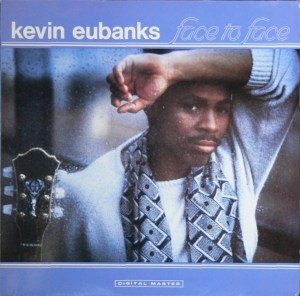
 You know you’re doing something right when the boss takes an interest.
GRP Records was just coming into its own when label co-founder Dave Grusin co-produced, arranged and played keyboards on brilliant guitarist Kevin Eubanks’ fourth solo album Face To Face, released 40 years ago this month.
Part of the so-called Young Lions generation, Eubanks’ first major gig had been with Art Blakey. His playing was a turbo-charged fusion of Wes Montgomery, George Benson and John McLaughlin, and by 1986 he was a seriously hot property.
Face To Face remains probably his best solo album to date and one of GRP’s best too – but it’s still not on Spotify and bloody hard to find on CD… It apes the kinds of albums Verve and CTI were making in the 1960s with Montgomery and Benson, mainly jazz, Latin and pop covers with rich string arrangements and high production values.
But this one also benefits from some fantastic bass playing from Marcus Miller and Ron Carter (but hardly any drums – Buddy Williams is almost inaudible and the rhythmic energy comes from the percussion, guitar and bass).
As the 1980s progressed, mastering engineers were looking for new ways to push the bass front and centre in the mix, and here Miller obliges with one of the hottest slap tones ever committed to vinyl – the version of Stevie Wonder’s ‘Moments Aren’t Moments’ and title track are almost comical examples.
Grusin writes a new middle eight for the Bacharach/Bayer Sager classic ‘That’s What Friends Are For’, inspiring an absolutely brilliant Eubanks solo, while Carter and the guitarist duet beautifully on Charlie Parker’s ‘Relaxin’ At Camarillo’ and Montgomery’s ‘Trick Bag’.
Elsewhere the delicious version of Antonio Carlos Jobim’s ‘Wave’ may be its best cover version bar none. The three Eubanks originals are cool too, marrying his love of bebop, funk and McLaughlin. The mixture of his steel-string acoustic guitar and Miller’s bass is original and exciting.
Sadly Face To Face proved a bit of a false dawn in terms of Eubanks’ tenure on GRP and subsequent solo career, though his brief period on Blue Note in the 1990s has some fans. He also spent a long time on TV in Jay Leno’s ‘Tonight Show’ band, and guested fruitfully with artists like Dave Holland, Greg Osby and Will Downing.
But arguably his solo career has been hampered by a lack of memorable original compositions, not a problem on Face To Face. Happy birthday to one of the great guitar albums of the 1980s.

 movingtheriver.com