Tin Machine: 1989

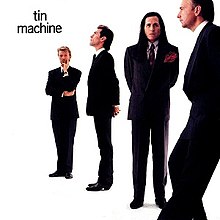
This week marks 30 years since Tin Machine wrapped up their first year of activity with a low-key gig at Moby Dick’s in Sydney, Australia on 4 November 1989.

In the previous 12 months, they’d recorded and released their first album, written and recorded most of the second album, and toured extensively.

Any true Bowie fan must surely like elements of Tin Machine, or at least appreciate the career-reviving value of the band. After all, he was reportedly seriously considering giving up music at the beginning of 1988.

My muso college mates and I had an instant kinship with Tin Machine, particularly picking up on the Jeff Beck and Hendrix influences. Never Let Me Down had completely passed me by, but this felt instinctively like the natural followup to Scary Monsters.

Bowie first hooked up with guitarist Reeves Gabrels, whose wife Sarah had been a press officer on the US leg of his ‘Glass Spider’ tour. But who should join them on bass and drums?

There were mentions of Percy Jones and Terry Bozzio, but they settled on the street-tough Sales brothers, of course previously known to Bowie as the rhythm section on Iggy’s Lust For Life.

Bowie realised what he had signed up for when drummer Hunt apparently strode into the first rehearsal wearing a ‘F*ck You I’m From Texas’ T-shirt.

One of the first things the assembled unit apparently did was make a list of the artists that would inform and influence the band’s sound: Neil Young, The Pixies, Cream, John Coltrane, Sonic Youth, Glenn Branca, Bo Diddley, Sex Pistols, John Lee Hooker, John Lennon.

The debut album was recorded quickly (producer Tim Palmer was apparently barely able to get a decent sound before he realised they were in the middle of a take) and released on 22 May 1989.

How does it sound these days? Pretty damn good. Bowie’s singing is as committed as at any time in his career, and the material is sometimes electrifying.

The Mission/Cult helmer Palmer brings cavernous drums and great guitar layering, finding a most willing participant in Gabrels; ‘Pretty Thing’ in particular delivers a huge wall of sound. Palmer discusses the making of the album in this excellent interview.

Hunt Sales: a rock drummer who swings. He goes double-time if he feels like it.  He slows down, he speeds up. You can’t teach this stuff. The music breathes. Gabrels plays brilliantly, consistently coming on like a cross between Adrian Belew and Robert Fripp, but with more of a blues attitude.

Back in 1989, it was also absolutely fascinating watching Bowie sublimate himself into a band situation, albeit very ‘artfully’ (one of Gabrels’ proposals for a band name was The Emperor’s New Clothes).

He was instructed by the Sales brothers not to over-think his lyrics, but rather to lean on his first instincts. Consequently a few tracks aren’t going to win any #MeToo awards but they’re an honest, unfettered portrayal of middle-aged male lust. And why not?

But those tracks are balanced by the tender ‘Amazing’ and politically-charged ‘Crack City’, ‘Video Crimes’ and ‘Under The God’. It’s invigorating hearing David eschewing irony and nihilism in favour of passionate commitment, though he dusts off the old ennui for the brilliant ‘I Can’t Read’.

The album is 20 minutes too long. If it had been shorn of the dire ‘Working Class Hero’, deafening ‘Baby Can Dance’, dreary ‘Bus Stop’, turgid ‘Run’ and silly ‘Sacrifice Yourself’, I’d put Tin Machine up there with Scary Monsters as Bowie’s last great rock album.

It’s also largely forgotten that it was a critical and commercial success, reaching #3 in the UK, selling a million copies and making many writers’ albums of the year. Hilariously, it also made the Melody Maker’s Worst Ever Albums top 20 list in 1998.

Weirdly, Bowie bounced straight into announcing his own solo ‘greatest hits’ tour in December 1989, ostensibly to promote the excellent series of Rykodisc CD reissues which had kicked off with the Sound + Vision box set.

Quite what his TM bandmates thought of this state of affairs isn’t documented, though Gabrels declined to play guitar on the ‘Sound + Vision’ tour (Belew accepted). Gabrels went off to guest on The Mission’s Carved In Sand instead.
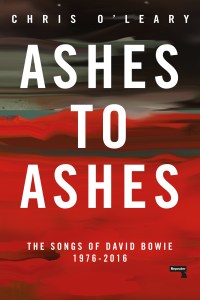
Book Review: Ashes To Ashes (The Songs Of David Bowie 1976-2016) by Chris O’Leary

Another song-by-song study of Bowie’s output is certainly an ambitious undertaking; we already have Nicholas Pegg’s excellent ‘The Complete David Bowie’ and David Buckley’s brief but arresting ‘The Complete Guide To The Songs Of David Bowie’.

But O’Leary is more qualified than most, having run the popular Pushing Ahead Of The Dame website for over 10 years now. And, by and large, ‘Ashes To Ashes’ pulls it off, offering a far more personal, florid take on Bowie’s songs than the aformentioned books.

He makes the decision to discuss the songs not in alphabetical order but, roughly, in the order in which they were ‘conceived’ and/or recorded. While this doesn’t allow for easy reference, an alphabetical title index is included at the back of the book.

The section on Low/”Heroes”/Lodger is excellent, with up-to-date interview material from Tony Visconti and Adrian Belew, and a focus on the city’s geography/history mostly missing from previous Bowie books. And it’s great to see the ‘Baal’ sessions getting the detailed analysis they deserve.

Fascinating items also emerge around Bowie’s late-’80s/early ’90s work, from Never Let Me Down through ‘Pretty Pink Rose’ to The Buddha Of Suburbia, with more detail than usual about the formation of Tin Machine. And it would be hard to find a better study of Bowie’s final two albums, even if they are this writer’s least favourite works of the era.

There are predictable put-downs of Tonight (but an excellent analysis of ‘Loving The Alien’, complete with reading list!), Black Tie White Noise and Tin Machine II.  And there are also oft-repeated errors about the Let’s Dance era, like the listing of Tony Thompson’s drum appearances (he didn’t play on ‘Ricochet’ or ‘Shake It’), but a fascinating section on the fact that Bowie was actually more of an actor than a singer when he made that album.

Musical appreciation doesn’t seem the author’s strong point – for example, ‘Always Crashing In The Same Car’ is described as ‘being ‘mostly in E minor, the harmonic murkiness finally resolved with a closing Em chord’. This ignores the fact that the verse’s home key is clearly G major. And he denegrates Hakim’s ‘gated tom fills’ in ‘I Keep Forgettin’,  but they’re actually the dreaded Simmons electric drums. But elsewhere there are interesting, original observations, like the comparisons between ‘Modern Love’ and ‘Lust For Life’.

One thing’s for sure – ‘Ashes To Ashes’ takes one back to the music. Revisiting Scary Monsters in particular was very illuminating in light of the book. So even if one can’t avoid O’Leary’s natural aversion to much of this material, it’s a valuable addition to the Bowie bibliography.

The question is, will one reach for ‘Ashes To Ashes’ for quick reference ahead of the Pegg and Buckley works? Only time will tell… (NB – one has definitely reached for the book on many occasions since this first reading, so it’s doing its job…)

‘Ashes To Ashes’ is published by Repeater Books.

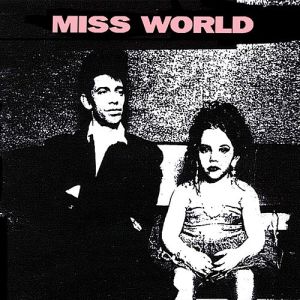
Cult-De-Sac: Miss World (1992)

There were a lot of good quiffs around in the ’80s.

The rockabilly and psychobilly revivals certainly wouldn’t have been the same without them, but one of the best was sported by Jonathan Perkins, lead singer/songwriter of Miss World.

Though Miss World’s self-titled debut album came out in early ’90s, it seems very much informed by the music of the 1980s.

It was released on David A Stewart’s Anxious Records, featured cameos from Pretenders drummer Martin Chambers and was very much under the influence of Iggy Pop’s Blah-Blah-Blah, INXS and Nick Cave, as well as Lou Reed, The Doors and Berlin-era Bowie.

I bought the first album after seeing their mightily impressive set supporting Shakespear’s Sister at the Hammersmith Odeon in summer 1992.

An internet search of Perkins reveals very little, except that he was born in Swindon, was possibly an early member of XTC and probably later turned up in mid-’80s nearlymen Silver Spurs.

But whatever his pedigree, Perkins certainly seems to have a great record collection. Miss World opener ‘The First Female Serial Killer’ has a super-cool vocal delivery (is it about Aileen Wuornos?) while ‘Nine Steps To Nowhere’ sounds like Michael Hutchence fronting The Doors.

‘Watch That Man’ marries Iggy Pop’s ‘Isolation’ with Bowie’s ‘New Career In A New Town’ to superb effect. ‘Dead Flowers’ comes on a bit like Jim Morrison singing with The Clash, and then there are great, weirdo murder ballads ‘Highway Of Dead Roads’, ‘Thief Inside’ and ‘British Pharmaceuticals’.

Lou Reed couldn’t have done a better job at covering ‘What A Wonderful World’. ‘Love Is The Whole Of The Law’ might be the best of the lot, the only co-write with David A Stewart.

Perkins also has a great ear for a strong first line: ‘You make me act like a locust‘ (‘Nine Steps To Nowhere’), ‘I’m wasting away/The voices in my head have come out to play‘ (‘Highway Of Dead Roads’) and the Withnailesque ‘I was feeling very beautiful/Having taken pharmaceuticals‘.

And – good news for us – the songs either seem to be about sex, drugs, death or religion, sometimes all four at once.

Legendary recording engineer Phill Brown (Spirit Of Eden, Solid Air etc) gets a gorgeously uncluttered sound and then there’s the none-more-David-Lynchian cover image.

Not much has been heard from the band since this excellent debut, though some weird footage emerged a few years ago of a comeback gig with Perkins sporting a natty turban.

And they seem to have some more recent tracks on streaming platforms. But they never quite caught on after this strong start, more’s the pity.

33 Great Cover Versions Of The 1980s

We’ve briefly looked at crap cover versions before (though doubtless there’ll be more to come), but how about good ones from the 1980s?

It was quite easy coming up with a fairly long list. I guess the ultimate test is that at the time most people (including me) didn’t know – or didn’t care – that they were cover versions.

There wasn’t a great deal of looking back in this golden period for pop.

But it did seem as if a lot of ’80s acts had the magic touch, or at least a total lack of fear, making almost everything sound like their own. Punk probably had quite a lot to do with that.

Some of the following choices get in for sheer weirdness but most are genuine artistic achievements. Recurring themes? The Beatles, Motown, Otis Redding. Probably not too much of a surprise there. And 1981 seems a particularly good year for covers.

Anyway, enough of my yakkin’. Let the countdown commence…

33. Bow Wow Wow: ‘I Want Candy’ (1982)

32. David Bowie: ‘Criminal World’ (1983)

31. Ry Cooder: ’13 Question Method’ (1987)
Ry’s brilliant solo take on Chuck Berry from the Get Rhythm album.

30. Propaganda: ‘Sorry For Laughing’ (1985)
The Dusseldorf pop mavericks take on Josef K’s post-punk curio (apparently at Paul Morley’s urging) to produce a sweeping, majestic synth-pop classic.

29. Joan Jett & The Blackhearts: ‘Little Drummer Boy’ (1981)

28. Living Colour: ‘Memories Can’t Wait’ (1988)

27. Sting: ‘Little Wing’ (1987)

26. Randy Crawford/Yellowjackets: ‘Imagine’ (1981)
Who knew this would work? Sensitive and imaginative reading of the Lennon classic, with a classic Robben Ford guitar solo.

25. Lee Ritenour: ‘(You Caught Me) Smilin” (1981)
Gorgeous West-Coast version of Sly Stone’s pop/funk opus. Surely one of the most unlikely covers of the decade, but it works a treat.

24. Luther Vandross: ‘A House Is Not A Home’ (1982)

23. John Martyn: ‘Johnny Too Bad’ (1980)
Originally a reggae track by The Slickers and first released on ‘The Harder They Come’ soundtrack in 1972, Martyn and drummer Phil Collins rearranged it and added some lyrics. It featured on John’s fantastic Grace And Danger album.

22. Soft Cell: ‘Tainted Love’ (1981)
Cracking version of Gloria Jones’ ’60s Northern Soul classic (written by Ed Cobb). A hit all over the world, with pleasingly remedial synth arrangement, instantly recognisable soundworld and classic intro.

21. Grace Jones: ‘Use Me’ (1981)
The Nightclubbing album featured a veritable smorgasbord of good cover versions, but this take on Bill Withers scores particularly highly for originality.

20. The Flying Lizards: ‘Sex Machine’ (1981)

19. The Replacements: ‘Cruela De Vil’ (1988)
From the brilliant Hal Willner-helmed Disney tribute album Stay Awake, you’d have been a brave punter to bet a dime on this one working, but work it does.

18. Quincy Jones: ‘Ai No Corrida’ (1981)

17. Donald Fagen: ‘Ruby Baby’ (1982)

16. Stanley Clarke: ‘Born In The USA’ (1985)
Who knows, maybe this could have provided Stanley with a novelty hit if CBS had been quicker off the mark. He references John Coltrane’s ‘A Love Supreme’ in the intro while Rayford Griffin lays down seismic grooves and a funny old-school rap.

15. The Power Station: ‘Get It On’ (1985)
‘If cocaine was a sound…’, as a YouTube wag described it. This near-hysterical rave-up is mainly the sound of a fun late-night jam (Tony Thompson’s drumming being particularly notable). Also check out guitarist Andy Taylor’s little ode to Talking Heads’ ‘Burning Down The House’ throughout.

14. Deborah And The Puerto Ricans: ‘Respect’ (1981)
A one-off solo single from The Flying Lizards’ singer, this Dennis Bovell-produced curio missed the charts but remains a fascinating post-punk artefact.

13. Roxy Music: ‘In The Midnight Hour’ (1980)
Roxy’s first cover version presumably raised some eyebrows but the lads pull it off with some aplomb, aided by Allan Schwartzberg’s tough NYC drum groove – and the fact that Bryan Ferry can’t resist adding some typical weirdness in the first 20 seconds.

12. Ringo Starr & Herb Alpert: ‘When You Wish Upon A Star’ (1988)
Another once-heard-never-forgotten cracker from the aforementioned Stay Awake collection, the album version is preceded by a very menacing Ken Nordine spoken-word intro.

11. Japan: ‘Ain’t That Peculiar’ (1980)
David Sylvian probably hates this but no matter. It’s hard to think of another band pulling it off. Ominous synthscapes from Richard Barbieri, a nice recorder solo by Mick Karn and brilliant ‘where’s-one?’ beat from Steve Jansen.

10. Everything But The Girl: ‘I Don’t Want To Talk About It’ (1988)
It definitely divides opinion, but certainly fits the ‘sounds like they wrote it’ criterion.

9. Bananarama & Fun Boy Three: ‘Really Saying Something’ (1982)
Penned by Motown songsmiths Norman Whitfield, Micky Stevenson and Edward Holland Jr and first performed by The Velvelettes in 1964, it’s hard not to smile when this comes on the radio. I love the way the ladies pronounce ‘strutting’.

8. David Bowie: ‘Kingdom Come’ (1980)
The Dame’s magnificent take on a little-known track from Tom Verlaine’s 1978 debut album.

7. UB40: ‘Red Red Wine’ (1983)
No apologies for including this Neil Diamond-penned perennial. Great bassline, nice groove, lovely Ali Campbell vocal performance.

6. Phil Collins: ‘Tomorrow Never Knows’ (1981)
Phil closed his Face Value album with this oft-forgotten corker, featuring a classic John Giblin bassline (later cribbed by Pearl Jam for the opening of their ‘Once’) and cool Shankar violin.

5. Robert Palmer: ‘Not A Second Time’ (1980)
Robert adds some New Wave grit to this Lennon-penned rocker, and his singing has rarely been better.

4. Siouxsie And The Banshees: ‘Dear Prudence’ (1983)

3. Joan Jett & The Blackhearts: ‘I Love Rock And Roll’ (1982)
First recorded by The Arrows in 1975, this is simply one of the great singles of the 1980s and a huge hit to boot.

2. Hue & Cry: ‘The Man With The Child In His Eyes’ (1988)
It shouldn’t work but it does, courtesy of singer Pat Kane’s excellent tone and phrasing. His trademark ‘na-na-na-na’s help too. I wonder what Kate thought of it.

1. Blondie: ‘The Tide Is High’ (1980)
Written by reggae legend John Holt and first performed by The Paragons in 1966, this was an inspired – if somewhat cheesy – choice for the band. It’s mainly included here for Debbie Harry’s delightfully off-the-cuff vocal, sounding like her first crack at the song.

Gig Review: Kevin Armstrong @ Pizza Express Holborn, 12 September 2018

DB and Kevin A, 1986 photo by Paul McAlpine

It would be tempting to call Kevin Armstrong the ultimate ‘nearly man’ of 1980s pop – he nearly joined a post-Johnny-Marr Smiths, was nearly a founder member of David Bowie’s Tin Machine, nearly joined Level 42 Mark II, and nearly became Paul McCartney’s right-hand man during the ex-Beatle’s late-decade renaissance.

But that would be unfair on the guitarist; as well as stellar work with Bowie (Live Aid, ‘Absolute Beginners’, ‘Dancing In The Streets’) and Iggy Pop (Blah-Blah-Blah, countless world tours), he has also contributed to classic albums by Prefab Sprout, Thomas Dolby and Morrissey and performed live with Roy Orbison, Sinead O’Connor, Grace Jones, Propaganda and PiL.

This entertaining Pizza Express show was half wonderfully-indiscreet spoken-word memoir and half gig. Decked out in all-black rock-star garb, Armstrong described his initiation into the music world via an obsession with Zappa’s ‘Black Napkins’ and postal-order guitar handbooks, and lamented the current pop scene as ‘just another part of consumer culture’.

He spoke of one life-changing morning in early 1985 when he received the call from legendary (and brilliantly-named) EMI A&R man Hugh Stanley-Clarke: an invitation to Abbey Road to record with ‘Mr X’. Arriving at the famous address, Armstrong was shown upstairs to a tiny demo studio (not the big Beatles-frequenting Studio 1 downstairs) to find a bunch of session players and a smiling, suited Bowie holding an omnichord and uttering the totally superfluous ‘Hi, I’m David!’. Bowie then proceeded to teach the band a song called ‘That’s Motivation’ (from the ‘Absolute Beginners’ soundtrack) two bars at a time – and they then recorded it that way too.

A few days later, Bowie summoned Armstrong to Westside Studios near Ladbroke Grove for the ‘Absolute Beginners’ and ‘Dancing In The Street’ recordings (the former with vocals by Armstrong’s sister, then working behind the till at Dorothy Perkins, responding to Bowie’s request for a ‘shopgirl’ to sing duet with him!). The latter session was of course graced by an absurdly perky Mick Jagger. Apparently Bowie and Jagger spent most of the vocal sessions shouting ‘Let’s ring Maureen!’, their nickname for Elton John.

Armstrong then told great tales of Live Aid, mainly highlighting Bowie’s incredible generosity: fluffing the names of backing vocalists Helena Springs and Tessa Niles during his onstage band introductions (no other solo artist introduced his/her band on the day), according to Armstrong he immediately apologised profusely to the singers as soon as they were offstage.

There were further funny tales of Gil Evans, Iggy and McCartney (who apparently once smoked some unbelievably strong grass with Armstrong, said ‘That’s you stoned!’ to the erstwhile guitarist, then promptly disappeared) and an exceptionally eccentric Grace Jones who allegedly took a distinct liking to Armstrong at a party, taking him by the hand and leading him away for some sexual shenanigans. Who should intervene but Bowie, grabbing Armstrong’s other hand and whispering in the guitarist’s ear: ‘No you don’t. She’ll have you for breakfast, sunshine…’

In the second half of the evening, Armstrong was joined by Iggy bandmates Ben Ellis on bass and Matt Hector on drums to perform songs that he’d played live with all the aforementioned stars. Efficiently sung and superbly played, it nevertheless emphasised the difference between a perennial sessionman and born headliner.

But this was still a hugely enjoyable evening, foregrounding a time when music really was transformative. We await Armstrong’s forthcoming memoir with great anticipation.

1980s Pop: The Best Bits

Earworms: 1980s pop was chock-a-block with ’em.
Studio technology was blossoming fast and there was constant temptation (and pressure?) to come up with new sounds. Fairlights, Emulators, Synclaviers, gated snare drums: there had never been more ways to skin a cat.

But woe betide the ’80s popster who neglected the basic tenets of songcraft; the trick was coming up with memorable bits that fitted seamlessly into a track and bore repeated listening.

Thankfully, for every what-does-this-button-do novelty, there was a genuinely innovative, memorable pop moment, and some great instrumental solos to boot. So here’s a compendium of good bits from the 1980s, details that mark the decade out as a unique musical era. The rules: one artist per slot and every song has to have made the UK or US top 40 singles chart, or both…

41. Ian Dury’s ‘…and!’ during his monologue/introduction at the start of ‘I Wanna Be Straight’

40. Helen Terry’s backing vocals on Culture Club’s 1984 hit ‘It’s A Miracle’.

39. The spoken word bit in SOS Band’s ‘Weekend Girl’.

38. Nigel Kennedy’s violin solo on Paul McCartney’s ‘Once Upon A Long Ago’.

37. Greg Phillinganes’ synth bass on Donna Summer’s ‘Love Is In Control (Finger On The Trigger)’, especially the ‘squelch’ at 2:53 below:

36. Lee Thompson’s sax in the second verse of Madness’s ‘My Girl’

35. Marc Almond’s spoken-word line in Soft Cell’s ‘Say Hello Wave Goodbye’

34. Mel Gaynor’s volcanic snare-drum fill after the breakdown in Simple Minds’ ‘Alive And Kicking’
There’s a similar eruption in ‘Don’t You Forget About Me’, but this one wins out for sheer audacity. I wonder what ‘anti-muso’ co-producer Jimmy Iovine had to say about it…

33. The fade of The Police’s ‘Every Little Thing She Does Is Magic’

32. The Middle Eastern synth riff in Blancmange’s ‘Living On The Ceiling’

31. Steve Jansen’s marimba solo on Japan’s ‘Ghosts’

30. Mark Knopfler’s lead guitar at the tail end of Dire Straits’ ‘Romeo And Juliet’

29. Martin Drover’s trumpet riff on Adam Ant’s ‘Goody Two Shoes’

28. The bassline enters at 0:20 of The Cure’s ‘Love Cats’
Phil Thornalley is a veritable Zelig figure in ’80s pop, but even he couldn’t have imagined that his superbly simple-yet-complex bassline (try playing along) could have had such an impact on this stand-alone UK top 5 single.

27. Martin Fry’s hysterical ‘You think you’re smart/That’s stupid/Right from the start/When you knew we would part!‘ at the tail end of ABC’s ‘Poison Ivy’ 
Pointing the way forward for similar outbursts from Jarvis Cocker et al.

26. The weird coda of Stephen Tin Tin Duffy’s ‘Kiss Me’
Just when you thought this slightly-annoying-but-effective UK top 10 single was all done and dusted, there’s that menacing little DX7 kiss-off…

25. Melle Mel’s laugh-rap on Grandmaster Flash’s ‘The Message’

24. The guitar riff on The Pretenders’ ‘Back On The Chain Gang’
The jury seems to be out on whether Billy Bremner or Robbie McIntosh played this (answers on a postcard please).

23. Pino Palladino’s opening bass salvo at 0:04 of Paul Young’s ‘I’m Gonna Tear Your Playhouse Down’ 

22. David Williams’ guitar break on Michael Jackson’s ‘Wanna Be Startin’ Somethin”

21. The jangling piano motif of Associates’ ‘Party Fears Two’
Who came up with this weird brilliance? For a generation of listeners, it’ll always be the theme to BBC radio’s ‘Week Ending’.

20. The post-chorus drum fills on It Bites’ ‘Calling All The Heroes’
Deceptively simple (leading with the left hand is not easy for a right-handed drummer), tasty fills from Bob Dalton, the Cumbrian four-piece’s sticksman.

19. The backing vocals at 1:45 of Quincy Jones’ ‘Razzamatazz’
Patti Austin’s kaleidoscopic overdubs on the Rod Temperton-penned single which reached #11 in the UK chart.

18. ‘Heeeere’s Grace!‘ on ‘Slave To The Rhythm’

17. ‘Science!’
Dr Magnus Pyke’s outburst on Thomas Dolby’s ‘She Blinded Me With Science’ still raises a titter, but apparently he quickly came to regret his contribution to this US #5 single.

16. The Emulator string stabs which close Paul Hardcastle’s ’19’

15. The spoken-word bits in Frankie Goes To Hollywood’s songs
Take your pick from: ‘Well ‘ard!’, ‘Are you flipping me off?’, ‘In Xanadu did Kublai Khan/Pleasuredome erect!’ or my favourite: ‘In the common age of automation, where people might eventually work ten or twenty hours a week, man for the first time will be forced to confront himself with the true spiritual problems of livin”!

14. Neneh Cherry’s cockney accent on ‘Buffalo Stance’

13. The Sweetbreaths’ backing vocals at 1:36 on Tom Tom Club’s ‘Wordy Rappinghood’
Tina Weymouth’s sisters Lani and Laura bring the silliness, interpreted by Google thus: ‘Ram sam sam, a ram sam sam/Guli guli guli guli guli ram sam sam/Haykayay yipi yaykayé/Ahou ahou a nikichi’.

12. Bill Wyman’s French accent in the chorus of ‘(Si Si) Je Suis Un Rock Star’

11. Stevie Wonder’s harmonica solo on Eurythmics’ ‘There Must Be An Angel’
Is there any musician in pop music history who has better communicated pure joy?

10. The ‘Hey!’ sample on Art Of Noise’s ‘Close (To The Edit)’
Not the Noise’s Anne Dudley apparently, but Camilla Pilkington-Smyth (Who she? Ed.). A song of good bits.

9. The ‘Oh yeah!’ sample in Yello’s…’Oh Yeah’

8. Eric B’s ‘Pump up the volume!’ on ‘Paid In Full’

7. That Phil Collins drum fill on ‘In The Air Tonight’
It’s always a bit louder than you think it’s going to be…

6. Roy Bittan’s flanged piano on David Bowie’s ‘Ashes To Ashes’

5. The banshee-wailing on The Specials’ ‘Ghost Town’
It’s a close call between that and the haunting air-raid sirens at the end.

4. The whistling on XTC’s ‘Generals And Majors’
Real whistling or a synth? Who cares? Colin Moulding’s song has more great pop hooks than you can shake a stick at.

3. Abby Kimber’s cod nursery rhyme at the end of Bucks Fizz’s ‘Land Of Make Believe’

2. The synth riff of Human League’s ‘Love Action (I Believe In Love)’

1. Ryuichi Sakamoto’s funky piano on David Sylvian’s ‘Red Guitar’

David Bowie: The Serious Moonlight Tour 35 Years On

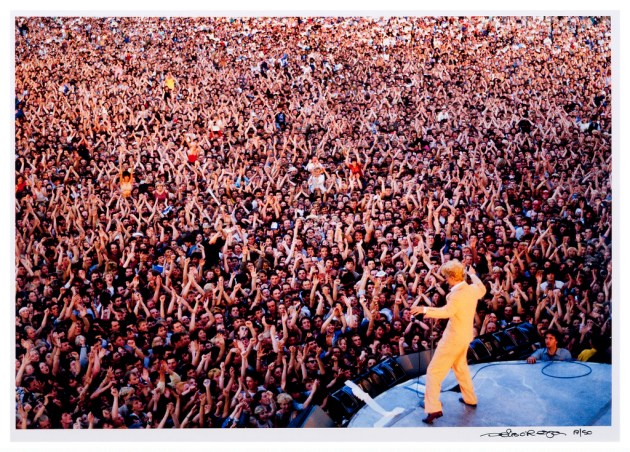
David Bowie, Milton Keynes Bowl, 3 July 1983. Photo by Denis O’Regan

The current London heatwave has sent me back to the summer of 1983 when it seemed like the sun shone every day and the radio was set to ‘fun’, blurting Men At Work, Thompson Twins, Kid Creole, KC and the Sunshine Band, Dexys Midnight Runners and Culture Club.

But Bowiemania trumped them all. In July ’83, all my parents’ friends were dancing to Let’s Dance and David’s Serious (or should that be Sirius?) Moonlight Tour was the hottest ticket in town.

Apologies to Milton Keynes natives, but Londoners of a certain generation will probably always suppress a titter at the mention of the new town’s name (The Style Council didn’t help with their satirical 1984 single ‘Come To Milton Keynes’).

Maybe Bowie tittered a bit too when three Milton Keynes Bowl dates (1/2/3 July 1983) were swiftly added to the tour due to unprecedented demand in the London area (he had already done a night at Wembley Arena and a charity show at the Hammersmith Odeon).

But the gigs were a huge success, and Denis O’Regan’s photo marking the occasion is surely one of the great ’80s music documents.

According to O’Regan, who had unparalleled access to Bowie and his entourage throughout the world tour, David had never been happier: ‘He talked about it being his Phil Collins period but this was heavily in retrospect. At the time, I know he loved it. It was the happiest and most successful he’d ever been’, O’Regan recently told MOJO magazine. Bowie was also making a bit of money at last, freed from dodgy record and management deals.

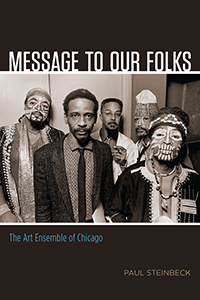
Book Review: A Message To Our Folks (The Art Ensemble Of Chicago) by Paul Steinbeck

If the 1980s saw the full flowering of PR and image’s influence on the music world, it’s sometimes forgotten that jazz was an unlikely beneficiary of this trend too.

The Art Ensemble Of Chicago, that important unit whose line-up went unchanged for almost 30 years until trumpeter/co-founder Lester Bowie’s death in 1999, were a massive live draw during the early ’80s, particularly in France, where they were welcomed more like rock stars than avant-garde jazzers. Image and stage presentation were undoubtedly big factors.

Paul Steinbeck fine new biography of the band ‘A Message To Our Folks’ is a scholarly, forensic study, tracing their origins from the South Side of Chicago through their controversial move to Paris in 1969, return to the States in 1971 and commercial peak in the early 1980s.

He analyses key albums, talks to living members and dissects the Ensemble’s cultural importance. Despite the sometimes frivolous onstage ‘antics’, musically the collective was as serious as your life, to borrow the title of Val Wilmer’s groundbreaking book.

Drummer Don Moye remembers Bowie taking him aside after his successful audition and saying: ‘Don’t even mess with us or get any more involved if you can’t commit to playing Great Black Music at a very high level, becoming famous and taking our place in the history of jazz.’ The stakes were high.

They were ahead of their time with the use of slogans, labelling their sound Great Black Music to distinguish it from jazz; according to Bowie, ‘Never before were we even allowed the dignity of selecting a name for our own music.’ They also described their music as ‘Ancient To The Future’.

The band would pick up various celebrity fans: in 1975, Bowie took a trip to Nigeria and became Fela Kuti’s ‘guest of honour’ when he wowed him with an impromptu trumpet solo: ‘I played this blues… After I played a couple of choruses, Fela said, “Stop. Somebody go get this guy’s bags. He’s moving in with me…”‘

David Bowie also famously employed his namesake for the Black Tie White Noise album as did Danny Wilson for their acclaimed debut Meet Danny Wilson.

Don Moye in 2017

The Art Ensemble Of Chicago would also open doors for other instrumental groups with their onstage presentation, verging on dramatic performance – face paint and stage personas were the norm at a time when ‘jazz’ was becoming extremely bland.

‘Message To Our Folks’ is a fairly brief, fairly serious but highly effective biography, a must for general fans and a good companion piece to other key books on Free Jazz: ‘As Serious As Your Life’, Graham Lock’s ‘Forces In Motion’ and Ben Watson’s ‘Derek Bailey’.

‘A Message To Our Folks: The Art Ensemble Of Chicago’ is published now by The University Of Chicago Press.

David Bowie in Alan Clarke’s ‘Baal’ (1982)

Alan Clarke’s films generally go straight into the ‘once seen, never forgotten’ file.
Features such as ‘Scum’ and ‘Rita, Sue And Bob Too’ courted huge controversy while his groundbreaking TV work including ‘The Firm’, ‘Psy Warriors’, ‘Elephant’, ‘Road’ and ‘Made In Britain’ shone a light on the darker corners of the Thatcher years to devastating effect.

Those films and many others adorn the superb new BFI box set ‘Disruption’ which gathers all his television work made between 1978 and 1989 – including David Bowie’s remarkable turn as Baal, Bertolt Brecht’s anti-hero, adapted by Clarke and John Willett from the 1918 play.

Though it wasn’t exactly a frequently-performed work, British theatre audiences were treated to a Peter O’Toole star turn during the early 1960s, just after the actor’s Oscar-winning appearance in ‘Lawrence Of Arabia’.

For some reason, ‘Baal’ was scarcely mentioned in Bowie obituaries as one of his more successful screen performances, a serious oversight. Bravely broadcast by BBC One at 9:25pm on Sunday 2 March 1982 (cosy Sunday night viewing it wasn’t), it was filmed at Television Centre (W12 8QT!) during the summer of 1981, just after Bowie had recorded ‘Under Pressure’ with Queen.

According to producer Louis Marks, Bowie jumped at the chance to portray the ultimate street punk, and was already a fan of Clarke’s work. He was also reportedly completely undemanding, modest and eager to please on set, requesting only a car and bodyguard and receiving the standard BBC fee.

Bowie could also hardly look less ‘star-like’ in ‘Baal’, with his battered teeth, dark eyes, ratty beard, grimy face and dishevelled clothes; he completely embodies the role of the amoral troubadour. Clarke captures him mostly in long shot with very lengthy takes in the classic alienating Expressionist style, but the camera positively adores Bowie’s Baal with his alligator grin, dangerous sexuality and moments of sudden violence.

He also delivers several plainsong ballads straight to camera in strident, superb voice, accompanying himself on banjo. The subsequent Baal EP, re-recorded at Hansa Studios with added instrumentation, even got to #29 in the UK singles chart, Bowie’s last release for RCA.

‘Baal’ makes for fascinating viewing these days and you only wish the Beeb would take such chances again. Critics of the time were pretty scathing about Bowie’s performance but their comments make for fairly amusing reading these days.

It’s scarcely believable to think that only a year after ‘Baal’ was broadcast, Bowie was rocking the zoot suit and peroxide blond quiff for the Let’s Dance media offensive. It’s also virtually impossible to think of another star of such magnitude who would dare take on such a bleak, singular project. A true artist.

Further reading: ‘Alan Clarke’ edited by Richard Kelly

In Defence of David Bowie’s ‘Tonight’

The general critical consensus is that Tonight represents the nadir of David Bowie’s career, the only true stinker in his discography.

It’s been described as a quickie cash-in on the Let’s Dance formula, a concession to his new ‘Phil Collins’ audience and a charity album for Iggy Pop. Only three years after its release, Bowie himself was virtually disowning it.

But it’s a fascinating, occasionally superb collection by arguably the greatest album artist in rock history. David tries out a lot of styles and gets away with most of them. And it could have been a lot worse.

So I’m putting it squarely alongside Heathen, Black Tie White Noise, David Bowie, both the Tin Machine studio albums, hours… and several others in the prodigious second tier of DB albums.

In the summer of 1984, Uncle David was competing with the shiny British New Pop acts of the era – Duran, Wham!, Culture Club, Thompson Twins, Nik Kershaw, Howard Jones, Frankie, Bananarama – and to some extent beating them at their own game: Tonight went straight in at number one in the UK album chart.

But writer Nicholas Pegg made an interesting point about its sound in his superb ‘Complete David Bowie’: David was apparently more taken with the ‘straight’, poppier artists of the era than the edgier acts such as Bronski Beat, The Smiths, The Cure, Marc Almond etc etc.

Tonight took five weeks to record, two weeks longer than Let’s Dance. It was tracked in Quebec, Canada during May 1984, only a few months after the end of the ‘Serious Moonlight’ tour.

Lenny Pickett’s Borneo Horns were retained from the live dates and there were some holdovers from the Let’s Dance sessions: Omar Hakim on drums, Carmine Rojas on bass, Sammy Figueroa on percussion.

But Nile Rodgers wasn’t asked back to co-produce (it’s oft forgotten that David was also a great producer). It was a decision that apparently baffled and disappointed Rodgers. Instead, ex-Heatwave bassist Derek Bramble was brought in on the strength of his work with Lynx, David Grant and Jaki Graham.

He probably hoped he would be the new Nile, but it wasn’t to be. He played some great bass, guitar and synths on the basic tracks but was given the boot only a few weeks into the project. Police/XTC/Peter Gabriel/Genesis man Hugh Padgham – initially only employed as the engineer – was asked to finish off the album as co-producer.

Hugh has since expressed dismay at the choice of songs, saying that a few new Iggy/Bowie compositions were left unfinished (perhaps later used for Blah-Blah-Blah) because Bowie ‘couldn’t be bothered’ to finish them.

It’s hard to disagree – if ‘God Only Knows’, the title track and ‘I Keep Forgettin’ had been replaced by some new tunes, Tonight could have been a corker.

But it ain’t bad. And the critics all pretty much loved it at the time. It may have been a huge shock if you were brought up on Ziggy Stardust and Hunky Dory, but I came in around Scary Monsters. It seemed a natural progression.

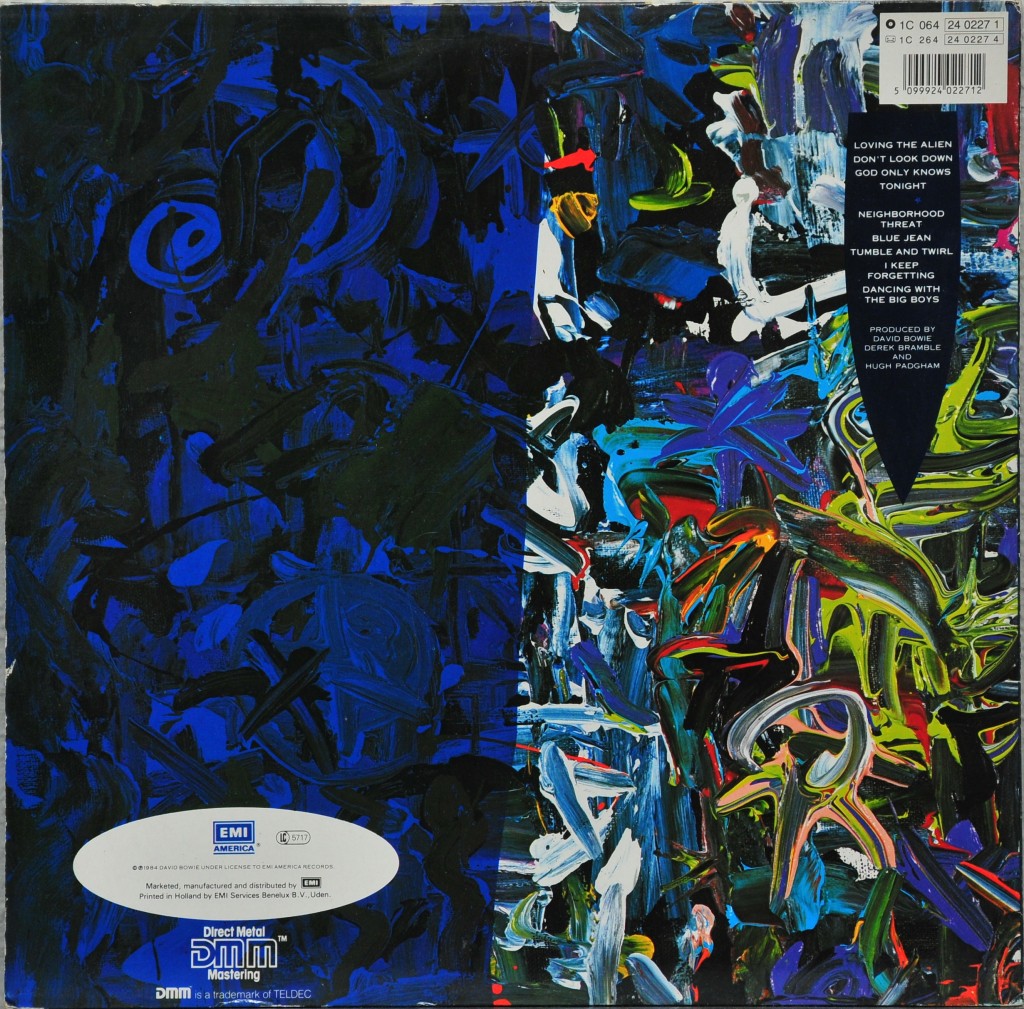
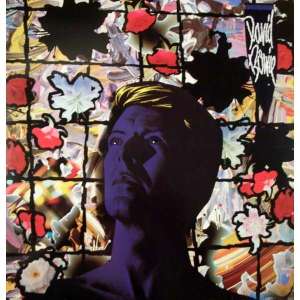
Mick Haggerty’s sleeve design splits opinion too – it’s either a witty Gilbert & George pastiche or a garish bit of mid-’80s tastelessness. Judge for yourself. Oh, and get the 1990 Rykodisc version of Tonight if you can find it rather than the 1999 EMI remaster.

Here’s a quick track-by-track rundown.

1. ‘Loving The Alien’

You can read my full analysis of the song here.

2. ‘Don’t Look Down’

Interesting reggaefied cover of a track from Iggy’s album New Values. Featuring a sublime David vocal, some excellent Bramble bass and a gorgeous horn/synth arrangement embedded in the mix, reminiscent of Gil Evans’ soundworld. Play loud.

3. ‘God Only Knows’

A great David vocal though very curious MOR arrangement of this Brian Wilson composition. Cavernous drums, soaring strings and acoustic guitar high in the mix. Fascinating though only really defensible if viewed as a kind of Scott Walker homage.

4. ‘Tonight’

Shorn of the shock heroin-overdose intro heard on the original from Iggy’s Lust For Life album. But it’s hard to defend this rushed, underwhelming filler which flopped as Bowie’s 1984 Christmas single. Even Omar sounds out-of-sorts on this. But let’s cut them some slack – David helped save Tina’s career. According to her, David dragged the bigwigs of Capitol Records out to see her perform live in New York against their wishes, prompting them to re-sign her.

5. ‘Neighbourhood Threat’

This perky techno-rocker, also originally from Lust For Life, features a fine vocal from David in ‘cyborg’ mode and brilliant drumming from Omar. It works very well but sounds unlike anything else on Tonight. Weirdly, Bowie dismissed it in 1987, saying ‘it wasn’t the right band to do that song. It sounded so tight and compromised.’

6. ‘Blue Jean’

A brief, harmless bit of ‘sexist rock’n’roll’ in Bowie’s words, a portrait of a woman he fancied in a magazine ad. Padgham works his magic on Omar’s drums, there’s some window-shaking sax from Lenny Pickett and Bowie borrows Iggy’s baritone. The first single from the album, it reached UK #6 and US #8 and featured a watchable but very silly long-form video directed by Julien Temple, shown in UK cinemas as support feature to ‘A Company Of Wolves’.

7. ‘Tumble And Twirl’

Another album highlight, co-written by David and Iggy, it’s an effective slice of tropical swing/funk with Mark King’s (uncredited) bass in Stanley Clarke mode, Guy St Onge’s cheery marimba, some sparkling 12-string guitar from Alomar and funny ‘muzak’ bridge with soothing backing vocals. Also some amusing lyrics inspired by Iggy and David’s vacation in Java.

8. ‘I Keep Forgettin’’

The album’s low point, where its ‘happy’, summery, positive feel comes truly unstuck. Electric drums fizz unpleasantly, David hams it up to little effect and the arrangements are more Pebble Mill than Muscle Shoals.

9. ‘Dancing With The Big Boys’

Another Iggy/Bowie co-write, the album closes with a tasty piece of one-chord, horn-based techno-rock flash. A funny lyric that seems to be about American military might: ‘Your family is a football team’. Iggy is very audible on vocals. Arthur Baker also put together an ear-bleeding 12” remix which is worth a listen.

Further reading: ‘Strange Fascination’ by David Buckley

‘The Complete David Bowie’ by Nicholas Pegg

‘Open Up And Bleed’ by Paul Trynka