Nine Memorable 1980s Pop Parodies

The HeeBee GeeBees

One adjective you couldn’t use about 1980s pop is ‘boring’. The music had way too much character and the artists too much physical presence for that.

But 1980s music culture was easy to lampoon. And there was so much mainstream TV to do the lampooning, from ‘Not The Nine O’Clock News’ and ‘The Goodies’ to ‘The Kenny Everett Video Show’ and ‘Spitting Image’.

And across the pond, of course, there was ‘Saturday Night Live’. Then there were the radio spoofs and specially-constructed ‘bands’ like The Hee Bee Gee Bees. All in all it was a golden era for satire.

So here we round up some classic spoofs of 1980s music, with a few recurring subjects…

9. Not The Nine O’Clock News: ‘Happy Crappy Nappy Song’
Inane pop pretenders or joyous post-punk tunesmiths? If you thought Altered Images were the former, Pamela Stephenson and pals pretty much nailed the Glaswegian band’s shtick right here.

8. Stevie Nicks: ‘What The Hell Is She Saying?’
Who the hell is responsible for this classic?


7. Not The Nine O’Clock News: ‘Nice Video, Shame About The Song’
It’s the naughty gang again, this time brilliantly skewering early ‘80s pop videos, particularly the work of pioneers Russell ‘Vienna’ Mulcahy and David ‘Ashes To Ashes’ Mallet.


6. The Hee Bee Gee Bees: ‘Quite Ahead Of My Time’
Angus Deayton, Phil Pope and Michael Fenton Stevens brilliantly lampoon David Bowie’s 1976-1980 era, with nods to ‘Golden Years’, ‘Ashes To Ashes’, ‘African Night Flight’, ‘Fashion’, ‘It’s No Game’ and even ‘The Secret Life Of Arabia’. There’s also a touch of Eno and Bowie’s ‘point to some chord signs with a baton and get the band to play them’ Berlin-era modus operandi about the music here.


5. Spitting Image: ‘We’re Scared Of Bob’
Lyrically and musically spot-on, and also highlights the use of minor celebs in ‘We Are The World’ and ‘Do They Know It’s Christmas’.


4. The Kenny Everett Video Show: The Bee Gees
Ten years before Clive Anderson’s disastrous TV interview, Kenny nails the inescapable naffness of the Brothers Gibb.


3. The Hee Bee Gee Bees: ‘Too Depressed To Commit Suicide’
The first of two Police pastiches, Messrs. Deayton, Pope and Fenton Stevens (apparently with amusing lyrical input by Richard Curtis too) offer a great distillation of their sound, somewhere between ‘Walking On The Moon’ and ‘Don’t Stand So Close To Me’. Also check out the delicious piss-taking of Stewart Copeland’s penchant for adding ‘delays’ (echoes) to his drums.


2. Weird Al Yankovic: ‘Velvet Elvis’
Not as good as the previous track – his voice is pretty poor – but musically it’s pretty damn sharp.


1. Saturday Night Live: Frank Sinatra and Stevie Wonder
Just a timeless classic…

Any classic ’80s parodies missing here? Leave a comment below.

Frank Sinatra: She Shot Me Down 40 Years On

It’s probably not much of a surprise that Frank didn’t exactly thrive in the 1980s, but it’s funny thinking of She Shot Me Down, released 40 years ago this month, touching down in a landscape of AOR, yacht rock and new wave.

It was his penultimate solo studio album (the last was 1984’s Quincy Jones-produced LA Is My Lady) and the last he made for his own Reprise label (still extant and still a subsidiary of Warners).

It has its fans (esteemed jazz writer Gary Giddins called it ‘his last great album’) but is generally considered only a partial success.

Sinatra’s majestic voice falters throughout, and is subject to an uncharacteristically poor recording/mixing job: he’s generally mixed much too high with a ‘room’ reverb that quickly grates. The grim album cover design doesn’t help either.

But She Shot Me Down does feature four absolute classics that easily compare with his greatest work of the 1950s, regretful portraits of lost love that suit his world-weary voice perfectly. ‘Going Going Gone’, penned by the recently departed Stephen Sondheim from the musical ‘Merrily We Roll Along’, features a sumptuous melody and witty lyric, easily transcending its wafer-thin ‘rock’ arrangement.

‘Thanks For The Memory’, originally written in 1938 and famously Bob Hope’s signature tune, features some nice updated lyrics by Leo Robin that perfectly suit the occasion (‘Thanks for the memory/Of letters I destroyed/Books that we enjoyed/Tonight the way things look I need a book by Sigmund Freud’ etc.).

‘Monday Morning Quarterback’ is a superb co-write by producer Don Costa. But Gordon Jenkins’ ‘I Loved Her’ may be the album’s standout. He was of course a frequent Sinatra arranger of note and occasional composer (‘Good-Bye’), but this is his best song, a tragic tale of a mismatched couple that we can all relate to. The faltering piano solo (played by Sinatra?) perfectly conjures up the feeling of bar-room regret, and Sinatra’s pronunciations of ‘pie’, ‘movies’, ‘Dodgers’, ‘noon’ and ‘saloon’ linger long in the memory.

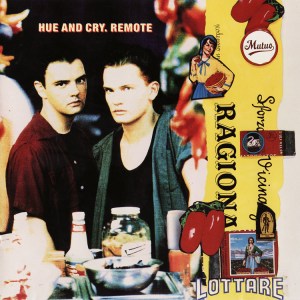
Hue And Cry: Remote

hue and cryJust for a few years at the end of the ‘80s, Hue and Cry bothered the charts with a classy fusion of pop, jazz and Latin.

Singer/co-composer Pat Kane said at the time that they wanted to create a musical mix of Scritti and Sinatra; they almost pulled it off with the excellent Remote, released in December 1988.

They also pulled off the Steely Dan-ish trick of singing about subjects which might seem unsuitable in a pop context (domestic violence on ‘Looking For Linda’, corporate sexism on ‘Dollar William’, Latin-American poverty on ‘Three Foot Blasts Of Fire’, the dawning of the Web on ‘The Only Thing More Powerful Than The Boss’).

hue and cry

And yet something about Hue and Cry seriously wound people up. When they emerged on the scene in 1987, they rode a wave of goodwill thanks to their clean-cut looks, anti-Thatcher politics and dynamic ‘Labour of Love’ single.

But by the time of Remote, the tide was turning. Hue and Cry’s relatively soft, ‘aspirational’ sound was anathema in the bombastic late-’80s. It was too jazz for the yuppies and too pop for the jazz revivalists.

Maybe the fact that they’re brothers never helped too – The Proclaimers were the more acceptable face of Celtic brotherhood, more meat-and-potatoes, more reliably blue-collar.

In 1995, Q Magazine wrote a cruel but witty hatchet piece about them entitled Britain’s Most Hated Band, offering them ‘a crisp tenner’ to split up (it didn’t do the trick…). Whatever. I love this album. Recording Remote in New York gave the Kanes access to some amazing guest musicians – Ron Carter and Michael Brecker play beautifully on the very pretty ‘Where We Wish To Remain’, and Pat’s excellent vocals demonstrate a big Mel Torme influence.

The prime NYC rhythm section of Wayne Braithwate and Dennis Chambers supplies a 24-carat groove on ‘Three Foot Blasts’. ‘Sweet Invisibility’ puts a fantastically exciting Latin horn arrangement right upfront in the mix, beating David Byrne at his own game.

‘Guy On The Wall’ is a witty portrait of a perpetual party wallflower set against a ‘Word Up’ groove and brilliant Salsa horn arrangement. Bassist Will Lee delivers beautifully measured performances on ‘Ordinary Angel’, ‘Dollar William’ and ‘Looking For Linda’, offering a subtle commentary on the songs back in the days when a musical performance was supposed to have some narrative development and couldn’t just be ‘cut and pasted’ together.

It’s quite funny to hear legendary jazz trumpeter Jon Faddis play a stratospheric solo on the otherwise very soppy ‘Violently’ (though Michael Brecker very controversially ‘fixed’ his solo – see below…) Pat Kane sings well throughout the album, with great phrasing, inventive ad-libs and excellent melodies.

But YouTube live footage from the Remote era hasn’t aged well and demonstrates why they were such a Marmite band, all cheap suits and wacky horn sections. I saw them at the Hammersmith Odeon in 1989 and struggle to remember anything about the gig.

Even they seemed to sense which way the wind was blowing; they disappeared for far too long after Remote, issuing the stripped-down Bitter Suite live EP and disappointingly brittle Stars Crash Down in 1991. The momentum and recording budget had gone.

But because in the main they lent towards jazz and Latin rather than funk and soul, they avoided the all-too-audible mistakes of contemporaries like The Blow Monkeys, Style Council, Climie Fisher and Johnny Hates Jazz. A great video has emerged of the boys discussing the making of the album: