Essential 1980s Jazz/Rock Albums (Part 1)

1980s jazz/rock generally gets the side-eye these days.

But it wasn’t all the Chick Corea Elektric Band prancing around the stage in tracksuits or pitiful WAVE-style smooth jazz.

The 1970s jazz/rock pioneers were mostly going strong and if some were too tempted by synths and drum machines, the best music was made by sticking pretty rigorously to the tried-and-tested real drums/bass/guitar/keys lineup favoured by Miles, Weather Report, Return To Forever et al.

So here’s a selection of 1980s jazz/rock albums that have consistently gripped movingtheriver, most of which he queued up to buy at the HMV or Virgin Megastore, or found in an Our Price bargain bin. (These are not proggy or funky. So no Herbie, Brecker Brothers, David Sanborn or David Torn, but there are elements of R’n’B/Latin/soul/whatever mixed in with the jazz).

Bireli Lagrene: Foreign Affairs (1988)
Just 21 years old when he recorded it with producer Steve Khan, the French guitarist’s second Blue Note album is a cohesive gem and massive improvement on the debut, with terrific contributions from keyboardist Koono and drummer Dennis Chambers.

Ornette Coleman: Virgin Beauty (1988)
One of the most ‘accessible’ albums of the master’s career, with memorable melodies, a brilliantly expressive bassist (Al McDowell) and some decidedly odd guest appearances from Jerry Garcia.

Tribal Tech (Scott Henderson/Gary Willis): Nomad (1988)
Recorded in April 1988 but not released until early 1990, guitarists were rightly wowed by Henderson’s brilliance, a mixture of Michael Brecker, Allan Holdsworth and Stevie Ray Vaughan, while the rhythm section is groovy and propulsive and both Henderson and Willis’s compositions are excellent. And ‘Tunnel Vision’ may feature the perfect guitar solo…

John McLaughlin: Mahavishnu (1984)
OK there are some question marks in the keyboard and sax departments, and a few mediocre tracks, but Billy Cobham has rarely sounded better and John contributes three or four classic compositions and a few brilliant solos to this reunion album of sorts.

Marc Johnson’s Bass Desires: Second Sight (1987)
Wonderful interplay between guitarists John Scofield and Bill Frisell, plus some classic compositions including Scofield’s surf-rock-meets-jazz ‘Twister’, Frisell’s Monk-like ‘1951’ and Johnson’s moving ‘Hymn For Her’.

Larry Carlton: Last Nite (1987)
Guitarists of all stripes were blown away by Carlton’s playing in the 1980s, and here’s the best evidence, captured live at LA’s Baked Potato club with Alex Acuna, Abe Laboriel and JR Robinson.

Human Chain: Cashin’ In (1988)
This Brit jazz/rock classic, released on EG Records, had elements of the Canterbury sound, West Coast cool jazz, English folk music and 1980s Weather Report, featuring Django Bates’ fantastic keys and French horn and some weirdly impressive guitar and fretless bass from Stuart Hall (who he?). Also injects a healthy dose of much-needed humour to the ’80s jazz world.

Hiram Bullock: Give It What U Got (1988)
All the fun of the fair from this gifted but troubled guitarist: raunchy funk/rock, instrumental Steely Dan, Brecker Brothers horns, classic fusion and an Al Jarreau guest appearance on a Sam Cooke tune, but all shot through with jazz chords and Hiram’s lyrical playing.

Ronald Shannon Jackson: Mandance (1982)
Ornette-style harmolodics and Mingus-like ensemble work meet NYC punk-jazz on the drummer’s intriguing and powerful album, recorded live in the studio, featuring future Living Colour axeman Vernon Reid.

Weather Report: Sportin’ Life (1985)
It was a toss-up between this and Night Passage, both classics, but this gets the nod courtesy of the newly-minted rhythm section of Omar Hakim and Victor Bailey, plus a few classic Wayne Shorter tunes including ‘Face On The Barroom Floor’ which reportedly Joni Mitchell was particularly smitten by.

Wayne Shorter: Atlantis (1985)
Wayne again, fronting this fascinating, complex song-cycle featuring Alex Acuna on drums and Joni’s husband Larry Klein on bass. Takes some time to digest, but like a good wine gets better every year.

Allan Holdsworth: Secrets (1989)
A toss-up between this and Metal Fatigue, this gets in because of his delicious guitar tone and the inspired contributions of drummer Vinnie Colaiuta – ‘City Nights’, ‘Spokes’, ‘Peril Premonition’ and ‘Joshua’ are musical landmarks. Fiery, exciting, unmissable.

Steps Ahead: Modern Times (1984)
Messrs Brecker, Erskine, Mainieri, Gomez and Bernhardt were embracing some new technology but they never let it overshadow the mostly excellent compositions with telling solos, particularly from Brecker.

John Scofield: Still Warm (1985)
Take your pick between this, Blue Matter and Loud Jazz, all fantastic pieces of work, but Still Warm gets the nod courtesy of its dynamite rhythm section (Darryl Jones and Omar Hakim) and arguably John’s best writing of the ’80s.

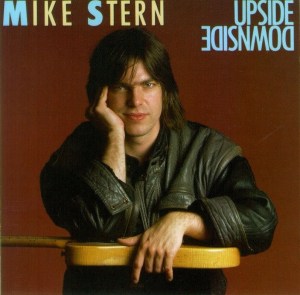
Mike Stern: Upside Downside (1986)
Produced by Hiram Bullock and featuring a crack band including Dave Weckl on drums, it showcases Stern’s finest/fieriest playing on record to date and also one of Jaco Pastorius’s last notable appearances. Still the best Stern solo album and quite extreme in its own way.

(If you’re new to any of these albums and they float your boat, please consider buying physical copies to support the artists.)

Revealed! The Ultimate Christmas Present!

Give the only sensible Christmas present this year – the new book ‘John McLaughlin: From Miles and Mahavishnu to The 4th Dimension’, from the chap who brought you 2021’s ‘Level 42: Every Album, Every Song’.

Get informed, keep entertained, stay fashionable and slob out the modern way! Satisfaction guaranteed for you, your friends or family!

Get 30% off the list price by ordering directly on the Rowman & Littlefield website and entering discount code RLFANDF30 at the checkout (available as an eBook too).

Otherwise of course there are many other buying options – all the details here.

The reviews are in:

‘A must-have in every aspiring musician’s personal library.’ Billy Cobham

‘A wonderful insight into a true innovator and colossus of the guitar.’ Mark King (Level 42)

‘Scrupulously researched… A fluent career overview.’ **** MOJO, December 2023

‘The most comprehensive overview of McLaughlin’s career to make it into print thus far.’ **** Shindig!, January 2024

‘Enthralling… Details the many album releases in a highly readable style… Informative and thoroughly enjoyable, it’s easy to recommended this book.’ Jez Rowden, The Progressive Aspect

‘Phillips is the perfect guide through McLaughlin’s byzantine discography, his training enabling him to keep pace with the guitarist’s baffling mastery of time signatures, his passion earning to the trust of anyone still reeling from the early Mahavishnu Orchestra.’ *** Record Collector, December 2023

‘Comprehensive and thoroughly researched, Phillips’ book is a revelation. A must-read for guitar aficionados and McLaughlin devotees.’ Bill Milkowski, author of ‘Jaco’ and ‘Michael Brecker’

‘Riveting… Meticulous storytelling… The book is not just a narrative, it’s a visual feast.’ Jazz In Europe

‘A compelling study of the man, his music and his marvellous creative legacy.’ JazzViews

‘Paints the fullest picture yet of the guitarist’s life.’ Jazzed

‘Thorough and impassioned… The first book to fully illuminate the least-appreciated, least-documented periods in the extraordinary career of this wondrously free-spirited, prolific, perpetually questing artist.’ Booklist

Book Launch: John McLaughlin (From Miles and Mahavishnu to The 4th Dimension)

Matt’s new book ‘John McLaughlin: From Miles and Mahavishnu to The 4th Dimension’ is available now and can be ordered via the links below.

‘A must-have in every aspiring musician’s personal library.’ Billy Cobham, Mahavishnu Orchestra drummer

‘A wonderful insight into a true innovator and colossus of the guitar.’ Mark King, Level 42 bassist/vocalist

‘Scrupulously researched… A fluent career overview.’ **** MOJO, December 2023

‘The most comprehensive overview of McLaughlin’s career to make it into print thus far.’ **** Shindig!, January 2024

‘Comprehensive and thoroughly researched, Phillips’ book is a revelation. A must-read for guitar aficionados and McLaughlin devotees.’ Bill Milkowski, author of ‘Jaco’ and ‘Michael Brecker’

‘Riveting… Meticulous storytelling… The book is not just a narrative, it’s a visual feast.’ Jazz In Europe

‘Paints the fullest picture yet of the guitarist’s life.’ Jazzed

‘Thorough and impassioned… The first book to fully illuminate the least-appreciated, least-documented periods in the extraordinary career of this wondrously free-spirited, prolific, perpetually questing artist.’ Booklist

UK orders:

UK Bookshops

Rowman & Littlefield (Enter discount code RLFANDF30 to save 30% off the list price)

World Of Books

Hive

Blackwell’s

Waterstones

Foyles

WHSmith

USA orders:

Rowman & Littlefield (Enter discount code RLFANDF30 to save 30% off the list price)

Barnes & Noble

BooksaMillion

It’s an exhaustive look at John’s catalogue, live career and spiritual life, with an introductory note by Robert Fripp, testimonials from Mark King, Billy Cobham and Bill Milkowski, interviews with key collaborators and lots of exclusive photographs. I cover John’s early sessions with David Bowie and Donovan, his remarkable sideman work with Tony Williams and Miles Davis, the fabled solo career fronting The Mahavishnu Orchestra and Shakti and various projects alongside the likes of Sting, Jeff Beck, Herbie Hancock and Carlos Santana.

If you’ve enjoyed this website in any capacity, please consider buying this book and getting it to the toppermost of the poppermost… Thank you!

Gig Review: John McLaughlin/Shakti @ Hammersmith Odeon, 28 June 2023

Late July 1976: if you were a British jazz/rock fan, all roads led to the legendary Hammersmith Odeon in West London.

The Billy Cobham/George Duke Band opened three nights of music, followed by John McLaughlin’s Shakti and then the headliners Weather Report. The encores often featured members of all three fusion supergroups.

So how apt that a reformed Shakti should appear at the same venue almost exactly 47 years on. And what a relief that they chose the Hammersmith Odeon (it’ll always be the Odeon to me, I can’t call it the ‘Apollo’…) to kick off this hugely anticipated 50th anniversary tour rather than the predictable Barbican or Royal Festival Hall. Accordingly, this was not your usual ‘jazz’ crowd after a little ‘culture’ – it was a vocal, refreshingly multicultural audience.

An attempt to marry ‘Western’/blues-influenced timbres with both North/South Indian rhythmic/melodic approaches, Shakti released three albums between 1976 and 1978, then reformed as Remember Shakti in 1998 for three more tours and subsequent live albums.

For this iteration, promoting brand new album This Moment, 81-year-old guitar master McLaughlin was joined by regular collaborators Zakir Hussain on tabla, Shankar Mahadevan on vocals and Selvaganesh Vinayakram on sundry percussion, plus youthful new recruit Ganesh Rajagopalan on violin.

There was combustive interplay on the opener ‘5 In The Morning, 6 In The Afternoon’, McLaughlin going back to his youth with some potent blues licks, bringing to mind his playing on Miles’s ‘Right Off’. Is he using an amp again, after years of firing his guitar straight through the PA?

An exquisite ‘Zakir’ came with heartfelt words from John to his friend. ‘Anna’, described as a ‘golden goldie’ by Hussain, featured flawlessly-played classical Indian lines and a brilliantly fluid solo from Rajagopalan.

John’s guitar gained a little more distortion in time for the violinist’s composition ‘Mohanam’, and by the middle of the gig he was in his element, dropping in references to ‘Lila’s Dance’ and Lee Morgan’s ‘The Sidewinder’. New track ‘Bending The Rules’ even saw John inject a lick from his 1980s classic ‘Florianapolis’. ‘Sakhi’ and ‘Lotus Feet’ were very touching, and some incendiary konnakol percussion duels closed the show on ‘Finding The Way’.

There was light and shade, fury and meditation at this excellent gig – the only downside was the incessant filming with mobile phones. Is there no privacy/immediacy at these larger concerts? The Shakti story continues. Who would have predicted that five years ago? Their tour continues through Europe and into the US during August. Don’t miss.

New John McLaughlin book: your feedback

Movingtheriver.com wants YOU!

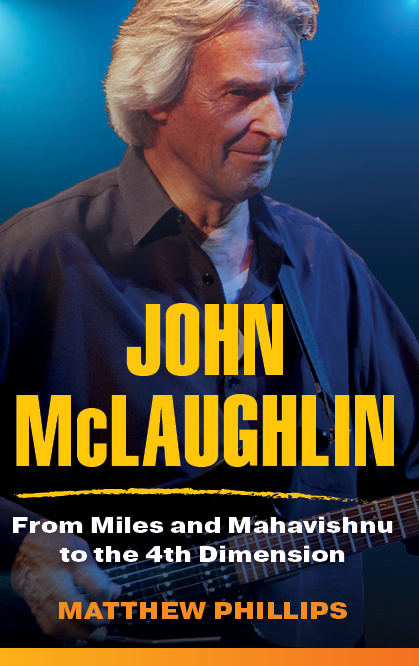
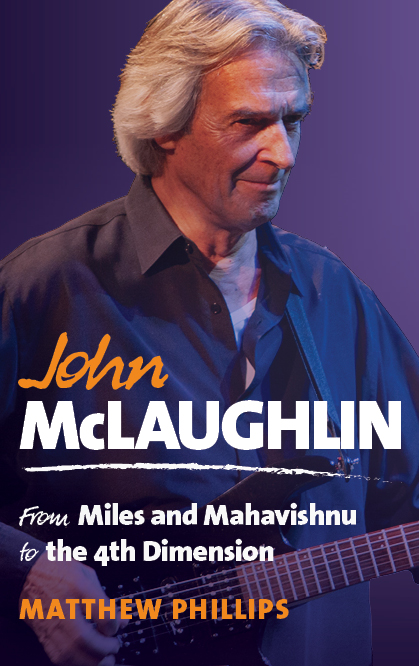
My new book on master musician John McLaughlin will be published worldwide by Rowman & Littlefield in September. The design department have put together a few draft covers, and I’d like to know which one YOU most like the look of. It would be good to get your feedback, and you’ll get a thanks in the book.

Please have a look at these three images and let me know your favourite by commenting below or dropping me an email. Many thanks in advance.

Cover #1:

Cover #2:

Cover #3:

Miles Davis: The Bootleg Series Vol. 7 (That’s What Happened)

The heart always beats a little faster when there’s news of a ‘previously unreleased’ Miles project. And if it’s from the 1980s, even better.

The era is still one the least understood/lauded periods of Miles’s work, despite the stellar efforts of George Cole.

It also has not been served well posthumously, particularly by his final label Warners; in recent years there has been the weirdly undercooked/incomplete Rubberband project, and the appallingly-mastered/incomplete Warners Years box set.

So hopes were high for Sony’s new Bootleg Series 7, which takes in the years 1982 to 1985 and looks at the sessions that made up the (classic) albums Star People, Decoy and You’re Under Arrest. The packaging looks OK:

But what about the music? Before his death, Teo Macero, producer of many epochal Davis albums and also Star People, was very critical of the ‘complete sessions’ boxes that appeared after Miles’s demise. It’s safe to say he would not like this either.

We essentially get a collection of long studio jams, featuring the occasional familiar section – generally the best bit of the jam, expertly filleted by Teo. He really earned his money during this era of Miles music. There are also some alternative versions of You’re Under Arrest material, a few full-length, unedited versions of released tracks and one or two outtakes such as ‘What’s Love Got To Do With It’.

The full, unedited versions of ‘Freaky Deaky’ (Darryl Jones’ first recording with Miles) and ‘Katia’ (before Miles took his razor blade to John McLaughlin’s remarkable solo) are well worth hearing. Marcus Miller plays a brilliant bass solo on ‘Remake Of OBX Ballad’. There’s also a really strange duet featuring trombonist JJ Johnson and Miles on keyboards.

Unlike some of the previous Bootleg Series albums, there’s a lack of interesting studio chatter, which would have enlivened things (though there is the occasional brief Miles interjection). And there are still tracks that refuse to leave the vaults, such as the version of Nik Kershaw’s ‘Wild Horses’.

Disc one just contains too many formless jams, with Mike Stern, Miles and Bill Evans struggling to put together cogent solos (despite Al Foster’s beautiful drumming), and basically the band is crying out for John Scofield’s arrival in autumn 1982. He brings immediate relief, from both a soloing and compositional perspective. The live disc is serviceable and quite well recorded, but certainly not one of the best nights from the 1983 tour.

Essentially, we learn three things from the very uneven Bootleg Series 7: Scofield was a vital addition to Miles’s band and prolonged his career, Miller was Miles’s best bass player of the 1980s and Macero did a great job on Star People. But we probably knew all of that already.

So, basically, it’s another opportunity missed. I’ll stick to the original albums, with one or two exceptions. But you gotta check it out if you’re a fan of Miles’s 1980s music. George Cole covers the box in a lot more detail here.

Bill Evans: Living In The Crest Of A Wave/The Alternative Man

When people say ‘I hate jazz’, I sometimes wonder if they’re really saying they know a crap composition when they hear one.

Legions of talented jazz sidepeople have been given solo record contracts only to deliver music that proves they can’t write decent tunes.

A case in point is saxophonist and William Hurt-lookalike Bill Evans. He’s had a very solid career but his solo work is distinctly underwhelming.

(And then there’s the name. If you play jazz, you probably need a stage name if you have exactly the same moniker as a bona fide legend from decades gone by – the pianist Bill Evans died in 1980.)

But give Sax Bill some credit – he was an absolutely vital figure in Miles Davis’s 1980s comeback, a good friend and carer of the trumpeter and player of several gritty solos on record (Star People is a good place to start). But by 1983 Bill found himself inexplicably frozen out, barely getting any solo space from Miles.

He got the message and jumped ship to join John McLaughlin in the new Mahavishnu Orchestra and also embark on a solo career which kicked off with 1984’s Living In The Crest Of A Wave, a pretty anodyne collection of new-agey fusion. Let’s call it The Metheny Effect. Many tried and failed to ape that guitarist’s mixture of Ornette Coleman-inspired melodicism, Latin flavours and down-home, Midwestern, open-sky simplicity.

With its folky themes, puny production, emphasis on soprano sax, fretless bass, ride cymbals and an ‘environmental’ bent, LITCOAW could almost have come out on Windham Hill. Only the closing title track works up any kind of energy or interest, when Evans finally busts out the tenor and blows up a storm over Adam Nussbaum’s frenetic jazz/rock groove.

Evans’ followup, 1985’s The Alternative Man, was his first record for the illustrious Blue Note Records and as such should have been a celebration. Unfortunately it was an object lesson in how not to use technology, and just the kind of ‘80s ‘jazz’ album that illustrates what a brilliant job Marcus Miller did on Miles’s Tutu.

Evans in the main stumbles around with ugly Linn Drum patterns, electric drums, blaring synth pads and raucous hair-metal guitar solos, all topped off with some fairly insipid soprano playing. A few tracks and you’ll be wanting to break out the Albert Ayler or David Murray albums, and fast.

The only interest predictably comes with two more open, organic offerings, the excellent ‘Miles Away’ which reunites Evans with his Miles colleagues Al Foster on drums and Miller on bass. And ’Let The Juice Loose’ is fun, a cool bebop head featuring some enjoyably un-PC Strat-mangling from the late great Hiram Bullock.

But hey – some of this music brings back good memories, when I was digging around the Record And Tape Exchange and Our Price for bargains and closely monitoring the personnel on the back of my favourite Miles and McLaughlin albums.

These albums also definitely represent a weird time for ’80s jazz, when established labels were signing all and sundry, fishing around for the next Young Lion or Metheny.

And thankfully a few dodgy early solo records didn’t hurt Evans’ career much, as he’s gone on to be one of the most respected players on the scene.

John McLaughlin Trio: Live At The Royal Festival Hall 30 Years On

Recorded 30 years ago, Live At The Royal Festival was the beginning of John’s live career in concert halls rather than ‘rock’ venues, at least as far as the UK goes.

I’m not sure why I wasn’t at this gig, but, in those days, even major shows could easily go under the radar. If it wasn’t listed in Time Out or The Wire, you could easily miss it. Or maybe I was just turned off by the lack of ‘stars’ appearing with John.

Which was a big mistake, because this album introduced two monster players, both hitherto unknown to UK audiences. Bassist Kai Eckhardt was yet another miraculous bass find for McLaughlin, apparently fresh out of the Berklee School of Music.

Trilok Gurtu brought the best aspects of American jazz and fusion playing but also rhythmic concepts and sounds from his native Mumbai (including a water bucket and tablas). In short, he was a perfect fit for McLaughlin.

It had been a weird few years for the guitarist, closing down Mahavishnu for good, duetting with bassist Jonas Hellborg and guitarist Paco De Lucia but also recording the fabulous Mediterranean Concerto which was finally released in 1990.

So his return to the acoustic guitar had thus far been a partial success, but Live At The Royal Festival Hall was the beginning of an acclaimed trio that lasted nearly three years (though weirdly it doesn’t appear to have made it to streaming platforms yet).

The album starts slowly but gets better and better; a gentle take on Miles/Bill Evans’ ‘Blue In Green’ is nothing special but demonstrates John’s rich, Gil Evans-inspired chord concept.

Adventures In Radioland tracks ‘Florianapolis’ and ‘Jozy’ are quite superb, beautifully rearranged for the trio. When Gurtu lays into the half-time shuffle on the latter, it’s one of the great bits of modern fusion drumming.

His ‘Pasha’s Love’ is an intricately-arranged version of a track on an impossible-to-find Nana Vasconcelos live album. But the album’s centrepiece is ‘Mother Tongues’, the debut of a tune which is a mainstay of John’s live sets to this day. The only disappointment is the over-extended ‘Blues For LW’, almost derailed by some dodgy group vocals, Gurtu beatboxing and throwaway references to ‘Are You The One?’ and ‘Miles Beyond’.

Eckhardt didn’t stick around for long after this gig, for undisclosed reasons – Dominique Di Piazza came in, yet another Jaco-influenced chops monster. But Trilok stayed on for the decent 1992 studio album Que Alegria. Then it was time for another change – John’s forte.

Great Guitar Solos Of The 1980s (Take One)

Steve Stevens

What do we expect from a great guitar solo?

A sense of contour, of line, a bit of flash, a good tone and maybe a touch of storytelling.

Luckily for us, the 1980s featured an embarrassment of riches on the guitar solo front, a decade when you could hear everything from post-punk insanity, avant-garde weirdness, shock-and-awe widdlefests and sometimes perfect little compositions in themselves.

Sometimes great solos came from the guitarist in the band, but more often than not they came from the ‘ringer’, the session player. Truly great players of all stripes could find themselves blowing on a top 10 single. Their job was to add the pizzazz, the zing, the memorable bit that all the kids wanted to learn.

So here’s a selection of goodies from the guitar-shaped chocolate box, featuring some rock, some blues, some fusion, some soul, some new-wave, some pop, some metal, some funk, some jazz:

27. Lloyd Cole And The Commotions: ‘Forest Fire’ (Guitarist: Neil Clark)

26. Tears For Fears: ‘Everybody Wants To Rule The World’ (Guitarist: Neil Taylor)

25. Marillion: ‘Easter’ (Guitarist: Steve Rothery)

24. Michael Hedges: ‘Aerial Boundaries’
The whole thing is a solo, of course, but it’s one of the most astonishing examples of solo guitar in recording history, a mixture of tapping, strumming, thumping and hammering. There are no overdubs and a very strange tuning on the classic title track to Hedges’ 1984 album.

23. Tribal Tech: ‘Tunnel Vision’ (Guitarist: Scott Henderson)
A perfect solo from the jazz/rock master’s album Nomad. It’s so complete it sounds almost pre-composed (apparently only the first eight bars were hummed to him by the tune’s writer Gary Willis), each interesting idea following completely logically from the last.

22. Talk Talk: ‘I Don’t Believe In You’ (Guitarist: Robbie McIntosh)
This one taken from the classic album The Colour Of Spring can be filed in the ‘minimalist’ category, but it’s brilliant. The way the veteran Pretenders/McCartney guitarist bends into his last note, perfectly fitting with the key change, is sublime.

21. Johnny Guitar Watson: ‘Telephone Bill’
Johnny G pulled out all the stops for this barnstorming bebop-meets-blues breakdown, from the Love Jones album, closing out his funny proto-rap in some style. He also gets extra points for quoting Dizzy Gillespie’s ‘Salt Peanuts’.

20. Bootsy Collins: ‘Kissin’ You’ (Guitarist: Stevie Salas)
From Booty’s now forgotten 1988 album What’s Bootsy Doin’, a brief but flamboyant classic from one of the great unhinged metal guitarists of the decade, used as a ringer by George Clinton, Bill Laswell and Shakespear’s Sister to good effect.

19. Thomas Dolby: ‘Budapest By Blimp’ (Guitarist: Larry Treadwell)
The LA-based guitarist was part of a Christian duo backing the Pope on his infamous ‘Popemobile’ tour of American stadiums when he answered Dolby’s magazine ad, and he excelled himself on this epic track from Aliens Ate My Buick, coming up with a strong melody over the funky break and even throwing in a little Dave Gilmour homage.

18. Trevor Rabin: ‘I Can’t Look Away’
The title track of the Yes guitarist’s 1989 solo album was a song of two brilliant solos, but I’m going for the opening salvo, a brutal, flashy classic that features all the notes he knows and more.

17. Robert Cray: ‘Waiting For The Tide To Turn’
You could choose almost any solo from Mr Cray’s Bad Influence album, but this one seems to be best encapsulate his classy string-bending, snappy rhythmic sense and ice-cold Strat tone.

16. Nile Rodgers: ‘Stay Out Of The Light’
A brilliant player not necessarily known for his solos, but this closing track from his forgotten second solo album B Movie Matinee opened the floodgates – a fantastic mixture of Charlie Christian and Jimmy Nolen. Starts at 3:37:

15. John McLaughlin: ‘The Wait’
McLaughlin plugs in the Les Paul and unleashes one of the most vicious solos of his career, gradually developing in intensity, with even a touch of his old mucker Carlos Santana at times. Unfortunately it mostly fell on deaf ears, coming from a nearly-forgotten 1987 album Adventures In Radioland.

14. Defunkt: ‘Eraserhead’ (Guitarist: Ronnie Drayton)
One of those unhinged solos that starts at ’11’ and then just carries on in the same vein. The underrated session great is given his head and goes for it. From the punk/funk legends’ forgotten, excellent 1988 comeback album In America.

13. Yngwie J. Malmsteen: ‘Black Star’
This piece, kicking off the Swede’s Rising Force opus, is a guitar masterclass from top to tail, but the first few minutes demonstrate some extraordinary touches like a legato section that you’d swear was achieved with a delay pedal.

12. Stanley Clarke: ‘Straight To The Top’ (Guitarist: Carlos Santana)
The song – which kicked off Stanley’s 1981 career nadir Let Me Know You – may be a disco cheesefest but Carlos’s solo is a stonker, an emotive showstopper with a luscious, creamy tone and lots of emotional moments. It was a good period for Santana – see also Herbie Hancock’s ‘Saturday Night’ and Carlos’s own ‘Stay Beside Me’ and ‘Song For Devadip’.

11. It Bites: ‘You’ll Never Go To Heaven’ (Guitarist: Francis Dunnery)
The Cumbrian gunslingers wrote a great ballad here and Dunnery laid his claim as one of the great Brit guitarists of the ’80s with this extreme solo, a sometimes lyrical, sometimes demented mixture of flash and panache. From the lads’ debut album The Big Lad In The Windmill. 

10. Billy Idol: ‘Rebel Yell’ (Guitarist: Steve Stevens)
He produced several memorable moments alongside the 6’2” blond bombsite born William Broad, but Stevens excelled himself here with a memorable, well-organised solo full of flashy bits and unexpected ‘outside’ notes.

9. Joe Satriani: ‘Ice 9’
Satch’s sophomore album Surfing With The Alien of course produced some guitar highlights but this track featured one of his most distinctive solos ever, Allan Holdsworth meets Eddie Van Halen.

8. Randy Crawford: ‘You Might Need Somebody’ (Guitarist: Steve Lukather)
This gets in for superb tone and admirable restraint, apart from that fantastic flurry of notes in the middle. Luke could hardly do any wrong around this time. Just around the corner was Quincy’s The Dude, ‘Rosanna’, Joni Mitchell’s ‘Love’ and Jacko’s Thriller.

7. Red Hot Chili Peppers: ‘Sex Rap’ (Guitarist: Hillel Slovak)
One of those great solos that sounds like it could fall apart any second, and frequently does. From the lads’ uneven but sometimes thrilling George Clinton-produced Freaky Styley album.

6. Yellowjackets: ‘Monmouth College Fight Song’ (Guitarist: Robben Ford)
In the days when Robben’s trump card was playing bebop/blues with a distorted guitar, and when he loved blowing over interesting chord changes, this track from 1981’s Casino Lights is a classic. A super-sophisticated mixture of Charlie Parker and Albert King. Starts at 1:35:

5. Sting: ‘Little Wing’ (Guitarist: Hiram Bullock)
Hiram could be relied upon to produce classic solos in the late 1980s, as he did with Steps Ahead, Terri Lyne Carrington and on his solo records, and this from Sting’s …Nothing Like The Sun was sublime.

4. Pink Floyd: ‘Comfortably Numb’ (Guitarist: David Gilmour)
Take your pick between two fantastic solos from The Wall album, but I’m going for the first one, a beautiful feature with a killer tone and great use of whammy bar.

3. XTC: ‘That’s Really Super, Supergirl’ (Guitarist: Dave Gregory)
He apparently rehearsed it alone for hours in a little room stinking of rat poison in Todd Rundgren’s rundown studio complex in Woodstock, upstate New York, but it paid off, a memorable, melodic classic.

2. Mike Stern: ‘Time In Place’
The title track of Mike’s second solo album demonstrated definitely one of the slowest solos of his career, and also one of the most lyrical.

1. John Martyn: ‘Johnny Too Bad’
This was one of the more memorable solos of Martyn’s career, during a decade when he was more interested in songwriting than making extreme guitar statements. But he sure found his Les Paul’s sweet spot on a classic cover version from Grace And Danger.

Gig Review: John McLaughlin @ Barbican, 23 April 2019

If this was John’s final London gig, what a way to go out.

Though the audience’s response was at times reverential and/or strangely undemonstrative, the outpouring of emotion at the conclusion was heartfelt and seemed to come as quite a shock to the performers too.

It’s hard to think of another ‘jazz’ band which has endured for so long with the same personnel as The 4th Dimension. This unit (McLaughlin – guitars, Gary Husband – keyboards/drums, Etienne M’Bappe – bass, Ranjit Barot – drums) has toured the world and elsewhere since 2010, playing a fiery mix of jazz, rock, blues, Indian, old-school R’n’B and industrial.

Tonight was no exception, though there was a much larger dose of spiritual jazz than usual, courtesy of not one but two Pharoah Sanders covers: ‘The Creator Has A Master Plan’ and ‘Light At The Edge Of The World’. You could take or leave the slightly dodgy band singing, but the message of love and understanding was powerful and still relevant.

One can also take or leave John’s guitar tone these days (sometimes one wishes for a far less ‘refined’ sound), but his playing sounded back to its brilliant, fluid, lyrical best tonight, a little like his return to the electric in 1978 after the long acoustic sojourn in Shakti.

And if the mood of the evening’s music was generally uplifting, with new takes on the frenetic modern classic ‘Hijacked’, Mahavishnu favourite ‘Trilogy’ and raunchy ‘Echoes From Then’, ‘Gaza City’ was heartfelt and touching, a lament for a lost place.

Just a few gripes: one occasionally hankered after another soloing foil for John, an L Shankar or Gary Thomas; this music asks a hell of a lot from Husband and Barot. Also, listening to the latter’s ‘hit everything all the time’ ethos (though his konnakol vocal/rhythmic interludes are always fascinating), one realised what a tasteful, selective drummer Dennis Chambers had been during the ’90s organ trio/’Heart Of Things’ era.

John started the evening heralding a slight return not to Great Britain but to ‘Great Brexit’, and ended it with a gentle: ‘You’re all one. Thank you’. A powerful, important concert, especially if we don’t see him on a British stage again.