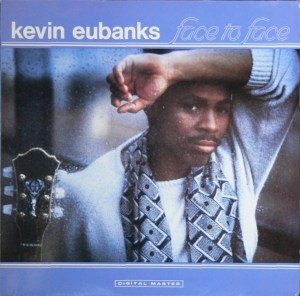
Kevin Eubanks: Face To Face @ 40

You know you’re doing something right when the boss takes an interest.

GRP Records was just coming into its own when label co-founder Dave Grusin co-produced, arranged and played keyboards on brilliant guitarist Kevin Eubanks’ fourth solo album Face To Face, released 40 years ago this month.

Part of the so-called Young Lions generation, Eubanks’ first major gig had been with Art Blakey. His playing was a turbo-charged fusion of Wes Montgomery, George Benson and John McLaughlin, and by 1986 he was a seriously hot property.

Face To Face remains probably his best solo album to date and one of GRP’s best too – but it’s still not on Spotify and bloody hard to find on CD… It apes the kinds of albums Verve and CTI were making in the 1960s with Montgomery and Benson, mainly jazz, Latin and pop covers with rich string arrangements and high production values.

But this one also benefits from some fantastic bass playing from Marcus Miller and Ron Carter (but hardly any drums – Buddy Williams is almost inaudible and the rhythmic energy comes from the percussion, guitar and bass).

As the 1980s progressed, mastering engineers were looking for new ways to push the bass front and centre in the mix, and here Miller obliges with one of the hottest slap tones ever committed to vinyl – the version of Stevie Wonder’s ‘Moments Aren’t Moments’ and title track are almost comical examples.

Grusin writes a new middle eight for the Bacharach/Bayer Sager classic ‘That’s What Friends Are For’, inspiring an absolutely brilliant Eubanks solo, while Carter and the guitarist duet beautifully on Charlie Parker’s ‘Relaxin’ At Camarillo’ and Montgomery’s ‘Trick Bag’.

Elsewhere the delicious version of Antonio Carlos Jobim’s ‘Wave’ may be its best cover version bar none. The three Eubanks originals are cool too, marrying his love of bebop, funk and McLaughlin. The mixture of his steel-string acoustic guitar and Miller’s bass is original and exciting.

Sadly Face To Face proved a bit of a false dawn in terms of Eubanks’ tenure on GRP and subsequent solo career, though his brief period on Blue Note in the 1990s has some fans. He also spent a long time on TV in Jay Leno’s ‘Tonight Show’ band, and guested fruitfully with artists like Dave Holland, Greg Osby and Will Downing.

But arguably his solo career has been hampered by a lack of memorable original compositions, not a problem on Face To Face. Happy birthday to one of the great guitar albums of the 1980s.

Billy Cobham @ 80: Five From The 1980s

The author with Billy Cobham, autumn 2000

Many happy returns to Mr Cobham who turned 80 this week. His drum mastery continues to inspire.

Movingtheriver pretty much learnt to drum by listening to Mr Cobham’s Spectrum, David Sanborn’s (RIP) Hideaway, Steely Dan’s Aja and a few more. His playing was sheer class, something to aim for. There was always an emphasis on technical excellence and good tuning – but the most important thing was the music, the groove.

I was fortunate enough to study with Mr Cobham at the Guildhall School of Music circa 2000. Unforgettable memories.

To celebrate his 80th birthday, here are five key moments from his 1980s. The early part of the decade saw Mr Cobham forge a new life in Switzerland, whilst fronting various bands featuring the likes of Mike Stern, Don Grolnick and Gil Goldstein. Then came the short-lived, controversial tenure in John McLaughlin’s revamped Mahavishnu Orchestra (explored in my book) which nonetheless produced some great music, and then a high-profile return to the solo career via Dave Grusin and Larry Rosen’s GRP Records.

5. Drum Clinic (Part 6), BBC TV, 1982 (?)
Here’s where it all started for movingtheriver. My dad caught it totally by chance on BBC2 and luckily recorded it onto a VHS. It blew the minds of many British drummers including Level 42’s Phil Gould who was reportedly present at the filming.

4. Billy Cobham/Herbie Hancock/Ron Carter: ‘Eye Of The Hurricane’, Lugano, Switzerland, 1983
A period when Billy embarked on various brilliant European collaborations. Still one of the most exciting, propulsive trios I’ve ever heard in acoustic jazz.

3. ‘The Dancer’ (1985)
If memory serves, I was given Mr Cobham’s Warning for my 13th birthday, alongside Joni Mitchell’s Dog Eat Dog and Steely Dan’s The Royal Scam. What a day that was. I still love this album and am glad I kept the vinyl.

2. ‘The Debate’ (1986)
Warning’s followup Power Play didn’t quite have the impact of his GRP debut but Billy’s drums have arguably never been better recorded.

1. Live In Cannes (1989)
A recent find this, worth watching for a rare look at Billy playing timbales (during the first song) and also his fine hookup with percussionist Nippy Noya.

John Giblin (1952-2023): Seven Of The Best

Phil Collins and John, circa 1980

The period roughly between 1978 and 1985 was a golden age if you were a British or American session musician.

The mission: to sprinkle your unique brand of fairy dust over a song or album. You lived on your wits and gambled on your talent but your employers were more often than not creative artists at the top of their game.

As far as UK bassists go, Glasgow-born John Giblin, who has died at the age of 72, was always near the top of the list. He was famed for his melodic fretless bass style (though later pretty much disowned it, moving to five-string fretted and stand-up acoustic basses), starting his career with ex-Yes guitarist Pete Banks. He then hooked up with Brand X and Phil Collins and the rest is history.

After prestigious work with Kate Bush, John Martyn and Peter Gabriel, Giblin joined Simple Minds as full-time member in summer 1985 but left three years later after a falling out with producer Trevor Horn during the recording of Street Fighting Years. He also ran a much-loved rehearsal studio called Barwell Court near Chessington, Surrey.

Of course he was influenced by Jaco Pastorius but didn’t really sound like him. (Anyway, he traced that particular line from Eberhard Weber, who apparently claims Jaco ripped HIM off!) Giblin played memorable bass on tens of key tracks but here are seven that particularly registered with your correspondent, in chronological order.

7. John Martyn: ‘Some People Are Crazy’
movingtheriver’s introduction to Giblin’s work, he delivers a brilliant fretless commentary here, though I’m not even sure I realised it was a ‘bass’ circa 1985 – just superb music. It’s funky, flowing and also features those famed sliding harmonics, nicked from Ron Carter and Percy Jones. Giblin is also a talking head in the great Martyn documentary ‘Johnny Too Bad’.

6. Peter Gabriel: ‘Family Snapshot’
The whole of Gabriel III is of course a bass masterclass but Giblin and Gabriel fill in the backstory of the troubled political assassin to great effect in the moving final minute of this.

5. Kate Bush: ‘Breathing’
Just business as usual for Giblin on this classic Bush anti-nuclear ballad, weaving arch, memorable lines around her vocals. Also listen out for his closing, sepulchral E-flat.

4. Phil Collins: ‘Tomorrow Never Knows’
The much-ripped off (hello Pearl Jam) line that propelled one of the better Beatles cover versions.

3. Simple Minds: ‘Let It All Come Down’
Giblin didn’t get many composer credits but this co-write was always your correspondent’s favourite track on Street Fighting Years (Jim Kerr apparently wrote the words).

2. Kate Bush: ‘Love And Anger’
Kate again, and this time Giblin lets fly with some brilliant slap bass in the final few minutes alongside David Gilmour’s tasty guitar solo.

1. Scott Walker: ‘Tilt’
Demonstrating his post-’80s five-string style, Giblin enlivens Walker’s classic title track with some strikingly ‘out’ notes and a great sense of space.