Prefab go Pop. There are big-name guest spots (Stevie Wonder, Pete Townshend), gospel choirs, an orchestra and Deacon Blue’s producer.
The lengthy recording period and increased budget certainly paid off; synths and strings glisten, Paddy McAloon and Wendy Smith sound like they’re singing in the room with you and one can hear every nuance of Neil Conti’s tasty drumming.
Steve McQueen producer Thomas Dolby could only find the time to oversee four out of the ten tracks; of these, only ‘Knock On Wood’ sounds like trademark TD. Apparently, once McAloon learned that Dolby would be unavailable for much of the recording, he flirted with the idea of using a different producer for each song. The notion was quickly abandoned but it reinforced the idea that this would be Paddy’s most collaborative project so far.
At the time of its release, Paddy publicly declared that he hated the sound of records being made in the late ’80s and in response seems to have looked for songwriting inspiration from pre-rock’n’roll forms – Gershwin, Berlin, Cole Porter, Broadway musicals (he also later said that he was slightly obsessed by Barbra Streisand’s The Broadway Album around this time).
Paddy had also by now made big strides in his keyboard playing, writing all but two FromLangley Park tracks on piano. Consequently, his melodies are daring and original, but there’s arguably a fair degree of musical ‘schmaltz’ in the arrangements too, particularly on ‘Hey Manhattan’, ‘Nightingales’, ‘Nancy’ and ‘The Venus of the Soup Kitchen’, but it’s Stephen Sondheim schmaltz rather than Disney schmaltz. The wonderful ‘Nightingales’ sounds like the score from some kind of futuristic Broadway musical.
CBS obviously had high hopes for the album and their faith was paid off in the shape of a hit single, ‘King of Rock & Roll’, and one near-hit, ‘Cars And Girls’, though one wonders how McAloon views those now – I’ll wager with a degree of sheepishness. But I remember being extremely excited to see the video for ‘Cars And Girls’ popping up on ‘The Chart Show’.
Listening back after all this time, it’s From Langley‘s minor, more understated tracks that really stand the test of time. ‘Knock On Wood’ and ‘Enchanted’ could have come from Steve McQueen.
The former features a simple, unusually direct lyric from Paddy over a surreal, subtle pot-pourri of percussion and synth effects from Dolby. One wonders what McAloon’s demo sounded like. It’s slight and simple but no worse for that.
‘Nancy’ is gorgeous, a ‘Brief Encounter’esque tale of unrequited romance in the workplace, possibly inspired by McAloon’s relationship with his fellow Sprout (it doesn’t take a huge effort to imagine the word ‘Wendy’ in place of ‘Nancy’).
‘I Remember That’ sees McAloon in full-on crooner mode, emoting over MOR strings and weirdly-stilted gospel backing vocals. Paddy pokes fun at Springsteen’s obsessions on ‘Cars And Girls’, but then hilariously attempts a four-on-the-floor, Springsteenish rocker ‘The Golden Calf’ which doesn’t quite come off.
It’s hard to overstate the weirdness of the closing ‘Venus Of The Soup Kitchen’, a collision of slick Steely Dan drums, wonky Farfisa organ, distinctly-unfunky vocals from the Andrae Crouch singers and some amusing cocktail guitar from McAloon, coming over like a Ken Loach tale told in Broadway-musical style. For better or worse, there’s nothing else remotely like it in the Prefab output.
So, an important, big-selling album for Prefab (reaching #5 in the UK album charts) and another hugely impressive chunk of songwriting from McAloon. He was in a bullish mood, talking to the media about chart placings and competing with Michael Jackson and Prince, and his purple patch led to an even more cogent and powerful piece of work in the extraordinary Jordan The Comeback.
In the UK, despite decent chart success (six top 40 singles), China Crisis have always had what you might call an image problem – they’ve never quite been able to shake off an almost imperceptible naffness.
Is it because of their name? Because their first hit was the extremely wimpy ‘Christian’? Because they were neither doomy enough for the post-punk crowd nor cosmopolitan enough for the New Romantics?
Or maybe because they had the dubious honour of being playlisted by Alan Partridge? (Actually, they were played by Partridge’s nemesis Dave Clifton, Ed.)
Steely Dan co-conspirator Walter Becker didn’t think they were too shabby though, apparently requesting a meeting with the Liverpudlians after he heard the nuclear-themed ‘Papua’ from their second album, 1983’s Working With Fire And Steel. He was intrigued by their obtuse lyrics, they liked the cut of his jib and apparently got on like a house on fire.
Becker signed on as producer and was summoned to Parkgate Studios near Battle, Sussex, to begin work on Flaunt The Imperfectionwhich would turn out to be CC’s biggest success to date. Flaunt reached 9 in the album chart and stayed in the UK top 100 for 22 weeks.
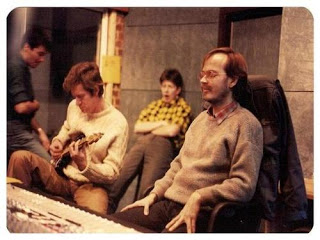
China Crisis and Walter Becker, Parkgate Studios, 1985
With the steady hand of legendary Stones/Sly/Hendrix engineer Phill Brown onboard too, the album featured two infectious top 20 UK hits, ‘Black Man Ray’ and ‘Wake Up (King In A Catholic Style)’.
Well worth checking out too is the ‘Black Man Ray’ B-side ‘Animalistic’ which shows that the lads were also flirting with a variation on Britfunk in their spare time.
Apart from the singles, there are a host of other treats on this album, not least the drumming of the late Kevin Wilkinson. He was a big drumming hero in my teenage years. He’s very close to a British Jeff Porcaro or Carlos Vega, a tasteful groovemaster with a few chops too.
Gazza Johnson’s basslines are catchy and memorable and the songwriting is solid throughout, only ‘Wall Of God’ and ‘Blue Sea’ lacking strong choruses. Then there’s Becker’s top-draw production. He ‘Fagenizes’ Gary Daly’s excellent vocals (usually double-tracked with a touch of delay) and shows off his arranging skills with subtle synth/guitar layering and brooding horns.
In particular, ‘Strength Of Character’, ‘You Did Cut Me’, ‘Bigger The Punch I’m Feeling’ and ‘Gift Of Freedom’ bear his fingerprints, the latter featuring some Gil Evans-esque woodwinds.
China Crisis followed up Flaunt with 1986’s What Price Paradise, a massive misfire wherein producers Clive Langer and Alan Winstanley inexplicably tried to turn them into Madness (If I remember rightly, the Q review of the album ended with the phrase ‘File under: Victim Of A Cruel Medical Experiment’!). But the band reunited with Walter Becker on the excellent Diary Of A Hollow Horse four years later.
Drummers and bassists: this album’s for you. And it’s for guitarists, percussionists and fans of great music too.
Put simply, Steve Khan’s hard-to-track-down Casa Loco has enthralled me and a whole generation of jazz and jazz/rock aficionados for over 30 years.
The compositions and performances of guitarist/leader Khan, bassist Anthony Jackson, drummer Steve Jordan and ex-Weather Report percussionist/vocalist Manolo Badrena are unique and unforgettable.
The album is also totally unclassifiable – a ‘fusion’ band playing a blazing surf-rock cover tune (‘Penetration’)? An unhinged Puerto Rican percussionist singing in quasi-Spanish but sounding remarkably like Sting?
Casa Loco is full of such beautiful and unpredictable juxtapositions. And it’s also blessed with Jean-Michel Folon’s eye-catching cover art.
I had previously bought Steve’s 1981 album Eyewitness just on the strength of the Folon cover but was immediately blown away by the all-time-great Jordan/Jackson rhythm section, Khan’s enigmatic, inimitable voicings and Badrena’s inspired percussives. But Casa Loco, the 1983 follow-up, cranked everything up a notch.
Steve Khan, the son of Sinatra/Dean Martin/Doris Day lyricist Sammy Cahn, is one of the most respected guitarists of the ‘fusion’ era. He played on not one but four of the great Steely Dan tunes (‘Peg’, ‘Babylon Sisters’, ‘Gaucho’, ‘Glamour Profession’), contributing to the latter one of the finest guitar solos in the band’s oeuvre, though he has mixed views on the painstaking recording process that led to those landmark pieces.
Check out his great interview with Leo Sidran for more on this and also a good overview of his career in general. But Steve is also one of jazz and fusion’s most erudite and honest figures, revealing (almost) all on his excellent website. He knows where the bodies are buried…
Steve, who recently released a well-received solo album Subtext, spoke with great candour and humour to movingtheriver.com from his New York City base.
Doug Epstein
MP: Casa Loco still sounds fantastic over 30 years on – how important was engineer Doug Epstein in the recording process?
SK: On countless levels, Doug Epstein was huge in all of this. At that time, he was the only person, on the technical side of things, who had participated in every single recording of mine. I owe him so much. He was always full of enthusiasm and energy for whatever it might have been that I was doing, and he encouraged me to do more. Knowing the financial difficulties we were having, he was the first one to offer to try to get the executives at Mediasound Studios to give us a break on the recording costs, and everyone there was wonderful to us. Nothing, of course, was ever free, but they tried their best to help. At the recording end of things, Doug was absolutely fearless. I think that most of the problematic issues came from Steve Jordan’s constantly changing, per tune, hybrid kit of drums: a combination of natural drums and Simmons electronic drums. Then there was Manolo’s amazing percussion set-up which included all his natural and supernatural sounds, plus the electronics emanating from the Syn-cussion that he was using back then. To accommodate all of that on 24-tracks, with one track taken for SMPTE code and another one blank just because of the risk, there were really only 22 tracks available. In the end, Doug had to know where each tune was headed in terms of possible overdubs, vocals, etc. He did all of that. But, it has to be noted, that Steve Jordan – where our mixing process was concerned – was hovering over Doug’s shoulder the entire time, and in many ways Steve is totally responsible for being the protector of Anthony’s bass sound and playing, and for his own drums, of course. Steve’s contributions in this regard were indispensable to the overall sound that you have come to know. Steve was present for the mixes on all three of our recordings together. He had a vision and a sound in mind, and he pushed hard for that. In great part, that’s why he has become an excellent producer himself – he has a great ear for these things.
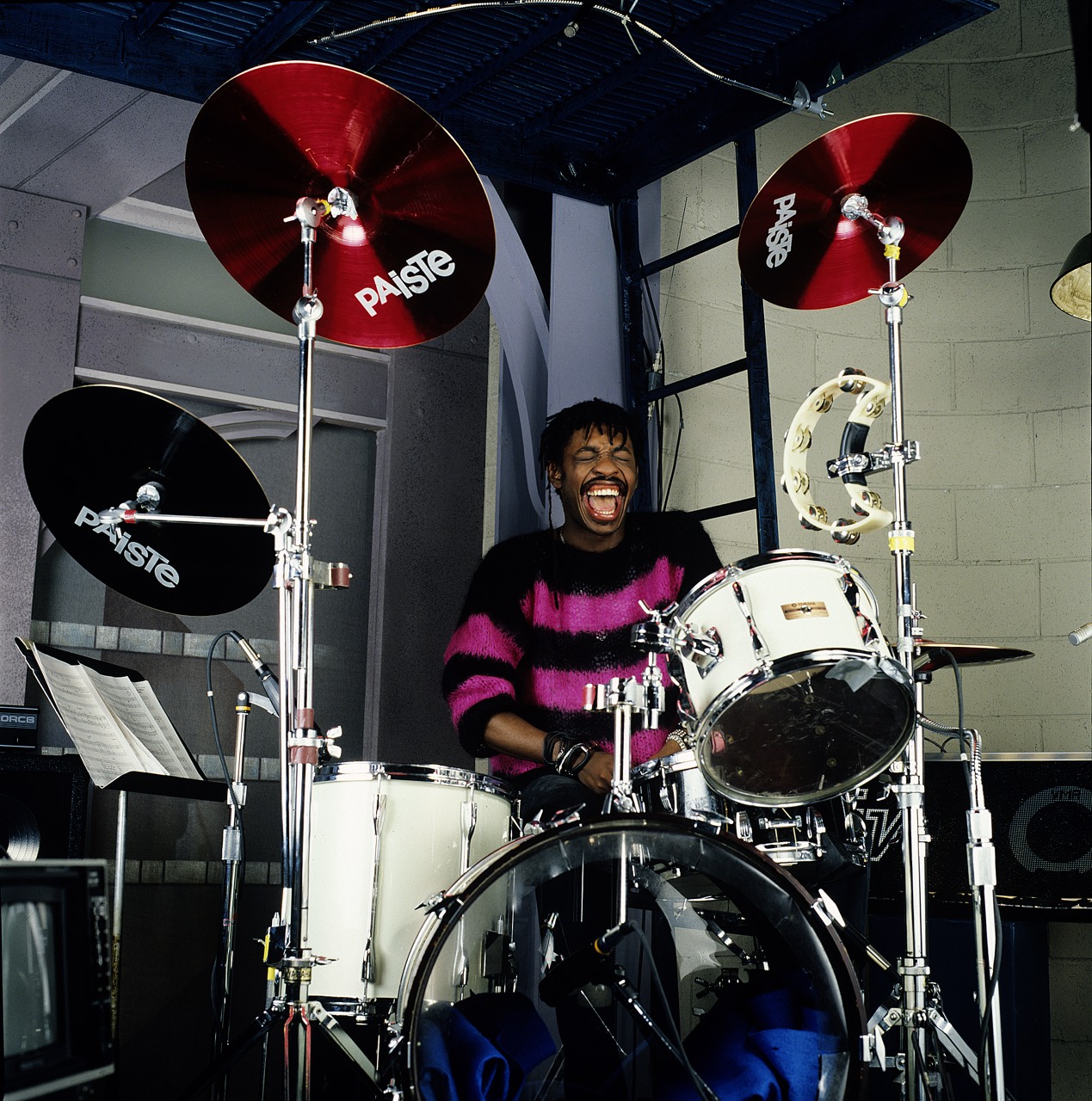
Steve Jordan Photo by Deborah Feingold
There’s a big Police influence on Casa Loco. Who brought that into the band?
I would say that Steve Jordan brought that into the band. I don’t think Anthony had ever heard anything by The Police. The fact that Manolo sounds a bit like Sting at times is just a cosmic accident. It’s not intentional at all. And, of course, 90% of the time Manolo is either singing in Spanish or vocalese, or his own form of gibberish! Recently, the great French jazz journalist Frêdèric Goaty wrote a piece for MUZIQ Magazine about his perceptions of the influence of The Police in contemporary music, and he cited all three of our albums as examples.
Regarding Steve Jordan’s famous drum solo on the title track – how the hell did you and Anthony stay in time when he really starts going out?!
Speaking for myself, it wasn’t easy. Anthony and Steve had a way of stretching the rhythmic boundaries in ways that would often confuse me, and I would get turned around. It was always an exercise in feel and concentration. That day, in the studio, my concentration was at its highest level, because there was no way that I was going to screw something up and ruin Steve Jordan’s incredible drum solo! No f***ing way! It remains one of the great moments on any recording of mine. I think that the complexities of that solo section, which is really a simple Latin tumbao, are demonstrated by the fact that Modern Drummer magazine published a transcription of the drum solo, but with the tumbao completely turned around and written out incorrectly! So, even an educated musician can get screwed-up with that one. I remember once when we were playing at Seventh Avenue South here in New York City, Bob Mintzer, one of the greatest musicians that I’ve ever known, came up to me and said, ‘What the f*** are you guys doing? I can’t ever find one!’ If Bob Mintzer felt that way, I guess there isn’t a much higher compliment. But it was never our intention to play anything that was purposely confusing to anyone.
The structure of ‘Some Sharks’ is incredibly intricate with many repeat signs and tags – were all the guys reading charts while recording this?
At that time, I don’t believe there were any formal charts to any of the tunes. We rehearsed hard and long, and we were prepared. The first lead sheets were done afterwards, I believe. I did them for copyright purposes, nothing more. I remember, when doing that, how astonishing it was to see, on paper, the intricacy of the music that we had created by improvising, and just jamming together pieces of music. It’s possible that I had written out ‘Uncle Roy’ beforehand, but maybe not. It’s hard to remember now. My facualties are not what they once were! But, when I listen to what Steve Jordan contributed to that tune with his unique concepts of beat displacement, it’s remarkable, and when you add in Anthony’s perspective, it makes perfect sense as to why the recordings that we made together between 1981-1983 have influenced bassists and drummers all over the world. Anthony and Steve deserve all of that adoration and more.
‘The Suitcase’ hints at a Discipline-era King Crimson influence – is that accurate?
I have never paid any attention to King Crimson’s music at any time. However, thanks to MTV, I did get to hear ‘Elephant Talk’ and I absolutely loved that tune. I love Adrian Belew and only wish that I could create 5% of the sonic textures that he creates. He is totally unique and brilliant. I admire him a lot.
Why is (great British drummer) Steve Ferrone thanked in the album credits?
To tell you the truth, I have no idea! In those days, we thanked people who stopped by the studio while we were recording, just for their good vibes. It’s also possible that Steve Ferrone lent something, a piece of gear, to Steve Jordan. I just can’t remember. We thanked people who didn’t even exist. For example, at one of our sleep-deprived rehearsals, Steve Jordan was trying to say the name Gore Vidal, and somehow it came out as Gordie Voll, and once he said that, I was rolling on the floor laughing – it was just so silly and funny. So Gordie ended up in the ‘special thanks’ section. I thanked a CNN newswoman, Marcia Ladendorff, who I had a crush on. I thanked an actress that I had a crush on too, Roberta Leighton. I thanked Flippy Hussein, who is not a real person – just a goofy name that the great vibraphonist David Friedman made up one day years before. But most of the names mentioned were people who in some way, shape or form contributed something positive, even if only via their encouragement to the music and the effort to keep going forward.
Jaco
Is there anything else printable you can tell us about Steve Jordan’s crazy house of music (the Casa Loco or ‘crazy house’ of the album title – Ed.) ?
In all honesty, no! Unless someone wants to burn all their bridges behind them, there is a sacred trust that exists between musicians, especially those who are bandmates, or even just work on a special project together. You don’t talk ‘out of school’ about things that you see and hear, sometimes not even after a person has passed away. Those kinds of stories can be hurtful, and even end-up hurting relatives or loved ones. In those days, each of us was going through something difficult in our personal lives, and our behaviour reflected that. Trying to just get together to rehearse for a few hours a couple of days per week was never easy, but we managed. And Steve Jordan’s loft, his home, was a huge part of that. I can only say that all kinds of hysterical shit used to happen there, including people trying to stop by to hang out with us while we were trying to work. Jaco Pastorius was one of them. He used to phone Jordan all the time and beg us to let him come by. We reached a point where we would never answer the phone and never allow anyone in except for the delivery guy who was bringing by Steve Jordan’s breakfast – at 2pm in the afternoon! Does that give you an idea?! No matter what transpired those days were some of the most fun and productive days of my creative life. I have rehearsal cassettes from those times – I used to listen to them every so often – and the constant laughter on those tapes about absolutely nothing is priceless. It was just so damn funny most of the time and exasperating too, at least for me!
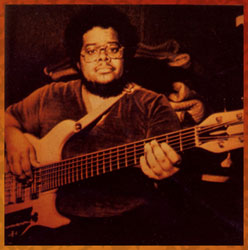
Anthony Jackson photo by David Tan
I was astonished to read that the whole album was recorded in just TWO days, quite amazing when you consider the time spent on other albums of the era (Hello Donald and Walter…). How do you explain that? Was it just a case of getting the goods in the shortest possible time with the meter running?
Well, though it is true that the serious content of Casa Loco was recorded during May 21/22 1983 at Mediasound, I didn’t realize that we were going to need a third day just for Manolo Badrena! I actually thought that we could finish a performance of a piece and then he would simply, right then and there, overdub his vocals. I’m speaking about tunes like the title track, ‘Some Sharks’ and ‘The Suitcase’. But what happened really threw me for a loop, because I did not want to spend the money, other than for mixing, to return to the studio just for Manolo. Thinking this way demonstrated my lack of experience and understanding that recording vocals, by anyone, requires a different kind of care and patience. It is something that you have to plan for. I was too worried about spending money for an extra day in the studio! The great lesson in this is always the same: if you begin by being cheap, you will pay for it later! There is, of course, a most wonderful expression for this very thought in Spanish: ‘Lo barato sale caro!’ If you are unwilling to spend money, you will end-up with a lousy or sub-standard sounding recording, and this is something that I never want to be a part of, because you have to live with the results forever. So as the recording unfolded, during ‘Casa Loco’, ‘Penetration’ and ‘Some Sharks’, Manolo actually just sat there and didn’t play a damn thing while Anthony, Steve and I were performing those tunes. At the time, he just motioned wildly to me that he could not hear himself in the headphones. Mediasound had one of the early systems whereby each musician could make his own headphone mix. Each time this happened, we all tried to work harder with Doug to help Manolo get what he wanted and needed. It was so frustrating to have him there and not have him with us making that music. So, in the end, I had to spend the time and money overdubbing him on those tunes. I was furious about this! In sharp contrast to that, if you just listen to what Manolo contributes to ‘Uncle Roy’ – there is not a sound there that was not performed completely live. It is simply brilliant – no one else could have created textures like that. He’s one of the most unique musicians on this earth but not easy to work with. Years later, I learned that it really wasn’t the damn headphones at all; he had been upset that he wasn’t getting paid for the sessions, as if I was pulling a ‘fast one’ on him and secretly hoarding money somewhere. This is, of course, the furthest thing from the truth. We had a number of band meetings during our rehearsals and I clearly explained to everyone that I was paying for the album out of my own pocket, and that after I had recouped my investment in full, if that ever happened, whatever money there was to be had, we would all split it equally four ways. Period! In other words, we were all going to get rich together, or stay exactly as we were, but together. It was certainly my impression that Manolo understood that. Anthony and Steve were on board, as they always were, and I will never ever forget their selflessness when it came to this music. I love them both and I’m deeply indebted to them, forever, no matter what else has happened.
According to your website, you paid for recording costs entirely out of your own pocket – have you managed to recoup some of this over the years? I hope so…
We’ve addressed a portion of this during my answers to some of the other questions. But, the answer is: No! Absolutely not! I believe that, back then, my total investment in making Casa Loco was $17,500. That might not sound like much in 2015, but it felt like a fortune to me, having to go into my personal savings to do this. But that’s how much it meant to me. It was the second time that I had done that, Evidence (1980) being the first. And, it would not be the last; I have done this seven more times since! In the end, I was given advances from Trio Records (Japan) and eventually from Antilles Records (USA) that totalled $11,000, and that’s all that I have ever seen come back to me from this recording. In short, as it has been with all of my self-financed recordings, I will never ever again see that money come back to me. Do I regret it? Of course not. I am, and will always be, exceptionally proud of those recordings because everyone who participated gave something of themselves to do it. I don’t forget those people, those players! Never!
In the miasma of soap-opera tie-ins, boy-band debuts, one-hit wonders and Stock, Aitken and Waterman productions that constituted late-’80s pop, Love and Money’s second album Strange Kind Of Love was a breath of fresh air.
Released in December 1988 and produced by legendary Steely Dan helmer Gary Katz, the record was a triumph. James Grant’s literate, dramatic songs of romantic anguish and corporate avarice were built to last.
Musicians had a field day with Grant’s intricate guitar work and the rock-solid grooves courtesy of drum legend Jeff Porcaro and underrated bassist Bobby Paterson. Critics of the time were generally confused but I was sold from the first bar of ‘Hallejulah Man’.
Funkier than the likes of Curiosity Killed The Cat or Hipsway but lyrically just as piquant as The Smiths or The The, Love And Money joined Prefab Sprout, Prince, The Blue Nile, Danny Wilson, David Sylvian, De La Soul, Scritti Politti and Cocteau Twins in my list of late-’80s pop saviours.
I caught up with singer/songwriter/guitarist James Grant to talk Strange Kind Of Love, Jeff Porcaro, Tom Waits, touring with Tina Turner, ‘Top of the Pops’ and ’80s marketing meltdowns.
Love And Money 1988
MP: Could you just give us a quick bit of background to Strange Kind Of Love – what were the expectations for album number two and how did you come to work with Gary Katz?
JG: I always felt the first album was disparate and didn’t marry the different influences well. We sounded too desperate to impress. I was also anxious to prove that I was more than just a haircut. For Strange Kind Of Love, I had written the album and we had lived with the songs for a while. The mantra was: the song is king. Meaning that the song would dictate how it was meant to be, what was appropriate and what was not. The desire was to create something timeless and the man to facilitate that was Gary Katz. He had a track record that spoke for itself. He just seemed perfect. We set up a meeting – I flew to New York – and we just hit it off right away. There was a symbiosis, a shared desire to make great records, and we liked each other. We’re still pals to this day.
Lyrically, SKOL focuses mainly on the anguish, pain but also joy of romantic infatuation. Was there a particular relationship that precipitated this or had these songs built up over time?
Yes, there was someone in particular, but obviously there’s poetic license. Songwriters deify those we love. I just happened to think – and still do – that besides knowing you are going to die, being in love is the utmost existential experience there is. I was young, heartbroken and hungry; the right ingredients to make great music! I also had the distinct feeling that great songs contain a truth, perhaps not the literal truth but a truth. I wrote about myself; this tended to get uncomfortably forensic at times for those close to me.
Jeff Porcaro 1988
How much of a contribution did the great Jeff Porcaro make to SKOL‘s arrangements and why is his surname misspelt in the credits? Was there enough budget to get him for rehearsals? His playing seems so integral to the material.
Jeff didn’t make any contribution to the arrangements – that was all planned months before we even met. I have no idea why his name is misspelt. We did the drums over a month in LA. Sometimes we just jammed the thing till we got the right vibe. On other tracks, I had a more concrete idea of what I wanted. For example, on ‘Razorsedge’, I wanted a go-go beat. I just went in with my guitar and told him what I was hearing. He just started playing this incredible, jaw-dropping stuff. Yes, we had the budget. Jeff was a brilliant, phenomenal musician. I felt like I had f***ing boxing gloves on sometimes when we were jamming but he never ever made me feel like that. He was a beautiful guy, great fun to be with and genuinely humble about his achievements and ability.
The four sublime singles from the album just missed out on the UK Top 40 – was that a disappointment? Was there pressure from Phonogram to get that first UK or US hit?
Yes – it was always a disappointment. You try and be stoic and say, ‘That’s not what it was about’, but we were gutted. We so nearly made it with Strange Kind Of Love. I always wanted to do ‘Top of the Pops’. If that’s shallow, then so be it. I grew up watching Slade and Bowie and prancing around in front of my bedroom mirror imitating them – it was my dream to be part of that, just like any kid. There wasn’t pressure from Phonogram as such; they were trying their best with us. It just wasn’t to be. I do believe that if we had had the success, Dogs In the Traffic may not have happened. That’s the Love And Money record I’m most proud of and it’s most representative of who I am. Perhaps that’s why I find it so hard to listen to…
Why is Tom Waits thanked in the album credits? And presumably (Steely Dan singer/co-leader) Donald Fagen is thanked because of the Katz connection?
Because I’m a fan and he was and still is a massive inspiration. It wouldn’t be easy to tell if you were judging this from the record. Donald Fagen played a little something. I’ve always kept that a secret. We didn’t want to make an issue of it or make it something marketable.
Gary Katz
You play some fantastic lead guitar on the album and also some really inventive acoustic/electric textural stuff – did Gary Katz’s experience with the likes of Larry Carlton and Jeff ‘Skunk’ Baxter have any bearing on your playing?
Not really – Gary would have me playing for weeks on end though. I reckon I came on a bit during my time with him. And thank you.
SKOL doesn’t really sound like anyone else from the era and stands up exceptionally well today. At the time of release, some critics rather snootily compared it to Dire Straits and Deacon Blue but were there contemporary artists the band admired or were influenced by?
No, not especially – my tastes have always been very eclectic. In terms of marketing, this always led to problems; ‘Are you guys rock, pop, funk or country?’ ‘Yes…’ I did love Bowie, Talking Heads, Chic, Led Zeppelin and Prince – I can hear certain little things from all of them here and there.
Who is Beatrice Colin? Her voice compliments yours beautifully, especially on ‘Walk The Last Mile’.
She was my girlfriend. She’s an author now.
Who came up with the album cover concept? Studying it again, it’s one of the weirder covers of the ’80s…
Someone in the marketing department at Phonogram saw a photograph like the one on the cover and we decided to recreate it. Though I’ve always believed it to be extremely important, the amount of time and money invested in things like artwork was, by today’s standards, science fiction. We would have months of meetings discussing details. People would have nervous breakdowns!
You toured with and supported various US acts such as BB King and Tina Turner in the late-’80s – any memories that stand out? I loved your playing with Tom Verlaine on The Tube.
The one anecdote that would perhaps stand out is that when we supported Tina Turner, when I introduced the band, I said, ‘Hi, we’re not Tina Turner, she’ll be on a bit later.’ I thought this was amusing. Tina’s management did not. We were kicked off the tour. You’d think we would have been disappointed by such a thing, but – and I’m really proud of this – we did not give a f*ck.
I saw you revisiting SKOL on a memorable night at the Shepherds Bush Empire a few years ago – how do you feel about the album and its place in ’80s music now?
I’m really proud of it. It’s of its time, certainly, but a bit more than that. I think sonically it’s absolutely spot-on – it still sounds fantastic. I always think of the band’s place in the greater scheme of things as awkward. I think, as I said previously, we were difficult to categorise. This seemed to be a huge problem for some people. I never tried to make ‘difficult’ music. I still don’t. I think my tastes are fairly mainstream. Perhaps lyrically things are a bit more challenging at times, but even so, I don’t think they are wilfully arcane or esoteric.
I came across a review of Meet Danny Wilson in Q magazine which drew comparisons between Gary Clark’s voice and Donald Fagen of Steely Dan’s (spot-on).
That was enough incentive for a massive Steely fan like me to check it out. I wasn’t disappointed. Meet Danny is one of the most arresting, original debut albums of the ’80s, and it stands up extremely well today.
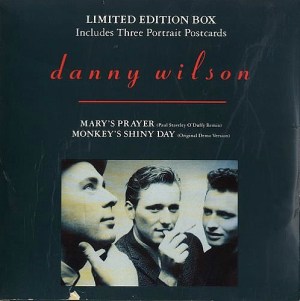
I would annoy my school friends bigging up the album and trying to get it played during art lessons – to no avail. U2, Simple Minds, The The, Fleetwood Mac and INXS couldn’t be usurped. But my enthusiasm was slightly justified when the gorgeous ‘Mary’s Prayer’ was finally a big hit at the third attempt (UK number 3, US number 23).
Danny Wilson shared a love of jazz, the Great American Songbook and Steely Dan with contemporaries Hue and Cry, Swing Out Sister, Sade and various other late-’80s acts, but (fortunately?) Meet Danny Wilson doesn’t sound remotely like any of them.
Gary graciously answered my questions in the middle of a very busy period of travelling, writing and recording. We talked about the inspiration behind the timeless ‘Mary’s Prayer’ single, hanging out with Billy Mackenzie, the golden age of Virgin Records and busking on transatlantic flights…
MP: Could you give a quick summary of how you started making music as Danny Wilson with your brother Kit (keyboards) and Ged Grimes (bass)?
GC: Ged was at school with me and clearly one of the most talented kids so we naturally gravitated towards each other and stayed together from the school band stage all the way through to Danny Wilson. Kit is my younger brother. When Ged and I returned from London we wanted to re-think the band and Kit, in our absence, had grown into a formidable musician, writer and singer so he was a natural choice to bring onboard.
What were the musical influences that went into the pot for Meet Danny Wilson? Any contemporary mid-’80s artists?
Well, I really found my voice as a writer when I stopped trying to sound contemporary. Ged and I spent three years in London living in a squat, gigging and trying to get a record deal and it seemed like the labels wanted us to sound like what was already on the radio at that time. If you can remember radio in 1984/85, everything was super- polished, super-quantised and very synthesised. Even guitars all tended to be layered in multi-effects. I very consciously decided to go in the opposite direction and return to my musical roots; all the music I loved was devastatingly unfashionable at the time. Off the top of my head, the main influences for that album were not contemporary at all: Sinatra, Bacharach and David, Jimmy Webb, Becker and Fagen, Tom Waits, a little bit of Hall and Oates, heavy dollops of the Great American Songbook and a ton of soundtrack records.
How did Danny write songs? Were all the tracks co-written or did you provide the blueprints?
I wrote all of the songs on that album and they were all written and mostly demoed prior to recording. The only exception I recall is finishing ‘Five Friendly Aliens’ at the piano in Puk studios after we’d started recording the rest of the album.
How did you come to be signed to Virgin? Were you fans of the label beforehand?
We played a gig in a bar in Edinburgh and a music journalist called Bob Flynn was there. He wrote a review in NME that literally changed our lives. The review was so good and the band were so unknown that the record labels who had systematically rejected us only months before were calling Bob asking how they could get in touch with the band. We had really served our time in the trenches live and in the studio so we were really ready for it when it came. The next gig we did in Edinburgh was packed and half of the audience were A&R and publishers from London. We literally had the choice of every major label and almost signed to Warners. In the end, a mixture of Virgin’s reputation as an artistic label, their sheer passion for the music and their willingness to give us complete artistic control won the day.
Can you remember your inspiration for ‘Mary’s Prayer’ and where you wrote it?
Yes, I wrote it in the squat in London quite a few years before it was released. My friend, the songwriter Ali Thomson, loaned me a Roland Juno 60 synth and I just switched on the first preset and immediately played the verse chords without thinking (they’re all white notes!). The melody and a large chunk of the first verse lyric came to me instantly. I liked it but couldn’t get a chorus that did the verse justice and it took about another year of me coming back to it until I finally hit on the chorus.
How did you come to include Lester Bowie’s Brass Fantasy on the album? Definitely not an obvious choice of special guests! Weren’t they signed to Virgin at the time?
They were signed to ECM. The Virgin connection came later through us. Howard Gray (later of Apollo 440) was producing the first half of our album at Puk. They had an incredible system in there and we liked to blast records on the big speakers at the start of the day and at the end of the night with some fine Elephant beers for refreshment. Digital was in its infancy and ECM were making some of the first records that could be legally labelled ‘DDD’ which meant ‘recorded, mixed and mastered without leaving the digital domain’. Howard played us Lester’s ‘I Only Have Eyes For You’ one of those nights as an example of how great this process could sound and we all fell instantly head over heels in love. By sheer mind-bending coincidence, we saw that Lester Bowie’s Brass Fantasy were playing Copenhagen when we were still in Denmark. We went to the gig, one of the greatest live shows I have ever seen, and accosted Lester afterwards. It’s a little-known fact that because of budget restrictions, Ged, Kit and I busked our fare on a very early Virgin Atlantic flight to New York so we could be there for the sessions! Pre-9/11, of course… But we actually got free flights for entertaining the passengers in mid-air.
Your amazing vocal on ‘You Remain An Angel’ always reminded me of The Associates’ Billy Mackenzie – were you a fan and did you know him at all?
Well, thank you. I’m a huge fan of Billy’s work but I can honestly say that The Associates were nowhere near my mind when we did that song. There is a B-side called ‘Living To Learn‘ that has a huge Associates influence. Billy and I are from the same home town, Dundee in Scotland, and I got to know him a little. We would all hang out at a place called Fat Sam’s cocktail bar where they played great music and had great live acts passing through. We saw some amazing bands in their infancy back then. Billy was always so wonderful, charming and encouraging to me.
Meet Danny Wilson has a really pleasing mix of acoustic instrumentation and late-’80s technology – was there any pressure to be ‘produced’ and make a very modern-sounding record? I have a B-side version of ‘Aberdeen’ that was subtitled something like ‘The Way It Should Have Been‘…
No. Virgin were great like that. I think they understood that we had just as much chance commercially by being true to ourselves as we would have had conforming to some blueprint of what radio sounds like. I wish that vision was more prevalent in the music business today. I will say that although we used the most up-to-date technology available at the time, we didn’t use it to sound modern but to get what was in our heads onto the recording. On ‘Aberdeen’, for instance, we used a Fairlight to get the trumpet and string sounds but the production is probably more ’60s in tone than ’80s. That B-side was an interesting one; we had made a very early stripped back Portastudio demo of that song before the album and it had a certain beatboxy charm that we all kind of harked back to. The tape was lost so that B-side was our attempt to recreate that vibe. Never a great idea!
How do you feel about Meet Danny Wilson and its place in the 1980s musical landscape now?
I feel pretty much the same as at the time. It’s very me, very honest, very heartfelt and, just like me, doesn’t fit in anywhere. Exactly what we were going for, I suppose.
What are you working on at the moment?
I’m always writing and recording with other artists. That’s what I do these days and have a whole heap of stuff in the pipeline but aside from that I’ve just written the music with John Carney (Once, Begin Again) for his next movie (‘Sing Street’) which I’m very, very excited about. As it happens, he got in touch with me because Meet Danny Wilson was a record his brother had turned him onto as a young kid growing up in Dublin in the ’80s. That neatly brings this interview to a lovely, rounded conclusion so I’d better shut up now!
Just for a few years at the end of the ‘80s, Hue and Cry bothered the charts with a classy fusion of pop, jazz and Latin.
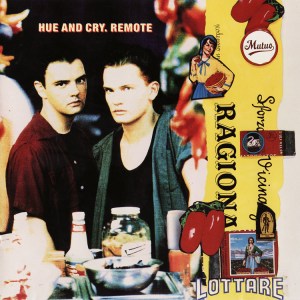
Singer/co-composer Pat Kane said at the time that they wanted to create a musical mix of Scritti and Sinatra; they almost pulled it off with the excellent Remote, released in December 1988.
They also pulled off the Steely Dan-ish trick of singing about subjects which might seem unsuitable in a pop context (domestic violence on ‘Looking For Linda’, corporate sexism on ‘Dollar William’, Latin-American poverty on ‘Three Foot Blasts Of Fire’, the dawning of the Web on ‘The Only Thing More Powerful Than The Boss’).
And yet something about Hue and Cry seriously wound people up. When they emerged on the scene in 1987, they rode a wave of goodwill thanks to their clean-cut looks, anti-Thatcher politics and dynamic ‘Labour of Love’ single.
But by the time of Remote, the tide was turning. Hue and Cry’s relatively soft, ‘aspirational’ sound was anathema in the bombastic late-’80s. It was too jazz for the yuppies and too pop for the jazz revivalists.
Maybe the fact that they’re brothers never helped too – The Proclaimers were the more acceptable face of Celtic brotherhood, more meat-and-potatoes, more reliably blue-collar.
In 1995, Q Magazine wrote a cruel but witty hatchet piece about them entitled Britain’s Most Hated Band, offering them ‘a crisp tenner’ to split up (it didn’t do the trick…). Whatever. I love this album. Recording Remote in New York gave the Kanes access to some amazing guest musicians – Ron Carter and Michael Brecker play beautifully on the very pretty ‘Where We Wish To Remain’, and Pat’s excellent vocals demonstrate a big Mel Torme influence.
The prime NYC rhythm section of Wayne Braithwate and Dennis Chambers supplies a 24-carat groove on ‘Three Foot Blasts’. ‘Sweet Invisibility’ puts a fantastically exciting Latin horn arrangement right upfront in the mix, beating David Byrne at his own game.
‘Guy On The Wall’ is a witty portrait of a perpetual party wallflower set against a ‘Word Up’ groove and brilliant Salsa horn arrangement. Bassist Will Lee delivers beautifully measured performances on ‘Ordinary Angel’, ‘Dollar William’ and ‘Looking For Linda’, offering a subtle commentary on the songs back in the days when a musical performance was supposed to have some narrative development and couldn’t just be ‘cut and pasted’ together.
It’s quite funny to hear legendary jazz trumpeter Jon Faddis play a stratospheric solo on the otherwise very soppy ‘Violently’ (though Michael Brecker very controversially ‘fixed’ his solo – see below…) Pat Kane sings well throughout the album, with great phrasing, inventive ad-libs and excellent melodies.
But YouTube live footage from the Remote era hasn’t aged well and demonstrates why they were such a Marmite band, all cheap suits and wacky horn sections. I saw them at the Hammersmith Odeon in 1989 and struggle to remember anything about the gig.
Even they seemed to sense which way the wind was blowing; they disappeared for far too long after Remote, issuing the stripped-down Bitter Suite live EP and disappointingly brittle Stars Crash Down in 1991. The momentum and recording budget had gone.
But because in the main they lent towards jazz and Latin rather than funk and soul, they avoided the all-too-audible mistakes of contemporaries like The Blow Monkeys, Style Council, Climie Fisher and Johnny Hates Jazz. A great video has emerged of the boys discussing the making of the album:








 movingtheriver.com