Joni Mitchell: Wild Things Run Fast 40 Years On

joni_mitchell-wild_things_run_fast(4)Joni entered the ’80s in a despondent state: ‘Everyone realised at the brink of the decade that it was going to be a hideous era…’, she reported to Q magazine.
It didn’t help that her beloved ’69 Bluebird had been stolen from outside Tower Records on Sunset Boulevard on New Year’s Eve 1979.

She was also sued by her cleaning lady and then found herself headhunted by old friend David Geffen for his new record label, though their relationship were never easy.

Then there were Thatcher and Reagan and a simmering Cold War. But Joni’s new songs avoided politics completely (she’d make up for that later). Instead, buoyed by her relationship with new bassist Larry Klein and beguiled by The Police and Talking Heads she was hearing on the radio, she produced possibly her most romantic, upbeat album to date, released 40 years ago this month.

But while there are some concessions to hard rock, new-wave and reggae, Wild Thing‘s best tracks are the ones that most closely resemble the shimmering, jazzy, almost psychedelic tracks of the mid-to-late-’70s.

Larry Klein and Joni, 21st November 1982

Larry Klein and Joni on their wedding day, 21 November 1982

It helped that many of her ’70s ‘repertory company’ were still in place at the dawn of the ’80s – singer James Taylor, percussionist Victor Feldman, drummer John Guerin, saxist Wayne Shorter and guitarist Larry Carlton.

Her new recruits were the new generation of hotshot session players: guitarists Mike Landau and Steve Lukather, keyboardists Larry Williams and Russell Ferrante, formidable ex-Zappa drummer Vinnie Colaiuta.

My point of entry for this album was superb lead-off track ‘Chinese Cafe/Unchained Melody’, the first music I’d ever heard by Joni. I was immediately a fan. It’s a moving meditation on love and loss with a haunting piano/bass motif and intricate Guerin drum part.

‘Be Cool’ and ‘Moon At The Window’ are classic Jazzy Joni. On the former, Klein stakes his claim as a worthy successor to Jaco while Shorter offers a witty, beautifully judged commentary on the latter. Klein in general gets a lot of space on the album – as much as Jaco got on Mingus – but he’s a totally different player (and doesn’t play fretless). His contributions make Wild Things one of the great bass records of the 1980s.

Larry Carlton plays a sublime accompaniment in the left channel on the elegant ‘Ladies’ Man’ (featuring more than a hint of Steely Dan’s ‘Third World Man’), while Joni surveys her lover’s ‘cocaine head games’ – one of several drug references on the album.

Some tracks are a curious but engaging mixture of hard rock and fusion – the title track, ‘You’re So Square’ and ‘Solid Love’ feature some dynamic, chops-infused interplay between Colaiuta and Klein, and it’s exciting hearing Joni pushing her vocals, singing with a lot of bite, though she probably should have left reggae well alone.

The closing ‘Love’ – appropriating Corinthians 13 11-13 – encapsulates all that’s good about Wild Things Run Fast: a beautiful vocal, superb and sensitive guitar playing from Steve Lukather and empathetic textures from Shorter and Colaiuta.

TourProgram83RefugeGroup

The 1983 touring band: Vinnie Colaiuta, Mike Landau, Joni, Larry Klein, Russell Ferrante

Joni toured Wild Things extensively with a band consisting of Colaiuta, Landau, Klein and Ferrante, dropping in to London’s Wembley Arena in 1983. Wish I had been there. Thankfully we have YouTube (see below).

The album was a minor hit, reaching #32 in the UK and #25 in the States, and the single ‘You’re So Square’ reached #47 in the US.

One’s appreciation of it probably depends on when you were born. People who adore Blue and For The Roses probably loathe this. But as my first exposure to Joni’s music, I hold it very dear.

Movie Review: David Bowie in ‘Moonage Daydream’ (2022)

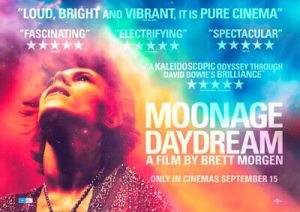
The hype for ‘Moonage Daydream’ is presenting it as a very different kind of David Bowie documentary (and music doc in general), and in some ways that’s true – it’s certainly ‘non-linear’ (which creates a few problems, as we’ll see later) and not yet another retelling of the Bowie story replete with talking heads (David alone ‘narrates’ the movie).

It’s undoubtedly best seen in the cinema, with its striking sound collages, surreal jump cuts and sometimes startling imagery taken from many sources, cult movies (including Canadian curio ‘Universe’, apparently also an influence on Kubrick and Lynch) to Hollywood’s golden age.

Director Brett Morgen is best known for his Kurt Cobain and Rolling Stones documentaries (neither of which your correspondent has seen), and apparently he got complete family approval to sift through countless hours of Bowie’s personal archive – though reportedly David was less than convinced by Morgen’s credentials/pitch when they met in 2007.

But Morgen has certainly got hold of some coups: there’s madly exciting, previously unseen DA Pennebaker footage from the Earls Court and Hammersmith Odeon Ziggy gigs in 1973, including Jeff Beck’s guest spot on ‘Jean Genie/Love Me Do’ – what a thrill to see him trading licks with Mick Ronson.

There’s also some terrific David Hemmings-directed 35mm Earls Court footage from 1978, and you’ll be doing well if you don’t get a lump in the throat during ‘Heroes’ (when is the complete footage finally going to get a proper release?). Then there are tantalising glimpses of Bowie’s many paintings and some intriguing footage from his mid-1970s video experiments. Morgen also borrows large sections of Serious Moonlight tour curio ‘Ricochet’ and ‘The Man Who Fell To Earth’.

But the film really comes into its own with its sound design. Tony Visconti has donated audio stems from Bowie’s studio masters so there are interesting reversions of material like ‘Ashes To Ashes’, ‘DJ’ and ‘Absolute Beginners’. I almost cheered when Dennis Davis’s ‘Sound And Vision’ groove exploded into action and it’s a delight hearing Rob Sabino’s solo’d piano from ‘Modern Love’.

But there are issues with ‘Moonage Daydream’. The frenetic editing sometimes leads to jarring moments. If you were being kind you’d say it was ‘non-linear’, if you weren’t you might say it was completely random. Again, not a problem in itself, given Bowie’s use of cut-up techniques and mistrust of linear narratives by the mid-1990s.

Then there are the obvious omissions/Morgen’s perceived irrelevances. Tin Machine isn’t mentioned by name, nor are there any images of the band. In fact the period of 1989-2005 is scarcely covered, save for some interesting outtakes from Samuel Bayers’ videos from that time, some footage from Bowie’s 50th birthday concert and a section on his marriage to Iman.

There is a fairly lengthy exploration of his family background, suburban upbringing and half-brother Terry Burns, though very little about his early Mod days and art-school contemporaries. And Bowie purists may be troubled (well, I was!) by the use of the Pet Shop Boys remix of ‘Hallo Spaceboy’ rather than the original to kick off the film.

Of course the question is, if you’re a big Bowie fan – and I presume you are if you’ve read this far – do you need to see ‘Moonage Daydream’? I’d say a qualified ‘yes’… But ultimately it’s still like a very expensive-looking YouTube greatest hits, with many bits of familiar interview footage and a lot of previously seen live stuff. But even that is a thrill to see on the big screen with good sound. Is the film pretentious? Of course, but that was never a criticism for Bowie. He even described his collaborations with Brian Eno as ‘the new school of pretension’…

Further reading: ‘Sight & Sound’ October 2022

What Is The Ultimate 1980s Floorfiller?

Here’s a quandary. If you had to choose one 1980s song to get people on the dancefloor – maybe you’re the last-minute guest DJ at a wedding disco – what would you go for?

The track probably needs a few things going for it:

1. A great intro – a ‘call to arms’.

2. Cross-generational appeal, one for the kiddies and grandparents alike.

3. It has to be a total hit – no cult favourites.

4. Loudness and ‘impact’.

5. It’s probably ‘pop’ and pretty genre-less – no heavy metal or R’n’B.

6. A soundtrack hit might be good – something from a John Hughes joint or ‘Dirty Dancing’?

7. A flavour of the ‘novelty’ hit/one-hit wonder might help.

In his (great) book ‘Nothing Is Real’, David Hepworth comes up with five ultimate floorfiller contenders including two from the 1980s: Brucie’s ‘Dancing In The Dark’ and Madonna’s ‘Open Your Heart’. Both choices strike this correspondent as a little odd. Rather I’d posit the following (feel free to chime in with any omissions):

Michael Jackson: ‘Billie Jean’

Prince: ‘Kiss’

Dexys Midnight Runners: ‘Come On Eileen’

Simple Minds: ‘Don’t You Forget About Me’

Toni Basil: ‘Mickey’

Musical Youth: ‘Pass The Dutchie’

Roxy Music: ‘Same Old Scene’

Cyndi Lauper: ‘Girls Just Wanna Have Fun’

Bill Medley/Jennifer Warnes: ‘(I’ve Had) The Time Of My Life’

De La Soul: ‘Say No Go’

Young MC: ‘Know How’

Wham!: ‘Wake Me Up Before You Go-Go’

Human League: ‘Don’t You Want Me’

ABC: ‘Poison Arrow’

Madonna: ‘Into The Groove’

But the one 1980s track I’d choose to get people onto the dancefloor is…

David Bowie: ‘Let’s Dance’

I’ve rounded up most of these and some others into a playlist. Happy groovin’.

Book Review: Elegant People (A History of the band Weather Report) by Curt Bianchi

‘The baddest shit on the planet’ – that was Weather Report keyboardist/co-founder/chief composer Joe Zawinul’s assessment of his band’s music.

He wasn’t alone – many credit them as the greatest jazz/rock unit in history, pretty impressive considering they developed out of a ‘scene’ that also included The Mahavishnu Orchestra, Return To Forever and Herbie Hancock’s Head Hunters.

Curt Bianchi has run the acclaimed Weather Report Discography website for many years and now expands his study to create the excellent ‘Elegant People’, an elaborate history of the band which features a myriad of exclusive interviews, photographs and information.

It has Brian Glasser’s effective Zawinul biography ‘In A Silent Way’ in the rear-view mirror but emerges as a very different proposition. Bianchi initially looks in detail at the formative years of Zawinul and co-founder/saxophonist Wayne Shorter, with sobering tales of the young Zawinul’s experiences in wartime Vienna and fascinating insights into Shorter’s extended periods in the bands of Maynard Ferguson, Art Blakey and Miles Davis.

The sections on Weather Report’s formation around 1970 are fascinating. Columbia’s marketing of them as a ‘progressive’ – rather than ‘jazz’ – band led to some interesting dichotomies; Shorter and Zawinul were already established superstars in their field but often had to engage in fairly menial/minor promotional work just to get a foot in the door with rock audiences. We also learn about the other potential band names that hit the cutting-room floor before ‘Weather Report’ appeared.

Bianchi then expertly traces the group from those early days as a kind of ‘chamber’ jazz/rock unit to their status as a ‘power band’ around the arrival of bassist Alphonso Johnson and drummer Chester Thompson in 1975, and the subsequent boost with the recruitment of Jaco Pastorius and Peter Erskine.

Bianchi brings the albums to life with great gusto. There’s a rare photo from the Night Passage sessions at The Complex in Los Angeles, and the last-ever photo of the Jaco/Erskine band taken at the Power Station in NYC, with Jaco almost a ghost at the back of the shot (shades of that famous final Syd Barrett photo with Pink Floyd). Elsewhere there are ticket stubs and even session track sheets.

And fans of Weather Report’s 1980s music can rest assured that Bianchi doesn’t give that era short shrift – there’s almost as much about the last few albums Sportin’ Life and This Is This (and many of Zawinul and Shorter’s post-Weather Report projects) as there is about commercial breakthroughs Black Market and Heavy Weather.

So ‘Elegant People’ is surely the ultimate Weather Report book – it’s an absolute must for fans and those wanting a deeper dive into the band’s music.

It Bites: Live In London

The classic It Bites lineup (Francis Dunnery, John Beck, Richard Nolan, Bob Dalton) produced three excellent studio albums and of course snared one huge UK hit in the shape of ‘Calling All The Heroes’.

Then, after the band split in 1990, there was the middling best-of live collection Thankyou And Goodnight. But now there’s an excellent new limited-edition 2018 boxed set called Live In London.

It collects three complete, unedited London gigs (I was at two of them) over five CDs, including their very last major show in the capital. Whilst these are essentially desk recordings, the sound quality ranges from good to excellent. The set also features nice, previously unseen photos and some good liner notes including a long interview with Dalton, telling of their London history and details of each gig.

The Marquee concert from 21 July 1986 (at less than 40 minutes, presumably a support?) catches the band in their full-on, zingy, poppy/funky early pomp. Everything sounds a little fast and they haven’t quite settled into their groove yet but it’s still a good listen. There’s a shrill early version of ‘Black December’ and a great, rare outing for ‘Whole New World’ with Dunnery playing the horn lines on lead guitar with some aplomb.

Next is the very tangible peak of the band, a Once Around The World tour gig from 13 May 1988 at the much-missed Astoria. The sound is beefy, the tempos locked in, the backing vocals excellent and this really is the dog’s bollocks. There’s so much evidence of craft, with an extra note here and lick there, always slightly modifying the album versions.

‘Plastic Dreamer’ is a revelation, ‘Black December’ is huge, and ‘Old Man & The Angel’ ambitious and exciting. We finally get to hear what Dunnery sings in ‘Hunting The Whale’. The ‘Midnight/Wanna Shout’ medley is a knockout, complete with ‘Purple Haze’ coda, and Once Around The World’s title track is brilliant, complete with excerpt from ‘New York, New York’ which chimes rather cleverly with Dunnery and Beck’s Lamb Lies Down On Broadway fixation.

The third gig is the band’s final London show, from the Hammersmith Odeon on 7 April 1990. The intro sounds like something from Prince’s Lovesexy. The new songs sound great, ‘Let Us All Go’ is superb but Dunnery’s voice is pretty shot throughout, and some of the backing vocals are also showing signs of strain. In truth you can hear the schisms in the band developing, though there are many, many great moments.

Barely two months later Dunnery had left the group. Not long after that, this correspondent would see him skulking around the King’s Head pub in Fulham (he was rehearsing upstairs with Robert Plant, I was gigging there), not looking a particularly well or happy man. Thankfully he’s on a far more even keel now.

Live In London is a really exciting release, a must-have collection for anyone who owns any of the studio albums, and arguably a much better package than Thankyou And Goodnight.

Frank Zappa: 1988

Here’s a panacea for these mad times – spend a few weeks drilling down into the music released from Frank Zappa’s (final) 1988 tour.

It was a vision of modern America and a goodbye to ‘rock’; rather, FZ dealt with country, musical theatre, marches, TV/film themes, early ‘60s jazz, hymns, modern classical, reggae. In contemporary interviews he professed an admiration for Prince, who was also pretty much rejecting ‘rock’ in 1988.

The band had four months of intensive rehearsal, and you can hear it. He got the horn section doing things horn sections don’t normally do, playing lines from ‘The Untouchables’ or a Bartok piano concerto.

Some of rock’s sacred cows – Johnny Cash, Hendrix, Clapton, Led Zeppelin, Elvis – were in the firing line, as were the right-wing Christian fundamentalists running for US presidency in 1988. In fact, anyone restricting his right to speak freely (he cited that his politics were neither intrinsically left nor right-wing). He encouraged fans to register to vote at the shows and also incorporated snippets of daily news (‘confinement loaf’, Jimmy Swaggart etc.).

There were spectacular reimaginings of his old work and a cadre of new cover versions, including ‘Stairway To Heaven’ and Ravel’s ‘Bolero’. There were good, new, sometimes stoopid songs with political lyrics and disarmingly brilliant musical flourishes. The epic ‘Jesus Thinks You’re A Jerk’ became a kind of an epitaph: ‘I hope we never see that day/In the land of the free…And if you don’t believe by now/The truth of what I’m telling you/Then surely I have failed somehow’.

Though the gigs took place in big arenas, there was forensically superb musicianship and also lots of room for improvisation, areas where no one knew exactly what was going to go down. Zappa would set the Synclavier running with random ‘events’ and see how the band responded.

The tour made it down the East Coast of the US and to Europe. I saw the first night at Wembley Arena in April 1988 – an absolute revelation. But sadly the West Coast US leg was cancelled. Some say bassist Scott Thunes became persona non grata, others pointed to Zappa’s health and the huge outlay of the tour. The truth is probably somewhere inbetween. The various views are outlined in Andrew Greenaway’s book ‘Zappa The Hard Way’.

Watching the few bits of tour footage (from Madrid and Barcelona) is interesting – not always an easy watch and apparently neither were particularly good nights on the European tour. But one somehow forgets that Zappa chiefly saw himself as a COMPOSER, and there he is conducting the band through all the instrumentals. He didn’t leave the stage like Miles. Nor did he fine musicians if they screwed up, JB-style, but meticulously ‘comp’d’ only the best performances for any released work from the tour (and often incorporated ‘mistakes’ into a song’s arrangement).

Still, some will just take against Frank’s music – understandable, but it’s their loss. Paraphrasing Ian Penman’s famous hatchet piece: ‘Listen to this stuff quietly because you don’t want your neighbours to hear you listening to this kind of stuff’ – I beg to differ. Play most of this stuff boldly and proudly, because it’s more interesting, more challenging and funnier than 90% of other contemporary music.

Check out the complete albums taken from the tour – Broadway The Hard Way, The Best Band You Never Heard In Your Life, Make A Jazz Noise Here – or I’ve put together a 1980s Zappa playlist which fillets my favourite moments (OK, even I can’t take ‘Planet Of Baritone Women’ or ‘Elvis Has Just Left The Building’…).

Further reading: ‘The Big Note’ by Charles Ulrich

‘The Complete Frank Zappa’ by Ben Watson

David Sanborn: Hideaway

It’s no coincidence that alto saxist/composer David Sanborn’s purple patch (1980-1982) came about just when genres (yacht rock, soul, funk, jazz, R’n’B) were breaking down to create one of the most egalitarian musical eras.

Hideaway, his fifth studio album, was the breakthrough, and I love it. Released in February 1980, it made #2 on the Jazz chart, hung around in the Urban Contemporary charts for over a year and was nominated for a Best R&B Instrumental Performance Grammy.

For some, Sanborn’s solo material will always be ‘smooth jazz’, but I’d point to four aspects of his music that elevate it above similar material, particularly on Hideaway – his tone and his note choices, both born of the ‘50s and ‘60s St. Louis jazz and R’n’B scenes; his writing; and also the playing of top-notch guests. On Hideaway, the stars are drummer Steve Gadd (Gadd fans, this is the album for you), bassist Neil Jason and keyboard player Don Grolnick.

The title track remains a classic. Sanborn lays down rich Fender Rhodes soul chords while Gadd constructs a perfectly judged post-disco drum part heavily involving cross-stick and floor tom, laying just behind the beat, with an unexpected, explosive fill just before the fade. Jason is given free rein and comes up with an outrageous bass performance.

Hideaway also benefits from Steely/Doobies man Michael McDonald co-writing two tracks. Sanborn doesn’t have anything much catchier than ‘Anything You Want’ and ‘Again An Again’ in his repertoire. ‘Carly’s Song’ and ‘Lisa’ are memorable ballads with beguiling harmony, while Gadd provides another brilliant commentary on ‘If You Would Be Mine’.

Rick Marotta appears to expertly marshal ‘Creeper’ through its slow half-time groove – guitarist and frequent Sanborn collaborator Hiram Bullock was so taken with it he later wrote a sequel called ‘Son Of Creeper’.

Hideaway’s packaging helps too – its minimalist cover is a winner, as is the photo featuring Dave reclining in his apartment with a Magritte over his left shoulder and paramour draped over his right. Warner Bros. were just realising he wasn’t the worst looking guy in the world.

The only downside: in a classic bit of Warners penny-pinching, they add the very dull (and certifiably smooth-jazz) ‘The Seduction’ from the ‘American Gigolo’ soundtrack to the streaming and CD versions but in the process edit down ‘Anything You Want’ and the title track to ‘single’ length. Best try to find Hideaway on vinyl.

The Essential Nik Kershaw

Universal’s Nik Kershaw CD re-release program seems to have stalled after Human Racing and The Riddle emerged around ten years ago, a pretty scant return considering he spent more weeks on the UK singles chart during 1984 and 1985 than any other solo artist.

And though all four of his MCA albums are now on streaming platforms, there’s still no sign of decent physical versions of Radio Musicola or The Works (and absolutely nothing on vinyl yet), so we’ll have to make do with Essential Nik Kershaw, a new budget 3-CD compilation which, confusingly, has the same title as a similar one-CD comp that came out in 2000.

Back when his four 1980s albums were basically unavailable, Kershaw fans had to make do with fairly crappy CD compilations, so it’s a relief to report that this one’s pretty good. It’s two discs of original album tracks/singles plus one of remixes.

The good stuff first: the remastering is absolutely first-rate. The tracks have punch and not too much bass, usually the first sign of an overzealous tinkerer. The design is attractive, and the digipack very light but very solid.

There are a few decent B-sides I’d never heard: ‘When I Grow Up’ circa The Works could easily have been a single, and certainly should have appeared on the album. Instrumental ‘One Of Our Fruit Machines Is Missing’ gives the Chick Corea Elektric Band a run for their money in terms of insanely technical jazz/fusion.

Now for the not-so-good stuff: the track order is random, certainly not chronological, and there are songs missing that most fans would say are among his greatest: ‘Easy’, ‘City Of Angels’, ‘Walkabout’, ‘Lady On The Phone’, ‘LABATYD’, ‘Violet To Blue’.

The disc of remixes is a slog to get through, but it’s worth hearing ‘One Step Ahead’, ‘Radio Musicola’ and ‘Don Quixote’. There are also zero musician/producer credits and no liner notes.

But Essential Nik Kershaw a very good entry-level compilation and a treat to acknowledge again just how high the quality threshold was with this guy. I’ve also developed a real penchant for some material from the first album which I’d earlier dismissed, especially ‘Bogart’.

In recent interviews, both his engineer/mixer Julian Mendelsohn and keyboard player Andy Richards rate Kershaw as top of the list in terms of musical talent, pretty special when you consider the two have worked with Trevor Horn, Yes, George Michael, Level 42, Prefab Sprout and Paul McCartney.

(Mendelsohn also revealed that, much to producer Peter Collins’ annoyance, he spent a whole WEEK mixing ‘Know How’, so highly did he rate the track. His work definitely paid off…)