David Sanborn: A Change Of Heart 30 Years On

On 17 July 1986, Tampa-born sax great David Sanborn broke off from a European tour to guest with Miles Davis and band at the Montreux Jazz Festival.

Though obviously nervous, Sanborn acquitted himself well, getting stuck in with some tasty modal solos and prompting many Miles smiles. Hopefully the performance would bode well for Sanborn’s next studio recording.

Unfortunately not. Sanborn made some fine albums during the 1980s – Hideaway, Voyeur, As We Speak, Straight To The Heart – but A Change Of Heart was not one of them. It was the kind of over-produced, under-composed, unfunky ‘fusion’ record that Tutu should have killed off once and for all.

I bought it on cassette when it came out, proudly showing it off to a cool family friend who had previously introduced me to loads of great music. I hoped he would be impressed by my purchase. He turned his nose up, mumbling something about ‘Bloody muzak…’ Harsh but fair, at least when it comes to most of A Change Of Heart.

The opening two Marcus-written-and-produced tracks – ‘Chicago Song’ and ‘Imogene’ – deliver a quality that the rest of the album never even remotely approaches. Miller was in constant demand around this time and presumably couldn’t commit to the whole album. ‘Imogene’ is a classic ballad with a haunting fretless bass melody and beguiling bridge, while ‘Chicago Song’ transcends its simple melody with an irresistibly funky rhythm section and biting Hiram Bullock guitar bridge.

The rest of A Change Of Heart seems designed for the latest Don Simpson movie or an episode of ‘Miami Vice’. Syndrum overdubs and unsubtle Fairlight samples prevail alongside ugly synth sounds and flimsy melodic motifs, without a whiff of jazz or R’n’B. Producer/synth players/writers Ronnie Foster, Philippe Saisse and Michael Colina toil away fruitlessly and even Sanborn’s licks don’t stick.

Sanborn toured A Change Of Heart extensively with a great band featuring Bullock and Dennis Chambers on drums, even popping up on primetime UK music show ‘The Tube’ playing Michael Sembello’s smooth-jazz ballad ‘The Dream’. He was clearly at his commercial peak (the album made the top 100 in the US and UK) but the creative rot would prevail to the end of the ’80s. He got back on track with the release of 1991’s Another Hand.

Steve Khan’s Backlog: Interview & Album Review

backlog_esccov_hires600Steve Khan, one of jazz’s most underrated and distinctive guitarists, made two fine fusion albums during the 1980s: Eyewitness and Casa Loco.

His unique chord voicings, intriguing melodic sense and subtle use of effects have also illuminated work by The Brecker Brothers, Steely Dan, Billy Cobham and Joe Zawinul.

Khan’s other solo albums across a 40-year career showcase his enormous versatility, from overdubbed guitar tributes to Thelonious Monk (Evidence) and jazz trios (Headline, Let’s Call This) to large fusion ensembles featuring the likes of Steve Gadd, Don Grolnick, Michael Brecker and David Sanborn (The Blue Man, Arrows).

Khan has also become well known as a master-interpreter and reharmoniser of non-guitar jazz compositions by the likes of Andrew Hill, Herbie Hancock, Wayne Shorter, Ornette Coleman, Lee Morgan and Randy Brecker. His new collection Backlog, the third in a Latin Jazz triptych following Parting Shot (2011) and Subtext (2014), continues to plunder the songbooks of his favourite composers.

steve_khan

The album kicks off with the killer one-two of Monk’s ‘Criss Cross’ and Greg Osby’s ‘Concepticus In C’. The former is inspired by the late great pianist Kenny Kirkland’s Latin version which first appeared on his fine 1991 debut album.

Says Khan, ‘It’s a wonderful arrangement and so good that it’s hard to escape its influence. It took me years to find a way to do the tune in a way where I could put my own stamp on it. As everyone already knows, I love Monk’s compositions and have recorded many of them. I happen to feel that Monk’s tunes have a way of fitting into a Latin context, as if they were made to be interpreted in that style.’

The Osby tune was played by Khan during their tenure together in the New Sound Collective band; the guitarist clearly relishes arranging his version of ‘Concepticus’ on Backlog, adding a funky Joe Zawinul flavour to the tasty harmonies and quirky rhythmic concept.

‘Latin Genetics’, composed by Ornette Coleman and first appearing on his In All Languages album, features a fine guest spot from Randy Brecker on trumpet.

On first listening, it seems a light, almost joyous piece of music, but Khan has a different take on it: ‘It’s funny to me that people see this tune as being so happy – I actually see it as a rather dark piece of music, one with many sinister and even humorous qualities.’

Backlog‘s other Coleman cover version is ‘Invisible’, featuring Bob Mintzer on sax, originally recorded in 1958: ‘It comes from one of his earliest albums, Something Else!!!!, featuring an acoustic piano,’ says Khan. ‘Every time I hear this tune, I feel that Ornette’s playing and improvisational concepts are a bit constricted by having the chord changes applied so literally. There seems to be an absence of space. So, in my interpretation, though there are chord changes, both Bob and I play pretty much unaccompanied, and that’s really how I like it.’

Elsewhere on Backlog, Khan reimagines the music of Stevie Wonder, his father Sammy Cahn, Johnny Mandel, Bobby Hutcherson and Andrew Hill.

Clearly a labour of love, Khan wonders whether it will be his final album: ‘When I recorded Parting Shot, for reasons of the health and condition of my left hand, I thought that was going to be the final album. Then when I decided that I felt well enough to record Subtext, I was even more certain that that would be the final album. But, as 2015 unfolded, I came to the simple conclusion that I just do not feel alive unless I am creatively involved in the formation of new music. So, while I can still do it, I had to do everything possible to record. Can I foresee ever being able to self-finance another recording of my own again? I don’t want to utter the word “never” in conjunction with such a thought, but honestly, I really don’t know. With the release of any new piece of work, there is always hope for better days and better times, but this remains to be seen…’

Backlog is out now on ESC/Tone Center.

Read the full interview with Steve at his website.

Lou Reed: The Blue Mask 35 Years Old Today

61doi8e-mvl-_sl1050_Humour: it’s not something often associated with Lou Reed, even though he filled up much of 1978’s Live: Take No Prisoners with breakneck Lenny Bruce-style banter.

But a listen to ‘The Gun’, ‘Underneath The Bottle’ or ‘Waves Of Fear’ from The Blue Mask – released 35 years ago today – always cheers me up; there’s just something so uncensored, unapologetic and even cathartic about his worldview, and of course an element of ‘there but for the grace of God…’

Newly married to Sylvia Morales (who also designed the striking album cover), recently clean and apparently the happiest he’d ever been, the more extreme cuts from the album seem to point towards some of the sacrifices Reed had made for this new life, and/or the fears that it could all go pear-shaped at any moment. Maybe falling in love just scared the hell out of him.

He had put together possibly the finest band of his career (Robert Quine on guitar, Fernando Sanders on bass, Doane Perry on drums). Gone were the perky, ‘funky’ tones of 1980’s Growing Up In Public – now it was time to return to two guitars, panned hard-left and hard-right, voice, bass and drums. The whole album has a gorgeous, ambient mix – Rudy Van Gelder would have approved.

‘Women’ is magnificent – Sanders plays some charming countermelodies on fretless while Lou eulogises: ‘A woman’s love can lift you up/And women can inspire/I feel like buying flowers and hiring a celestial choir/A choir of castratis to serenade my love/They’d sing a little Bach for us and then we’d make love.’

‘Waves Of Fear’, a coruscating portrait of alcohol DTs, plays out like a deleted scene from ‘The Lost Weekend’. In the extended outro, as Reed riffs viciously, Quine’s manic solo flaps around like a dying fish. ‘Underneath The Bottle’ also focuses on the booze to gripping and sometimes amusing effect: ‘Things are never good/Things go from bad to weird/Hey, gimme another scotch with my beer.’

The title track is a Burroughsian jaunt through torture, pain and self-loathing, while ‘The Gun’ seems to represent the worst possible situation between a man and woman: ‘A man…carrying a gun/And he knows how to use it/Nine millimetre Browning/Let’s see what it can do/Tell the lady to lie down/I want you to be sure to see this,’ croaks Lou over a gentle two-chord vamp and superb Sanders bass.

‘Average Guy’ brings back the lightness, a mock-heroic look at Lou’s new life: ‘Average in everything I do/My temperature is 98.2.’ ‘The Day John Kennedy Died’ is a classic piece of modern Americana, a fable of lost innocence: ‘I dreamed I was young and smart and it was not a waste/I dreamed that there was a point to life and to the human race.’

‘No redemption, no salvation… My characters just squeeze by’, Reed told the NME in 1983. Dylan rates him as one of the great lyricists and The Blue Mask offers many reasons why. The band sounds pretty damn great too but was sadly short-lived – apparently Lou couldn’t stand Perry who fled to Jethro Tull pretty soon after the recording. Quine lasted a little longer but was also soon on his way.

The Blue Mask only reached number 167 on the US album chart and didn’t even register in the UK – a pretty dire state of affairs for such an influential artist. The ’80s were not going to be easy on Lou.

John Scofield: Blue Matter 30 Years On

scofield

Occasionally a musician appears out of nowhere, ‘fully-formed’, or at least it can seem that way during one’s formative years.

In my lifetime, there have been a few: Lewis Taylor, Omar Hakim, Trilok Gurtu, and probably a few more. Drummer Dennis Chambers, who plays brilliantly throughout Blue Matter, would definitely be one too.

My muso schoolmate Jem Godfrey had lent me John Scofield’s superb Still Warm album sometime around 1986. Before then, I knew John’s playing mainly from Miles Davis’s Star People, one of my mid-’80s favourites.

So when the Steve Swallow-produced Blue Matter dropped in early ’87, I was primed and ready – and instantly gripped.

The presence of Hiram Bullock’s rhythm guitar on three tracks gives a good indication of Scofield’s approach on this album – it’s R’n’B/funk-based jazz/rock, with great grooves, neat chord changes and no gratuitious displays of instrumental technique for technique’s sake – though Scofield and Chambers were of course quite capable of some serious chops, evident on the killin’ ‘Trim’.

The dynamic title track is clearly influenced by Miles/Marcus Miller’s ‘Tutu’ with its half-time groove, walking synth bass and enigmatic chords, but Chambers’ brilliant contribution (closely monitored by the excellent Gary Grainger on bass) transforms it into something totally new.

In the first minute of the tune, he achieves a novel ‘bouncing ball’ snare drum effect and then unleashes some of the most kick-ass kick-drum playing in music history.

Chambers had already turned some heads playing with George Clinton, but, even if he had never picked up the sticks again after 1987, ‘Blue Matter’ would probably have put him right up in the drum pantheon.

‘Heaven Hill’ – named for Sco’s favourite brand of bourbon – a slow blues with surprising chord changes and tasty gospel-tinged piano playing by Mitch Forman, influenced a whole host of ‘fusion’ guitarist/composers such as Robben Ford, Scott Henderson and Frank Gambale (compare it to Henderson’s ‘Slidin’ Into Charlisa’).

‘Now She’s Blonde’, ‘Time Marches On’, ‘The Nag’ and ‘So You Say’ manage to be both funky and catchy while retaining enough harmonic interest and ‘dirt’ to go way beyond the smooth jazz tag.

The Blue Matter band got quite a live following around this time, with good reason. They were somewhat of an antidote to the Chick Corea Elektric Bands and Al Di Meolas of this world, as musically jaw-dropping as those artists were/are. Scofield himself acknowledged as much during an interview with Howard Mandel in 1988:

‘What I hate about fusion music is the gymnastics. We are often playing to audiences who want to hear fast and loud and I have to watch myself. I’ve never been that good at doing fast stuff. Luckily, it doesn’t come easy to me. Now, Dennis Chambers is a chops phenomenon. On his solos, he destroys the drums. But he also has inbred musicianship, so it’s exciting and not so calculated…’

XTC: English Settlement 35 Years Old Today

r-1455277-1313625163-jpegVirgin Records, released 12 February 1982

Produced by Hugh Padgham and XTC

Recorded at The Manor, Oxfordshire, October/November 1981

Working titles: Rogue Soup, Motorcyle Landscape, World Colour Banner, Explosion Of Flowers, Knights On Fire

Album Chart position: #5 (UK), #48 (US)

Singles released: ‘Senses Working Overtime’ (UK #10)
‘Ball And Chain’ (UK #58)
‘No Thugs In Our House’ (did not chart)

Andy Partridge (vocals, guitar, keyboards, percussion, co-composer): ‘We spent the summer of 1981 rehearsing at Terry “Fatty” Alderton’s Tudor Rehearsal Studio and it was very sweaty. All the Swindon heavy rock bands would rehearse there, drink cider and piss in the corner. Terry (Chambers) had forgotten how to drum. He had spent the early summer working on a building site and when he set up his drum kit it was more like scaffolding. He was just useless (but apparently improved pretty quickly… Ed.). I forced him to buy a new snare drum and timbale. I bought a Yamaha acoustic. It opened up possibilities for new sounds where the live arrangements mattered less. I’d become unhinged a couple of times on tour and wanted a break. The album cover (by Ken Ansell)? I think it was just that we were fascinated with the Uffington Horse. The Americans thought it was a duck…’

Dave Gregory (guitar, keyboards, backing vocals): ‘I’d always dreamed about owning a 12-string Rickenbacker but it had seemed like a frivolous folly until now. I fell totally in love with the sound. English Settlement was a watershed record for us. We’d made a couple of guitar records and then the acoustic side came out. It was definitely a progression. There weren’t too many songs, just not enough time…’

Colin Moulding: (vocals, bass, keyboards, percussion, co-composer): ‘I bought a fretless bass. I thought it would fit in with the acoustic stuff we were doing but it was impossible on tour. You have to have a flair for playing something without frets and I haven’t. As soon as the lights went out…the rest is history…’

For much more info on English Settlement, check out Neville Farmer’s book ‘XTC Song Stories’.

Wayne Shorter: Phantom Navigator 30 Years Old Today

wayne sh

In the late-’80s, Wayne was seemingly about as far away from ‘jazz’ as it’s possible for a jazz legend to get.

His music hadn’t featured any tinging ride cymbals or walking acoustic basses for decades. Even Miles thought Wayne was getting a bit too ‘far-out’ – he reportedly told the saxophonist as much when they met backstage during Miles’s Paris tribute show in July 1991.

Which must have come as quite a shock to Wayne – after all, his ’80s music featured strong, ‘funky’ grooves and attractive, happy melodies. On the face of it, albums like ’87’s Phantom Navigator (apparently inspired by the ‘Other Worlds’ sci-fi comic series he drew in his teenage years) weren’t that different from Miles’s Tutu and Amandla.

But of course they were completely different, and Phantom Navigator is probably the most ‘far-out’ collection of Wayne’s solo career.


Many critics couldn’t see beyond the drum machines, bass vamps and synths, missing the complexity of the arrangements and incredible care and attention that went into making the album, though maybe Wayne was asking for trouble by recruiting legendary NY beat-maker Jimmy Bralower, who had recently featured on Steve Winwood’s ‘Higher Love’ and Nile Rodgers’ B Movie Matinee.

wayne-shorter_in_amsterdam_1980

But these elements were just ‘sweeteners’ – Phantom Navigator was designed to be lived with, devoured in long stretches as one would a classical piece.

There were so many good melodic ideas packed into every tune but it wasn’t an album for short attention spans – not ideal in the MTV-flavoured, thrill-a-minute late-’80s.

‘Condition Red’ fairly bursts out of the speakers, with Wayne’s hair-raising soprano (I’d posit that Phantom Navigator features the best soprano tone of his career), sublime harmonies and witty scat vocals.

Chick Corea’s crystalline piano features strongly on the intricate, beguiling ‘Mahogany Bird’, while ‘Remote Control’ taps into a go-go groove (though Bralower’s snare is way too big – where was Ricky Wellman when Wayne needed him?) underpinning rich, endlessly-flowing soprano harmonies.

Side two’s triptych of ‘Yamanja’ (named for a sea goddess of Brazilian legend), ‘Forbidden – Plan-It!’ and ‘Flagships’ are nothing less than mini concertos for soprano sax, electric bass and synths. All would work fine with a symphony orchestra with their endlessly intertwining lines and countermelodies.

Wayne toured a lot during this period (I think I saw him three times in London between ’85 and ’88) and to a certain extent the music was a hard sell, both for audiences and the musicians. His sci-fi fusion stuck out like a sore thumb during the late-’80s London jazz/rare-groove revival when he was sometimes put on the same bill as people like The James Taylor Quartet and Gilles Peterson! I remember a really weird such gig at the old Town & Country Club in the late ’80s.

It’s the same old story – the problem of marketing music that goes way beyond category. But, in the final analysis, Wayne doesn’t play jazz, rock, go-go, funk or soul on Phantom Navigator – he plays life.

Bill Bruford: Earthworks @ 30

earthworks

Some musicians have a unique touch – you can identify them within a few notes.

In Bill Bruford’s case, his snare drum is his main audio imprint. But he also always had a highly-original composing style before his retirement in 2009, and both are very much in evidence on the excellent Earthworks album.

Bruford had spent the mid-’80s winding down Crimson and duetting with ex-Yes keyboardist Patrick Moraz, mostly in spontaneous improvisation mode, but now a new musical approach was called for.

He had based his career on defying expectations and he did it again in 1986, forming a quartet made up two young jazz tyros best known for their work in big-band-extraordinaire Loose Tubes (keys man Django Bates and saxist Iain Ballamy) plus acoustic bassist Mick Hutton.

bruford-inside

Bruford chose well: Bates and Ballamy were excellent and prolific composers too. Also key to this new band was Bruford’s development of a very advanced electric/acoustic kit whereby he could play chords and melodic ideas alongside a ‘standard’ jazz setup.

This approach also chimed well with Bates’ propensity on both acoustic piano and synth. On the latter instrument, he was fast becoming almost as recognisable as Jan Hammer, Joe Zawinul, Chick Corea or George Duke.

All the ingredients add up to one of the key British jazz albums of the ’80s, showcasing a band equally at home playing Weather Report-style fusion, Eastern themes and odd-time prog as they were with ECM-flavoured chamber jazz of the type played by obvious heroes Kenny Wheeler and John Taylor.

Ballamy’s opener ‘Thud’ (inspired by the Rosenhan psychology experiment?) almost has a ska feel – if Madness had tried their hand at quirky instrumental jazz/rock, they might come up with something like this.

‘Pressure’ is possibly the album’s standout, a superb mini-suite featuring some classic odd-time Bruford mischief and lyrical piano playing from Bates.

Ballamy’s ballad ‘It Needn’t End In Tears’ still sounds like a jazz-standard-in-waiting to this writer, though its possibly a bit saccharine for some.

Bruford unleashes a fine drum solo on ‘My Heart Declares a Holiday’ while Bates’ ‘Emotional Shirt’ veers humourously between an early hip-hop groove and free-jazz freakout. ‘Bridge Of Inhibition’ fuses Turkish modes with high-speed bebop.

Buoyed by state-of-the-art production (maybe a bit too state-of-the-art) and stylish packaging, Earthworks was a palpable hit by ‘jazz’ standards, selling well and turning up in several ‘best of 1987’ lists.

Some critics were of course suspicious of Bruford’s jazz credentials, but he probably couldn’t have cared less; he had always considered himself a jazz drummer anyway and knew he was onto a winner with Bates, Ballamy and Hutton.

The latter wouldn’t last beyond this first album, but Earthworks (the band) would continue to make some excellent music throughout the rest of the ’80s and for two decades beyond that.

Grace Jones: Inside Story @ 30

Grace

In her memoir, Grace rates Inside Story as her favourite album – pretty surprising considering the likes of Nightclubbing and Living My Life nestling in her discography.

But close reading of the small print reveals why it’s her most personal project – she co-wrote every track (with ex-Camera Club/’Slave To The Rhythm’ co-writer Bruce Woolley) and also co-produced the album with Nile Rodgers.

And while hardly a classic, Inside Story‘s a much more wholehearted and successful record than the previous year’s Slave To The Rhythm.

It seems pretty inevitable that Nile would end up collaborating with Grace. They were long-time acquaintances on the NY party scene since the Studio 54 days.

On paper, he would seem the perfect fit for her, though she barely gets a mention in his excellent memoir ‘Le Freak’ (though he has promised a sequel which will presumably feature her a lot more).

Inside Story‘s lead-off single ‘I’m Not Perfect (But I’m Perfect For You)’ surprisingly didn’t make much impact on the US or UK charts but was a minor hit all over Europe.

Its Keith Haring-directed video is particularly striking though, featuring cameos from Andy Warhol and a load of other NY art figures, and there was also an interesting 12″ mix by early house pioneer Larry Levan.

The album is great when it sticks to short, sharp, frivolous pop tunes but comes a bit unstuck when going for something more ambitious.

‘White Collar Crime’ is very much the son of ‘Slave To The Rhythm’, sneaking in a few of that song’s chords and an almost identical two-note verse, but it’s let down by asthmatic synths, a puny drum machine and Nile’s sketchy bass playing, though Lenny Pickett’s punchy horn arrangement is a winner.

The title track is weirdly reminiscent of Leonard Cohen’s ’80s output while ‘Victor Should Have Been A Jazz Musician’ is possibly the standout, namechecking Nina Simone and featuring some lovely Wes Montgomery-style guitar from Rodgers.

Inside Story‘s rhythm section sounds in general are slightly disappointing – Rodgers’ guitar is too low in the mix and a Linn machine takes care of all the drum parts. This suits the mechanized grooves of ‘Barefoot In Beverly Hills’ (almost an example of early house music), ‘Party Girl’ and ‘Scary But Fun’.

But the jazzier tracks are crying out for a real drummer. Who knows why Nile didn’t enlist the services of Steve Ferrone, seeing as they’d recently worked together to superb effect on Al Jarreau’s L Is For Lover and Duran Duran’s Notorious.

Inside Story was a flop, reaching only #61 in the UK album chart and #81 in the US. It’s unlikely to ever get the re-release/remaster treatment, but sounds pretty good these days.

Hiram Bullock’s From All Sides: 30 Years Old Today

hiramIn the mid-’80s, London seemed to be Hiram Bullock’s second home.

The late great New York-based guitarist was in David Sanborn’s band at the Wembley Arena in November ’84 (alongside Marcus Miller, Don Grolnick and Steve Gadd, one of my first ever gigs) and also appeared in town regularly with Carla Bley and Gil Evans during this period.

At a Sanborn Hammersmith Odeon gig in February 1987 (see the comments section below), Hiram embarked on a solo, and, with the aid of a wireless unit, promptly jumped off the stage to serenade the stalls.

He then vacated the auditorium, soloing all the while, and a few minutes later appeared in the front row of the balcony, still blazing away, illuminated by a single spot. Such shenanigans would earn himself column inches in the jazz magazines and a cult following but sometimes overshadow the fact that he was one of the great guitarists of the ’80s or any other decade, effortlessly mixing up the blues, funk, bebop and rock. You might even call him the Jaco of guitar.

By mid-1986, he had enjoyed ten years as a first-call session player (Steely Dan, Chaka Khan, Brecker Brothers et al) as well as being part of the famous ‘Saturday Night Live’ and ‘Late Night With Letterman’ bands.

He had also recently hooked up with his one-time bass student Jaco in the PDB trio (with drummer Kenwood Dennard) and produced Mike Stern’s excellent Upside Downside (guitar-wise, they have a lot in common).

In short, he had paid his dues. It was time for a solo album. Though From All Sides is in many ways a classic ‘journeyman’ record, covering all the bases from funky fusion (‘Window Shoppin’, ‘Cactus’, written by Randy Brecker) through R’n’B (‘Funky Broadway’) to smooth Sinatra-influenced balladry (‘Really Wish I Could Love You’), it’s never boring, helped also by some good guest spots – Kenny Kirkland supplies a classy solo to ‘Window Shoppin’ while Sanborn lights up ‘Say Goodnight, Gracie’.

On the witty ‘state of the world’ blues ‘Mad Dog Daze’, Bullock even comes over a bit like a Johnny Guitar Watson for the ’80s. The album also benefits greatly from mostly sticking to the same excellent rhythm section – Charley Drayton on drums, Will Lee on bass, Clifford Carter on keys – which gives some consistency from tune to tune.

Hiram plays some brilliant solos, even on somewhat cheesy material such as ‘When The Passion Is Played’ and ‘Until I Do’. The production is state-of-the-art for ’86, ie. extremely high on treble and compression but short on low-end.

But From All Sides is still mostly a blast, driven on by Hiram’s irrepressible energy and good vibes, though the followup Give It What U Got was a big improvement – more on that later.

Hipsway!

hipswayThe 1980s spewed out a lot of cool baritone vocalists: Ian McCulloch, Ben V-P, Matt Johnson, James Grant, Nick Cave, Edwyn Collins, David Sylvian…

The list goes on. But one name that doesn’t exactly trip off the tongue is Hipsway’s Grahame Skinner, possibly because the Glaswegian band’s tenure was so short, consisting of just two studio albums and a few tours including a high-profile jaunt with Simple Minds.

hipsway-pim-skin-sf

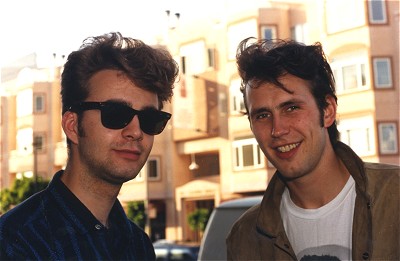
Hipsway’s Pim Jones and Grahame Skinner

A shiny new re-release of Hipsway’s 1986 debut album, complete with B-sides, outtakes, remixes and excellent Skinner liner notes, shows why they were briefly one of the most highly-regarded Scottish acts of their day, during a golden period for Caledonian pop.

It also shows Skinner to be one of the most distinctive vocalists of the era, apparently an influence on everyone from Mansun’s Paul Draper to Marti Pellow.

Hipsway’s star shone briefly but brightly, with one UK (#17) and US (#19) hit ‘The Honeythief’, a track that still sounds like a classic ’80s floorfiller. The accompanying debut album just sneaked into the US top 60 but was a bigger hit in the UK, reaching #42 and staying in the chart for 23 weeks.

‘The Honeythief’ still stands up 30 years on, but does the rest of the album? Yes and no. With producers Paul Staveley O’Duffy (Swing Out Sister, Was Not Was, Lewis Taylor, Amy Winehouse) and Gary Langan (ABC, Art Of Noise) onboard, a slick, pristine mix and selection of solid, attractive grooves are guaranteed. The wider problem is memorable hooks.

The good stuff first: ‘Long White Car’ is a richly-chorded, jazzy bossa-nova which sounds like a hit even now (it only got to #55 on initial release). The excellent ‘Broken Years’ ends with Skinner quoting from Talking Heads’ ‘This Must Be The Place (Naive Melody)’ while ‘Forbidden’ initially comes on like something akin to Frankie Goes To Hollywood on downers before breaking out into an unexpectedly resplendent pure-pop chorus.

‘Ask The Lord’ is also initially attractive and distinctive but lacks the killer hook that might have made it a hit. ‘Bad Thing Longing’, ‘Tinder’ and ‘Upon A Thread’ borrow Roxy Music’s Avalon template with their swooning synths and intricate bass/drums/percussion, but they are decidedly flimsy songs.

But overall this is an impressive debut album of funky mid-’80s pop and it’s worth a reappraisal.