Book Review: Sheila E’s The Beat Of My Own Drum

sheila eConsidering he was such a huge star and cultural icon, it’s surprising that Prince’s eventful life and sad death has yet spawned so few ‘kiss and tell’ memoirs.

Let’s hope it stays that way. But while his long-time musical partner and one-time fiancée Sheila E certainly doesn’t shy away from sharing her memories of him in her fine autobiography ‘The Beat Of My Own Drum’ (co-written with Wendy Holden), those recollections form only a small part of a very rich, diverse collection of portraits.

After all, Sheila has played percussion and/or drums with some of the all-time greats: Carlos Santana, Herbie Hancock, Marvin Gaye, George Duke, Lionel Richie, Tito Puente, Diana Ross and Billy Cobham, not forgetting her father Pete Escovedo.

But while there are plenty of tasty music biz anecdotes, the book also provides a fascinating portrait of growing up in a mixed-race family (her mother is African-American and father Mexican) in a less-than-salubrious section of Oakland, California.

Sheila paints a rich picture of a seemingly happy childhood based around music, dancing, sports (she is apparently a pretty useful football player), charity and community, with shared cultural references such as The Carpenters (Sheila was hugely inspired by seeing Karen on the TV), Sly and the Family Stone and The Jackson 5, though there also some racial tensions around too.

But then the book goes in a completely different, unexpectedly harrowing direction when she chronicles the sexual abuse suffered as a young girl at the hands of several cousins. The section rivals James Rhodes’ recent book ‘Instrumental’ in its shocking candour.

Thankfully, if anything, the abuse drives her ambition rather than beats her down, though she admits to seeing it as a dark secret that clouds the rest of her life.

There are fascinating anecdotes about travelling to Colombia at the age of just 15 to play percussion with the Latin/fusion supergroup Azteca. Cobham, Duke and Gaye are mainly described in glowing terms, almost as father figures, and she is unexpectedly candid about her romantic and musical infatuations with Santana. There’s also a hilariously mismanaged backstage ‘meeting’ with Diana Ross.

But it’s easy to forget just how unique Sheila’s talent was in the 1980s when she made it as a ‘pop star’. We had never seen a percussionist/singer/dancer triple-threat before, as she herself points out, and Latin celebrities were very rare.

This pop period is grippingly covered in the book, with tales of disastrous video shoots, crazy tour schedules and much celebrity hobnobbing. Escovedo also very nicely juggles the spicy anecdotes with some genuine, intelligent advice for the modern musician, and just enough technical stuff about playing drums and percussion too.

Sheila also discusses her project Elevate Hope Foundation which focuses on music therapy for victims of child abuse, a noble and important program which continues to go from strength to strength.

So if the last quarter of ‘The Beat Of My Drum’ reads more like a self-help book than a famous musician’s autobiography, we can surely cut her some slack. Highly recommended.

Book Review: Inside The Songs Of XTC

complicated gameBooks about songwriting are a small but fast-growing and fascinating subgenre of music journalism.

Alongside such classic tomes as Paul Zollo’s ‘Songwriters On Songwriting’, Omnibus Press’s ‘Complete Guides’ and Bob Dylan’s ‘Chronicles’, we’ve also recently had Daniel Rachel’s excellent ‘Isle Of Noises’. And now here comes another cracker.

XTC fans, however, may be slightly surprised about the publication of ‘Complicated Game: Inside The Songs Of XTC’, a gripping new book of interviews with mainman Andy Partridge, seeing as they may possibly feel that it would hard to better Neville Farmer’s ‘XTC Song Stories’.

But, while obviously covering similar ground, ‘Complicated Game’ zooms in with forensic detail on a select group of Partridge songs, particularly ones that may well have been overlooked throughout his stellar career (‘Travels In Nihilon’, ‘No Language In Our Lungs’, ‘Beating Of Hearts’, ’25 O’Clock’ etc).

He once said that XTC’s music explores the unexplored nooks and crannies of the guitar neck; this book does the same for their discography.

Essentially, ‘Complicated Game’ is a transcription of over 30 interviews by American rock journalist/musician Todd Bernhardt. Though some of Partridge’s legendary West-Country repartee and clever wordplay occasionally get a bit lost in translation, these conversations are candid, detailed and never less than engaging.

Discussions about a rhyming couplet can suddenly give way to painful memories of Partridge’s divorce, or asides about Swindon or 9/11.

The ‘Dear God’ controversy gets a whole chapter. The thorny subject of record company wrangling is never far from the surface, and Andy’s troubled relationships with producers is also a constant theme, with Steve Nye, Todd Rundgren and Gus Dudgeon taking centre stage (the former being described as ‘possibly the grumpiest guy we’ve ever worked with’!)

There’s just enough musical theory discussed too, and – not surprisingly, given that Bernhardt once interviewed Partridge at length for Modern Drummer magazine – a lot of emphasis on the role of the rhythm section, with much talk about Colin Moulding’s superb bass playing and many hilarious anecdotes about original XTC drummer Terry Chambers and later sticksmen Pete Phipps, Prairie Prince and Dave Mattacks.

But, most importantly, Partridge is able to give detailed and fascinating answers about where he gets his songwriting inspiration, looking in detail at how unusual – and often completely accidental – chords can set off images and themes, and also how much he associates music with colours. There’s also a lot of advice for songwriters about how to develop initial ideas.

Andy_Partridge

Of course, the real measure of a great music book is how quickly one is drawn back to the records, and ‘Complicated Game’ works a treat in that regard – I rushed first to the CD and then to the guitar to try and nail down ‘That’s Really Super, Supergirl’ and ‘Church Of Women’.

The orchestral arrangements and song structures of the truly singular ‘River Of Orchids’ and ‘I Can’t Own Her’ are also discussed in great detail.

There are a few minor quibbles: some of the interviews have a slightly ‘flogging a dead horse’ feel to them, and also there’s a strange reluctance to talk about Partridge’s contemporaries – Sting, Weller, McAloon, Gartside et al go unmentioned, and Elvis Costello is only referred to once in terms of his huge bank balance!

But hey, enough of my nitpicking. ‘Complicated Game’ is another fine book about songwriting, a good holiday read for ’80s music fans and a great companion piece to ‘XTC Song Stories’. I devoured it almost in one sitting and will definitely be reaching for it regularly.

Book Review: Steve Jansen’s Through A Quiet Window

karn sylvian

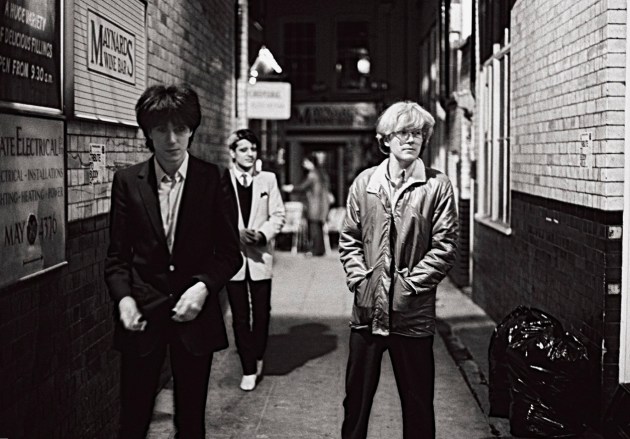
Mick Karn and David Sylvian, Stanhope Gardens, London, 1981

Ringo Starr was once asked: What do you remember about recording Sgt Pepper’s? His reply? ‘I learnt how to play chess on that album.’

Not to do Ringo down at all – he’s the reason this writer picked up the drum sticks – but the line does say something about the sometimes tedious nature of recording in the era of multi-tracking.

The drummer may have laid down all his parts in the first week of a project, so he or she had better have a Plan B for when the rest of the band are tinkering endlessly.

カバー0720.indd

Japan drummer Steve Jansen didn’t learn chess but he did use his time very productively while the band recorded their masterpieces, Gentlemen Take Polaroids and Tin Drum; he developed his formidable photography skills, and now his work has been collected in a sumptuously-designed hardback book ‘Through A Quiet Window’.

To say that it will appease Japan fans is a total understatement – it makes a brilliant companion piece to Anthony Reynolds’ excellent recent biography ‘A Foreign Place’, and brings the band’s relatively short but very eventful story to life.

We see portraits of the band in all kinds of different locations, mainly between 1979 and 1981: Mick Karn laying down his bass parts at AIR Studios and mooching about Holland Park in West London; David Sylvian lounging in various hotel rooms and recording studios including the Townhouse and the Manor, Richard Barbieri sitting stone-faced at his keyboard or smirking on the tour bus.

There is also a memorably candid shot of Karn and Sylvian at the breakfast table in their Stanhope Gardens flat. We also see fleeting glimpses of producers Steve Nye and John Porter at various mixing desks, often flanked by either Karn or Sylvian.

Jansen’s other musical projects of the time are also beautifully documented, including various Japanese sojourns featuring Ryuichi Sakamoto, Masami Tsuchiya and Akiko Yano.

JAPAN_1 (1)

Richard Barbieri, Mick Karn and David Sylvian, South Moulton Street, London 1981

While there are a lot of laughs about, the overall impression is of a very insular bunch of guys, extremely dedicated to their music but also their friendships. No real surprise there, then, but the intimate nature of many photos is very refreshing.

Steve Jansen demonstrates the same precision and natural sense of timing behind the camera as he always does behind the kit. And there are some cracking hairstyles on show too. Highly recommended.

‘Through A Quiet Window’ is available from Artes Publishing.

Japan: A Foreign Place

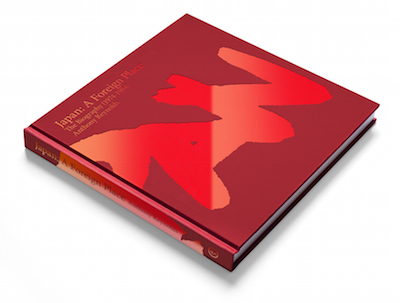
japanIt’s only befitting that Japan – a groundbreaking ’80s band who undeniably put a big emphasis on surface and style – should be rewarded with Anthony Reynolds’ glossy, beautifully-designed biography.

To paraphrase an old joke, when I got ‘A Foreign Place’ in my hands I didn’t know whether to read it or frame it. It comes with a weighty, thick binding and a glorious cover featuring the band’s characteristic logo.

It’s also packed with many fantastic photos, almost all of which were new to this correspondent. Many of them even appear to show David Sylvian smiling…

Mick Karn and David Sylvian, Toronto, 24th November 1979

Mick Karn and David Sylvian, Toronto, 24th November 1979

But what of the book’s content? Though it will satisfy the most information-starved Japan fan, with detailed commentaries on the band’s music and relationships, it also works very nicely as a portrait of the wider late-’70s/early-’80s music scene: Giorgio Moroder, Ryuichi Sakamato, Simon Napier-Bell, Gary Numan and David Bowie make regular appearances.

Though the band were, critically, a laughing stock up until the Quiet Life album in 1979, it’s often forgotten quite how out of place they always were in the UK pop firmament.

From androgynous glam-rockers to glacial art-popsters, Japan resolutely stuck to their own guns and, by the time of their split in 1983, had become probably the most influential group of their era.

Sylvian and Barbieri, The Oxford Road Show, November 1981

Sylvian and Barbieri, The Oxford Road Show, November 1981

Reynolds expertly builds up a lucid picture of South-East London in the 1970s with its racial/cultural/class divisions and dodgy schoolmasters.

The brothers Batt (soon to be rechristened David Sylvian and Steve Jansen) hooked up with schoolmate Andonis Michaelides (soon to become Mick Karn) to jam and write songs.

Reynolds reveals some of Japan’s more outré musical influences (Stanley Clarke, Chick Corea, Aynsley Dunbar) and also that their early material was full of Sylvian guitar solos.

Jumping forward a bit, we get many gossipy revelations: Sylvian’s toe-curling audition for legendary manager Simon Napier-Bell, Gary Numan’s frequent stalking and also Japan’s early (and uniformly bad) experiences on the live scene of the late-’70s, supporting the likes of Blue Oyster Cult.

Though the band were all resolutely straight, onstage they were subjected to constant homophobic comments and a barrage of missiles. Reynolds reveals that Black Sabbath guitarist Tony Iommi had a real thing for Sylvian, pestering Napier-Bell for an introduction, not realising Sylvian wasn’t a ‘chick’. But this surely wasn’t the first time Sylvian had been mistaken for Brigitte Bardot.

Japan, November 1982

November 1982

Japan’s pop breakthrough is expertly handled, Reynolds spelling out in great musical detail how Sylvian’s emergence as a high-quality songwriter fused with Richard Barbieri’s canny synth programming and the stunning Karn/Jansen rhythm section to finally produce some music of worth.

But success had come at a great cost; the band had completely grown apart, not helped by Karn’s girlfriend moving in with Sylvian on the eve of an important tour.

This Kickstarter project has clearly been a labour of love but ‘Japan: A Foreign Place’ punches way above its weight with in-depth interviews, sumptuous design and anecdotes aplenty.

Occasionally, the text has a repetitious, ‘cut and paste’ quality, but this is a minor quibble. It’s hard to imagine that anyone will ever write a better book about one of the key bands of the ’80s. Highly recommended.

‘Japan: A Quiet Place’ is published by Burning Shed.