The Cult Movie Club: Moviedrome

Watching ‘Halloween 2’ (1981) on the big screen the other night brought back lots of memories.

Apart from generating a few more good scares than I was expecting, it also reminded me of the very real excitement of the late-night cult movie. ‘Moviedrome’ wasn’t a cult movie but a series of cult movies transmitted on Sunday nights by the Beeb between 1988 and 2000.

Pre-internet, there was a real curiosity to this collection of lost classics. Your parents had gone to bed. It was just you and the TV. What forbidden wonders were about to be unfurled. ‘Moviedrome’ was initially presented by director Alex Cox (‘Sid And Nancy’, ‘Walker’, ‘Repo Man’), and just a glance at the running order of the first two series should excite movie fans of a certain hue:

1988:

The Wicker Man
Electra Glide in Blue
Diva
Razorback
Big Wednesday
Fat City
The Last Picture Show
Barbarella
The Hired Hand
Johnny Guitar
The Parallax View
The Long Hair of Death
Invasion of the Body Snatchers (1956)
The Fly (1958)
One From The Heart
The Man Who Fell To Earth
The Good, The Bad and The Ugly
One-Eyed Jacks

1989:

The Man With The X-Ray Eyes
Jabberwocky
D.O.A.
The Thing From Another World
The Incredible Shrinking Man
California Dolls
THX 1138
Stardust Memories
Night of the Comet
The Grissom Gang
The Big Carnival (Ace in the Hole)
Alphaville
Two-Lane Blacktop
Trancers
The Buddy Holly Story
Five Easy Pieces
Sweet Smell of Success
Sunset Boulevard

Many of these films are etched upon my brain 30 years on, particularly ‘THX 1138’, ‘Electra Glide In Blue’,  ‘The Man With X-Ray Eyes’, (‘Pluck it out! Pluck it out!’), ‘Five Easy Pieces’ and ‘The Parallax View’.

In later series, they showed uncut UK premieres of ‘Bad Timing’, ‘Scarface’ and ‘Pulp Fiction’, amongst others. Checking in to watch ‘Moviedrome’ on a Sunday night gave you the feeling that you were a member of a very small but select club.

Cox’s introductions were highly original bits of film criticism in themselves, with his arch sense of irony and keen eye for detail (bit-part actors, weird editing, striking set design). He even had the audacity to present his own movie ‘Walker’ during the series.

Later Mark Cousins brought a more serious tone, an intriguing accent and also some intelligent, subtle analyses. Watching a few of these intros just make me want to watch the movies again. If only there was such a widely-seen yet distinctly ‘cult’ film club as ‘Moviedrome’ these days.
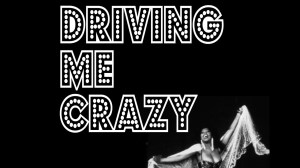
The Cult Movie Club: Driving Me Crazy (1988)

In the ’70s and ’80s, documentarian Nick Broomfield’s focus was mainly on societal concerns – the British class system (‘Proud To Be British’), urban decay (‘Behind The Rent Strike’), juvenile delinquency (‘Tattooed Tears’) the US Army (‘Soldier Girls’), legalised prostitution (‘Chicken Ranch’). All are superb and worth seeking out.
But 1988’s ‘Driving Me Crazy’ marked a lightening of tone and the birth of Broomfield’s post-modern style, where he became a ‘character’ in the film – and, it has to be said, often an irritant.

The movie came about when the financiers of big-budget, all-black musical ‘Body And Soul’ – booked for a six-month run in Munich – sought out Broomfield to make a ‘Fame’-style documentary about the extended rehearsal process in New York. All well and good, thought Broomfield. It was a chance to extend his range and do something different, a little more light-hearted.

But then it all went pear-shaped. The financiers reduced the documentary budget from $1.6 million to $300,000. They also wanted to incorporate a ‘fictional’ element into the film, with writer Joe Hindy and his agent playing themselves. Egos ran wild and sensibilities were messed with.

Broomfield considered bailing but decided to hang around and document the resulting drama. So ‘Driving Me Crazy’ became a film about not being able to make a film, in the tradition of ‘Waiting For Fidel’. The good news is that it’s one of the funniest but also most awkward movies of Broomfield’s career. ‘Body And Soul’ choreographers George Faison/Mercedes Ellington and assistant director Howard Porter don’t take kindly to the film crew and give them hell.

Broomfield almost becomes persona non grata. Though this must have sometimes been painful, he almost seems to relish it. He also flirts outrageously with the PA of show producer Andre Heller and there are uncomfortable suggestions of racism from some of the suits.

But Broomfield and his DoP Rob Levi also document some stunning rehearsal footage. There are memorable jazz, hip-hop, soul and doo-wop performances and beautiful images of late ’80s New York, with shades of ‘Fatal Attraction’ and ‘9 1/2 Weeks’. There’s a particularly notable panoramic cityscape shot towards the end, soundtracked by one of many fractious but funny Broomfield phone calls.

Entertaining, unsettling and sometimes exhilarating, the oft-neglected ‘Driving Me Crazy’ is well worth another look.

The Cult Movie Club: The King Of Comedy (1982)

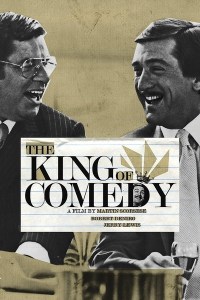
Looking at the trailer and publicity for James Franco’s Tommy Wiseau biopic ‘The Disaster Artist’, it’s hard to ignore the ‘King Of Comedy’ comparisons. 
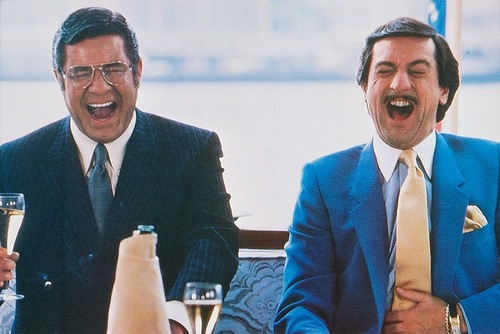
Featuring Robert De Niro’s fascinating and detailed turn as anti-hero Rupert Pupkin, Martin Scorsese’s classic black comedy was released 35 years ago today.

If Wiseau didn’t actually exist, Hollywood would probably have to invent him. Recent American cinema is full of Wiseaus and Pupkins – desperate characters, probably a few cards short of a full deck, who will do almost anything to make it.

Pupkin passive-aggressively stalks celebrities for their autographs, but then comes to believe that he is owed a shot at fame.

Talk-show host Jerry Langford (Jerry Lewis) is his passport to success – Pupkin and disturbed rich-girl Masha, brilliant played by Sandra Bernhard, kidnap him. Pupkin then demands the opening monologue on Langford’s nightly TV show.

Jerry Lewis and Robert De Niro in character

If ‘The King Of Comedy’ had been made today, it would probably be hailed as a modern classic, a fable for our times, a coruscating attack on narcissism, celebrity culture and unchecked ambition.

It’s ‘Nightcrawler’ meets ‘Curb Your Enthusiasm’. But it stiffed on its original release (not helped by a substandard trailer – see below), grossing barely $3 million against a $19 million budget.

The studio didn’t know how to market it, trying to sell it as a knockabout comedy. Scorsese sensed the bad vibes gathering around the film long before it was released, telling writer Peter Biskind:

‘A close friend of mine told me “The buzz is bad.” I hate that. When the buzz is bad, people don’t want to be associated with the picture. But they were right – the film was a bomb. It’s called “The King Of Comedy”, it’s Jerry Lewis, and it’s not a comedy. Already it’s a problem…’

Yes, it sometimes feels like a succession of skits strung together, almost in the style of Brian De Palma’s early films ‘Greetings’ and ‘Hi Mom’. And it would be nice to get a bit more access to Pupkin and Masha’s backgrounds.

But Scorsese, Lewis, De Niro and Bernhard, working instinctively from ex-Newsweek film critic’s Paul D Zimmerman’s slight but intriguing story, create something toxic and completely memorable.

Scorsese fills the screen with significant minor characters, mainly playing themselves and recruited from the ‘real’ TV world, and he obviously has deep respect for Lewis and all he stands for (though has less respect for the all-pervading, gossipy influence of TV culture).

Bernhard, prodded by De Niro, is superb, given free rein by Scorsese to improvise: ‘I cover the waterfront, remember that!’ she bawls at Pupkin, just before one of the director’s typically bracing cuts.

There are many excruciating moments: Pupkin’s arrival at the Langford house (De Niro apparently screamed antisemitic abuse at Lewis to elicit the correct level of outrage in his response to having his golf game interrupted) and Masha’s ‘seduction’ of Langford. Is his violence towards her ‘justified’?

And then there’s Pupkin’s monologue, shown in one long take with no cutaways – Scorsese and De Niro dare us to laugh at this schmuck, and it’s unsettling when one or two of his gags hit the spot.

‘The King Of Comedy’ is the De Niro/Scorsese collaboration your correspondent returns to the most. Nobody gets killed, but a lot of people get hurt. Very hurt indeed.

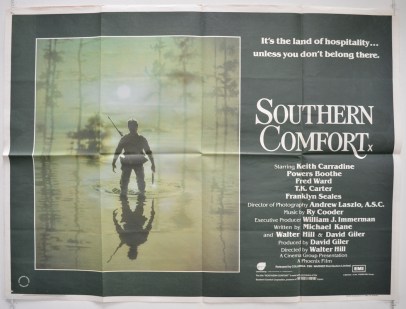
The Cult Movie Club: Southern Comfort (1981)

After the extended prologue, when Ry Cooder’s swampy blues riff slides in over a glorious widescreen shot of the Louisiana bayou, you know you’re watching a classic of its kind.

To this day, co-writer/director Walter Hill claims that the superb ‘Southern Comfort’ doesn’t directly allude to the Vietnam War, but it’s hard to conclude otherwise.

Set in 1973, his film concerns a motley group of weekend National Guardsmen whose sojourn into Cajun country (with the promise of prostitutes at the end of the road) turns into a desperate fight for survival when a foolish prank leaves them at the mercy of some particularly vengeful locals.

Hill prefers to call it a ‘displaced Western’, a film about escalating moral dilemmas in unfamiliar surroundings. That rings true too, but watching it again after ten years or so, it’s hard not to compare it to John Carpenter’s ‘The Thing’, another all-male classic about creeping, self-defeating paranoia, fudged leadership and dodgy group-think.

‘Southern Comfort’ might also be described as ‘The Warriors’ meets ‘Deliverance’. It’s that good. This is a pre-irony, pre-CGI action movie, where men are men, decisions have consequences and vengeance is swift and fairly brutal.

The action sequences are gripping, though never tawdry, and look extremely punishing for the cast – there’s a particularly realistic dog attack and a memorable quicksand incident. Apparently the shoot was long, cold and difficult, with camera tripods frequently sinking into the bayou.

The dialogue is fast and loose – the brain has to be in gear to pick up all the political/ethical nuances that fly by – and the acting styles deceptively ‘naturalistic’.

Keith Carradine and Powers Boothe are superb as the reluctant heroes who must overcome their basically apolitical stances to become men of action and moral choice.

Carradine in particular makes for a fascinating action-man (according to Hill, his character is a ‘Southern aristocrat’). The secondary cast of mainly unknowns (the ever-excellent Peter Coyote aside) is also superb.

But ‘Southern Comfort’ was a commercial dud on its 1981 release. Maybe, like ‘The Thing’, it’s far too stark a vision. But it certainly it spawned some new movie clichés and looks like an influence on many ’80s movies from ‘Aliens’ to ‘Predator’.

It’s also a fascinating watch these days considering the state of the US – the film’s message seems to be that peace is impossible while there remain so many internal divisions and prejudices.

You Terrible Cult: Seven Reasons Why ‘Withnail And I’ Has Enduring Appeal

Which films do you revisit every couple of years?

I never tire of ‘Sideways’, ‘Diner’, ‘Duel’, ‘Career Girls’, ‘Tape’, ‘This Is Spinal Tap’, ‘The Long Goodbye’, ‘The Apartment’, ‘Eyes Wide Shut’, and a few others too.

But ‘Withnail’, released 30 years ago this week, should probably go right at the top of that list. I first saw it around 1988 when my dad rented the video. I think he was a vague acquaintance of the movie’s writer/director Bruce Robinson at the time and had an inkling that it would float my boat.

How right he was. I was immediately smitten, drawn in by the superb swearing, anti-establishment mood, hilariously down-at-heel, self-important protagonists and low-key ending.

By the early ’90s, there was an outbreak of Withnails all over Britain – pasty, unshaven, rather insolent youths mooching around in leather overcoats and muttering about ‘wanting the finest wines available to humanity’…

Not a big hit on its original release, ‘Withnail’ has nonetheless become a classic cult movie, inspiring many devotees and even a notorious drinking game. But why has it endured? Here are seven reasons why it doesn’t seem to date as the years go by (swearing and spoiler alerts…).

7. No ‘Crap Bits’
Actor Ralph Brown – who plays Danny the Dealer – analysed ‘Withnail”s appeal thus. Almost every movie has a clunky change of pace/tone or a dodgy character beat – not this one, though Bruce Robinson has pinpointed an uncertain moment in the final reel when Danny embarks on his ‘They’re selling hippy wigs in Woolworths’ speech.

6. Lack Of Plot
Let’s face it, nothing much happens in ‘Withnail’. There are no ‘life lessons’. But that’s its main strength. Two out-of-work actors try to go on holiday, one of their uncles comes to stay, falls in love with and attempts to seduce the other one, then they come home. It’s two fingers up to the screenwriting template taught in most film schools. But, framed another way, it’s actually the classic plot: put your hero(es) up a tree, throw rocks at him and get him down, though poor Withnail seems destined to stay up the tree forever…

5. Endlessly Quotable Dialogue
This is probably the key to the film’s longevity. ‘Fork it!’… ‘Monty, you terrible c**t!’… ‘We’ve gone on holiday by mistake’, ‘I demand to have some booze!’ ‘My thumbs have gone weird…’ etc. But as the years go by, it’s the throwaway lines that now make me chuckle the most: ‘Out-vibe it’, ‘Jesus, you’re covered in sh*t,’ ‘I’ve waited an aeon for assistance’, ‘Drugs banned in sport…’ ‘We’ll be found dead in here next spring…’ etc., etc…

4. Memorable Minor Characters
The film is chock-a-block with them. There’s Ralph Brown’s classic turn, Noel Johnson’s delightfully-plastered pub landlord, Llewellyn Rees’s tea-shop proprietor, Michael Elphick’s psychotic poacher and Anthony Strong’s manic traffic cop. All perform as if their lives depended on it. Late, great casting director Mary Selway must take a lot of credit.

3. Outstanding Lead Performances
Has there ever been a better movie drunk than Richard E Grant? (How about Ray Milland in ‘The Lost Weekend’? Ed.) It’s a superb breakout performance, especially coming from a famous teetotaler. In a far less showy role, Paul McGann does a fine job of tethering the movie (Kenneth Branagh and Michael Maloney were apparently sniffing around his part, so to speak), even if his accent flies around a bit. And of course Richard Griffiths as Uncle Monty is a delight.

2. Lack Of A Remake/Sequel
Please, please, please may it stay this way. Hollywood: stay away from ‘Withnail’. ‘Edgy’ young Brit writer/directors: leave well alone. You can just imagine the horror of a remake – lots of touchy-feely moments about ‘friendship’, and Withnail going on a ‘journey’… Just NO.

1. Good Grammar
It’s not called ‘Withnail And Me’… (Enough reasons already… – Ed.)

Magic Mickey: ‘Angel Heart’ 30 Years On

angel_heartIn 1987, Mickey Rourke was fast becoming one of the most controversial movie stars of the era, the go-to guy (alongside Michael Douglas) for potentially commercial but decidedly ‘off-colour’ material.
Even David Bowie rated Rourke as one of the coolest people on the planet in ’87 – to my knowledge, only Mickey, Iggy Pop, Tina Turner and Al B Sure! ever shared ‘lead vocals’ on a Bowie solo album (though their collaboration was less than essential…).

‘Angel Heart’ turns 30 this week. I’ve been a Mickey fan since randomly renting the video circa 1988. If, as Marlon Brando attested, acting (or at least good acting) is essentially ‘behaviour’, Rourke delivers one of the great modern screen performances.

He mumbles lines, adds strange emphases (‘Yeah, I could be free‘) and quirky ad-libs, smirks inappropriately and generally shambles around in his filthy linen suit; Pauline Kael memorably wrote that ‘he has enough dirt on him to sprout mushrooms’. But also he carries off the action sequences with aplomb, looking like he could take care of himself in a bar fight.

Most importantly, Rourke tempers the increasingly hokey supernatural elements of the film with a believable, sympathetic, relatively down-at-heel protagonist: Harry Angel seems to be a regular knockaround guy in Brooklyn. ‘He likes the simple life, going for a beer, getting laid whenever he can. He minds his own business. He just gets by. He works, reads the comics, he takes a walk,’ Rourke told his biographer Christopher Heard.

William Hjortsberg’s screenplay for ‘Angel Heart’, based on his New York-set novel ‘Falling Angel’ (described by Stephen King ‘as if Raymond Chandler had written “The Exorcist”’), had been hanging around Hollywood for a while.

First it looked like Robert Redford would produce and star. Then ‘Midnight Express’/’Fame’ director Alan Parker came onboard, rewrote the script (with the questionable decision to relocate most of the action to New Orleans) and offered the lead role to naysayers Jack Nicholson, Al Pacino and Robert De Niro, the latter taking the role of Louis Cyphre (geddit?) instead.

Enter Mickey. Parker made it clear to Rourke that he was nowhere near his first choice, but was interested in what he could bring to the role. Rourke was disillusioned with acting in general and Hollywood in particular but desperately needed the part: ‘I was about to lose my big-assed house in California and needed a big paycheck fast…’ Parker warned Rourke that he wouldn’t put up with any funny business, also apparently giving him many a dressing-down on set.

But how does ‘Angel Heart’ stack up these days? It’s still very watchable, salvaged by the Rourke/De Niro scenes and Mickey’s eccentric ‘behaviour’. Bonet is a refreshingly natural presence and De Niro hams it up semi-convincingly.

Trevor Jones’ original soundtrack (recorded at the aptly-named Angel Studios in Islington, North London) still holds the attention alongside some great crooner and blues tunes. But Parker searches in vain for his inner Nicolas Roeg (or Ken Russell?), showing his background in advertising with a succession of beautiful, if clichéd, images of ‘evil’ (a glistening, freshly-extracted human heart, ceiling fans, lift shafts, writhing bodies, blood-stained walls), memorable crane shots and disorientating flashbacks, but it all feels way too slick.

Kael again: ‘There’s no way to separate the occult from the incomprehensible. Parker simply doesn’t have the gift of making evil seductive, and he edits like a flasher.’ There’s also a lack of memorable secondary characters – Charlotte Rampling and Brownie McGhee seem miscast and barely register.

‘Angel Heart’ just about broke even at the box office but has enjoyed a healthy cult following since. My brother tells me that it most definitely worked on the big screen, delivering a real sense of impending doom. I don’t doubt it, ably aided by some classic Mickey.

The Cult Movie Club: The Rachel Papers (1989)

rachel papersHere’s a late, almost completely forgotten contender for the pretty short ‘film better than the book’ list.

Writer/director (and son of Richard) Damian Harris’s ‘The Rachel Papers’, based on Martin Amis’s 1973 debut novel, crept out in May 1989 to mediocre reviews and underwhelming business.

At the time, the post-‘Mission’, pre-‘Four Weddings’ British film industry was in its latest rut, unsure of its place in the global marketplace and reeling from massive government cuts.

But somehow ‘The Rachel Papers’ movie remains true to Amis’s irreverent, adolescent, sweary, very ‘London’ vision, while understandably playing down the overt racism, sexism and druggier aspects of the novel.

The plot centres around Charles Highway, a precocious, upper-middle-class tyke on the cusp of his 20th birthday. He’s no virgin (the title alludes to the secret ‘research files’ he keeps on all his previous conquests) but is desperate to sleep with an older woman before he hits his twenties.

The lovely, intelligent, well-bred Rachel seems to fit the bill perfectly, but Charles gets a lot more than he bargains for when he pursues her. Falling in love wasn’t part of the plan, etc, etc… He also has to contend with Rachel’s on/off American boyfriend DeForest. Charles does a fair bit of learning and ‘growing’, but with an agreeable lightness of touch. Most importantly, the movie rattles along at a good lick.

rachel papers

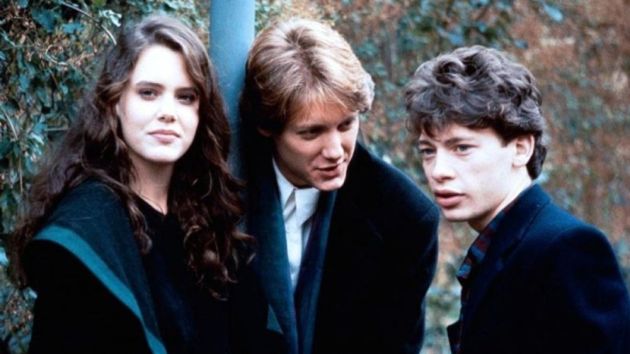
Ione Skye and Dexter Fletcher

I came across ‘The Rachel Papers’ completely by chance in the early ’90s when I was almost exactly Charles’s age, and it rang a lot of bells. Watching it again recently, I was pleased how well it stands up whilst obviously being very much of its time. The movie lives or dies by the casting of the Charles character – Dexter Fletcher does his best but wouldn’t seem a natural fit for the role. For a start, he looks barely older than 15. Where was Hugh Grant when Harris needed him?

Often breaking the fourth wall and speaking directly to camera, Charles is a fusion of Ferris Bueller and Alfie, basically a cocky, rather spoilt little prick with, as it turns out, a few deep-rooted insecurities. In Amis’s book, Rachel isn’t American – the casting of Ione Skye was apparently a studio-imposed decision, but it doesn’t upset the balance of the film at all. She does a great job in an underwritten role. She’s a fresh, natural, uplifting presence, carrying on from where she left off in the classic ‘Say Anything’. James Spader delivers a typically superb performance as DeForest, mining the same smarmy, condescending schtick he so memorably employed in ‘Pretty In Pink’.

rachel

Skye, Spader, Fletcher

The film is also chock-a-block with other memorable character turns – Jonathan Pryce, Michael Gambon, Lesley Sharp, Aubrey Morris, Gina McKee and Claire Skinner do some great work, particularly Gambon as an amusingly-off-hand university interviewer. Ian Dury’s right-hand-man Chaz Jankel does a decent job with the soundtrack on top of some choice contributions from Shakespears Sister and John Martyn.

pryce

Jonathan Pryce in ‘Rachel’

In the final analysis, ‘The Rachel Papers’ is the only Brit romcom I’ve seen that approaches something like ‘The Sure Thing’.

It’s irreverent and unpretentious but certainly not dumb, a fairly accurate portrait of late-’80s London, bringing an appealing cheerfulness to the city without resorting to picture-postcard clichés (there’s not a shot of Big Ben or Trafalgar Square in sight). The sexual politics and shenanigans are also refreshingly upfront.

It’s surely due a remake – the recent ‘Don John’ seems to touch on similar areas but looks like somewhat of a disaster area if the trailer is anything to go by. Don’t judge ‘The Rachel Papers’ by the trailer either, though, by the way…