Book Review: Walls Come Tumbling Down by Daniel Rachel

walls come tumblingDaniel Rachel’s excellent new book focuses on the links between music and politics in the 1980s.

Ostensibly an oral history of three epochal movements of the era – Rock Against Racism, 2 Tone and Red Wedge – ‘Walls Come Tumbling Down’ shows how these campaigns politicised a whole generation.

Fresh from his fine ‘Isle Of Noises’ tome which interviewed key British songwriters, Rachel opens his contacts book again to get telling contributions from Pauline Black, Dennis Bovell, Billy Bragg, Lloyd Cole, Elvis Costello, Jerry Dammers, Andy Gill, Junior Giscombe, Paul Heaton, Linton Kwesi Johnson, Tracey Thorn, Tom Robinson, Paul Simonon, Paul Weller and many more. There are also rare or never-before-published photos of the era by the likes of Pennie Smith, Jill Furmanovsky and Kevin Cummins.

The story starts on 5 August 1976 when Eric Clapton used a notorious Birmingham Odeon gig to lambast the audience, calling for ‘w*gs’ and ‘P*kis’ to ‘leave the country’ and pledging his support for Enoch Powell, the Conservative MP who eight years earlier had made the infamous ‘Rivers Of Blood’ speech.

Clapton’s shocking proclamations sparked the Rock Against Racism movement, a campaign also inflamed by David Bowie’s comments to Playboy magazine concerning Hitler and the rise of fascism.
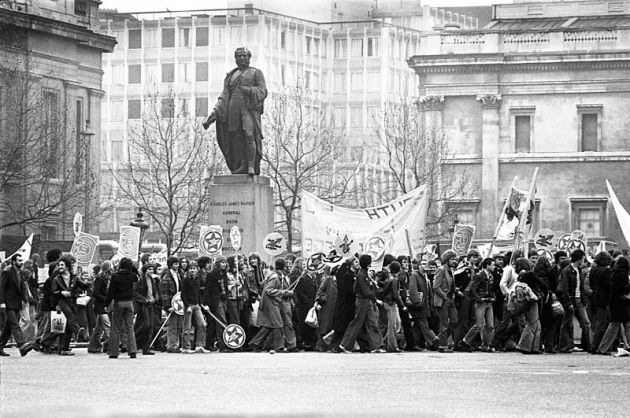
Rock Against Racism march, Trafalgar Square, April 1978

Rock Against Racism march, Trafalgar Square, April 1978

This troubling era is picked over in immense detail, with various jaw-dropping artefacts: Clapton’s handwritten ‘apology’ letter to Sounds magazine is printed in full, and there’s also an extremely rare photo of Bowie’s ‘Nazi salute’ at Victoria station in May 1976 (as well as a new-to-this-writer explanation/apology from Bowie). Black musicians and music-biz legends also comment with great candour about life in the UK during this period.

3-september-20162c-walls-come-tumbling-down-billy-bragg-in-conversation-with-author2c-daniel-rachel-40-people27s-history-museum-image-red-wedge5b45d

The 2 Tone movement attacked racism at its source while many artists under that umbrella also supported the Campaign For Nuclear Disarmament and Rock Against Sexism.

When Margaret Thatcher swept to a second term of office in 1983, bolstered by the Falklands War, a new pacifism emerged, typified by tracks like Elvis Costello’s ‘Shipbuilding’ and Heaven 17’s ‘(We Don’t Need This) Fascist Groove Thang’.

Later, as the miners’ strike took hold and Thatcher’s assault on socialism gathered pace, Paul Weller and Billy Bragg formed the Red Wedge movement which focused its attentions on ousting her in the 1987 General Election. It wasn’t to be, of course – although she did resign in December 1990.

The final section of ‘Walls Come Tumbling Down’ focuses on Dammers and various accomplices’ efforts to raise public awareness about the banned ANC, with high-profile singles and the famous 1988 Nelson Mandela 70th birthday tribute at Wembley Stadium, followed by his eventual freeing from jail on 11 February 1990.

Full of juicy details, potent memories of a far more passionate and politically-engaged era of pop music, and gripping, sometimes moving testimonies, this fascinating book outlines a period when youth culture demanded a voice.

‘Walls Come Tumbling Down’ is published by Picador.

King Crimson: Discipline 35 Years Old Today

crimson-cover14 April 1981: King Crimson – or Discipline, as they are currently named – are rehearsing new material in deepest Dorset.

But all is not well. Guitarist/de facto leader Robert Fripp is getting seriously ticked off with Bill Bruford’s drumming.

He outlines the pertinent issues in his diary (available to read in the remastered CD’s liner notes):

Bill is really getting to me, so I’m trying to understand how he works:
1. He’s a very busy player and doesn’t enjoy playing sparsely.
2. His parts have lots of fills and major changes of texture.
3. His fills are dramatic ie., they shock.

So Fripp comes up with some suggestions for Bruford:

1. Repeat yourself.
2. Take your time.
3. Leave room.
4. Listen to everybody else.
5. Develop a new set of clichés.
6. Develop a new vocabulary of drum sounds.
7. Listen to the sound of what you play.

Bruford’s autobiography outlines his general attitude to these instructions. But he gamely meets Fripp halfway and adapts his style accordingly, laying off the hi-hats, ride and crash cymbals unless absolutely necessary and adding a set of Octobans, a China cymbal and a few electric drums to his kit.

There are other Fripp stipulations. The music’s high frequencies should be saved for the electric guitar (Fripp was perhaps influenced by the ‘rules’ set by Peter Gabriel for his groundbreaking third album) and the 16th notes usually played by the hi-hat or ride cymbal should also now be the guitarists’ responsibility.

The formula was set. And one of the great albums (and bands) of the ’80s was born.

There was something very exciting in the air around late ’70s/early ’80s rock. The talk was all of ‘village music’ – an African concept wherein each player’s contribution is vital but only a small part of the mighty whole.

Talking Heads’ Remain In Light, Brian Eno/David Byrne’s My Life In The Bush Of Ghosts, David Bowie’s Lodger, Japan’s Tin Drum and Gabriel III showed how ‘world’ influences could integrate with ‘rock’ to thrilling effect, and Discipline fits in very neatly with those albums.

Musical references might come from Mozambique, Java, China, Bali or South Africa, or from the soundworlds of Karlheinz Stockhausen, Glenn Branca, Philip Glass and Steve Reich. Like Talking Heads, King Crimson filtered these influences through a New York art-rock/post-punk perspective but, arguably, no one integrated them more successfully.

Fripp and Bruford recruited Adrian Belew (who chose Crimson over Talking Heads) and Tony Levin in New York. Belew had grown into an incredibly assured vocalist – according to Bruford, he was literally incapable of singing out of tune – and master of unusual guitar textures. His solos featured tones and approaches never heard before.

Levin had already played bass with a plethora of heavyweights including Paul Simon, John Lennon and Gabriel, and had also just turned down an invitation to join Weather Report at the beginning of 1981. He unleashed a new weapon for the Crimson gig – the ten-stringed Chapman Stick, played by tapping or ‘hammering on’ (heard to great effect during the opening of ‘Elephant Talk’).

Back in the mid-’80s, my brother and I used to peruse Discipline‘s liner notes for clues as to the powerful and mysterious music therein. We didn’t have a clue what a ‘Stick’ was, concluding wrongly that it must be the slightly synthetic woodblock sound heard throughout ‘The Sheltering Sky’ and title track (I’m still not sure what that sound is – maybe a ‘triggered’ Bruford hi-hat?).

Tony Levin and Chapman Stick

Tony Levin and Chapman Stick

The band wrote an hour of new material fairly quickly and toured modestly in the UK during April and May 1981, calling themselves Discipline. The album of the same name was recorded over the summer at Island’s Basing Street Studio in Notting Hill (later Trevor Horn’s Sarm complex) with producer Rhett Davies, fresh from helming Roxy Music’s Flesh And Blood.

By September, pleasantly surprised by the quality of music in the can, Fripp was issuing a lengthy (and fairly incomprehensible) press release explaining why the band would henceforth be known as King Crimson.

As Bruford says in his book, ‘For a couple of years at the beginning of the ’80s, we were the right band in the right place at the right time – not to get hits, but to do useful, fascinating and right work.’

He also says that the Crimson drum stool was one of the three best rock gigs in the last few decades of the 20th century, naming the other two as Gabriel and Frank Zappa. Hard to argue with that.

The Pop Group: Where There’s A Will…

pop groupPunk’s tributaries reached far and wide post-1976.
Save country and classical, there was barely a music genre that wasn’t affected by it.

But one of the most singular and unclassifiable collectives to emerge from the punk boom was Bristol’s The Pop Group, who just for a few years fused all their passions – reggae, dub, free jazz, funk, Erik Satie, Beat poetry, Dadaism, Situationism – into a gloriously chaotic unit.

hqdefault

I don’t know a better band for annoying the neighbours. At their best, The Pop Group sound a bit like an avant-garde jazz band trying and somehow failing to play like Chic, run through Adrian Sherwood’s dub effects.

But they are pretty damn exciting in small doses and offer textures that are genuinely surprising. I generally turn to them as an antidote to the Ed Sheerans and Ellie Gouldings of this world. They also came up with some of the best cover artwork of their era.

The Pop Group emerged from a gang of West Country teenage music fans called The Bristol Funk Army who apparently would wear zoot suits and brothel creepers and listen to heavy ’70s funk. Meanwhile, vocalist/lyricist and Last Poets fan Mark Stewart was getting a serious political awakening, hellbent on documenting his research into consumerism, nuclear power and US foreign policy.

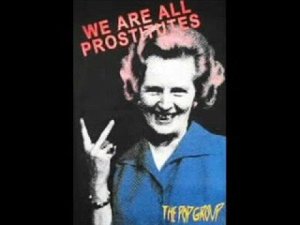
The band’s lifespan was pretty brief, limited to two albums (the debut Y was produced by UK reggae legend Dennis Bovell) and three classic singles – ‘She Is Beyond Good And Evil’ (not about Thatcher, according to Stewart), ‘We Are All Prostitutes’ and ‘Where There’s A Will’, which was released as a double A-side with The Slits’ ‘In The Beginning There Was Rhythm’ in March 1980.

R-196296-1403389558-3690.jpeg

They apparently lost thousands of pounds of revenue by mainly playing benefit gigs for Cambodia and Scrap The Sus (stop and search law). It was a very volatile time and they definitely put their money where their mouth was.

Their last gig before an amicable parting of the ways was the Campaign For Nuclear Disarmament benefit in Trafalgar Square on 26 October 1980 in front of 250,000 people.

Mark Stewart spent the rest of the ’80s pursuing a fascinating solo career, while Gareth Sager and Bruce Smith formed Rip Rig & Panic (later featuring Neneh Cherry on vocals), and Smith has also been PiL’s drummer since the mid-’80s.

The Pop Group’s sound has also been massively influential on a host of punk/funk bands over the last 20 years or so including Radio 4, Primal Scream and LCD Soundsystem.

And guess what – they are back among us again. They released a superb comeback album in 2015, Citizen Zombie, and have played live fairly regularly since 2011. It’s a pleasure to report that the rage and weirdness are very much still there.

But back to ‘Where There’s A Will’. This recently unearthed clip has become a favourite (I love the studious Belgian host attempting to make some sense of this insanity), an antidote for anaemic, safe music everywhere. Not even Chris Morris could have come up with anything more grippingly bizarre.

For much more about The Pop Group and early ’80s music, check out Simon Reynolds’ excellent ‘Rip It Up And Start Again‘.

Working Week: Does Jazz Go Into Pop?

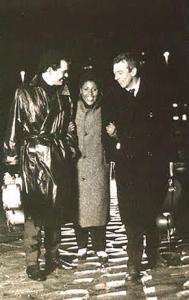
Simon Booth, Juliet Roberts and Larry Stabbins of Working Week

Simon Booth, Juliet Roberts and Larry Stabbins of Working Week

I’ve just had the pleasure of writing the liner notes to a really good new live album by Working Week, possibly the premier jazz/pop band of the 1980s.

It got me thinking about why jazz has totally disappeared from the charts and why the first half of the ’80s seemed the perfect time for jazz and pop to co-exist, especially in the UK.

Here an excerpt from the notes:

‘Does jazz go into pop? Judging by the current music scene, the answer would appear to be an unequivocal ‘no’, but, for a golden period in the early-to-mid ’80s, it seemed as if the two styles could happily co-exist.

Artists like David Sylvian, John Martyn, Hue and Cry, Elvis Costello, Kate Bush, The Rolling Stones, Sting, Danny Wilson, Swing Out Sister, Joe Jackson and Everything But The Girl smuggled some cool chords into the charts introduced the pop audience to players of the calibre of Kenny Wheeler, Harry Beckett, Lester Bowie, Michael Brecker, Ronnie Scott, Eberhard Weber, Sonny Rollins, Guy Barker, Kenny Kirkland and Branford Marsalis.

Sade, Carmel, The Style Council and Matt Bianco’s fusion of jazz and pop wasn’t everyone’s cup of tea but all of them had big hits. The Stranglers’ ‘Golden Brown’ was a jazz waltz (with a few bars of 4/4 thrown in) which got to number one!

The advertising and TV industries played ball and a full-scale jazz ‘revival’ was underway, documented in classic 1986 documentary ’10 Days That Shook Soho’. Courtney Pine and Miles Davis shared space on the UK album chart, Wynton Marsalis made the cover of Time and you could even catch Loose Tubes, Tommy Chase and Andy Sheppard on primetime terrestrial TV.

DJs Paul Murphy, Baz Fe Jazz, Patrick Forge and Gilles Peterson packed out Camden’s Dingwalls and the Electric Ballroom and young hepcats were dancing to Cannonball Adderley, Roy Ayers, Donald Byrd, Art Blakey and Lee Morgan.

Dancers at Dingwalls, London, 1988

Dancers at Dingwalls, London, 1988

Though older British jazzers such as Stan Tracey, Keith Tippett and Mike Westbrook (and some younger ones too) naturally viewed this latest revival with some suspicion, at least it was a relief from the extremely precarious ’70s when rock, funk and fusion almost subsumed jazz.

The old guard hung on, gigging in the back rooms of pubs, picking up occasional free improve shows in Europe or moonlighting in West End pit orchestras. But then punk came along, and it affected more than just disenfranchised young rock fans – its DIY ethos breathed new life into jazz too. Bands like Rip Rig + Panic and Pigbag made huge strides in engaging a youthful, receptive audience. Pigbag even made it onto ‘Top Of The Pops’…twice!

But it was Working Week, co-founded in 1983 by saxophonist Larry Stabbins and guitarist Simon Booth, who really typified the successful fusion of jazz and pop in mid-‘80s. Formed in 1983 from the ashes of jazz/post-punk outfit Weekend (whose ‘The View From Her Room‘ was a confirmed early-’80s club classic), initially Working Week was almost the de facto house band for the emerging scene, with the infectiously exuberant IDJ dancers often joining them onstage.

Robert Wyatt and Tracey Thorn duetted on classic single ‘Venceremos – We Will Win’ which briefly made an appearance on the UK singles chart in late 1984. The accompanying album Working Nights, featuring other Brit jazz legends Guy Barker, Harry Beckett and Annie Whitehead and produced by Sade’s regular helmer Robin Millar, reached a sprightly number 23 in the UK album chart soon after…’

Read more in the Working Week live album.

Scritti Politti: Cupid & Psyche 85 30 Years Old Today

Listening again to the brilliant Cupid 30 years after its release, I wonder if it sounds very dated to modern ears.

Whilst it unabashedly utilised all manner of mid-’80s technology (Fairlight, drum machines, sequencers), I don’t really ‘hear’ those elements any more. All I hear is top-notch songwriting, intriguing and intelligent lyrics, great grooves and Green’s unique vocals.

Cupid hit me at exactly the right age; it was the soundtrack to endless summer evenings, teenage crushes, adolescent musings.

Though Scritti leader/vocalist/co-songwriter Green Gartside left behind his post-punk roots and the ‘indie’ sound of his Rough Trade debut album Songs To Remember to create this major-label debut, Cupid certainly had antecedents: Green and keyboardist/co-composer David Gamson revered the highly-syncopated R’n’B/electro of The System, Chaka Khan, ZAPP and Michael Jackson, but they added some classic pop songcraft and intricate harmony.

Rough Trade boss Geoff Travis gave Green his blessing and, coupled with manager Bob Last (who also managed Human League and ABC), Green pitched the Americans his fusion of pop and funk. As he told WORD magazine in 2006, ‘The American labels were all tickled pink by these big NME interviews we did and that loosened their wallets. Bob and I were terribly persuasive as to why they should part with vast sums so we could make a record.’

Legendary Aretha/Chaka producer Arif Mardin came on board as did a raft of quality players such as Marcus Miller, Steve Ferrone, David (The System) Frank, Robbie Buchanan, Robert Quine and Paul Jackson Jr. But Green apparently turned out to be more of a perfectionist than any of them: ‘It took us a great deal of time to get our bits right and my anxiety about singing was pretty acute. I would demand to sing things over and over again and I’m not sure I ever got it better than the first time.’

Cupid featured three classic singles – ‘The Word Girl’, ‘Absolute’ and ‘Wood Beez (Pray Like Aretha Franklin)’, though eventually a total of five tracks were released as A-sides.

The John Potoker remix of ‘Perfect Way’ (far superior to the album version) even became a massive hit in the States, reaching 11 on the Billboard Hot 100 and pushing worldwide sales of the album over the million mark.

While ‘Don’t Work That Hard’ and ‘Lover To Fall’ might be deemed ‘filler’, they easily transcend that label by dint of their sprightly grooves and sheer catchiness. The beautiful ‘A Little Knowledge’ showed that Green and Gamson were on the same page as Prefab’s Paddy McAloon when it came to sumptuous, intelligent romantic ballads in the mid-’80s, and the track is a great companion piece to ‘When Love Breaks Down’.

Post-Cupid, Green and Gamson booked and then cancelled a world tour (they were apparently visited in the studio by MTV executives who told them, ‘Just think, you’ll never have to tour again!’), wrote songs for Al Jarreau and Chaka Khan, made friends with Miles (who covered ‘Perfect Way’ on Tutu), hung out with George Michael at various London nightspots, embarked on a year of press in America to cash in on the success of ‘Perfect Way’ and then reluctantly hit the studios of New York and London to record the follow-up Provision.

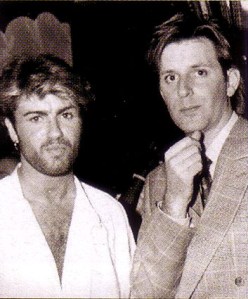
george michael green gartside

George and Green, London, 1986

A cursory listen to a radio station like Absolute 80s reveals the wide-reaching influence of Cupid on countless late-’80s bands: a-ha, Go West, Climie Fisher, Living In A Box, Pet Shop Boys, Bros and Aztec Camera all tried for those clinical, Swiss-watch-precision arrangements and uplifting pure pop sound, but generally lacked Gamson’s ingenious chord changes and Green’s gift for melody.

Happy birthday to a bona fide ’80s classic.

Simple Minds: Empires And Dance

Simple minds

Before their mid-‘80s commercial peak, Simple Minds were an art-rock band par excellence.

They fitted perfectly into the post-punk landscape and on Empires And Dance, their third album, they certainly wore their influences boldly on their sleeve – Kraftwerk, Can, Roxy, Joy Division, Eno, Magazine, Velvet Underground, ‘Lodger’-era Bowie – but combined them exceptionally well.

Musically very strong, with Derek Forbes’ memorable basslines very much to the fore, this uncompromising album combines motorik beats with doomy vocals, Eno-style ambience, jagged post-punk guitar and deliciously sludgy synths.

Jim Kerr’s travelogue lyrics compliment the music perfectly, snapshots of bleak European passport controls, attempted assassinations and wintery landscapes. Producer John Leckie brings his usual spirit of experimentation and lays on the brittle, creeping sense of paranoia.

Simple_Minds

While the one-chord grooves tire a bit on ‘Today I Died Again’, ‘Celebrate’ and ‘Capital City’, the Euro-funk of ‘I Travel’ and ‘This Fear of Gods’ chills the blood. ‘Twist/Run/Repulsion’ is almost an early example of sampling with its random speech, out-of-phase horn blasts and queasy, looped drums. Kerr channels Bowie’s ‘African Night Flight’ with his high-speed rap (though on the demo he took a different approach).

‘Thirty Frames a Second’ and ‘Constantinople Line’ almost approach the work of Throbbing Gristle and Gary Numan with their garish synth tones and forbidding atmospheres. ‘Kant Kino’, named after a Berlin art-house cinema, pits a slight but very catchy Charlie Burchill guitar melody against amplifier hiss, tape echo and synth drone; Eno would surely approve and the track was possibly an influence on U2’s ‘4th Of July’.

The closer ‘Room’ could almost have come from the first Velvet Underground album (though they could have done with playing to a click track; the song almost doubles in speed by the end…).


Empires And Dance peaked at #41 in the UK album charts. It might have gone higher had Arista Records pressed more than just 7,500 copies at a time. The band couldn’t get off that label fast enough (like Iggy Pop).

But Peter Gabriel became a major fan and took them on tour with him throughout October and November 1980, allegedly paying most of their expenses.

Empires And Dance is very interesting album indeed and a great companion piece to Bowie’s Berlin trilogy, Peter Gabriel III and Talking Heads’ Remain In Light.