The Stanley Clarke Band: Find Out @ 40

Like several other jazz/rock heroes of the 1970s, Stanley had a distinctly dodgy 1980s.

But the decade had a decent beginning (Rocks, Pebbles And Sand), middle (Find Out, released 40 years ago this month) and end (If This Bass Could Only Talk).

Circa 1989, this writer found a vinyl copy of Find Out in a weird (long-gone) record shop on Hammersmith Broadway called Trax, having no idea that it had ever been released.

As it turned out, the album was a fresh (but false) start for Stanley, arguably his best funk/pop record and a last shot at stardom, complete with ingenious ‘Born In The USA’ cover.

His bass playing could still knock your socks off but here it took a back seat to well-crafted, commercial songs plus a few decent instrumentals, all utilising top LA-based players/engineers/songwriters.

The liner notes reveal all. Many of the keyboards were played by Patrick Leonard, who had just finished a stint as musical director for the Jacksons’ Victory tour and was rehearsing for Madonna’s first US tour during the recording. He also had a hand in several compositions.

Stanley had also recruited his best drummer since Simon Phillips: Rayford Griffin. Their duels match anything he did with Steve Gadd and Gerry Brown during the ‘70s, and Griffin brought great grooves and arrangement-smarts too.

Then there was the presence of teenage soul prodigy Robert Brookins, a fine vocalist and keyboard player who had toured extensively with George Duke in 1983. Finally the album sounds great, helped by superstar engineers Chris Brunt, George Massenburg, Mick Guzauski and Tommy Vicari.

It’s full of catchy, easy-on-the-ear pop/soul tracks like ‘Don’t Turn The Lights Out Yet’, ‘Psychedelic’, ‘What If I Should Fall In Love’, the title track and ‘The Sky’s The Limit’. His Springsteen cover pushes the envelope, opening with a nod to John Coltrane’s ‘A Love Supreme’ and turning into a neat mash-up of rock, electro and old-school hip-hop, with mad bass solo thrown in for good measure.

The two synth-heavy instrumentals are a blast and the album closes with a kind of ‘School Days’ for the ‘80s called ‘My Life’, complete with superbly over-the-top Raymond Gomez guitar playing and Griffin drumming, much-imitated by yours truly back in the day.

Sadly Stanley followed up Find Out with the dismal Hideaway and his solo career arguably lost momentum. He mainly moved over to movie soundtracks in the ‘90s though made a partial return to top solo form in the mid-2000s. But if you want to mainline mid-1980s synth-funk heaven, you could do a lot worse than this.

Stanley Clarke: The Message

Stanley’s music first grabbed me sometime in the mid-’80s.

It was the bassist/composer’s incredible 1974 self-titled album featuring Tony Williams on drums, Jan Hammer on keyboards and Bill Connors on guitar.

Clarke remains a hero – I still greet his new albums with some enthusiasm and his career seems to have enjoyed a new lease of life over the last 10 years or so.

2006’s Toys Of Men was a huge return to form, and releases since then have been prolific if less impressive.

Which brings us to Stanley’s new album, The Message. It continues his tried-and-tested formula: some sh*t-kickin’, symphonic jazz/rock, vocal-based R’n’B, acoustic interludes with a classical bent and brief novelty curios featuring some guest star or other (this time Doug E Fresh on rapping and human beatbox).

On previous classics like School Days and If This Bass Could Only Talk, the formula worked a treat. But this time, besides the typically great playing, there are a few issues – with Stanley’s production, compositions and ‘message’.

The opener ‘And Ya Know We’re Missing You’ is a tribute to all of the following: Al Jarreau, Ndugu Chancler, Tom Petty, Chuck Berry and Larry Coryell. It sounds suspiciously like a demo, complete with distortion and rudimentary ‘slap in E’ groove. Sure, he can pay tribute to whoever he likes in whichever way he deems suitable, but this seems a really uncommitted two minutes of music.

A re-tread of the Return To Forever classic ‘After The Cosmic Rain’ also emphasises the problem with contemporary production. The new one sounds hemmed in, dried out, panicky. Drummer Mike Mitchell must take some of the blame too – he has perfected the lightning-fast single-stroke rolls but they get boring very quickly. It doesn’t help that he tunes his drums to choking point.

There are substantial pieces of music here: the title track, ‘The Rugged Truth’ and ‘The Legend Of The Abbas And The Sacred Talisman’ are great compositions which bear comparison with Stanley classics like ‘Light As A Feather’, ‘Life Is Just A Game’ and ‘Song To John’.

The acoustic-bass take on Bach’s Cello Suite is gorgeous too, but a few other tracks are beyond help – the treacly ‘Lost In A World’ and ‘To Be Alive’ irritate, while only Stanley knows what’s behind ‘Combat Continuum’, a nutty futuristic spoken-word/fusion piece about impending war.

What a shame. It could have been a classic, but The Message has 5/10 written all over it. It’s definitely one for filleting on streaming services though, and I’m sure the music will come alive in concert.

The Message is out now on Mack Avenue.

Stanley Clarke: If This Bass Could Only Talk

stanley_clarke-1988-if_this_bass_could_only_talk

This album was a substantial breath of fresh air when it came out in 1988.

I remember walking into Our Price and hearing Wayne Shorter’s majestic soprano sax over some swooning chord changes and thinking: ‘What the hell is this?!’

It was a relief and total surprise when it turned out to be Stanley’s cover of Mingus’s ‘Goodbye Pork Pie Hat’ (and what a brave choice of track to play in the shop…).

It wasn’t just the Baby Boom rockers who struggled a bit during the 1980s. Stanley started the decade very well with Rocks Pebbles & Sand but then there were a few middling collaborations with George Duke and a very patchy run of albums: Let Me Know You, Time Exposure and Hideaway. 1985’s Find Out had some brilliant moments though.

But ITBCOT put Stanley back on the jazz map. Its full-on playing – with admittedly a few late-’80s production values in tow – brought to mind classic ’70s albums Journey To Love and School Days. Drum machines were out: drummers were back in (Ndugu Chancler, John Robinson, Gerry Brown and Stewart Copeland, all of whom play beautifully).

The album also emphasised how much of a singular voice Clarke had now developed on piccolo bass, as distinctive on his instrument as Parker, Miles, Monk or Rollins were on theirs.

‘Working Man’ is an update of ‘Lopsu Lu’ from Stanley’s classic first album and features some ridiculously brilliant soloing leaning very heavily towards John Coltrane’s ‘sheets of sound’ approach.

Gerry Brown stays toe-to-toe with Stanley, providing some spectacularly-unhinged drums, though maybe with a bit too much ’80s ‘gated’ snare for some ears.

My cassette copy of ITBCOT didn’t have any personnel listed on it, so when I first heard ‘Stories To Tell’ I didn’t realise I was getting my first exposure to the extraordinary guitar playing of Allan Holdsworth.

I’m very thankful that Stanley unleashed Holdsworth onto my sensibilities. He delivers some remarkably-fluid playing with a shrill, almost reedy tone. The first and last four bars of his solo are really special. Copeland plays superbly too, with more restraint than usual.

Freddie Hubbard shines on a fine cover of Janet Jackson/Jam and Lewis’s ‘Funny How Time Flies (When You’re Having Fun)’ while Stanley brings the funk with a great take-off of Zapp’s Roger Troutman on ‘I Want To Play For You’.

Elsewhere there are two fun but rather dispensable duets with tapdancer Gregory Hines but they don’t outstay their welcome. Finally, ‘Tradition’ may feature Stanley’s finest recorded playing bar none and highlights a strong John McLaughlin influence (via Coltrane, of course).

In a much-maligned genre of music, ’80s fusion, ITBCOT is a minor classic that deserves critical reappraisal. It also led to a really good period for Stanley – he joined Shorter in Lenny White’s short-lived but intriguing Manhattan Project, and also toured as part of a supergroup with Herbie Hancock, Shorter and Omar Hakim.

Stanley was back, back, back!

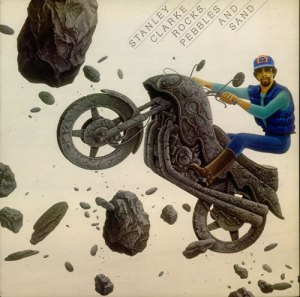
Stanley Clarke: Rocks, Pebbles And Sand

Stanley-Clarke-Rocks-Pebbles-And-543879

In 1979, Stanley recorded the sprawling double I Wanna Play For You which had some brilliant moments but also veered uncomfortably towards disco.

It also featured some outrageous live recordings which suggested he was going in a more ‘rock’ direction, mainly thanks to the sonic possibilities opened up by putting his Piccolo bass (tuned a fifth higher than a standard bass, A to C rather than E to G) through various effects pedals (see correction in the comments section below).

But how would Stanley start off the ’80s? On Rocks, Pebbles and Sand, he thankfully pushed the rock and prog-fusion rather than disco. It also really helps that it sounds very much like a ‘band’ project, apart from funk curio ‘We Supply’ which belongs on a different album altogether.

And what a band it is – Simon Phillips on drums, Charles Icarus Johnson on guitars and Steve Bach on keys. Phillips in particular is a perfect foil for Clarke with his meaty grooves and superchops. Though he was obviously coming from Billy Cobham with his prodigious double-bass playing, expansive tom fills and open-handed style (see below), his grooving on ‘Story of a Man and a Woman Part 2’ is just perfect.

Rocks, Pebbles and Sand‘s opener ‘Danger Street’ sounds like Stanley has been listening to The Who and Van Halen with its big drums, raucous guitar and gargantuan riff. Subtle it ain’t (and one can take or leave Stanley’s vocals), but it really works, mainly due to the mastering and mix – Rocks is one of the best-sounding albums of the era alongside Steely’s Gaucho, Lee Ritenour’s Rit and Zappa’s Sheik Yerbouti.

The duet vocals on ‘Underestimation’, ‘You/Me Together’ and ‘A Story of a Man and a Woman’ might put some people off, but isn’t that female voice familiar? A glance at the liner notes reveals a credit for one ‘Marcy Levy’ on vocals. It turns out to be none other than Marcella Detroit of Shakespeare’s Sister fame, an LA session singer in another life who had recorded and toured extensively with Eric Clapton (co-writing ‘Lay Down Sally’) before working with Stanley.

The funk/disco track ‘We Supply’ sticks out like a sore thumb but features a superb bassline from Louis Johnson and a hilarious spoken word intro from album engineer Dennis MacKay, proclaiming, ‘We supply all your funky needs!’ in the poshest voice you’ve ever heard. Git down and boogie with Dennis…

Stanley had a mixed ’80s to say the least, with a fair few misses but some big hits as well. Rocks is definitely one.