From Richard E Grant’s gloriously-English ‘Monty, you terrible c*nt!’ (‘Withnail & I’) to Harvey Keitel’s epochal ‘You rat-f*ck!’ (‘Bad Lieutenant’), modern cinema was made for despicable language.
Your mum told you that cursing was a sure sign of a limited vocabulary, but try telling that to writer/directors David Mamet, John Hughes, Bruce Robinson and Oliver Stone, who consistently broke out the memorable humdingers.
To celebrate the cinematic four-letter word, we proudly present some of the best swear scenes of the 1980s, in no particular order. A few rules: no cartoons, because…I hate them. And it has to be dialogue, not a stand-up routine or monologue. And yes, a few of these movies were released in 1990 but surely shot in ’89 (and I need them in the list…).
WARNING: this piece is rated X, not suitable for minors or those easily offended…
7. ‘Casualties Of War’ (1989)
We start with the only ‘serious’ item in the list, a well-placed profanity during one of the more poetic dialogue scenes in this underrated David Rabe-penned, Brian De Palma-directed drama.
6. ‘Planes, Trains And Automobiles’ (1987)
Steve Martin’s ’70s stand-up act wasn’t particularly known for the four-letter tirades, but he had his moments (including the memorable skit on The Steve Martin Brothers album that begins: ‘Well, good evening, motherf*ckers…’). But this endlessly-watchable John Hughes-penned blowout had even Steve’s hardcore fans hiding behind the sofa. The scene is also notable for featuring the brilliant Edie McLurg.
5. ‘Scarface’ (1983)
De Palma’s drama is surely the doyenne of swear movies, so we won’t pick out a single Oliver Stone-penned humdinger but rather itemise the entire film’s swearing thus. Thank you, YouTube (according to an urban myth, the band Blink-182 were named after the amount of f-words Pacino drops in ‘Scarface’).
4. ‘Withnail & I’ (1987)
Impossible to leave out Bruce Robinson’s sweary masterpiece, a killer in almost every line of dialogue. But every profanity in the film earns its keep, none more so than this panic-stricken classic.
3. ‘This Is Spinal Tap’ (1983)
Apparently performed very much under the influence of the notorious Troggs Tapes, this beautifully conjured the annoyances of a duff recording session. I particularly like David St Hubbins’ (Michael McKean) moment of total exasperation, when words begin to fail him. Here’s the full uncut version:
2. ‘The Godfather Part 3’ (1990)
Pacino again, and why not? When Shouty Al gets going, there’s always a good chance he’s going to deliver some quality swearing. In this unsung sequel, he remains fairly buttoned up until basically going ballistic…
1. ‘Goodfellas’ (1990)
Tommy (Joe Pesci) meets ‘old friend’ Billy Batts (Frank Vincent) who is none too complimentary about the days when Tommy used to shine shoes…
BONUS! Let’s extend our look at great swear scenes into the 1990s. Because we can…
4. Bad Lieutenant (1992) The Bad Lieutenant (Harvey Keitel) is driving his two young sons to school.
Boy 1: Aunt Wendy hogged the bathroom… All morning we couldn’t get in… So how are we supposed to be on time? The BL: Hey, listen to me. I’m the boss, not Aunt Wendy. When it’s your turn to use the bathroom, tell Aunt Wendy to get the f*ck out. What are you, men or mice? If she’s hogging the bathroom, call me, I’ll throw her the f*ck out…
3. One False Move (1992) Pluto (Michael Beach) and Ray (Billy Bob Thornton) drive along having a row about the money they’ve stolen, which Ray may have given to his girlfriend…
Pluto: Where’s my f*cking money, Ray? Ray: I said I ain’t got any money. She took the f*cking money, all right? I’ve got 56 f*cking dollars, she took it, now let me go. Pluto: You’re a pussy-whipped motherf*cker! Ray: Don’t throw that sh*t at me, man. They’re your f*cking buddies back there that don’t have any money. That good friend of yours, Billy. Pluto: I don’t know what the f*ck I’m doing with you, man! You’re a pussy-whipped, sorry-assed motherf*cker!
2. Glengarry Glen Ross (1992) Blake (Alec Baldwin) turns up at a real estate office and makes his presence felt amongst the salesmen…
1. Fargo (1996) Carl (Steve Buscemi) wants to leave a car park but the Attendant (Don William Skahill) isn’t making it easy…
In a recent podcast, Donald Fagen spoke about the importance of vocal tone, saying that he’d rather listen to Ray Charles singing a mediocre song completely ‘straight’ than a jazz singer pointlessly embellishing a songbook standard.
It got me thinking about Phyllis Hyman’s crackerjack performance on ‘I’ll Be Around’ (not to be confused with the Alec Wilder standard sung by many including Frank Sinatra and Chaka Khan), from McCoy Tyner’s 1982 CBS album Looking Out.
The song, which has haunted me since I first heard it in the late 1980s, was mainly written by Stanley Clarke and recycled from his lacklustre (despite featuring Stan Getz on saxophone) 1979 track ‘The Streets Of Philadelphia’. ‘I’ll Be Around’ comes from an otherwise fairly mediocre McCoy album, mainly notable for featuring Carlos Santana, Clarke and Gary Bartz on several tracks.
But Tyner’s fabled work with John Coltrane must have seemed a distant memory by 1982. In jazz terms, CBS was obsessed with Wynton Marsalis and neo-classicism, though still had time for Herbie Hancock’s hip-hop explorations and Miles’s comeback.
Phyllis and McCoy in the studio
Maybe McCoy in turn thought he’d hit paydirt by grabbing Santana, Bartz and Clarke (huge Coltrane fans, all), but Looking Out is now barely a footnote to his illustrious career – it was his second and last album for Columbia.
‘I’ll Be Around’ doesn’t feature Santana or Bartz, and was the sole LA-recorded track on the album (the other tracks being recorded at the Power Station in NYC), adding the excellent pairing of Charles ‘Icarus’ Johnson on guitar and Ndugu Chancler on drums.
Chancler and Tyner work together almost telepathically, the former driving the song forward, though always with one ear on the groove, the latter sprinkling on his majestic chord voicings. Hyman’s vocals are huge, luscious, but she also adds some subtle flavours over Tyner’s piano solo, consciously removing vibrato and sometimes singing ever-so-slightly sharp for emotional effect.
Of course it’s virtually impossible now to assess this heartfelt performance without considering her tragic suicide in 1995. But, happily, ‘I’ll Be Around’ gives a different slant on a fine career and shows Hyman’s mastery of Black Music.
The great jazz/rock pioneers of the early 1970s generally had a very mixed 1980s.
But when keyboard genius Jan Hammer left the Mahavishnu Orchestra in 1973, no-one could have predicted that he’d become a bona fide pop star just over ten years later.
Two fascinating albums – originally on CBS, now re-released as a two-fer by BGO – trace Hammer’s early-1980s journey to ‘Miami Vice’, via a collaboration with Journey/Santana guitarist Neal Schon.
Of course Hammer had spent a few years in the late ’70s touring big venues with Jeff Beck and making ever-rockier solo albums. But Schon was probably a more successful musician than Hammer in 1981, if a more anonymous one – his playing has a lot of chops but isn’t particularly distinctive.
The first Schon/Hammer album, 1981’s Untold Passion, has a pleasingly dry, lo-fi quality, recorded solely at Hammer’s home studio in upstate New York, with the Czech genius also playing some great drums and engineering. The musicianship is exemplary and the sound has a real consistency. Unfortunately the same can’t always be said of the material.
Schon’s Phil Lynott-like vocals have some charm, particularly on the excellent ‘Hooked On Love’ and ‘I’m Talking To You’, but predictably it’s the three instrumentals that really do the business.
‘The Ride’ is a super-catchy Schon composition, while Hammer’s ‘On The Beach’ and the title track look forward to ‘Miami Vice’, the latter with a distinct Giorgio Moroder flavour and some kick-ass solos.
The second album, 1982’s Here To Stay, is less successful, adding a cameo from the other members of Journey and lots of stereotypical 1980s production values, and the duo are obviously making a far more concerted effort to get onto MTV.
They made it with the crunching ‘No More Lies’, and almost grabbed a minor hit too. The hilariously ill-judged video is well worth a look.
Neither Untold Passion nor Here To Stay were big hits – the former stalled at #117 in the US album charts, the latter sunk without trace, but these are really interesting projects for Hammer fans. When they work, they really work, and there are some great instrumental duels between the two virtuosos.
The genre ‘sophisti-pop’ is bandied about quite a lot these days – mainly ’80s music of an ‘aspirational’, elegantly-appointed variety, jazzy in hue with slinky grooves and dense harmony.
Dundee band Danny Wilson were one of its key practitioners and their second and final album Bebop Moptop, released 30 years ago this week, is a key exhibit.
And yet, despite featuring hit single ‘The Second Summer Of Love’ and a host of other superb compositions, Bebop has somehow fallen off the ’80s pop radar – it has never received the deluxe re-release treatment. (Nor, for that matter, has Danny’s superb debut Meet Danny Wilson...)
But it’s definitely due a critical reappraisal. So we caught up with singer/principal songwriter Gary Clark to discuss the ‘lost’ Danny Wilson album and loads of other stuff.
MP: Preparing for album number two, were there record company expectations? Presumably ‘Mary’s Prayer’ opened the door and Virgin wanted ‘the big hit’? You give (Virgin MD) Simon Draper credit in the liner notes for staying out of the way…
GC: That pressure is there in some form but doesn’t necessarily come from the record label. It comes from your own desire to be competitive, from management, from peers. The trick is trying to stay true to your artistic vision, and I think we always managed to fall on the artistic side of that seesaw.
There were rumours that a few big American producers almost came onboard for Bebop – is there any truth in that?
Our plan was always to record every song in Dundee with our friend Allan McGlone who had a studio in town, and at some point to bring in an outside influence to tie up the loose ends and add some perspective. We did that and throughout the process were keeping an open mind about that third party. We did meet Don Was. He came to the studio in Dundee. We played him a few tunes and went out on the town. A lovely, talented and very cool gentleman. Schedules didn’t pan out though and no more came of it. Ged suggested Fred DeFaye as he’d been listening to Eurythmics’ Savage album. We met and hit it off and pretty quickly decided to work together.
Were there any more contemporary influences going into Bebop? I hear some Prince and Pogues here and there and you play a lot more lead guitar on this than you did on Meet Danny. A conscious decision or just doing what’s right for the songs?
On the guitar, definitely the latter. I probably play just as much guitar on Meet Danny but it’s maybe more upfront on Bebop. On our influences, I guess what people are listening to has a constantly fluctuating and evolving influence, and you had three individuals all with very eclectic taste contributing. We were very open in the creative process so nothing was off limits.
‘The Second Summer Of Love’ was incredibly prescient and the hit single from the album – where did it come from? Was it a late addition?
It was definitely written in the fourth quarter of songs for that record. It was a day where we were all huddled round a phone at my girlfriend’s flat doing phone interview after phone interview. I needed to take a break so walked to the local store to buy snacks for everyone and it came to me in one piece. I had to grab a guitar when I got back, to work out and lay down on a Dictaphone what was in my head. It was originally a-minute-and-a-half long and the US label bosses heard it and asked us to extend it because they believed it was a potential radio hit. We went back into the studio and added a bridge and a harmonica solo. Ironically, it was never released as US single…
Talking of singles, I count ‘I Was Wrong’ as a missed opportunity…
After hearing a demo, the label thought so too and they encouraged us to record an early version with producer Phil Thornally. As often happens with early versions, it was never released and by the time it came to pick singles, everyone had lived with that song for around a year and it fell by the wayside when being held against newer songs that were fresher in peoples’ psyches.
The fantastic ‘Loneliness’ seems to be beamed in from a totally different world. Can you remember the genesis of that song?
Another song that I wrote mainly in my head, and indeed, in my bed. I remember sitting up with a note pad writing out the lyric like a poem at 2 or 3 in the morning. I had a melody in mind, and hashed out the musical elements on the piano over the following days and weeks.
The ‘Imaginary Girl/Shirley MacLaine’ prologue/epilogue is such a neat touch – did you ever think of Bebop as a ‘concept’ album?
Not the album as a whole, but I was aware in the writing of pockets of songs that were designed, almost like musical theatre, to live together.
Bebop got some great reviews including a rave in Q magazine, but I also remember a snarky interview in the Melody Maker… Did you care about reviews?
The music press was very powerful at that period of time and, of course, bad reviews sting. And very occasionally, when they have the ring of truth, they actually influence your thought process. But generally I would say that by the time of the second album, we had become more hardened to reviews good and bad.
You toured Bebop (I was there at London’s Town & Country Club). Did you enjoy playing this stuff live? There was a rumour that the drummer (whose name escapes me) cost more than the rest of the band put together…
Drummer Bobby Clarke and percussionist Karlos Edwards were cousins, and came as a team. They auditioned for us in London and we knew immediately that we needed them in the band, and they were such wonderful guys and wonderful musicians who brought so much to the DW party. All of the band were paid equally, but by album two we were playing bigger venues and so that would have meant higher wages than on the first album, just by the nature of economics of playing to more people.
Did you know during its recording that Bebop would be the band’s final album? Were there ever plans for record number three?
We started the songwriting process for number three and even recorded demos for a few songs that became part of my later solo album Ten Short Songs About Love but it became clear that everyone involved wanted a larger part of the writing and that would’ve meant me diminishing my input, which wasn’t going to happen, so I would say that – certainly for me – it was the underlying source of unhappiness that ultimately came to a head and ended the band.
What do you think of the Danny legacy now? Any regrets? Any temptation to do the ’80s nostalgia thing and reform, even just as a one-off?
I’m proud of what we achieved in a short period of time and I miss the creative process of working with Ged and Kit, who were and are exceptionally talented and creative people. Nostalgia is not something that any of us feed off but I would never say no to doing something if it was forward-thinking and creative. On regrets, I don’t really think about it, but if we had been able to take a break from living in each other’s pockets and faces, and stepped back a bit, we might’ve been able to keep the band going in some capacity. We are still great friends – Ged and Kit still occasionally play on music I’m involved in. They also both have amazing and separate careers in music, with a billion things going on (Ged is currently the bass player with Simple Minds – Ed.) so getting us all available at the same time would require a miracle of logistical organisation.
When we last spoke, you had just finished co-writing a lot of excellent songs for the movie ‘Sing Street’. What are you up to at the moment?
I’m executive music producer on John Carney’s new Amazon TV series ‘Modern Love’ and have played a large role in curating, producing, co-writing songs and and doing the score for that series. I even sing a little! ‘Sing Street’ is in production as a stage musical too, and is scheduled to open at the New York Theatre Workshop in their 2019/2020 season. The whole team and cast are incredible and I’m very excited about that. I’ve also been writing the musical ‘Nanny McPhee’ with Emma Thompson, which has been a thrill, and between Emma and John Carney I get to work with the most creative, talented, smart and funny collaborators that anyone could wish for. I feel very blessed and am, quite possibly, having the time of my life.
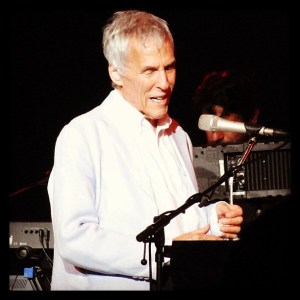
In an interview, Randy Newman once talked about how, on his self-titled debut album, he tried to use the orchestra rather than the drums to ‘move things along’.
It was impossible not to think about that while watching Burt Bacharach’s triumphant Hammersmith gig last night, featuring a large band and huge string section.
This is music relying on texture, melody and counterpoint – it’s the world of Pet Sounds and Oliver Nelson’s The Blues And The Abstract Truth, with barely a guitar lick or drum fill.
Every chord has a flavour and intention – but few of the voicings are quite how you remembered them. ‘I’ll Never Fall In Love Again’, ‘This Girl’s In Love With You’ and ‘Alfie’ were elliptical and mysterious last night, with beautiful, ‘floating’ harmony.
Joss Stone treats any stage like her backyard, totally at ease, barefooted and gorgeous. And if she did a great job on the melodic, medium-paced material (‘Walk On By’, ‘Wishin’ And Hopin”, ‘Say A Little Prayer’), sometimes there was a ‘screechy’ element to her voice when improvising on the slower tracks.
And some may have found her between-song ‘chats’ with Burt a little mawkish. But to be fair he did tell some good stories, particularly the one about being inspired by Ursula Andress – not his then-wife Angie Dickinson – to write ‘The Look Of Love’ for the original ‘Casino Royale’ movie.
And though Hal David’s name was only mentioned once by Bacharach, the lyricist’s influence hung heavy over proceedings. It came to mind just how brilliantly he evoked the nooks and crannies, the high stakes, of all romantic relationships, particularly when one party is looking for the door.
The inclusion of some more recent stuff was a revelation to this writer, particularly a couple of fervent – though musically gentle – anti-Trump songs, and the remarkable Elvis Costello co-write ‘This House Is Empty Now’, with its stratospheric middle eight and an excellent vocal from John Pagano.
‘On My Own’ and ‘Close To You’ were reinvented as spine-tingling, slow-motion ballads, even slower than the originals, while Josie James’ powerful take on ‘Anyone Who Had A Heart’ got the biggest ovation of the evening. Such is Bacharach’s range as a songwriter, you kept hoping he would throw in a few more outliers, ‘Arthur’s Theme (Best That You Can Do)’ or ‘Love Power’.
But ‘That’s What Friends Are For’ was the perfect closer, sending us out into that good night with a smile (though it was odd that Joss didn’t return for a final song).
One left the gig uplifted but also, truth be told, emotionally spent. Still, it was a weird, wonderful, affecting two hours of pop music. And you try to tell the kids these days…
Tackhead have always been ahead of their time, but no one could have predicted quite how prescient their 1989 album Friendly As A Hand Grenadewould prove.
When Trump became president in 2016, Gee Vaucher’s brilliant cover artwork went viral, though one wonders how many people knew the image’s origins.
In a way that’s a good metaphor for the band’s career. A supergroup of session players, and arguably the ultimate post-punk band in their effortless fusion of hip-hop, P-funk, agit-prop, dub, house, gospel, blues and industrial, Tackhead have never quite hit the mainstream, even while their respective careers flourished with other artists.
And that’s probably exactly how they like it. Tackhead has always been a kind of musical petri dish for each member’s explorations, kind of a funk version of 1980s King Crimson.
Bassist Doug Wimbish, drummer Keith LeBlanc and guitarist Skip McDonald had of course hooked up during their legendary sessions for Sugarhill Records, and vocalist Bernard Fowler was one of the great singers on the ’80s New York scene.
Add London-based mixologist/dub innovator Adrian Sherwood and it was a whole new thang, mixing the latest sampling technology with classic funk-rhythm-section smarts.
And if their second album Friendly, released 30 years ago this weekend, hasn’t dated as well as hoped, that’s more down to its mastering limitations (not enough bottom end) and occasional dearth of quality original material.
But when it works it really works, a thrilling mix of heavy guitar, funk basslines, tasty grooves, soulful vocals and scary samples, usually with a political element.
‘Mind And Movement’ steals a march on Heaven 17’s ‘We Don’t Need This Fascist Groove Thang’, a funky missive against Margaret Thatcher’s late-’80s policing policies. ‘Stealing’ is a grinding, gospel-tinged rail against TV evangelists.
The two ska cameos are pure filler, but side two is much better, kicking off with the classic Tackhead theme tune ‘Airborne Ranger’, and gradually adding in elements of old-school hip-hop and early house.
Friendly was a hit, reaching #3 on the UK Indie album chart and reportedly selling over 100,000 worldwide. The majors smelt a hit; EMI subsidiary SBK came calling with a big advance and huge recording budget (LeBlanc puts it at around £250,000), resulting in the 1990 major-label debut Strange Things, which had some brilliant moments but has been been described by a few band members since as ‘crap’.
Arguably the better follow-up to Friendly was the 1994 Strange Parcels album Disconnection, credited as a ‘A Tackhead Re-Duction’.
Elsewhere, Wimbish went on to great things with Living Colour, McDonald formed the potent Little Axe and Fowler became a key member of the Rolling Stones touring entourage. And they all continued to work with fascinating On-U Sound outliers Mark Stewart and Gary Clail.
But the ‘real’ Tackhead sound has probably never adequately been captured on record – the gigs were (and are) where it’s at (and highly recommended is their live anthology Power Inc. Volume Three).
There was a memorable March 1989 show at London’s Town & Country Club, and I went to many great gigs in the capital during the early 1990s and beyond. The band’s fans were (and are) an incredibly disparate bunch, from Whirl-Y-Gig crusties to B-boys and musos.
And they’re still with us. Don’t miss them if they come to your town – they’re still doing some of the best stuff out there.
37. Bireli Lagrene: ‘Rue De Pierre Part 3’
A triumph of solo guitar, and the only acoustic solo in this list, Bireli stunned the cognoscenti with this track from his 1988 Steve Khan-produced album Foreign Affairs.
36. Bros: ‘Chocolate Box’ (Guitarist: Paul Gendler)
Yes, Bros… Gendler had been a fully-paid-up member of New Romantic nearly-men Modern Romance before becoming an in-demand player on the UK scene, and he enlivened this hit with a raunchy, nimble classic.
35. REO Speedwagon: ‘Keep On Loving You’ (Guitarist: Garry Richrath)
Unreconstructed, huge-toned, double-tracked solo which revels in being almost out-of-tune throughout. Its sheer, brilliant in-your-faceness always comes as somewhat of a shock.
34. George Benson: ‘Off Broadway’
Slick, tasty solo from a truly great player. The tune is a Rod Temperton-penned, post-disco beauty from Give Me The Night.
33. Killing Joke: ‘Love Like Blood’ (Guitarist: Geordie)
This is ‘just’ a melody, but it’s a great melody, escalating in volume and intensity.
32. Phil Upchurch: ‘Song For Lenny’ (Guitarists: Phil Upchurch/Lenny Breau)
A couple of superb solos from a great, totally forgotten 1984 Upchurch solo album Companions. Breau stuns with his array of false harmonics and jazzy runs, while Upchurch brings the blues feeling.
31. Frank Zappa: ‘Alien Orifice’
It’s nice to hear Frank blowing over a few changes rather than his usual one or two-chord vamps. And he really gets a nice ‘flowing’ thing going here, right in the middle of one of his densest compositions. Starts at around 1:32:
30. Cameo: ‘A Goodbye’ (Guitarist: Fred Wells)
From the classic album Single Life, this solo goes way over and beyond the call of duty for an ’80s soul ballad. But it’s mainly included for its brilliant final flourish, spitting notes out like John McLaughlin. Who is Fred Wells and where is he now?
29. Rush: ‘YYZ’ (Guitarist: Alex Lifeson)
Hard to do without this flowing, creamy, Strat-toned classic on one of the great rock instrumentals of all time (though inexplicably it lost out to The Police’s ‘Behind My Camel’ at the Grammies…).
28. Kevin Eubanks: ‘That’s What Friends Are For’
A real hidden gem from the almost impossible-to-find Face To Face album, Eubanks lays down a short but beautifully-structured solo on a cool cover version.
27. Steve Miller Band: ‘Abracadabra’
Good fun and totally unpredictable. Also notable for its lovely Spanish-style flurry of triplets in its last two bars.
26. Starship: ‘Nothing’s Gonna Stop Us Now’ (Guitarist: Corrado Rustici)
Cheesy? Maybe a bit, but who cares when it’s this well-structured and performed. Add a great tone, nice string-bending and a lovely phrase at the end and you’ve got a classic.
25. Queen: The Invisible Man (Brian May)
May played a lot of great solos in the late 1980s, mostly on other people’s records (Holly Johnson, Fuzzbox, Living In A Box etc) but this one was just a kind of ‘play as many notes as possible in eight bars’ solo, and it’s a killer.
24. Lee Ritenour: ‘Mr Briefcase’
Rit found the sweet spot on his Ibanez many times in the early ’80s, no more so than on this single that kicked off the classic Rit album. The solo also sounds double-tracked too, no mean feat considering the crazy bunch of 32nd notes at the end of bar 10.
23. Michael Jackson: ‘Wanna Be Startin’ Something’ (Guitarist: David Williams)
Not so much a solo as a suddenly-foregrounded riff, Williams became one of the most in-demand US session players after laying down this classic.
22. Pat Metheny: ‘Yolanda You Learn’
A marvellous, ‘singing’ guitar-synth solo from the First Circle album, rhythmically interesting and reflecting a strong Sonny Rollins influence, also closing with a cool quote from the standard ‘My One And Only Love’.
21. Frank Zappa: ‘Sharleena’ (Guitarist: Dweezil Zappa)
Frank’s son was apparently just 14 years old when he laid down this absurdly fluid cameo.
20. Eric Clapton: ‘Bad Love’
Nice to hear Eric pushing himself for once, delivering a striking solo played right at the top of the neck, demonstrating a mastery of string-bending and precise fingering.
19. Sadao Watanabe: ‘Road Song’ (Guitarist: Carlos Rios)
A classic rock/fusion solo, all the more impressive because it’s apparently double-tracked, from the album Maisha. Rios is still one of the most in-demand session players in Los Angeles (and one of the few leftie fusion players…), probably best known for his work with Gino Vannelli, Chick Corea and Lionel Richie.
18. Prince: ‘Batdance’
It’s the unapologetic volume and raucous tone, almost distorting it’s so hot in the mix.
17. David Sanborn: ‘Let’s Just Say Goodbye’ (Guitarist: Buzz Feiten)
Feiten seems a weirdly unrecognised figure in the guitar fraternity, but he contributed some great stuff to Sanborn’s seminal Voyeur album including this tasty break over a killer Marcus Miller/Steve Gadd groove. There are some lovely moments when Sanborn’s sax cuts in to augment his solo.
16. Paul Simon: ‘Allergies’ (Guitarist: Al Di Meola)
I love hearing ‘jazz’ musicians turning up on ‘pop’ records, and this is a classic of its kind featuring all of Al’s trademark licks in one short, tasty burst. It’s a lot more fun than listening to his solo albums, anyway…
15. Manhattan Transfer: ‘Twilight Zone’ (Guitarist: Jay Graydon)
At a time when he was getting much more into the production game, Graydon still found time to toss off a double-tracked showstopper on this hit single. All in a day’s work for the session genius who of course unleashed the famous solo on Steely Dan’s ‘Peg’. Speaking of which…
14. Steely Dan: ‘Glamour Profession’ (Guitarist: Steve Khan)
A mini masterpiece of precision and invention. Khan is given his head and takes the classic tune OUT in the last three minutes. When the chord changes, he changes.
13. King Crimson: ‘Elephant Talk’ (Guitarists: Adrian Belew/Robert Fripp)
Two great solos for the price of one on this Discipline opener. Fripp supplies the opening horn-like curio, then Belew adds some fire and a bit of famous elephantosity for good measure.
12. Living Colour: ‘Funny Vibe’ (Guitarist: Vernon Reid)
A classic modern blues solo from a modern master, adding excitement and elan to an already burning piece, helped along by Will Calhoun’s cajoling kit work.
11. Steely Dan: ‘Third World Man’ (Guitarist: Larry Carlton)
Another day, another classic Steely guitar solo, this one recorded in 1977 during the Aja sessions but not unleashed for another three years. Again, double-tracked for lasting power, featuring a superb mastery of tone and melody.
10. Wendy & Lisa: ‘Waterfall’ (Guitarist: Wendy Melvoin)
Sadly this is my only female entry in the list (more suggestions please), but it’s a fuzz-toned, anthemic treat, with shades of Santana and McLaughlin.
9. The Police: ‘Driven To Tears’ (Guitarist: Andy Summers)
It’s the random, off-the-cuffness that appeals on this one. Summers sounds a lot more p*ssed off than usual, possibly reeling from yet another Sting jibe.
8. Steve Vai: ‘Call It Sleep’
Just a superb guitar composition from top to tail, but the moment at 1:22 when he stomps on the distortion pedal and rips it up is a great moment of ’80s music.
7. Propaganda: ‘Dream Within A Dream’ (Guitarist: Stephen Lipson)
Lipson modestly provided three or four extremely memorable guitar features during his golden ZTT period (not least Frankie’s ‘Two Tribes’), but this one gets extra points for its infinite reverb and a dynamite fuzztone.
6. Orange Juice: ‘Rip It Up’ (Guitarist: Edwyn Collins)
Just a funny two-fingers-up to the well-made solo, and also a fond homage to Pete Shelley’s famous break on Buzzcock’s ‘Boredom’.
5. Frank Gambale: ‘Credit Reference Blues’
Just wind him and watch him go. It starts slowly, almost wistfully, but then becomes a fire-breathing classic. Still scary after all these years.
4. Dire Straits: ‘Romeo And Juliet’ (Guitarist: Mark Knopfler)
The closing solo is just an oasis of choice phrases and unique tones.
3. Van Halen: ‘One Foot Out The Door’ (Guitarist: Eddie Van Halen)
Of course ‘Beat It’ is the industry standard, and possibly the greatest guitar solo of all time, but I’m going for this curio which closes out the oft-forgotten Fair Warning album. He just blows brilliantly over the changes with a gorgeous tone.
2. Jeff Beck: People Get Ready
The second and last solo is the one, a feast of Jeff-isms. A rare good bit from the rather poor Flash album.
1. Stanley Clarke: ‘Stories To Tell’ (Guitarist: Allan Holdsworth)
No chucking out any old solo for our Allan – this is a brief but fully-formed, perfectly structured, wide-interval classic that is easily the best thing about the tune. He seems to get a bit ‘lost’ in the middle, but then regroups for a stunning closing section over the rapid chord changes.
A sense of contour, of line, a bit of flash, a good tone and maybe a touch of storytelling.
Luckily for us, the 1980s featured an embarrassment of riches on the guitar solo front, a decade when you could hear everything from post-punk insanity, avant-garde weirdness, shock-and-awe widdlefests and sometimes perfect little compositions in themselves.
Sometimes great solos came from the guitarist in the band, but more often than not they came from the ‘ringer’, the session player. Truly great players of all stripes could find themselves blowing on a top 10 single. Their job was to add the pizzazz, the zing, the memorable bit that all the kids wanted to learn.
So here’s a selection of goodies from the guitar-shaped chocolate box, featuring some rock, some blues, some fusion, some soul, some new-wave, some pop, some metal, some funk, some jazz:
27. Lloyd Cole And The Commotions: ‘Forest Fire’ (Guitarist: Neil Clark)
26. Tears For Fears: ‘Everybody Wants To Rule The World’ (Guitarist: Neil Taylor)
25. Marillion: ‘Easter’ (Guitarist: Steve Rothery)
24. Michael Hedges: ‘Aerial Boundaries’
The whole thing is a solo, of course, but it’s one of the most astonishing examples of solo guitar in recording history, a mixture of tapping, strumming, thumping and hammering. There are no overdubs and a very strange tuning on the classic title track to Hedges’ 1984 album.
23. Tribal Tech: ‘Tunnel Vision’ (Guitarist: Scott Henderson)
A perfect solo from the jazz/rock master’s album Nomad. It’s so complete it sounds almost pre-composed (apparently only the first eight bars were hummed to him by the tune’s writer Gary Willis), each interesting idea following completely logically from the last.
22. Talk Talk: ‘I Don’t Believe In You’ (Guitarist: Robbie McIntosh)
This one taken from the classic album The Colour Of Spring can be filed in the ‘minimalist’ category, but it’s brilliant. The way the veteran Pretenders/McCartney guitarist bends into his last note, perfectly fitting with the key change, is sublime.
21. Johnny Guitar Watson: ‘Telephone Bill’
Johnny G pulled out all the stops for this barnstorming bebop-meets-blues breakdown, from the Love Jones album, closing out his funny proto-rap in some style. He also gets extra points for quoting Dizzy Gillespie’s ‘Salt Peanuts’.
20. Bootsy Collins: ‘Kissin’ You’ (Guitarist: Stevie Salas)
From Booty’s now forgotten 1988 album What’s Bootsy Doin’, a brief but flamboyant classic from one of the great unhinged metal guitarists of the decade, used as a ringer by George Clinton, Bill Laswell and Shakespear’s Sister to good effect.
19. Thomas Dolby: ‘Budapest By Blimp’ (Guitarist: Larry Treadwell)
The LA-based guitarist was part of a Christian duo backing the Pope on his infamous ‘Popemobile’ tour of American stadiums when he answered Dolby’s magazine ad, and he excelled himself on this epic track from Aliens Ate My Buick, coming up with a strong melody over the funky break and even throwing in a little Dave Gilmour homage.
18. Trevor Rabin: ‘I Can’t Look Away’
The title track of the Yes guitarist’s 1989 solo album was a song of two brilliant solos, but I’m going for the opening salvo, a brutal, flashy classic that features all the notes he knows and more.
17. Robert Cray: ‘Waiting For The Tide To Turn’
You could choose almost any solo from Mr Cray’s Bad Influence album, but this one seems to be best encapsulate his classy string-bending, snappy rhythmic sense and ice-cold Strat tone.
16. Nile Rodgers: ‘Stay Out Of The Light’
A brilliant player not necessarily known for his solos, but this closing track from his forgotten second solo album B Movie Matinee opened the floodgates – a fantastic mixture of Charlie Christian and Jimmy Nolen. Starts at 3:37:
15. John McLaughlin: ‘The Wait’
McLaughlin plugs in the Les Paul and unleashes one of the most vicious solos of his career, gradually developing in intensity, with even a touch of his old mucker Carlos Santana at times. Unfortunately it mostly fell on deaf ears, coming from a nearly-forgotten 1987 album Adventures In Radioland.
14. Defunkt: ‘Eraserhead’ (Guitarist: Ronnie Drayton)
One of those unhinged solos that starts at ’11’ and then just carries on in the same vein. The underrated session great is given his head and goes for it. From the punk/funk legends’ forgotten, excellent 1988 comeback album In America.
13. Yngwie J. Malmsteen: ‘Black Star’
This piece, kicking off the Swede’s Rising Force opus, is a guitar masterclass from top to tail, but the first few minutes demonstrate some extraordinary touches like a legato section that you’d swear was achieved with a delay pedal.
12. Stanley Clarke: ‘Straight To The Top’ (Guitarist: Carlos Santana)
The song – which kicked off Stanley’s 1981 career nadir Let Me Know You – may be a disco cheesefest but Carlos’s solo is a stonker, an emotive showstopper with a luscious, creamy tone and lots of emotional moments. It was a good period for Santana – see also Herbie Hancock’s ‘Saturday Night’ and Carlos’s own ‘Stay Beside Me’ and ‘Song For Devadip’.
11. It Bites: ‘You’ll Never Go To Heaven’ (Guitarist: Francis Dunnery)
The Cumbrian gunslingers wrote a great ballad here and Dunnery laid his claim as one of the great Brit guitarists of the ’80s with this extreme solo, a sometimes lyrical, sometimes demented mixture of flash and panache. From the lads’ debut album The Big Lad In The Windmill.
10. Billy Idol: ‘Rebel Yell’ (Guitarist: Steve Stevens)
He produced several memorable moments alongside the 6’2” blond bombsite born William Broad, but Stevens excelled himself here with a memorable, well-organised solo full of flashy bits and unexpected ‘outside’ notes.
9. Joe Satriani: ‘Ice 9’
Satch’s sophomore album Surfing With The Alien of course produced some guitar highlights but this track featured one of his most distinctive solos ever, Allan Holdsworth meets Eddie Van Halen.
8. Randy Crawford: ‘You Might Need Somebody’ (Guitarist: Steve Lukather)
This gets in for superb tone and admirable restraint, apart from that fantastic flurry of notes in the middle. Luke could hardly do any wrong around this time. Just around the corner was Quincy’s The Dude, ‘Rosanna’, Joni Mitchell’s ‘Love’ and Jacko’s Thriller.
7. Red Hot Chili Peppers: ‘Sex Rap’ (Guitarist: Hillel Slovak)
One of those great solos that sounds like it could fall apart any second, and frequently does. From the lads’ uneven but sometimes thrilling George Clinton-produced Freaky Styley album.
6. Yellowjackets: ‘Monmouth College Fight Song’ (Guitarist: Robben Ford)
In the days when Robben’s trump card was playing bebop/blues with a distorted guitar, and when he loved blowing over interesting chord changes, this track from 1981’s Casino Lights is a classic. A super-sophisticated mixture of Charlie Parker and Albert King. Starts at 1:35:
5. Sting: ‘Little Wing’ (Guitarist: Hiram Bullock)
Hiram could be relied upon to produce classic solos in the late 1980s, as he did with Steps Ahead, Terri Lyne Carrington and on his solo records, and this from Sting’s …Nothing Like The Sun was sublime.
4. Pink Floyd: ‘Comfortably Numb’ (Guitarist: David Gilmour)
Take your pick between two fantastic solos from The Wall album, but I’m going for the first one, a beautiful feature with a killer tone and great use of whammy bar.
3. XTC: ‘That’s Really Super, Supergirl’ (Guitarist: Dave Gregory)
He apparently rehearsed it alone for hours in a little room stinking of rat poison in Todd Rundgren’s rundown studio complex in Woodstock, upstate New York, but it paid off, a memorable, melodic classic.
2. Mike Stern: ‘Time In Place’
The title track of Mike’s second solo album demonstrated definitely one of the slowest solos of his career, and also one of the most lyrical.
1. John Martyn: ‘Johnny Too Bad’
This was one of the more memorable solos of Martyn’s career, during a decade when he was more interested in songwriting than making extreme guitar statements. But he sure found his Les Paul’s sweet spot on a classic cover version from Grace And Danger.
At the beginning of 1989, the tabloids were full of rumours that Prince was in dire financial straits.
While that seems unlikely, with hindsight it does seem a curious decision for him to take on a soundtrack gig for such a huge mainstream movie, stepping right into the belly of the Warner Bros. beast.
But then it’s also not much of a surprise that he smashed Batman out of the park. On many levels, it was the perfect project for the time – the movie’s themes appealed to his post-Lovesexy spiritual concerns and also tapped into his own feelings about fatherhood. He explored those themes poignantly on ‘The Future’ and ‘Vicki Waiting’.
Musically, in the main he retreated from Lovesexy‘s album’s dense, complex, band-inspired sounds and went back to a minimalist approach, pushing his guitar right to the fore and making liberal use of samplers and a Fairlight.
But even though ‘The Future’, ‘Electric Chair’, ‘Partyman’, ‘Batdance’ and ‘Lemon Crush’ are essentially one-chord jams, Prince knows exactly how to hold the attention with false endings, escalating riffs, hysterical guitar solos and quirky chord voicings. The net result is a somewhat forbidding but still undeniably funky album.
Also he doesn’t scrimp on the dancefloor classics – put on ‘Partyman’, ‘Trust’ or ‘Batdance’ (a UK #2 and US #1) and to this day you’ll get any party started. Elsewhere, ‘Scandalous’ is a brilliantly-sung, sometimes funny seduction ballad in the tradition of ‘Do Me Baby’ and ‘International Lover’, while ‘The Arms Of Orion’ is a pretty – if somewhat trite – ballad.
The album was a smash hit, selling over a million copies in its first week of release and becoming his first US #1 album since Around The World In A Day. Prince was almost returning to his Purple Rain popularity, no doubt helped by the huge success of the movie.
But this kind of mainstream success was short-lived. Something was eating him up inside – in typical form, he regrouped immediately and took on a deeply personal project, the doomed Graffiti Bridge movie/album. Probably his least-remembered album of the ’80s – and arguably his last classic – Batman is ripe for rediscovery as we reach more end-of-the-decade, spiritual/political uncertainty.
You’re the new kid in town, the young gunslinger, the sh*t-hot guitarist du jour.
You’ve been called up to play the solo on Mr X’s new single. He’s already had two number ones this year. The money is good but the stakes are high.
You buzz the front door of the studio just off Portobello Road and get let in. They know you here – you’ve done various sessions before. The pretty receptionist greets you warmly as you carry your three guitars past her into the recording area.
The star producer – who contacted you about the session personally, ringing you at home – greets you first. He’s jacked up on adrenalin, in your face and full of enthusiasm, his spectacles almost clouding over with excitement.
He’s saying how he’s your greatest fan and how excited he is to work with you. There’s no sign of the singer or any of the band yet.
After a cup of tea, he ushers you into the ‘live’ area. You notice that your favoured amp is already set up.
A thin, nervy character appears – the engineer. The producer introduces you and promptly disappears into the control room. As you chat about technical matters with the increasingly shifty engineer, you notice the star producer lighting his first spliff of the day.
You quickly get a passable sound. The engineer mumbles a lot and strokes his chin, then proceeds to f*ck about for an hour with different mics and leads. Does he know what he’s doing? You’re losing your mojo fast.
You’ve heard a very rough, umixed version of the track with a hole where your solo is going to go. It’s fairly standard stuff, a nice groove with a cute melody and neat key change that you’ve got to watch out for in the middle. You’ve worked out a few little things here and there but will leave the rest to chance.
Are they going to give you one or two passes at it, or are they going to make you play 20 takes and then comp the best bits? You can never tell how it’ll play out.
You peer into the control room. That guy with the crazy hair and thousand-yard stare – is that the singer? Maybe. Then you notice the singer’s famous manager – what’s he doing lollygagging in there?
They run the track a few times and you try a few passes. It sounds OK, though no one gives you any direction, and the producer and engineer are frequently having ‘chats’. The paranoia starts.
On your third run-through, you play an absolutely blinding solo. Your ideas are flowing. You’re ‘in the zone’. All your woodshedding has paid off. All those crappy gigs for crappy money, all of those expensive guitar lessons – it was all worth it. That time when Mr Mills said to you, ‘You’ll never make it as a musician – try something sensible, like accounting.’ Well, he’ll hear your solo on the radio when the song gets to number one and wish he’d never said that.
You grin up at the control room, happy with your day’s work.‘Sounds great, mate. OK, stand by. We’re going to record one now’, comes the weary voice over the talkback device.

 We all know good movie swearing when we hear it.
  What makes a ‘good’ singer?


 You toured Bebop (I was there at London’s Town & Country Club). Did you enjoy playing this stuff live? There was a rumour that the drummer (whose name escapes me) cost more than the rest of the band put together…
 In an interview, Randy Newman once talked about how, on his self-titled debut album, he tried to use the orchestra rather than the drums to ‘move things along’.


 You’re the new kid in town, the young gunslinger, the sh*t-hot guitarist du jour.
  movingtheriver.com