Robbie had a strange old ’80s, after winding up The Band in 1976.
He began the decade acting alongside Jodie Foster in weirdo circus movie ‘Carny’ before becoming Martin Scorsese’s best buddy and music consultant on ‘The King Of Comedy’ and ‘The Colour Of Money’.
He ended it by making one of the best debut albums of the era – at 44 years old.
Your correspondent was far too young to have any knowledge of The Band first hearing Robbie’s superb ‘Somewhere Down The Crazy River’ single (which made #15 in the UK singles chart) in autumn 1987.
It’s all about the beguiling film-noir vocal, delicious Manu Katche/Tony Levin rhythm section (check out Levin’s little countermelody in the song’s opening minute) and swirling Daniel Lanois ‘gaseous effect’ (as Q magazine memorably dubbed the Canadian’s production style).
Everywhere you look on Robbie Robertson there are modern classics. Gabriel himself supplies synth and vocals to the majestic opener ‘Fallen Angel’ (dedicated to Robertson’s former Band-mate Richard Manuel) and trademark Yamaha CP-300 piano to the anthemic ‘Broken Arrow’ (later covered by Rod Stewart).
The superb ‘Sonny Got Caught In The Moonlight’ features yearning backing vocals from Band-mate Rick Danko. ‘Showdown at Big Sky’ and harrowing, Vietnam-themed, almost Clash-like ‘Hell’s Half Acre’ rock hard but with enormous finesse, mainly thanks to Katche.
‘American Roulette’ is a coruscating portrait of US celebrity culture; the first verse concerns James Dean, the second Elvis and the third Marilyn. There’s some top-class rhythm section work from Levin and drummer Terry Bozzio.
Robertson’s voice has power and presence. In the main, synths are eschewed in favour of Lanois’s ambient textures and Bill Dillon’s ethereal guitars. Robbie himself supplies some biting, Roy Buchanan-ish Telecaster leads here and there. Bob Clearmountain works his magic on the mix. We’ll pass swiftly over the two U2 collaborations.
But Robbie Robertson is a corking debut and fascinating companion piece to Joni Mitchell’s Chalk Mark In a Rainstorm, Steve Winwood’s Back In The High Life, Neil Young’s Freedom and Bob Dylan’s Oh Mercy.
This was a really interesting era for the heroes of the ’60s and ’70s. Live Aid – featuring such strong showings by Jagger, The Who, Queen and Bowie – had given the older guys a new lease of life and reason to get back out there.
However, Robbie Robertson was surprisingly somewhat of a disappointment sales-wise, only reaching #38 in the US and #23 in the UK.
Music writer Sylvia Patterson’s hugely enjoyable memoir had me at page 28:
‘The post-punk era, roughly ’78 to ’83, was arguably the most richly dynamic of all musical time, an era defined by a cultural geyser of creative freedom and political indignation – all stoked, crucially, by the incendiary spark of jokes…’
It helps that Patterson is first and foremost a music fan (between 1980 and 1983, she describes herself consecutively as a Mod, Massive Goth, Moody Art-School Dreamer and Indie Kid).
She is also a highly respected journalist who cut her teeth writing for Smash Hits during its million-readers-an-issue peak and has also contributed to the NME, Face, Big Issue, Glamour and Observer.
She has been a witness to how music journalism (and the wider recording industry) has become run by the lawyers, PR people and gossip mags.
And she knows where the bodies are buried, locating the beginning of the decline in the 1990s when ‘tot pop’ (Christina Aguilera, S Club 7, Britney etc.), boy/girl bands, reality TV, corporate branding, celebrity culture and the internet ran roughshod.
She writes brilliantly about the surreal pop boom of the late 1980s, when Kylie, Jason, Big Fun, Guns N’ Roses, Phil Collins, Tiffany, Debbie Gibson, Enya, Deacon Blue, Milli Vanilli, Brother Beyond (or The ‘Yond, in Smash Hits-speak), Bananarama, Salt ‘N Pepa and especially Bros ruled the waves.
But in 1990, as the music biz hits a recession, Patterson opts to go freelance – an interview with Stock/Aitken/Waterman pop poppet Sonia is apparently the straw that breaks the camel’s back…
A few months later she’s on the dole, drinking too much, struggling to pay the rent, mourning her father and brother and rueing the deterioration of her relationship with an alcoholic, mentally-ill mother. Cue the second half of the book and the second half of her sometimes troubled life.
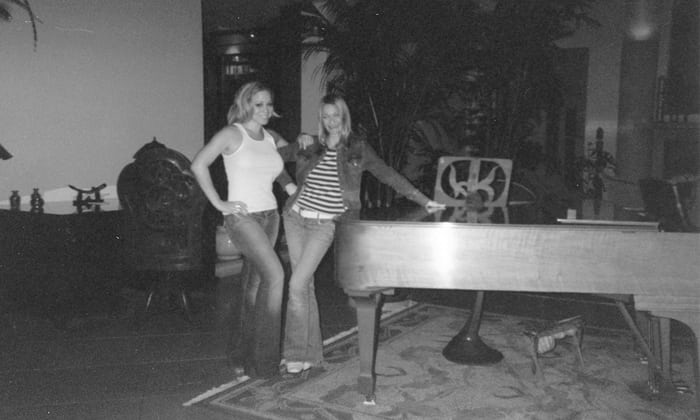
Mariah Carey and Sylvia
‘I’m Not With The Band’ outlines what it’s like to live and breathe music. It has certainly been tough remaining true to her school.
But in documenting her journey Patterson also reaches the places other music biogs don’t reach. She’s like a big sister reporting from the front line of the pop biz – you’re always rooting for her, no matter how dark things get.
She also raids her cassette box to sprinkle in hilariously candid interviews with almost all the major pop players of the last four decades: Barney Sumner, Mick Hucknall and George Michael in the 1980s, Richey Edwards, Liam Gallagher, Shaun Ryder, Blur, Jarvis Cocker, Paul Heaton, Bobby Gillespie, Westlife, Page/Plant, Madonna and Prince in the ’90s, U2, Johnny Cash, Beyoncé (sample question: ‘Now you’re working with Jay Z and loads of tough guys, you’re hanging out with ex-drug dealers – how does your mum feel about Jay Z’s background?’), Kylie, Mariah, Britney, Eminem, Lily and Amy in the noughties. She captures exactly what it’s like to meet these people and asks all the difficult questions.
Witty and humane, never boring, occasionally hilarious, at times deeply affecting, Patterson’s book is up there with Giles Smith’s ‘Lost In Music’ (perhaps consciously referenced in the title) in documenting a troubled love affair with this thing we call…pop. We await Mike Leigh’s film adaptation.
‘I’m Not With The Band (A Writer’s Life Lost In Music)’ is published by Sphere/littlebrown.
Most jazz players don’t really seem to ‘get’ the music of Thelonious Monk.
Decent cover versions are hard to come by, of course with some notable exceptions (Steve Khan, Kenny Kirkland, Lynne Arriale, Paul Motian and probably a few more).
During the centenary of the genius’s birth, it seems as good a time as any to revisit a classic 1980s Thelonious tribute album which puts his miraculous compositions front and centre (plus the fact that I’ve just acquired a brilliant new cassette player* which is bringing it to life again after years stuck in the proverbial drawer).
That’s The Way I Feel Now was masterminded by producer/curator Hal Willner and inspired by bad Monk cover versions. Willner told writer Howard Mandel:
‘I was sitting at Carnegie Hall at some jazz memorial to Monk, getting freaked out that all these other people who really had a love of Monk weren’t performing. Monk’s music was never boring.’
So, at New York’s Mediasound Studios in early 1984, he set about assembling an extraordinary cast of fans including Todd Rundgren, Donald Fagen, Joe Jackson, Carla Bley, Peter Frampton, John Zorn, Was (Not Was), Dr John, Gil Evans, Bobby McFerrin, John Scofield and Elvin Jones to celebrate Monk.
(Willner has gathered similarly eclectic casts for albums celebrating Mingus, Nino Rota, Kurt Weill and the music of Walt Disney films, as well as producing records by Lou Reed and Marianne Faithful and movie soundtracks including ‘Short Cuts’.)
Listened to in one sitting, That’s The Way I Feel Now still makes for a gloriously psychedelic celebration of Monk’s ouevre. Over 22 tracks, I can only make out three duds. It’s also a triumph of sequencing, holding the attention with ease.
First, the ‘rock’: Rundgren’s take on ‘Four In One’ is a gloriously anarchic, Gary Windo’s sax blaring out over a cacophony of samples, cheap drum machines and amateurish keyboards. Was (Not Was)’s take on ‘Ba-Lue-Bolivar-Ba-Lues-Are’ features a knockout multi-tracked guest spot from vocalist Sheila Jordan, while Donald Fagen and Steve Khan mesh perfectly on beautiful ballad ‘Reflections’.
NRBQ’s take on ‘Little Rootie Tootie’ comes near to perfection, as does Chris Spedding/Peter Frampton’s surf-rock-tinged ‘Work’ featuring a classic Marcus Miller bass performance. Only Joe Jackson didn’t get the memo, delivering an overly-lush – though obviously heartfelt – ‘Round Midnight’.
Then there’s the ‘jazz’: John Zorn lays down an outrageous ‘Shuffle Boil’ featuring babbling vocals, bubble-blowing, chainsaw guitar, Bontempi organ and hilariously remedial drumming; Elvin Jones and Steve Lacy deliver a memorable ‘Evidence’; Randy Weston, Dr John and Barry Harris’s contributions are solo piano masterworks; John Scofield and Mark Bingham smash ‘Brilliant Corners’ out of the park, as do vocalists Bobby McFerrin and Bob Dorough on ‘Friday The 13th’.
Finally, Carla Bley’s ‘Misterioso’ is possibly the album standout, an affecting symphony for Monk featuring electrifying performances from Kenny Kirkland on piano, Johnny Griffin on tenor and Hiram Bullock on guitar.
The Rundgren tune aside, to my ears That’s The Way I Feel Now could have been recorded yesterday. The only problem is that it’s almost impossible to buy these days. So I’m bloody glad I held onto my ancient cassette version. Here’s hoping for a CD/download re-release soon.
Although he was surely the most effortlessly brilliant British singer/songwriter of the 1980s, people always found reasons to dislike Sting: his ‘dabbling’ in ecological affairs, jazz and acting, plus the fact that he seemed to care about stuff besides pop music.
But perhaps the thing that most riled the critics in the anti-muso mid-’80s was Sting’s insistence on improving himself, as a singer, songwriter and musician.
British pop artists were supposed to exude a cool detachment from the ‘craft’ of pop, or at least not draw attention to it.
He probably didn’t give a monkey’s. And the fact is that in the late-’80s, some of the greatest rock, pop and jazz musicians were queueing up to collaborate with him (Frank Zappa, Mark Knopfler, Gil Evans, Herbie Hancock etc).
If his debut album now sounds largely like an indulgent misfire, with the jazz and classical elements crudely ladled in with the pop, the follow-up Nothing Like The Sun – co-produced by Brothers In Arms helmer Neil Dorfsman – fused all of Sting’s musical and political concerns in a far more cogent way. And it demonstrated that his voice had become a remarkable instrument.
Along with Ten Summoner’s Tales, this is the one I come back to most all these years later. But it’s a decidedly weird mainstream pop album, where political protest songs and love songs contain elements of fusion, cod-funk, cod-reggae, hi-life and even bossa nova.
You might hear some of Herbie Hancock or Weather Report’s chords here. Sting’s songwriting speciality is a great one-chord groove, a pretty melody and unexpectedly out-there lyric which makes you think ‘Did I hear that right?’ ‘They Dance Alone’ and ‘History Will Teach Us Nothing’ are cases in point. Talk about a sting in the tale.
The emotional and musical range is pretty impressive. When he closes the album with a very pretty, sparse neo-classical art-song (‘The Secret Marriage’), it doesn’t seem forced or trite the way ‘Russians’ did on the first album. Sting also excels in writing genuinely happy music – no mean feat.
The very Paul Simonesque ‘Rock Steady’ (featuring a remarkable performance from drummer Manu Katche – listen on good speakers), ‘Straight To The Heart’, ‘We’ll Be Together’ (apparently very influenced by Peter Gabriel’s ‘Sledgehammer’), ‘History Will Teach Us Nothing’ and ‘Englishman In New York’ are deceptively simple with vibrant melodies which lodge in the memory and don’t grate.
And there are always interesting musical grace-notes throughout. Percussionist Mino Cinelu, headhunted from Weather Report, gets an amazing amount of freedom – ‘History Will Teach Us Nothing’ is almost a feature for him.
Andy Summers supplies excellent textural guitar on a few tracks. Sting nicks Gil Evans’ superb rhythm section (Mark Egan and Kenwood Dennard) for Hendrix’s ‘Little Wing’ and coaxes one of the great guitar solos from the late Hiram Bullock.
So, all in all, a cracking album which remains Sting’s most successful solo release, selling around 18 million and hitting #1 in the UK and #9 in the US.
But he couldn’t get arrested with singles – the first four from the album missed out on the UK top 40 (though ‘We’ll Be Together’ made the top 10 in the US) before fifth single ‘Englishman In New York’ made the top 20 (fact fans: astonishingly, he only has three UK top 10 singles to his name, all ’90s duets…).
The general critical consensus is that Tonight represents the nadir of David Bowie’s career, the only true stinker in his discography.
It’s been described as a quickie cash-in on the Let’s Dance formula, a concession to his new ‘Phil Collins’ audience and a charity album for Iggy Pop. Only three years after its release, Bowie himself was virtually disowning it.
But it’s a fascinating, occasionally superb collection by arguably the greatest album artist in rock history. David tries out a lot of styles and gets away with most of them. And it could have been a lot worse.
So I’m putting it squarely alongside Heathen, Black Tie White Noise, David Bowie, both the Tin Machine studio albums, hours… and several others in the prodigious second tier of DB albums.
In the summer of 1984, Uncle David was competing with the shiny British New Pop acts of the era – Duran, Wham!, Culture Club, Thompson Twins, Nik Kershaw, Howard Jones, Frankie, Bananarama – and to some extent beating them at their own game: Tonight went straight in at number one in the UK album chart.
But writer Nicholas Pegg made an interesting point aboutitssound in his superb ‘Complete David Bowie’: David was apparently more taken with the ‘straight’, poppier artists of the era than the edgier acts such as Bronski Beat, The Smiths, The Cure, Marc Almond etc etc.
Tonight took five weeks to record, two weeks longer than Let’s Dance. It was tracked in Quebec, Canada during May 1984, only a few months after the end of the ‘Serious Moonlight’ tour.
Lenny Pickett’s Borneo Horns were retained from the live dates and there were some holdovers from the Let’s Dance sessions: Omar Hakim on drums, Carmine Rojas on bass, Sammy Figueroa on percussion.
But Nile Rodgers wasn’t asked back to co-produce (it’s oft forgotten that David was also a great producer). It was a decision that apparently baffled and disappointed Rodgers. Instead, ex-Heatwave bassist Derek Bramble was brought in on the strength of his work with Lynx, David Grant and Jaki Graham.
He probably hoped he would be the new Nile, but it wasn’t to be. He played some great bass, guitar and synths on the basic tracks but was given the boot only a few weeks into the project. Police/XTC/Peter Gabriel/Genesis man Hugh Padgham – initially only employed as the engineer – was asked to finish off the album as co-producer.
Hugh has since expressed dismay at the choice of songs, saying that a few new Iggy/Bowie compositions were left unfinished (perhaps later used for Blah-Blah-Blah) because Bowie ‘couldn’t be bothered’ to finish them.
It’s hard to disagree – if ‘God Only Knows’, the title track and ‘I Keep Forgettin’ had been replaced by some new tunes, Tonight could have been a corker.
But it ain’t bad. And the critics all pretty much loved it at the time. It may have been a huge shock if you were brought up on Ziggy Stardust and Hunky Dory, but I came in around Scary Monsters. It seemed a natural progression.
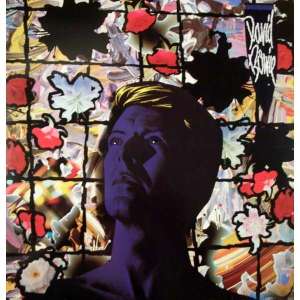
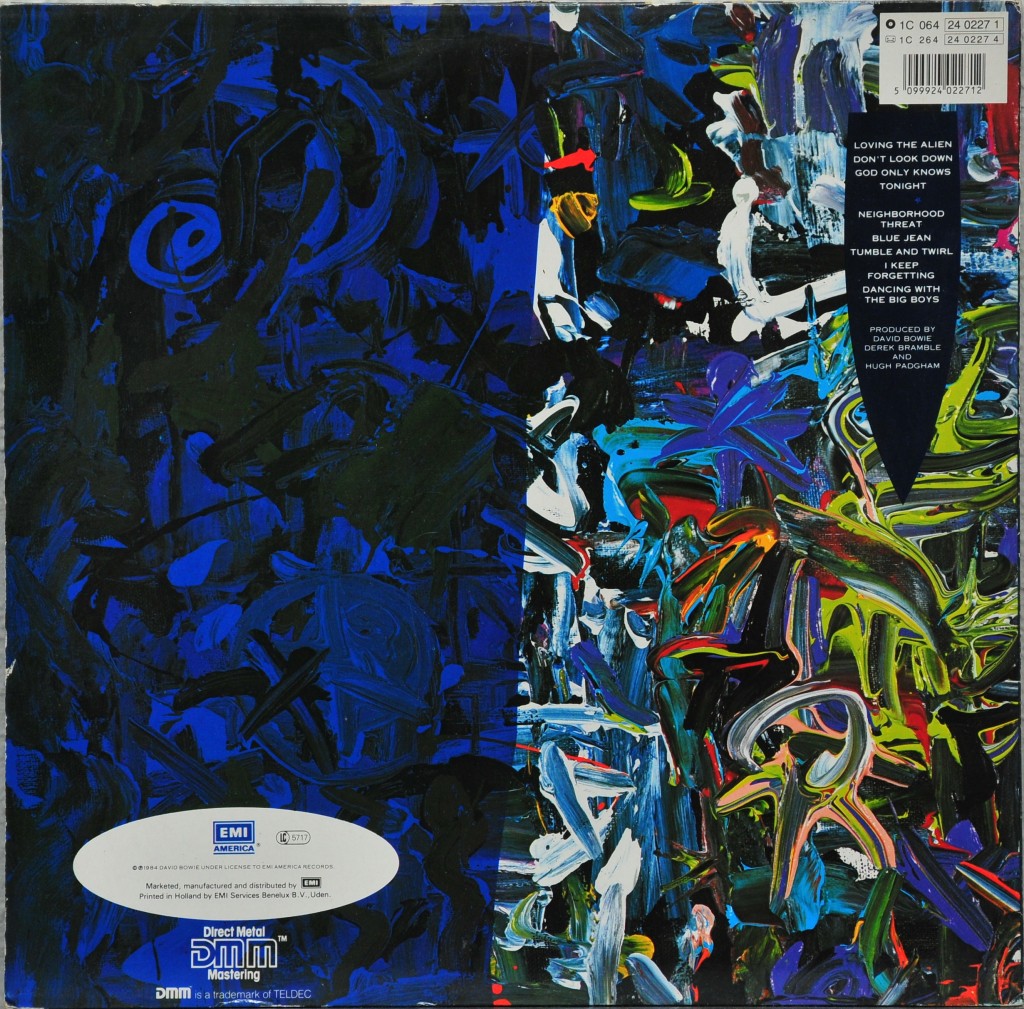
Mick Haggerty’s sleeve design splits opinion too – it’s either a witty Gilbert & George pastiche or a garish bit of mid-’80s tastelessness. Judge for yourself. Oh, and get the 1990 Rykodisc version of Tonight if you can find it rather than the 1999 EMI remaster.
Interesting reggaefied cover of a track from Iggy’s album New Values. Featuring a sublime David vocal, some excellent Bramble bass and a gorgeous horn/synth arrangement embedded in the mix, reminiscent of Gil Evans’ soundworld. Play loud.
3. ‘God Only Knows’
A great David vocal though very curious MOR arrangement of this Brian Wilson composition. Cavernous drums, soaring strings and acoustic guitar high in the mix. Fascinating though only really defensible if viewed as a kind of Scott Walker homage.
4. ‘Tonight’
Shorn of the shock heroin-overdose intro heard on the original from Iggy’s Lust For Life album. But it’s hard to defend this rushed, underwhelming filler which flopped as Bowie’s 1984 Christmas single. Even Omar sounds out-of-sorts on this. But let’s cut them some slack – David helped save Tina’s career. According to her, David dragged the bigwigs of Capitol Records out to see her perform live in New York against their wishes, prompting them to re-sign her.
5. ‘Neighbourhood Threat’
This perky techno-rocker, also originally from Lust For Life, features a fine vocal from David in ‘cyborg’ mode and brilliant drumming from Omar. It works very well but sounds unlike anything else on Tonight. Weirdly, Bowie dismissed it in 1987, saying ‘it wasn’t the right band to do that song. It sounded so tight and compromised.’
6. ‘Blue Jean’
A brief, harmless bit of ‘sexist rock’n’roll’ in Bowie’s words, a portrait of a woman he fancied in a magazine ad. Padgham works his magic on Omar’s drums, there’s some window-shaking sax from Lenny Pickett and Bowie borrows Iggy’s baritone. The first single from the album, it reached UK #6 and US #8 and featured a watchable but very silly long-form video directed by Julien Temple, shown in UK cinemas as support feature to ‘A Company Of Wolves’.
7. ‘Tumble And Twirl’
Another album highlight, co-written by David and Iggy, it’s an effective slice of tropical swing/funk with Mark King’s (uncredited) bass in Stanley Clarke mode, Guy St Onge’s cheery marimba, some sparkling 12-string guitar from Alomar and funny ‘muzak’ bridge with soothing backing vocals. Also some amusing lyrics inspired by Iggy and David’s vacation in Java.
8. ‘I Keep Forgettin’’
The album’s low point, where its ‘happy’, summery, positive feel comes truly unstuck. Electric drums fizz unpleasantly, David hams it up to little effect and the arrangements are more Pebble Mill than Muscle Shoals.
9. ‘Dancing With The Big Boys’
Another Iggy/Bowie co-write, the album closes with a tasty piece of one-chord, horn-based techno-rock flash. A funny lyric that seems to be about American military might: ‘Your family is a football team’. Iggy is very audible on vocals. Arthur Baker also put together an ear-bleeding 12” remix which is worth a listen.
Further reading: ‘Strange Fascination’ by David Buckley
I don’t know if it was sparked by reading MOJO’s recent article about the 40th anniversary of the Sex Pistols’ Never Mind The Bollocks, but everything’s going punk round movingtheriver’s way.
I’ve been enjoying Steve Jones’s hilarious autobiography, revisiting Jon Savage’s essential ‘England’s Dreaming’ and the superb BBC doc ‘Punk And The Pistols’. Then I was pleased to find myself near the site of Malcolm McLaren and Vivienne Westwood’s Sex shop during a King’s Road sojourn last week.
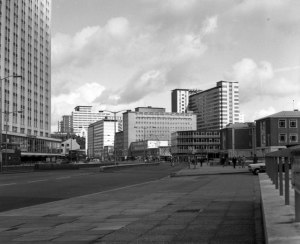
There’s a unifying factor joining all these aspects that I’d never noticed before: Croydon. For those readers outside the London area, it’s a large town just to the south-east of the capital (and these days officially a London borough) with a pretty bad rep as far as popular culture is concerned.
David Bowie possibly spoke for many in 1999 when he told Q magazine:
‘I’ve got this thing about Croydon. It was my nemesis. It represented everything I didn’t want in life, everything I wanted to get away from. I think it’s the most derogatory thing I can say about somebody or something: “God, it’s so f***ing Croydon!” I haven’t been back in a few years but I guess things take on a certain beauty if there’s distance…’
But maybe Bowie got it totally wrong. Maybe Croydon has various claims to hipness. After all, the opening chapters of ‘England’s Dreaming’ outline what an influential place the Croydon School Of Art was in the late ’60s: key Sex Pistols agitators Malcolm McLaren and Jamie Reid studied there, as did future ‘Pop Muzik’ star Robin Scott who described it as ‘like nowhere else’, adding that ‘the Saturday morning market in Surrey Street was full of intrigue and corruption, very lurid.’
All three were involved in various anarchist/Situationist hijinks during their time there, laying the foundations for the Pistols. But it’s ex-Damned bassist Captain Sensible who perhaps best evokes l’essence de Croydon. This song, performed hilariously in the aformentioned ‘Punk And The Pistols’, kickstarted his ’80s solo career.
I have nothing but good memories of his music around this period and I’ll be revisiting it. It’ll be hard to top this affecting little number though – about all our hometowns.
Marvin Gaye: ‘I wasn’t going to peddle myself like I was some new kid on the block. I didn’t want to hear about any rejections, so I went about it differently. I decided what I wanted – to be with the biggest and best record company in the world – and I made it happen. No matter what, I couldn’t come up with another art album. After all, CBS was digging me out of a hole, paying off the IRS, Anna (Gordy, his ex-wife), the feds, the whole works. I felt like an old vet, a seasoned ballplayer who’d been traded to another team that still had faith in him. I owed CBS something – at least a couple of grand slams…’
One of the pleasures of reading Bob Dylan’s ‘Chronicles’ is following his trains of thought wherever they go, however obtuse.
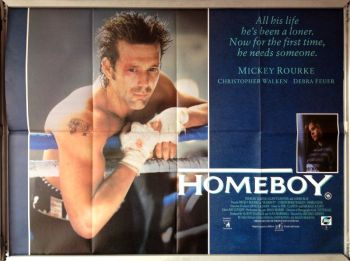
Possibly the most random is a mention of Mickey Rourke’s performance in the actor’s self-penned, almost totally forgotten 1988 film ‘Homeboy’, seen by Bob during the difficult Oh Mercy sessions:
‘He could break your heart with a look. The movie traveled to the moon every time he came onto the screen. Nobody could hold a candle to him. He was just there, didn’t have to say hello or goodbye.’
I’m a huge Mickey apologist, but I think Bob was way off the beam here. ‘Homeboy’ is irredeemable. It also signalled the beginning of Rourke’s 20-year slump.
Clearly a ‘vanity project’ for our star (he started writing it during the ‘Heaven’s Gate’ shoot in 1980), it’s the film where Mickey started to believe his own hype and play the sort of parts which echoed how badly he obviously felt about the movie business.
‘Homeboy’ is a weirdly masochistic (at times reminiscent of Brando’s similar explorations in that area), relentlessly downbeat, funereally-paced, vaguely camp melodrama.
The ‘plot’, such as it is, is almost identical to that of ‘The Wrestler’, the 2008 comeback that won Mickey his first Oscar.
He plays Johnny Walker, a punch-drunk, third-division-south pugilist reduced to hawking his wares around Asbury Park for a few bucks with his portly coach in tow.
Possibly Mickey’s character is supposed to have endured some kind of stroke, because he spends the whole film squeaking out of the side of his mouth, rendering his sparse dialogue almost inaudible.
Christopher Walken appears intermittently as the dodgy agent who wants Johnny’s assistance with a jewellery heist. Modelling a succession of deafening suits, he chews up the scenery a couple of times, dances a bit, sings a bit, clearly knowing this film is a heap of sh*t.
At times amusing but not enough to rescue the movie, it’s a dry run for his superior turns in ‘King Of New York’ and ‘Wild Side’.
Poor Debra Feuer – Mickey’s wife at the time – underwhelms in the almost non-existent role of Johnny’s love interest. Eric Clapton phones in an always-too-loud soundtrack, obviously tossed off during yet another Albert Hall run, adding a few tired licks but mainly employing bassist Nathan East to improvise some fairly half-baked solo cues.
Director Michael Seresin, previously the cinematographer on ‘Angel Heart’ (and recently one of the Harry Potter films), can’t seem to rustle up any convincing or memorable scenes. The final effect is sub-Golan-Globus.
Rourke has one great moment towards the end of the film though, possibly the one Dylan picked up on, where he peers up at his coach and tearfully asks (with shades of Brando again), ‘You think I coulda been good?’ But it’s too little too late. ‘Homeboy’ should probably have stayed in Development Hell.
Los Angeles, October 1986, just after the Japanese leg of the ‘Parade’ tour.
Prince invites his bandmates Wendy Melvoin and Lisa Coleman to dinner (Lisa will later report in her excellent liner notes for the Wendy & Lisa 2013 reissue that she ‘knew something was up’ as soon as they arrived).
To cut a long story short, they are out. The Revolution is no more.
Lisa: ‘We were like Fleetwood Mac and Sly & The Family Stone rolled into one… I thought we were going to make records together for the rest of our lives.’
But Prince wants to take back his freedom and sex up his act again. Struggling for the right words, apparently he says to Wendy and Lisa: ‘I can’t ask you to wear crotchless panties or nippleless bras…’
After a period of introspection, the ladies get together with other former Revolution member Bobby Z to write a few songs. At this stage, they have no intention of releasing the new material as ‘Wendy & Lisa’.
But once they agree to front the band, a record company bidding war ensues. Huge advances are mentioned. They settle on a ‘big but sensible deal’ with Virgin.
Predictably, the suits are less than turned on by the more musicianly moments on the album, but the ladies are unapologetic, saying that they ‘wanted to show off all the colours in our crayon box’.
So much for the history. How does Wendy & Lisa stack up these days? Apart from some fairly unsavoury drum sounds, pretty well.
The singles ‘Sideshow’ and ‘Waterfall’ are probably the weakest tracks, though the latter has a cracking chorus and was apparently deemed a surefire hit by the record company and musician friends.
But it didn’t much business, not helped by its rather humdrum video. The ladies were not particularly keen to start dancing in videos at this stage of their careers – they wanted to be seen as musicians. As Lisa says in the liner notes: ‘I had paid my showbiz dues with The Revolution.’
But the album works brilliantly when it sticks to the ‘cool chord changes over good beats’ remit, when they genuinely do sound like a mashup of ’80s Joni Mitchell and Prince.
‘Honeymoon Express’ exemplifies this approach, nicking Sly Dunbar’s ‘My Jamaican Guy’ beat and adding a sumptuous melody. The vocal harmony in the chorus is sublime.
‘Light’, ‘Everything But You’ and ‘Chance To Grow’ also succeed in a similar vein. Wendy’s multi-instrumental skills (vocals, guitar, bass, sometimes drums) and Lisa’s impressionistic synth parts mesh perfectly.
‘Song About’ sounds eerily like The Carpenters. Ballads ‘The Life’ and ‘Stay’ have become fan favourites, the former also turning up in an improved Trevor Horn-produced reworking on the soundtrack of Michelle Pfeiffer movie ‘Dangerous Minds’.
The instrumental ‘White’, featuring Tom Scott on soprano and a killer bit of drum machine programming by Wendy, is possibly the standout. Test your speakers out with this one, kids.
Wendy & Lisa – perhaps surprisingly – was not a hit. Lacking a breakout single, it didn’t dent the US top 100 and only scraped to #84 in the UK.
Better Wendy & Lisa albums would follow, but this is an ambitious, arresting debut. All the colours in the crayon box indeed.
Jaco Pastorius died 30 years ago today: 21 September 1987.
He was beaten up outside the Midnight Bottle nightclub in Wilton Manors, Florida.
British Jaco fans had particularly meagre pickings in the late 1980s. You gleaned whatever info you could from Bass Player and The Wire magazine or swapped gossip with muso pals.
I’m not even sure I knew he had passed away when I got my hands on import albums like Stuttgart Aria and Live In Italy, both recorded with the brilliant French guitarist Bireli Lagrene, or heard his guest spot on Mike Stern’s Upside Downside.
Then my dad came home from work one day around 1989, excitedly talking about a Jaco concert movie for which he had secured the rights, eventually broadcast on Channel Four as part of the ‘Sounds Of Surprise’ series of jazz films.
Sure enough, the 1982 Montreal Jazz Festival show was a whole new insight into this master musician, shot at a time when he was firing on all cylinders and one of the biggest ‘jazz’ stars on the planet. He was ostensibly touring his Word Of Mouth album at the time, but didn’t play one tune from it.
Starting with his old ‘sweetener’, Pee Wee Ellis’s ‘The Chicken’, Jaco led his superb band (Peter Erskine on drums, Bob Mintzer on reeds, Randy Brecker on trumpet, Othello Molineaux on steel pans, Don Alias on percussion) through a tasty combo of jazz, R’n’B, blues and Caribbean influences.
Particularly notable are a breezy ‘Donna Lee’ and brilliant version of Mintzer’s ‘Mr Fone Bone’, starting at 27:40. Jaco’s soloing throughout the gig is beautiful – emotional, nuanced, dramatic. On the closer ‘Fannie Mae’, he plays the blues with as much feeling as Alberts King or Collins.
So here it is in all its glory. July 1982, Montreal, Canada. RIP Jaco.


 Most jazz players don’t really seem to ‘get’ the music of Thelonious Monk.


 One of the pleasures of reading Bob Dylan’s ‘Chronicles’ is following his trains of thought wherever they go, however obtuse.
 Jaco Pastorius died 30 years ago today: 21 September 1987.
