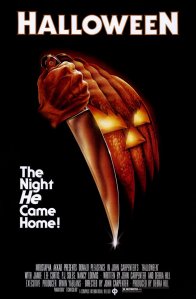
The Cult Movie Club: Halloween (1978/1982) Revisited (with spoilers)

John Carpenter’s classic horror movie ‘Halloween’ enjoyed its nationwide British TV premiere on 5 February 1982* (reportedly much to Mary Whitehouse’s chagrin).

It’s etched upon your correspondent’s memory. My parents recorded it onto VHS and my uncle thought it would be a laugh to show it to my brother and I. Instead it scared the hell out of me. But it’s remained a favourite movie over the years.

(And that premiere was edited for TV – watching the full version now, it’s always a shock when Michael Myers/The Shape admires his ‘handiwork’ after the kitchen murder, a moment that was cut from the original showing…).

It’s interesting that Carpenter’s work is still pretty much go-to Halloween horror fare for British terrestrial TV. Sky Arts celebrated the day with ‘The Fog’ while the Beeb have been showing ‘Halloween’ for a few weeks now.

And watching it again recently 45 years after my first viewing, it still proved itself a stone-cold classic – and offered up a few new insights:

The odd/inexplicable lines of dialogue
Carpenter and co-writer Debra Hill generally do a great job but there are still lines that baffle, maybe due to the actors’ delivery. Three from Laurie (Jamie Lee Curtis): ‘Well, kiddo, I thought you outgrew superstition’ and ‘The old girl scout comes through again’ and ‘What’s the boogieman?’ Maybe ‘What IS the boogieman?’ (with an emphasis on the ‘is’) would have been better…

‘Sexualised’ Jamie Lee in the second half?
In the first half of the movie, Laurie wears she wears a long skirt, bobby socks and cardigan, maybe a rather clever bit of character ‘motivation’ for Michael Myers/The Shape – Laurie possible reminds him of the sister that he murdered (there’s no evidence that Laurie and Michael are related in ‘Halloween’ – that silly idea only came later…). But in the second half of the film, she’s arguably ‘sexualised’ with tight blouse and tight jeans – better equipped to face her demons?

The massive influence of Hitchcock’s‘Psycho’
Obviously it was a coup to cast Jamie Lee, daughter of Janet Leigh. And Donald Pleasence’s character is named ‘Sam Loomis’ after a character from ‘Psycho’. Then there’s that brilliant tracking shot that follows Jamie Lee towards the ‘haunted house’, and Laurie’s entry into the ‘bedroom of horrors’ where evil lurks, as it does in ‘Psycho’. There’s also rather an effective use of a staircase, as in ‘Psycho’ where Martin Balsam meets his grisly end. Also it seems Carpenter wanted to do for cars what Hitchcock did for showers – see below.

The strange moving shape
Check it out – while Lindsey is watching ‘The Thing’, a weird shadow moves behind her in the corner of the room. For UK readers, it’s at 45:20 on iPlayer. Possibly camera shadow? Possibly not…

Illogical plot points
How does The Shape/Michael Myers get into the car to murder Annie (Nancy Loomis)? Carpenter makes a big deal of showing us that the car door’s locked – Annie then goes to get the keys – but when she returns it’s unlocked. Did he have a key? Then there’s the trowel locking the kitchen door when Laurie tries to escape the ‘haunted house’ (in the shooting script it is ‘key-locked’). Also why does it take Sam Loomis (Pleasence) so long to spot Michael’s car when he’s staking out the Myers house in the middle of the night?

The Shape/Michael Myers’ inhumanity
The naturally mild-mannered and sensitive Carpenter saw a lot of scary stuff growing up in the Bible Belt South, and it informed his writing. It’s clear he invested something absolutely immoral into The Shape, but it has precedents in the head baddie played by Frank Doubleday in ‘Assault On Precinct 13’ – shocking inhumanity and a reluctance to die, even when shot and stabbed a few times…

*Reportedly ‘Halloween III: Season Of The Witch’ got the biggest audience of all the UK ‘Halloween’ premieres though, 11 million when shown on the Beeb in 1986…

The Cult Movie Club: ‘Psycho’ Revisited

My dad was a huge Alfred Hitchcock fan.

He liked the ‘minor’ Hitch as much as the ‘major’ Hitch. As a war baby, maybe he relished the director’s trademark mixture of dread and humour.

He certainly didn’t sneer at ‘Psycho’; in fact, he would have put it firmly in the ‘major’ category.

We probably first watched the film together sometime around 1989. Revisiting it again recently, it struck me as a curiously – and defiantly – ‘modern’ movie.

Even as the ghastliness of America’s modern serial killers was becoming public knowledge towards the end of the 1950s, the kind of seediness ‘Psycho’ portrayed had still not been shown on screen (though David Thomson’s superb book ‘The Moment Of Psycho’ notes that a few figures – James Dean, Jerry Lewis, Elvis, Brando and Jack Nicholson, by way of Roger Corman, were ushering in a new, youthful edginess. Thomson also asks us to imagine Elvis as Norman Bates…).

Hitchcock and screenwriter Joseph Stefano really decided to let American audiences have it with their fairly loyal interpretation of Robert Bloch’s 1959 novel.

Thomson describes the film as Hitch’s ‘revenge’ on Hollywood, a Hollywood that had never granted the director an Oscar and whose mixture of humour and dread had never been fully accepted.

These factors also particularly struck me when revisiting ‘Psycho’:

7. Hitchcock/Stefano’s skewering of America’s sacred cows

The family unit, marriage, the home, sanity, the bathroom (never before in an American film had there been the shot of a toilet flushing), heterosexuality, the shower stall. And the way he gleefully starts the movie tracking into a fairly seedy motel room to eavesdrop on a post-coital tryst. It all seems run-of-the-mill now but all of this must have been an incredible shock for contemporary audiences. Hitch wanted to show how modern, urban people were living their lives.

6. Joseph Stefano’s dialogue

Speed-reading Robert Bloch’s novel again, it struck me that screenwriter Stefano deserves huge praise for reworking the dialogue. He puts some pep in its step, fashions some brilliant lines for Norman (the whole mental illness speech during dinner with Marion in his den) and turns the scenes between Norman/Sam Loomis (John Gavin) and Norman/Arbogast (Martin Balsam) into mini masterpieces. He also adds some good, hip stuff featuring the traffic cop (who doesn’t feature in the novel) and car salesman (who does).

5. The shower murder

Hitchcock’s ‘pride’ at the slickness of the scene belies its brutality. If there’s a more shocking death in the movies, I haven’t seen it. A troubling thought: to what extent does Hitchcock/Norman/’Mother’/Bloch/the audience ‘punish’ Marion for stealing (even though at the time of her murder she has made the decision to return the money)? In addition, does Norman ‘punish’ Marion for fooling him, by signing a false name in the guest book? Either way, modern audiences are primed for Janet Leigh’s early exit, since the opening credits say ‘…And Janet Leigh as Marion Crane’. But audiences in 1960 wouldn’t have twigged.

4. The sexual politics of the first 40 minutes

Marion strikes us as an incredibly ‘modern’ character, strong, determined, troubled, independent, defiantly single (though willing to give Sam a try… Or is she? Why doesn’t she ring him to tell him she’s on her way with the money?). She passes through the first half of the film encountering men in scenes that somehow ‘mirror’ each other – her lover, the creepy, predatory client at work, traffic cop, car salesman, and finally Norman.

3. The concept of ‘doubles’

Of course, Norman ‘is’ Norma Bates, mother and son combined. Then there are the – on first viewing – strange matching shots of characters leaving rooms; first Marion, then ‘Mother’. Then there’s the remarkable physical likeness between Sam Loomis (John Gavin) and Norman (who, of course, in many ways seems far more pleasantly disposed towards Marion than Sam ever is).

2. The brilliance of Anthony Perkins’ performance

Hitchcock apparently instructed Stefano to write for Perkins once the teen heart-throb had signed on very early in proceedings. The novel has Norman as an overweight, alcoholic, 40-year-old schlub, but Perkins’ leading-man looks, disarming smile and gentleness are the movie’s masterstrokes. He delivers a classic performance, possibly influenced by Dennis Weaver’s panic-stricken ‘night man’ in Orson Welles’s ‘Touch Of Evil’.

1. The flatness of the second half

Hitchcock barely seems interested in any characters other than Marion and Norman, fatally unhinging the second half of the movie. It’s pretty boring apart from the above terrific scene between Norman and Arbogast (which apparently earned lengthy applause from the crew), the Arbogast murder, the ‘Mother’ reveal in the basement and the closing Norman/Mother ‘monologue’, featuring more fantastic work from Perkins.