Shifty: the new Adam Curtis BBC doc

Those wanting to understand the mess in which Britain finds itself may get some answers from ‘Shifty’, Adam Curtis’s new BBC documentary series. It’s also a classic bit of 1980s reportage.

A rather po-faced press release announced the launch of the show on iPlayer (it’s also on YouTube) – Curtis has now been ‘moved on’ from terrestrial TV, and has alluded to the ‘freedom’ that streaming platforms give him.

But the new series certainly delivers, not a surprise given his track record of superb, unsettling docs such as ‘The Century Of The Self’, ‘The Mayfair Set’ and ‘HyperNormalisation’. Using long- forgotten/lost BBC footage mainly shot during the 1980s, ‘Shifty’ traces the death of Britain’s role as a technological superpower, showing how the decimation/privatisation of national industries ushered in an uncertain era when dark, long-dormant secrets bubbled up to the surface, and the tabloid press ran riot.

We see how Thatcherism (read monetarism) was based on a false belief – that money always acted predictably. Meanwhile the privatisation of state industries (a policy invented by the Nazis) handed fortunes to private capitalists, a system which the Tory government knew would lead to industrial ’empires’ and the creation of huge private fortunes. They were essentially buying the support of the financial elites, and this has been convulsive.

Re-editing the work of those brilliant, groundbreaking (uncredited) TV directors and technicians who plied their trade at the dawn of the 1980s, Curtis uncovers the ‘real’ decade. There are many striking juxtapositions; the death of a commercial airline pilot after a crash on the Isle of Sheppey uncovers tales of wartime mental distress.

We see what the Falklands Islands looked like just before the 1982 invasion, a National Front rally in Brixton, the birth of video dating in London, dub sound systems in Birmingham, a pop lookalike competition of 1981 with hilarious Midge Ure. Freemasonry is debated openly on national terrestrial TV.

We see Thatcher during down time, pottering in the kitchen, schmoozing with Jimmy Savile, discussing her wardrobe, teenagers dancing to Bee Gees in Belfast and Hawkwind’s ‘Silver Machine’ in Kent, sex pests calling mental-health helplines, abject poverty in Bradford, the first known personal surveillance camera in North Kent, Sus operations in West London, Princess Di opening the Broadwater Farm Estate just six months before the deadly riots, Dodi Fayed interviewed about his father and producing movies such as ‘Chariots Of Fire’, Stephen Hawking as an undergraduate at Cambridge University.

All in all, ‘Shifty’ is a fascinating look at a mostly forgotten Britain and a great companion piece to Simon Reynolds’ ‘Rip It Up’ book and Steve McQueen’s ‘Small Axe’ films. So The Beeb is still doing a few things right but it’s a shame the series wasn’t given a cursory showing on terrestrial TV.
The Cult Movie Club: Honest, Decent & True/News Hounds (1986/1990)

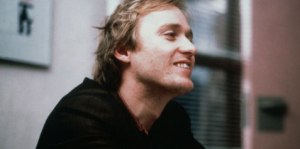
Adrian Edmondson in ‘Honest, Decent & True’

Brit writer/director/auteur Mike Leigh is partly famous for his method of creating shooting scripts: he works with each actor in turn to develop a character, then formulates a story based on improvisations between the various characters.

But he wasn’t the only notable figure to work in that way. Les Blair, a Manchester college friend of his, was another. Blair devised and directed two superb Play For Todays for the BBC, ‘Blooming Youth’ (1973) and ‘Bet Your Life’ (1976), before embarking on a varied career including a few feature films.

But two of his most intriguing TV plays were made during the 1980s: ‘Honest, Decent & True’ (1986) and ‘News Hounds’ (1990). They make for fascinating viewing today, shining a light on two of the decade’s most lucrative and controversial industries: advertising and tabloid journalism.

Both star ‘Comic Strip’/’Young Ones’ comedy hero Adrian Edmondson, and he plays a blinder in both. In ‘Honest, Decent’ he’s a hapless, ethically-challenged ad man, in ‘News Hounds’ he’s a tabloid hack with the morals of a sewer rat. He brilliantly subverts his madcap image to play nuanced, troubling characters, and he’s clearly fond of these two films, focusing on them in some detail in his recent autobiography. It’s a shame he hasn’t been called on to play more serious roles in his career.

‘Honest, Decent’, which won a major award at the San Francisco Film Festival of 1986, also features a great cast including Arabella Weir, Gary Oldman and Richard E Grant in his first screen role and only credit before ‘Withnail’. Grant nicely embodies the kind of ‘liberated’, louche, humourless ad man you’d come across in the 1980s, into Asian architecture, yoga and new-age music, probably driving an Audi Quattro too.

Elsewhere Leigh veteran/ex-wife Alison Steadman shows up in ‘News Hounds’ to brilliantly portray a celebrity interviewer, pitched somewhere between Nina Myskow and Lynn Barber. It’s another classic performance, and reportedly one of her favourite roles.

It’s nice to revisit these amusing, almost-forgotten movies on some hot-button topics of the ’80s (and ‘News Hounds’ is still extremely relevant courtesy of the Leveson Enquiry and its reverberations). As for Les Blair, apparently he’s still teaching at the London Film School, an alumnus of which is one M. Leigh…

Billy Cobham @ 80: Five From The 1980s

The author with Billy Cobham, autumn 2000

Many happy returns to Mr Cobham who turned 80 this week. His drum mastery continues to inspire.

Movingtheriver pretty much learnt to drum by listening to Mr Cobham’s Spectrum, David Sanborn’s (RIP) Hideaway, Steely Dan’s Aja and a few more. His playing was sheer class, something to aim for. There was always an emphasis on technical excellence and good tuning – but the most important thing was the music, the groove.

I was fortunate enough to study with Mr Cobham at the Guildhall School of Music circa 2000. Unforgettable memories.

To celebrate his 80th birthday, here are five key moments from his 1980s. The early part of the decade saw Mr Cobham forge a new life in Switzerland, whilst fronting various bands featuring the likes of Mike Stern, Don Grolnick and Gil Goldstein. Then came the short-lived, controversial tenure in John McLaughlin’s revamped Mahavishnu Orchestra (explored in my book) which nonetheless produced some great music, and then a high-profile return to the solo career via Dave Grusin and Larry Rosen’s GRP Records.

5. Drum Clinic (Part 6), BBC TV, 1982 (?)
Here’s where it all started for movingtheriver. My dad caught it totally by chance on BBC2 and luckily recorded it onto a VHS. It blew the minds of many British drummers including Level 42’s Phil Gould who was reportedly present at the filming.

4. Billy Cobham/Herbie Hancock/Ron Carter: ‘Eye Of The Hurricane’, Lugano, Switzerland, 1983
A period when Billy embarked on various brilliant European collaborations. Still one of the most exciting, propulsive trios I’ve ever heard in acoustic jazz.

3. ‘The Dancer’ (1985)
If memory serves, I was given Mr Cobham’s Warning for my 13th birthday, alongside Joni Mitchell’s Dog Eat Dog and Steely Dan’s The Royal Scam. What a day that was. I still love this album and am glad I kept the vinyl.

2. ‘The Debate’ (1986)
Warning’s followup Power Play didn’t quite have the impact of his GRP debut but Billy’s drums have arguably never been better recorded.

1. Live In Cannes (1989)
A recent find this, worth watching for a rare look at Billy playing timbales (during the first song) and also his fine hookup with percussionist Nippy Noya.

Keith Floyd: The Man On The Telly

What a treat to see that Freeview channel London Live seems to be re-running Keith Floyd’s classic BBC films of the 1980s.
There had been others before him but Floyd is generally regarded as the original modern TV chef. He’s certainly the only one I can watch, though probably wouldn’t be let within a mile of a television studio these days.

But who was this charismatic, erudite, passionate, well-spoken, Withnailesque bloke gently joshing the cameraman (the long-suffering Clive – ‘Stay where you are, old bean!’) and director (David Pritchard), all the while quoting poetry and chucking down the red wine?

He had a colourful past. Floyd was born at his family farm near Reading in 1943 into distinctly less-than-well-off circumstances. He developed a passion for picking fruit and vegetables and attended Wellington School (at the same time as Jeffrey Archer) but left at 16 to develop his writing skills alongside Tom Stoppard at the Bristol Evening News.

Then, on a whim, after seeing the Michael Caine movie ‘Zulu’, he joined the Army. He moved into catering work at the BBC before opening his own successful restaurant in Bristol, where he’d mill around amongst the clientele, reciting First World War poetry and Bob Dylan lyrics.

BBC producer David Pritchard observed Floyd there in 1983 and offered him a TV gig. The rest is history. First there was ‘Floyd On Fish’, then ‘Floyd On France’ and a selection of well-regarded films and series, all shot on film and still looking sumptuous today. Don’t watch if you are hungry…

Floyd was married and divorced four times and fleeced by the vicious British tabloid press of the late 1980s. It’s not surprising he fell out of love with the TV game, outlined in hilarious detail in Tom Hibbert’s ‘Who The Hell’ interview for Q magazine:

‘Celebrity? It’s a heap of sh*t! You get frightened to go out. People you’d like to speak to don’t speak to you because they’re too polite. People you don’t want to speak to hound you to death. Everyone thinks you’re incredibly rich when you’re not. No-one believes you if you say you’re lonely or depressed because…you’re The Man On The Telly.’

Floyd even made a single with The Stranglers’ Hugh Cornwell called ‘Give Geese A Chance’ (apparently no-no’d by Yoko Ono…), with Fuzzbox guesting on the B-side. Between 1989 and 1996, he also ran his own gastropub/B&B – The Maltsters Arms in Devon – still going strong today.

Floyd was probably not an easy man to get along with, and Keith Allen’s excellent TV doc – made just before his death in 2009 – shows the effect his drinking had on lovely daughter Poppy. But in terms of the idiot box, he was a breath of fresh air. And in these nannying, oversensitive days, his brutal honesty, erudition and unabashed debauchery are a delight.

And Smith Must Score! Brighton v Manchester United 38 Years On

Most football fans have a ‘worst misses of all time’ list.

In my lifetime, a few are memorable, mainly because I watched them live on TV: Ronnie Rosenthal’s botched tap-in for Liverpool v Aston Villa in 1992 and Geoff Thomas’s awful chip for England v France in the same year particularly come to mind.

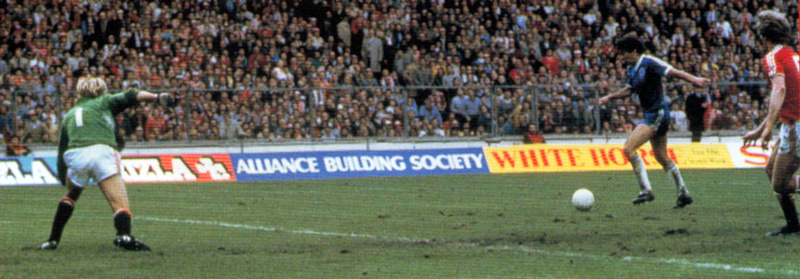
But Gordon Smith’s last-minute miss for Brighton v Manchester United during the classic 1983 FA Cup Final at Wembley Stadium, taking place 38 years ago today, always seems to get a mention too.

If he’d slotted the ball home, it would have given his club their first (and, to date, only) major competition win. Brighton lost 4-0 in the replay five days later.

The match holds a special place for me: I was there. I think it was the second time I’d visited the grand old stadium. My dad was a proud Brighton fan, and the sight of a packed Wembley and deafening chants of ‘Seaweed! Seaweed!’ from the Man United fans will linger long in the memory. It was also a tremendous game, one of the great Cup Finals.

But back to Gordon Smith. Is it one of the worst misses? BBC radio commentator Peter Jones certainly thought so: his famous ‘And Smith must score!’ commentary gave a title to a Brighton FC fanzine and is oft quoted to this day. Smith apparently frequently thinks about the moment, but has retained a very dignified outlook.

Decide for yourself. You could argue that he went with his wrong foot – maybe he should have hit it first time with his left – but you could also praise Gary Bailey’s fast narrowing of the angle and take into account the awful state of the pitch. But still… if only…

This excellent podcast also revisits the game with players from both sides.

‘Rockschool’ Revisited

The early 1980s was a pretty good period to start out as a musician.

If your ears were open and you had a half-decent hi-fi/radio, there were some truly inspirational players around and a host of different styles vying for your attention.

But the burgeoning muso couldn’t quickly get onto YouTube or download an app to learn a new skill or technique. Music education also wasn’t exactly in a great place, if the drum lessons at my comprehensive school were anything to go by…

You could see great homegrown bands and big-name American sessioneers playing live on ‘The Tube’, fork out an extortionate sum for the dreaded instructional video, or go to a live clinic (I gave up pretty quickly on these after seeing a guy called Lloyd Ryan, who supposedly ‘taught’ Phil Collins how to drum, even though Phil’s name is spelt incorrectly on his website…).

So you generally had to make your own fun (cue the violins…); jam with friends, play live whenever you could, and grab whatever bits of technical info that were passed around.

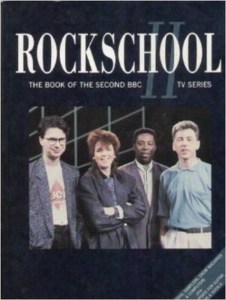
‘Rockschool’ was a bold attempt by the Beeb to bring modern music education right into the home. First airing on 1st November 1983, it featured a studio band (Deirdre Cartwright on guitar, Henry Thomas on bass, Geoff Nicholls on drums) breaking down basic contemporary arrangements, styles and instrumentation.

A US version also started in 1985, featuring the UK band and hosted rather excellently by Herbie Hancock. And then season two, broadcast in late 1987, brought in keyboard player Alastair Gavin. That was the series that really hooked my muso pals and I (and check out the brilliant, none-more-’80s intro music below).

But even back then we were dubious as to how proficient the studio band actually were. They certainly paled in comparison to the great US players of the decade.

But they were engaging, knowledgeable presenters and it was just a great way of seeing some musical heroes like Omar Hakim, Bootsy, Jan Hammer, Larry Graham, Andy Summers, Tony Banks and Allan Holdsworth demonstrating their craft.

Could you bring back ‘Rockschool’ now? It seems unlikely given the relatively solipsistic nature of ‘rock’ music education these days. YouTube is chock-a-block with technically brilliant players, but the general musicianship of bands has probably never been worse. Here come those violins again…

Jack Nicholson: 1982

What’s the first image that comes to mind when we think of 1980s Jack?

Leering through the bathroom door in ‘The Shining’, or tearing up the furniture in ‘Batman’ and ‘The Witches Of Eastwick’?

We probably wouldn’t think of a sober, suited-and-booted man about the arts, but that’s exactly what we get in a recently-discovered BBC interview.

It was broadcast on 18 January 1982 during his ‘year off’ after an intensive period of work on ‘Reds’, ‘The Shining’, ‘The Border’ and ‘The Postman Always Rings Twice’, and makes for fascinating viewing.

There’s an element of him being on his ‘best BBC behaviour’, aided by Ian Johnstone’s austere interviewing style, but it demonstrates how Jack could so convincingly pull off the brilliant but troubled classical piano prodigy Bobby Dupea in ‘Five Easy Pieces’ (a part written for him by Carole Eastman, whom he discusses below) and how brilliantly he can ‘dial down’ his IQ to conjure hellraising characters like McMurphy in ‘One Flew Over The Cuckoo’s Nest’.

Next up was his Oscar-winning turn in ‘Terms Of Endearment’ – the year off certainly paid dividends.

The Cult Movie Club: Fourteen Days In May (1987)

It doesn’t happen very often, but occasionally a documentary comes along that makes you question everything, puts a new slant on life and death, the whole shebang.

Or just gives you a damn good scare. Paul Hamann’s ‘Fourteen Days In May’ definitely fits the bill.

Shot over two weeks during the summer of 1987 at the infamous Mississippi State Penitentiary – AKA Parchman Farm – ‘Fourteen Days In May’ follows a young black man Edward Johnson as he prepares for – and, with the help of his lawyer Clive Stafford Smith, tries to evade – the gas chamber.

First shown on the BBC over 30 years ago, it has become a landmark film. Similar areas have recently been explored by Werner Herzog, Louis Theroux and Nick Broomfield, but arguably ‘Fourteen Days In May’ trumps all of them for sheer emotional impact.

It explores the inner workings of a prison geared up for taking human life. Astonishing shots shed light on a kind of modern slavery, with policemen on horseback brandishing shotguns, calling out loud reprimands and instructions to large groups of (almost exclusively) young black detainees as they dig ditches or clear roadside vegetation.

Elsewhere we are witness to the last few minutes of another (white) inmate’s life as he is strapped into the electric chair, though thankfully we don’t see the moment of truth. The gallows humour of both the killers and killed will linger long in the memory.

As ‘Fourteen Days In May’ moves painfully and inexorably on, it becomes increasingly clear that Johnson is innocent. But no-one can do anything about it. Various (black and white) prison officers bravely profess their doubts as to his guilt, while Johnson’s family rally around the quiet, unfailingly polite young man, singing him songs to keep his spirits up.

Hamann breaks the fourth wall to says his goodbyes to Johnson in a memorable scene. But shorn of a voiceover or title cards, ‘Fourteen Days In May’ offers no explicit critique of capital punishment. It doesn’t need to. The facts do that for themselves.

It would seem churlish and pointless not to reveal the ‘ending’ of the film here – Edward Johnson meets his maker. The crushing coda reveals that a young black woman came forward after the execution to verify that she saw him in a pool hall during the time of the alleged crime, but when reporting this to a white police officer soon after was threateningly advised to mind her own business.

What do we take away from ‘Fourteen Days In May’? The only correct response would seem to be rage. And fear. But after that, there’s a helplessness and a slow-burning disgust.

The only slight light at the end of the tunnel is the knowledge that it was in direct response to this documentary that the Lifelines organisation was set up, arranging pen pals for death row prisoners. Stafford Smith has also founded Reprieve.

Is America still like this? The suspicion would have to be that it is.

David Bowie in Alan Clarke’s ‘Baal’ (1982)

Alan Clarke’s films generally go straight into the ‘once seen, never forgotten’ file.

Features such as ‘Scum’ and ‘Rita, Sue And Bob Too’ courted huge controversy while his groundbreaking TV work including ‘The Firm’, ‘Psy Warriors’, ‘Elephant’, ‘Road’ and ‘Made In Britain’ shone a light on the darker corners of the Thatcher years to devastating effect.

Those films and many others adorn the superb new BFI box set ‘Disruption’ which gathers all his television work made between 1978 and 1989 – including David Bowie’s remarkable turn as Baal, Bertolt Brecht’s anti-hero, adapted by Clarke and John Willett from the 1918 play.

Though it wasn’t exactly a frequently-performed work, British theatre audiences were treated to a Peter O’Toole star turn during the early 1960s, just after the actor’s Oscar-winning appearance in ‘Lawrence Of Arabia’.

For some reason, ‘Baal’ was scarcely mentioned in Bowie obituaries as one of his more successful screen performances, a serious oversight. Bravely broadcast by BBC One at 9:25pm on Sunday 2 March 1982 (cosy Sunday night viewing it wasn’t), it was filmed at Television Centre (W12 8QT!) during the summer of 1981, just after Bowie had recorded ‘Under Pressure’ with Queen.

According to producer Louis Marks, Bowie jumped at the chance to portray the ultimate street punk, and was already a fan of Clarke’s work. He was also reportedly completely undemanding, modest and eager to please on set, requesting only a car and bodyguard and receiving the standard BBC fee.

Bowie could also hardly look less ‘star-like’ in ‘Baal’, with his battered teeth, dark eyes, ratty beard, grimy face and dishevelled clothes; he completely embodies the role of the amoral troubadour. Clarke captures him mostly in long shot with very lengthy takes in the classic alienating Expressionist style, but the camera positively adores Bowie’s Baal with his alligator grin, dangerous sexuality and moments of sudden violence.

He also delivers several plainsong ballads straight to camera in strident, superb voice, accompanying himself on banjo. The subsequent Baal EP, re-recorded at Hansa Studios with added instrumentation, even got to #29 in the UK singles chart, Bowie’s last release for RCA.

‘Baal’ makes for fascinating viewing these days and you only wish the Beeb would take such chances again. Critics of the time were pretty scathing about Bowie’s performance but their comments make for fairly amusing reading these days.

It’s scarcely believable to think that only a year after ‘Baal’ was broadcast, Bowie was rocking the zoot suit and peroxide blond quiff for the Let’s Dance media offensive. It’s also virtually impossible to think of another star of such magnitude who would dare take on such a bleak, singular project. A true artist.

Further reading: ‘Alan Clarke’ edited by Richard Kelly