The Worst Album Titles Of The 1980s

It was one of the many issues that probably had managers and marketing people tearing their hair out during the 1980s.

What to name your album? It might be a low-risk strategy to name it after the first single – even better if that song is a big hit – or, if you were feeling clever, after a ‘pivotal’ album track.

But oftentimes 1980s acts went out on a limb, looking for a ‘poetic’ title, something ‘novel’, something… You get the picture.

Here’s a selection (to be regularly updated) of 1980s album titles that went off-piste. Some are pretentious, some weird, some have needless word repetition (hello Sting), some fudge punctuation or foreign words in an infuriating way, some are rubbish puns, some are desperate to shock, some are way too high-falutin’, some throw concepts together in a seemingly random way. But the reaction to most is: eh?

Of course a bad title didn’t stop some of these being great albums, though, tellingly, very few were big hits…

Talking With The Taxman About Poetry (Billy Bragg)

Three Hearts In The Happy Ending Machine (Daryl Hall)

The Secret Value Of Daydreaming (Julian Lennon)

Steve McQueen (Prefab Sprout)

Shooting Rubberbands At The Stars (Edie Brickell & The New Bohemians)

The Uplift Mofo Party Plan (Red Hot Chili Peppers)

Mother’s Milk (Red Hot Chili Peppers)

As Falls Wichita, So Falls Wichita Falls (Pat Metheny/Lyle Mays)

Into The Dragon (Bomb The Bass)

Angst In My Pants (Sparks)

Tennis (Chris Rea)

Love Over Gold (Dire Straits)

North Of A Miracle (Nick Heyward)

Misplaced Childhood (Marillion)

Script For A Jester’s Tear (Marillion)

Boys & Girls (Bryan Ferry)

Journeys To Glory (Spandau Ballet)

Through The Barricades (Spandau Ballet)

Seven And The Ragged Tiger (Duran Duran)

Big Thing (Duran Duran)

Modern Romans (The Call)

The Secret Of Association (Paul Young)

Shabooh Shoobah (INXS)

Remain In Light (Talking Heads)

If This Bass Could Only Talk (Stanley Clarke)

Blood & Chocolate (Elvis Costello)

A Salt With A Deadly Pepa (Salt’n’Pepa)

Splendido Hotel (Al Di Meola)

Within The Realm Of A Dying Sun (Dead Can Dance)

The Moon Looked Down And Laughed (Virgin Prunes)

Architecture & Morality (OMD)

The Dream Of The Blue Turtles (Sting)

In-No-Sense? Nonsense! (Art Of Noise)

In Square Circle (Stevie Wonder)

Lawyers In Love (Jackson Browne)

The Story Of A Young Heart (A Flock Of Seagulls)

The One Giveth, The Count Taketh Away (Bootsy Collins)

You Shouldn’t-Nuf Bit Fish (George Clinton)

All The Best Cowboys Have Chinese Eyes (Pete Townshend)

Difficult Shapes And Passive Rhythms Some People Think It’s Fun To Entertain (China Crisis)

Working With Fire And Steel (China Crisis)

Franks Wild Years (Tom Waits)

So Red The Rose (Arcadia)

Café Bleu (The Style Council)

The F**king C*nts Treat Us Like Pricks (Flux Of Pink)

Chalk Mark In A Rainstorm (Joni Mitchell)

I, Assassin (Gary Numan)

Civilised Evil (Jean-Luc Ponty)

Introducing The Hardline According To Terence Trent D’Arby

Children (The Mission)

Casa Loco (Steve Khan)

The First Of A Million Kisses (Fairground Attraction)

Bebop Moptop (Danny Wilson)


More crap 1980s album titles? Of course. Let us know in the comments below (particularly looking for more in the metal, Goth and prog genres).

Book Review: Exit Stage Left (The Curious Afterlife Of Pop Stars) by Nick Duerden

The story goes that The Human League’s Phil Oakey smashed the phone to pieces immediately after hearing from his manager that ‘Don’t You Want Me’ had gone to number one in America.

There was a creeping suspicion that he had peaked too early, and the only way was down.

Maybe it was a natural reaction in those competitive, cut-throat pop years of the early 1980s, but little did he know that that song would probably come in very handy over the years and pay for kids’ school fees, parents’ homes, tax bills, etc etc.

Nick Duerden’s gripping, important new book ‘Exit Stage Left’ doesn’t interview Oakey but does many others from the pop pantheon who have had some early success and then swiftly asked ‘Is that all there is?’ after a career downturn or ‘change of musical direction’.

Duerden has a formidable contacts book and gets candid quotes from some surprisingly big names. Shaun Ryder tells of having to pay back huge debts after being hit with a legal bill in 1998. Robbie Williams discusses his surprisingly lonely, low-key bachelor life when moving to Los Angeles after becoming the UK’s biggest pop star.

Suzanne Vega relates the shame of having to ‘downsize’ her band and crew mid-tour when audiences failed to fill large enues and The Boo Radleys’ Martin Carr discusses saying no to licensing requests for ‘Wake Up Boo’, trying to hold onto his punk credentials, but then ‘teaching himself to say yes’. Ex-Frankie Goes To Hollywood guitarist Brian ‘Nasher’ Nash talks about his PTSD diagnosis (as do a few other artists).

Elsewhere there are fascinating interviews with Lloyd Cole, Natalie Merchant, Roisin Murphy and Wendy James on the relative benefits of success and the words of Kevin Rowland, Musical Youth’s Dennis Seaton and Ed Tudor-Pole are touching and somewhat humbling.

Duerden writes with compassion and has a winning way of summing up his interviewees’ physical essences – Stereo MC’s Rob Birch ‘never rose to his full height but rather hovered in a perpetual half crouch, as if his bones were made from elastic bands.’ Billy Bragg ‘looked like he would sunburn easily and so was best kept far from exotic beaches.’

‘Exit Stage Left’ is a sobering read and will ring true to anyone who’s ever been stung by the business, or had their dream job whipped from beneath them. Thanks to Duerden’s witty, fast-moving style, it’s pithy and powerful but never too depressing.

The book also touches on areas generally not touched with a ten-foot (Tudor) pole by the music biz – mental illness, poverty, shame, family estrangement, divorce, burnout. Like any other industry, the music biz sure has its casualties. And if the more discerning, slightly cynical reader may at points be shouting: ‘Why don’t you just go and get a NORMAL job?’ – well, a surprising amount of the interviewees did just that.

Along with Simon Garfield’s ‘Expensive Habits’, Eamonn Forde’s ‘The Final Days Of EMI’ and Seymour Stein’s ‘Siren Song’, ‘Exit Stage Left’ is one of the most illuminating books this correspondent has read about the music industry – how it really operates. As Duerden says, ‘Successful businesses tend to be the most ruthless, and the music business is very successful indeed.’ Don’t miss.

Duerden talks about ‘Exit Stage Left’ in this recent WORD podcast.

The 17 Weirdest Record Company Freebies Of The 1980s

Pity the poor marketing manager of a 1980s major record label.

Everyone was telling you the future was in PR. The musicians were no longer running the music industry – the suits were. Millions of pounds were sloshing around but a dodgy decision could cost you your job.

Label MDs had read their Dale Carnegies or at least their Peter Yorks. Everyone wanted to hobnob with Branson. And for every proverbial ‘fifth member of the band’ manager like Paul McGuinness or Ed Bicknell, there was a PR like Magenta Devine.

And, as James Grant of Love And Money (more from them below) once told movingtheriver.com, people had breakdowns over this stuff. But is it any wonder when staffers were sending radio programmers and promoters gifts like the following? (All are 100% authentic, and based on extensive research*.)

17. Doobie Brothers dope kit
It included a Doobies logo’d stash pouch, rolling machine and ‘skins’…

16. INXS pyjamas
These sartorial delights were embroidered with the time-honoured phrase ‘I Need You Tonight’. Groan…

15. Prefab Sprout snow globe
This cute little number featured some mini skyscrapers and bore the legend ‘Hey Manhattan!’ Unfortunately it couldn’t hype this Paddy classic into the top 40…

14. 10,000 Maniacs ceramic elephant teapot
A useful mammalian kitchen implement that was sent around to promote the Blind Man’s Zoo album.

13. Simply Red dressing gown
A his’n’hers, terry-towelling dressing gown to promote the Men And Women album. See what they did there?

12. Bob Seger windcheater
It was sleevless, quilted and defiantly macho, as befitting the proletarian singer/songwriter. And it was sent to promote…you guessed it… ‘Against The Wind’!

11. Brothers Johnson zippo cigarette lighter
The funk legends’ PR machine came up with this curio for fans to hoist aloft during ‘Light Up The Night’.

10. WASP bottle of ‘house red’
This disgusting blood-coloured beverage was sent around to promote the Live…In The Raw live album.

9. Billy Bragg teabag
As befitting the socialist icon, a marvellously utilitarian artefact to celebrate the release of the Brewing Up With… album.

8. Kirsty MacColl kite
Yeah?

7. Love And Money road atlas
This hand-bound tome failed to hype ‘Jocelyn Square’ into the top 40, though it remains a great single.

6. Madness pacamac
It was advertising their downbeat single ‘The Sun And The Rain’. And why not?

5. Eurythmics umbrella
To promote…you guessed it…’Here Comes The Rain Again’. Obviously did a pretty good job, to be fair – the single reached #8 in the UK charts.

4. ZZ Top frozen meal
Those naughty boys from Texas sent this around to promote – of course – ‘TV Dinners’.

3. Frankie Goes To Hollywood condom
One of Paul Morley’s better ideas, actually…

2. PiL jigsaw puzzle
A very strange object sent around to promote Johnny and the boys’ 9 album.

1. Kane Gang walkman
No, me neither…

*Copied from a Q magazine listicle circa 1989

Book Review: Walls Come Tumbling Down by Daniel Rachel

walls come tumblingDaniel Rachel’s excellent new book focuses on the links between music and politics in the 1980s.

Ostensibly an oral history of three epochal movements of the era – Rock Against Racism, 2 Tone and Red Wedge – ‘Walls Come Tumbling Down’ shows how these campaigns politicised a whole generation.

Fresh from his fine ‘Isle Of Noises’ tome which interviewed key British songwriters, Rachel opens his contacts book again to get telling contributions from Pauline Black, Dennis Bovell, Billy Bragg, Lloyd Cole, Elvis Costello, Jerry Dammers, Andy Gill, Junior Giscombe, Paul Heaton, Linton Kwesi Johnson, Tracey Thorn, Tom Robinson, Paul Simonon, Paul Weller and many more. There are also rare or never-before-published photos of the era by the likes of Pennie Smith, Jill Furmanovsky and Kevin Cummins.

The story starts on 5 August 1976 when Eric Clapton used a notorious Birmingham Odeon gig to lambast the audience, calling for ‘w*gs’ and ‘P*kis’ to ‘leave the country’ and pledging his support for Enoch Powell, the Conservative MP who eight years earlier had made the infamous ‘Rivers Of Blood’ speech.

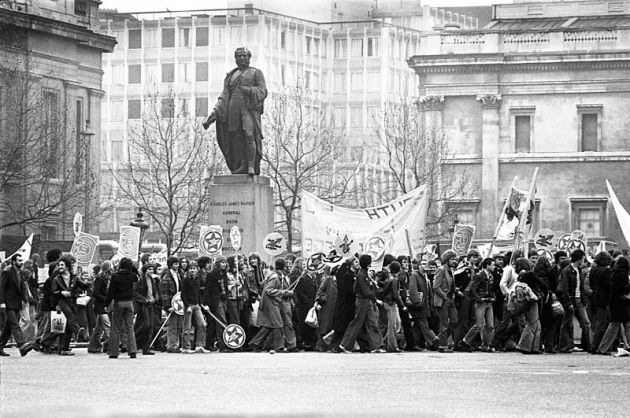
Clapton’s shocking proclamations sparked the Rock Against Racism movement, a campaign also inflamed by David Bowie’s comments to Playboy magazine concerning Hitler and the rise of fascism.

Rock Against Racism march, Trafalgar Square, April 1978

Rock Against Racism march, Trafalgar Square, April 1978

This troubling era is picked over in immense detail, with various jaw-dropping artefacts: Clapton’s handwritten ‘apology’ letter to Sounds magazine is printed in full, and there’s also an extremely rare photo of Bowie’s ‘Nazi salute’ at Victoria station in May 1976 (as well as a new-to-this-writer explanation/apology from Bowie). Black musicians and music-biz legends also comment with great candour about life in the UK during this period.

3-september-20162c-walls-come-tumbling-down-billy-bragg-in-conversation-with-author2c-daniel-rachel-40-people27s-history-museum-image-red-wedge5b45d

The 2 Tone movement attacked racism at its source while many artists under that umbrella also supported the Campaign For Nuclear Disarmament and Rock Against Sexism.

When Margaret Thatcher swept to a second term of office in 1983, bolstered by the Falklands War, a new pacifism emerged, typified by tracks like Elvis Costello’s ‘Shipbuilding’ and Heaven 17’s ‘(We Don’t Need This) Fascist Groove Thang’.

Later, as the miners’ strike took hold and Thatcher’s assault on socialism gathered pace, Paul Weller and Billy Bragg formed the Red Wedge movement which focused its attentions on ousting her in the 1987 General Election. It wasn’t to be, of course – although she did resign in December 1990.

The final section of ‘Walls Come Tumbling Down’ focuses on Dammers and various accomplices’ efforts to raise public awareness about the banned ANC, with high-profile singles and the famous 1988 Nelson Mandela 70th birthday tribute at Wembley Stadium, followed by his eventual freeing from jail on 11 February 1990.

Full of juicy details, potent memories of a far more passionate and politically-engaged era of pop music, and gripping, sometimes moving testimonies, this fascinating book outlines a period when youth culture demanded a voice.

‘Walls Come Tumbling Down’ is published by Picador.

Red Wedge 30 Years On

red wedge

The Red Wedge gang including Paul Weller, Jimmy Somerville and Glenn Gregory meet Ken Livingstone and Labour leader Neil Kinnock, 1987

Some might say that music and politics should never mix. But it’s less than two weeks to the General Election here in England. Looking at the music press or listening to music radio, you’d never know it.

Is politics just terminally uncool? Do today’s musicians not give a damn about who gets into power? It seems to be a mixture of both, though I was intrigued to see Paloma Faith hand-picking the writer Owen Jones to open some of her recent gigs.

The deafening silence (apart from a recent Jazz For Labour event at the Barbican) can’t help but beg comparison to the state of play 30 years ago when the movement known as Red Wedge got underway.

Formed in 1985 initially as a Labour-supporting group to encourage young people to vote and get Margaret Thatcher out of office, it arguably politicised a second generation of music fans a decade after Rock Against Racism and punk. Though I was too young to fully understand Red Wedge’s aims (and too young to vote), I certainly took notice.

Red Wedge officially started on 21st November 1985 when Kirsty MacColl, Billy Bragg, Paul Weller and Strawberry Switchblade were invited to a reception at the Palace of Westminster by Labour MP Robin Cook.

Major tours followed in the next few years leading up to the 1987 General Election featuring additional artists such as The Communards, The Style Council, Junior, Jerry Dammers, Madness, The The, Bananarama, Prefab Sprout, Elvis Costello, Sade, The Beat, Lloyd Cole and the Commotions and The Smiths. In short, this was no Mickey Mouse setup.

Unfortunately, their efforts amounted to diddly squat; the 1987 election resulted in a third consecutive Conservative victory. But at least they tried and their message didn’t fall on deaf ears. And where is the new batch of protest songs and protest singers? Unfortunately the current crop of musicians are just like most of the politicians: bland, middle-of-the-road, lacking in ideas and desperate not to offend.