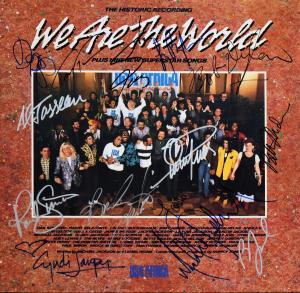
USA For Africa: We Are The World @ 40

Released 40 years ago this month and officially the fastest-selling single in American music history, USA For Africa’s ‘We Are The World’ shifted over 20 million copies and raised a huge amount of money for African famine relief.

Co-written by Michael Jackson and Lionel Richie during a few sessions at the former’s house in Encino, the song divides opinion but only the hardest heart could fail to be moved by its recording (even if one can definitely feel the vibe of some major agent/star power – no arriving in the manager’s battered old car for this lot…).

It brought together a fairly astonishing cast list of the great and good. And, inadvertently, it also arguably represented a last gasp for classic 1980s R’n’B and yacht rock.

The basic track was recorded at Kenny Rogers’ Lion Share Studios on 22 January 1985 with king-of-the-cross-stick John ‘JR’ Robinson on drums, bassist Louis Johnson and pianist Greg Phillinganes, closely monitored by a huge press corps, co-producers Quincy Jones and Michael Omartian and engineer Humberto Gatica. According to Robinson, all the musicians were sight-reading a chart and a click track was used, and they didn’t do more than two takes.

A few days later, Lionel sat down with Quincy and vocal arranger Tom Bahler to prep who would sing which lines (the decision was also made to mainly record vocals live and ‘in the round’ with no or at least very few ‘punch-ins’, unlike ‘Do They Know It’s Christmas’). All the major vocalists were then sent a copy of the basic track featuring Jackson’s guide vocal and with an enclosed letter from Lionel.

The featured singers then assembled at A&M Studios at around 9pm on Monday 28 January, most arriving after the American Music Awards (which Richie hosted). Notable absentees: Madonna (who was apparently bumped in favour of Cyndi Lauper), Prince (check out Duane Tudahl’s superb book for the details), George Benson, Dolly Parton, Donna Summer, Michael McDonald, Pat Benatar, Rod Temperton, Stevie Nicks, Joni Mitchell, Billy Idol? And is it odd that Smokey Robinson didn’t sing a solo line?

The complete footage of the recording session is still fascinating. We see how some of the biggest names in music history found different ways of preparing. Steve Perry waits for his line with eyes shut, looking down, listening intently. Diana Ross does just the opposite.

Bob Geldof gives a stirring pep talk and Stevie Wonder brings in two Ethiopian women to address the singers, moving many to tears. It’s hard not to be touched by Stevie, Kenny Rogers, Dionne Warwick, Diana, Steve Perry, Ray Charles and Cyndi Lauper’s vocals. But Harry Belafonte, Ray Charles, Bob Dylan and Bruce Springsteen seem to get the most respect from the assembled stars.

Other observations: Brucie – who had finished the latest leg of the Born In The USA tour the night before – looking like Judd Nelson in ‘The Breakfast Club’. Al Jarreau struggling throughout. Lionel the team player. Stevie giggling like a naughty schoolkid when Quincy gets annoyed. James Ingram hiding behind Kenny Rogers after a boo-boo.

Paul Simon twice saying to Rogers: ‘Can I help?’ Lauper sharing vocal tips with Kim Carnes. MJ holding hands with Diana and Stevie. Quincy and Stevie rehearsing with Bob Dylan. Stevie and Ray Charles using their braille machine. Quincy reading the score as he conducts the soloists, and his witty asides: ‘Who you gonna call?’ etc.

It looks like they recorded the first half of the song first (up to and including Daryl Hall) and then spent some time on the middle eight with Huey Lewis, Lauper and Carnes.

How does it sound now? Phillinganes’ piano playing is a pleasure to hear, typically tasty and gospel-inflected. But the track is inundated with synths – no less than four players are credited, including David Paich and Steve Porcaro from Toto – and probably why it reminded many of a Pepsi ad.

And it’s odd that the song features no guitar, though Prince offered to play a solo – Quincy reportedly told Prince’s manager Bob Cavallo: ‘I don’t need him to play guitar, we got f*ckin’ guitars’!

What Is The Ultimate 1980s Floorfiller?

Here’s a quandary. If you had to choose one 1980s song to get people on the dancefloor – maybe you’re the last-minute guest DJ at a wedding disco – what would you go for?
The track probably needs a few things going for it:

1. A great intro – a ‘call to arms’.

2. Cross-generational appeal, one for the kiddies and grandparents alike.

3. It has to be a total hit – no cult favourites.

4. Loudness and ‘impact’.

5. It’s probably ‘pop’ and pretty genre-less – no heavy metal or R’n’B.

6. A soundtrack hit might be good – something from a John Hughes joint or ‘Dirty Dancing’?

7. A flavour of the ‘novelty’ hit/one-hit wonder might help.

In his (great) book ‘Nothing Is Real’, David Hepworth comes up with five ultimate floorfiller contenders including two from the 1980s: Brucie’s ‘Dancing In The Dark’ and Madonna’s ‘Open Your Heart’. Both choices strike this correspondent as a little odd. Rather I’d posit the following (feel free to chime in with any omissions):

Michael Jackson: ‘Billie Jean’

Prince: ‘Kiss’

Dexys Midnight Runners: ‘Come On Eileen’

Simple Minds: ‘Don’t You Forget About Me’

Toni Basil: ‘Mickey’

Musical Youth: ‘Pass The Dutchie’

Roxy Music: ‘Same Old Scene’

Cyndi Lauper: ‘Girls Just Wanna Have Fun’

Bill Medley/Jennifer Warnes: ‘(I’ve Had) The Time Of My Life’

De La Soul: ‘Say No Go’

Young MC: ‘Know How’

Wham!: ‘Wake Me Up Before You Go-Go’

Human League: ‘Don’t You Want Me’

ABC: ‘Poison Arrow’

Madonna: ‘Into The Groove’

But the one 1980s track I’d choose to get people onto the dancefloor is…

David Bowie: ‘Let’s Dance’

I’ve rounded up most of these and some others into a playlist. Happy groovin’.

MTV @ 40: The Videos That Made MTV

By summer 1984, Frank Zappa was already decrying the MTV clichés in his ‘Be In My Video’ single (‘Pretend to be Chinese/I’ll make you wear red shoes’!).

But, away from the familiar tropes, there were trailblazing videos that set MTV on its way during the formative years. Either technically or thematically, these clips laid the groundwork right up until the end of the 1980s.

Of course they are kind of familiar, but watching them all the way through brought some interesting surprises, and even an unexpected lump in the throat area during the opening of ‘Borderline’ and denouement of ‘Take On Me’…

9. Musical Youth: ‘Pass The Dutchie’ (Dir. Don Letts, released September 1982)

The first ever video shown on MTV by a Black artist. This was a huge bone of contention in MTV’s early days, not helped by their regular, disingenuous rebuttal: ‘We only play rock’n’roll’. Don Letts’ joyful film put a spanner in the works, placing the lads in front of the Houses Of Parliament, the supposed ‘postcard’ vision of London, a tribute to the influence of Black culture in the UK and a stark message to the powers that be. Letts also created a huge hit in the process, reaching #1 in the UK and #10 in the USA.

8. The Police: ‘Every Breath You Take’ (Dirs. Kevin Godley & Lol Creme, released 20 May 1983)

Strongly influenced by Gjon Mili’s 1944 short ‘Jammin’ The Blues’, this was the video that catapulted Synchronicity‘s album sales into the stratosphere and gave the band a UK and US #1. Apparently directors Godley and Creme were pretty blitzed throughout most of the filming – according to the latter, ‘The first thing we’d do when we arrived on set was roll a reefer.’ Sting was reportedly no shrinking violet either, pointing to himself and telling the directors, ‘Keep the camera on the money’!

7. ZZ Top: ‘Gimme All Your Lovin’ (Dir. Tim Newman, released August 1983)

Randy Newman’s cousin Tim helmed all of ZZ’s key videos (and Randy’s excellent ‘I Love LA’) and he masterminded this much-imitated, endlessly-rewatchable classic, giving the band a new lease of life and a lasting image as kind of ‘mythical rockers’ (apparently influenced by his reading of Joseph Campbell). But it was ZZ manager Bill Ham who laid down the law to Newman, offering two directives: ‘Use the car (Billy Gibbons’ 1933 Ford coupe) and put some girls in it.’

6. Cyndi Lauper: ‘Girls Just Want To Have Fun’ (Dir. Edd Griles, released 6 September 1983)

Cyndi’s thing was inclusivity, and she delighted in showing a woman of every race in the video. It has echoes of John Waters’ aesthetic and the early Devo and B-52s videos, but this had a whole different vibe, apparently inspired by Lauper’s love of Jacques Tati’s 1958 film ‘Mon Oncle’.

5. Michael Jackson: ‘Thriller’ (Dir. John Landis, premiered December 1983)

‘Billie Jean’ opened the door for so many Black artists but this was pure box office and a delicious comedy/horror. Famously Michael headhunted director John Landis after watching ‘An American Werewolf In London’, giving him just one brief: ‘Can I turn into a monster?’ Landis was not interested in music videos but did like the idea of making a theatrical short. The video changed the game completely, and it’s arguable whether the dance routines have ever been bettered. It premiered on MTV on 2 December 1983 and reportedly doubled Thriller’s album sales within a few weeks of its first showing. It’s still absolutely thrilling.

4. Van Halen: ‘Jump’ (Dir. Pete Angelus, released December 1983)

Of course Metal acts were starting to make waves before this, with impactful videos by Twister Sister and Def Leppard, but ‘Jump’ laid down all the future ‘live on stage’ clichés, with balls on. Hair Metal became huge after this, and MTV adored the likes of Warrant, Winger and Bon Jovi, but none could ever match this song or Diamond Dave’s natural showmanship.

3. Madonna: ‘Borderline’ (Dir. Mary Lambert, released February 1984)

Lambert had only directed one video (Tom Tom Club’s ‘As Above So Below’) before getting her dream job on this breakout Madonna single. Madonna and Lambert discussed the video’s plot for two days in the former’s minimalist bolthole on the Upper East Side with Madonna insisting there be a Hispanic influence, necessitating moving the shoot to downtown Los Angeles. This is reportedly the first video to use black-and-white footage combined with colour; Madonna’s manager Freddy DeMann supposedly went ballistic on viewing the final cut but of course it became a video cliché, gave Lambert a successful career and Madonna her breakthrough song.

2. Lionel Richie: ‘Hello’ (Dir. Bob Giraldi, released February 1984)

Apparently director/scenarist Bob Giraldi was driven half mad by Lionel’s terminal lateness onto the set. For his part, Lionel was very sceptical about the bust. Apparently he finally plucked up the courage to approach Giraldi about it: ‘Bob, that bust does not look like me.’ There was a pregnant pause. Finally, Bob said, ‘Lionel… She’s blind.’

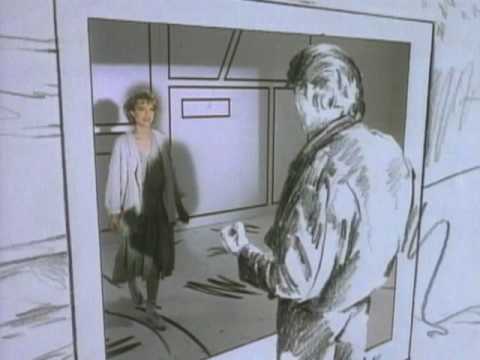
1. A-ha: ‘Take On Me’ (Dir. Steve Barron, released September 1985)

The song had completely flopped on its original release, so WEA gave Steve Barron a blank cheque to make a memorable video and get a hit. Working alongside rotoscope animator Michael Patterson, who did 1,800 drawings for the shoot, Barron was heavily influenced by Ken Russell’s 1981 movie ‘Altered States’. Barron knew he could make it work when the image of an animated hand reaching out of a comic book popped into his head whilst he was bored shooting a Toto video. Apparently singer Morten Harket and lead actress Bunty Bailey fell in love during filming, becoming almost inseparable. ‘By take four, they would carry on holding hands even when we’d cut,’ remembered Barron. Aided by the video, ‘Take On Me’ became the band’s only US #1.

Further reading: ‘I Want My MTV’ by Rob Tannenbaum and Craig Marks

MTV @ 40: The First Five Years

Like most good ideas, it was a deceptively simple one: music radio, but on TV.

When the Warner Bros./American Express-bankrolled MTV (Music Television) launched 40 years ago this month, kicking off with The Buggles’ ‘Video Killed The Radio Star’, the music business was in a post-Saturday Night Fever slump.

But global record sales doubled between 1981 and 1990. Like it or hate it, MTV had a huge role to play. Its story also has fascinating echoes of the music business in the 2020s. But how did it revolutionise the industry so quickly?

In the early ’80s, video-making was a veritable Wild West, an almost-anything-goes environment. There were undoubtedly some shenanigans which wouldn’t win any #woke awards these days but, interestingly, it was predominantly women who ran video shoots, as producers and production designers.

Though their offices were based in New York, MTV was only initially available in the Midwest and suburban areas, as these were the places that had cable laid (leading to a veritable industrial revolution after the iconic ‘I Want My MTV!’ promo spots). Sonically, it was also important that MTV insisted on stereo audio from day one.

The localisation of MTV led to a big grassroots following for bands, particularly British ones, almost overnight. It also led to record companies getting very granular with sales; they paid closer attention, watching with interest if a band took off in one area. Labels started to take MTV very seriously indeed.

Then there was the Second British Invasion: a whole legion of young British acts (ABC, Flock Of Seagulls, Eurythmics, Culture Club, Cure, Billy Idol, Bananarama etc.) emerged in the early 1980s who took to videos like a duck to water.

They wowed Middle America, helped enormously by gifted Brit directors such as David Mallet (whose groundbreaking work on ‘The Kenny Everett Video Show’ from 1978 to 1980 ushered in many music-video tropes), Julien Temple, Steve Barron, Godley & Creme, Nigel Dick, Don Letts and Tim Pope.

But, in a curious echo of the current streaming craze, it seems the major labels were not prepared for the video revolution. They didn’t understand it and were suspicious of giving their content away for free. So they did what they usually do: shafted the artists. Video budgets became recoupable fees that came straight out of the artists’ profits. Artists were to all intents and purposes paying for their own videos.

The rise of MTV also meant that now the emphasis was on killer tracks rather than albums. It was a big problem for some acts, and the 1980s became synonomous with one-hit wonders. Rolling Stone and the trade magazines regularly trashed MTV in its first few years, and David Bowie questioned the lack of Black artists amidst frequent charges of racism.

But, by 1984, everything had changed. In the bumper year for Michael Jackson, Bruce Springsteen, Prince, Lionel Richie, Cyndi Lauper, Tina Turner and Madonna, it was clear that MTV was the tail wagging the dog. The naïve, experimental era was over. Post-‘Thriller’, more and more money was being thrown at videos and every director wanted to put their stamp on the material.

Also, by 1984, thanks to advertising revenue, MTV’s margins were huge. They were dictating to record companies, not the other way round. MTV didn’t have to pay royalties to artists or labels for showing videos. There was no ‘playlist’ per se, so they could pick and choose what they played.

It couldn’t last. The big major labels demanded a royalty to play their videos in 1984, threatening withdrawal of their products, and they eventually got it.

The first few hours of MTV’s launch day is a fascinating watch, showing how rooted in the 1970s it was when it started out, featuring REO Speedwagon, Stevie Nicks, Carly Simon, Gerry Rafferty, Todd Rundgren, The Buggles, Lynyrd Skynyrd (and TWO videos each of Pat Benatar, Split Enz and Rod Stewart!) and showing the dearth of decent contemporary videos.

The gauntlet had been laid down and it didn’t take long for some very creative people to pick it up. Next time: the videos that made MTV during its first five years on the air.

Further reading: ‘The Speed Of Sound’ by Thomas Dolby

‘I Want My MTV’ by Craig Marks and Rob Tannenbaum


1980s ‘Classics’ I Don’t Need To Hear Again (AKA The Bland Files)

Noel Coward famously noted the strange potency of ‘cheap’ music.

There was certainly a lot of cheap, potent music around in the 1980s.

But as the nostalgia industry has grown, so has the dossier of seemingly ‘untouchable’ ’80s pop songs, tracks that are staples of daytime radio but, to many ears, lack distinctive grooves, beguiling melodies or interesting hooks.

If you were being cruel, you might say it’s music for people who don’t really like music. And, weirdly, it mostly comes from established, experienced campaigners who have a lot of other strings to their bow. But we only ever seem to hear one or two of their songs.

Here are those overplayed tracks that always have me reaching for the ‘off’ switch but have retained a weird grip on radio programmers for over 30 years. We consign them to Room 101, here and now, never to be heard again…

Dire Straits: ‘Walk Of Life’/’Money For Nothing’

Yazz: ‘The Only Way Is Up’

King: ‘Love And Pride’

Whitney Houston: ‘I Wanna Dance With Somebody’

Tina Turner: ‘Simply The Best’

The Beautiful South: ‘Song For Whoever’

Spandau Ballet: ‘Through The Barricades’

Dream Academy: Life In A Northern Town

Anything by The Proclaimers

Anything by Texas

Chris Rea: ‘The Road To Hell’

Sade: ‘Your Love Is King’/’Smooth Operator’

Steve Winwood: ‘Higher Love’

Mike And The Mechanics: ‘The Living Years’

Anything by Fleetwood Mac

The Cars: ‘Drive’

Mental As Anything: ‘Live It Up’

Soul 2 Soul: ‘Back To Life’

Anything by U2 apart from ‘Pride (In The Name Of Love’)’ or ‘The Unforgettable Fire’

Cyndi Lauper: ‘Time After Time’

Depeche Mode: ‘Personal Jesus’

Talking Heads: ‘Road To Nowhere’

Tracy Chapman: ‘Fast Car’

Anything by Tom Petty

Simply Red: ‘Holding Back The Years’

Prince: ‘When Doves Cry’

Womack & Womack: ‘Teardrops’

Anything by Duran Duran except ‘Notorious’ or ‘Skin Trade’

Anything by Bon Jovi

Culture Club: ‘Karma Chameleon’

Anything by Pet Shop Boys except ‘Suburbia’

Spitting Image: We’re Scared Of Bob

In the ’80s, there was no shortage of pop coverage to inspire conversation in the playground, whether it was Boy George’s first appearance on ‘Top Of The Pops’, Michael Jackson’s ‘Thriller’ video or Matt Bianco being verbally abused live on children’s TV.

Of course it really helped that there were only four terrestrial channels to choose from, breeding a feeling of community and sense of occasion.

But one TV show absolutely guaranteed to get the creative juices flowing and rescue many a depressing Sunday evening was ‘Spitting Image’.

Just a cursory look at a show from its mid-’80s peak leaves one stunned at the craftsmanship and production values on offer, especially as they only had a few days to write, build and shoot each episode. There were some good musical spoofs too, composed by Philip Pope, fresh from UK comedy classic ‘Not The Nine O’Clock News’ and his parody band The Hee Bee Gee Bees, who even managed a few hits in the early ’80s.

‘Spitting Image’ also featured some memorable Phil Collins, ZZ Top and Madonna skits, and they even managed to rope Sting in to re-sing this. But ‘We’re Scared Of Bob’ is full of surprises and surely the best spoof. Its sheer potency is still a shock to the system. You also suspect that Sir Gandalf was watching, so unmissable was the programme in the mid-’80s.

Why isn’t there anything like this around now? Oh, lack of money and talent, probably. A show like ‘Spitting Image’ also highlights the paucity of genuinely interesting musical (and public) figures these days.