
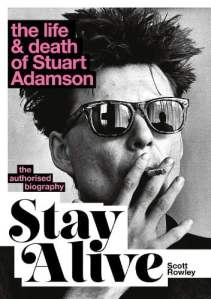
 Here’s another missive from the darker side of the music industry.
Author Scott Rowley has obtained the full cooperation of Stuart Adamson’s family, friends and bandmates to tell the gripping, sometimes troubling, sometimes sad, sometimes funny story of the Big Country frontman and Skids guitarist who took his own life in 2001 after struggles with alcoholism and depression.
A brave, unsettling opening takes us right into Adamson’s head just a few days before his death. From there it’s an unflinching look at his troubled life, and Rowley finds plenty in Adamson’s background pointing to mitigating circumstances (his father was jailed in 2004 for abusing children).
‘Stay Alive’ also takes an unusual approach with fairly detailed biographical detail about all the members of The Skids and Big Country. They are a huge part of this story – Richard Jobson and Tony Butler in particular deliver strikingly candid observations on Adamson, as do several family members.
This is also very much a Scottish tale, complete with unedited dialects and much fruity language, from Adamson’s childhood in Cowdenbeath (novelist Ian Rankin went to the same school) onwards.
Adamson makes an almost immediate musical impact during the punk era with The Skids. The Strangers’ JJ Burnel takes an interest as does John Peel, calling Adamson ‘Scotland’s answer to Jimi Hendrix’.
Virgin Records sign the band but indulge in various questionable business decisions; the book is extremely good on the machinations of the post-punk record industry (as is this ‘Play At Home’ documentary from 1984).
Adamson’s relationship with vocalist Jobson starts well – Adamson is particularly protective towards the singer when he finds out about his epilepsy – but the friendship becomes increasingly strained as the band gain some success.
Adamson flees The Skids and hooks up with young guitarist Bruce Watson and the hot West London rhythm section of drummer Mark Brzezicki and bassist Tony Butler (who had already played on Pretenders’ ‘Back On The Chain Gang’). It was Tony who was blown away by the musical chemistry after their first jam session, insisting that he and Mark join Big Country.
But even as the band achieve almost immediate success and create a great bond with their many fans (it’s often forgotten how popular Big Country were in the UK, enjoying 12 Top 40 singles during the 1980s), Adamson can’t ditch the serious drinking. More and more difficult behaviour ensues, including a disappearing act around the time of Live Aid which, to this day, Butler deems almost unforgivable.
But Adamson regroups and enjoys 14 years of sobriety after that difficult summer of 1985. A 1988 reunion leads to a bidding war between Virgin and Warners – they go with the latter, head honchos Russ Titelman and Lenny Waronker apparently marvelling at the band’s musicianship. But it all goes wrong again, Adamson jumping ship in 1989.
Big Country were one of the most musically-literate and distinctive rock bands of the 1980s, and we get plenty on just how they achieved their sound: Adamson’s first wife Sandra was a dancer, and her practice tape featured a piper named Willie Law. Adamson would often try to play along, probably the original source of the ‘bagpipe guitars’ tag that followed Big Country around.
Meanwhile Brzezicki based his style around military rudiments (his Polish father insisted that he work through a RAF drum book) and jazz/rock legends such as Billy Cobham and Lenny White.
The book is excellent on the literary sources of Adamson’s lyrics – even hardcore Big Country fans will probably be surprised how many there are.
There are plenty of pertinent, poignant details about him too. A regular five-a-side player, his football friends report that his nickname was Inspector Gadget, because he always had his legs wrapped around someone.
But there’s no getting away from the fact that the last third of ‘Stay Alive’ is a gruelling portrayal of alcoholism and attendant family breakdown, as Adamson begins a new life in the US and Big Country limp on with varying degrees of success.
Still, this excellent book covers all the bases – it’s an essential read about the 1980s music scene and also somewhat of a cautionary tale which should be read by every agent, manager and PR person.
Of course it’ll also be rather a heartbreaking book for Big Country fans. Their excellent performance of ‘King Of Emotion’ on the Channel 4 show ‘Wired’ (this writer’s first real exposure to the band) came complete with Adamson’s cheeky grin and nod to someone in the front row around 0:25. Hard to think of any other 1980s pop frontmen who were so inclined.
Author Scott Rowley discusses ‘Stay Alive’ in this podcast.

