Movie Review: Command And Control (2016)

cmd-ctl-movieThis is a golden age for documentaries, and, in its own way, ‘Command And Control’ may just be as powerful as 2012’s BAFTA-winning ‘The Act Of Killing’.

As nail-biting as any Hollywood thriller and carrying a terrifying message, it’s also a remarkably timely film given this week’s Theresa May Trident controversy.

Based on the book by acclaimed journalist and author Eric Schlosser (‘Fast Food Nation’, ‘Reefer Madness’), Robert Kenner’s documentary looks in detail at the notorious accident of September 1980 at the Damascus underground nuclear base in Arkansas, when the fuel tank of an idle Titan II missile was damaged – with disastrous consequences.

Meticulously researched and beautifully paced, the film expands into a shocking and riveting exposé of the US nuclear industry. Testimonies of the accident survivors are heartfelt, often surprising and occasionally moving, describing a world where human error can be catastrophic and is usually the result of an unreliable – and sometimes unjust – system.

Any event which leads to loss of life can hardly be classed as a ‘near miss’, but Damascus could easily have been a lot worse – we learn that Vice President Walter Mondale and Governor of Arkansas Bill Clinton were just 46 miles down the road at a Democratic convention in Little Rock when the accident happened.

They would have been pulverized if the warhead had exploded, along with thousands – if not millions – of other citizens.

The scary facts pile up: during the Cold War, it was believed that the US needed between 50 and 100 nuclear weapons to keep up with the Soviet Union – there are currently around 7,000 nuclear weapons on US soil and surrounding oceans, including approximately 500 primed and ready to go.

And some experts estimate that 1,000 similar accidents to the one at Damascus have occurred in the US since the advent of nuclear weaponry.

According to Schlosser, the fact that there hasn’t been more loss of life is down to the excellence of the weapons designers and bravery of the (mostly very young) site engineers.

But mostly it’s down to luck. And the thing about luck is that it eventually runs out, as ‘Command And Control’ so harrowingly depicts.
The Crap Movie Club: One-Trick Pony (1980)

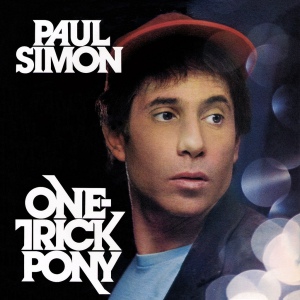
paul simonBy his own admission, Paul Simon had some very lean years between his 1975 classic Still Crazy After All These Years and 1986’s multi-million selling, multi-Grammy-winning Graceland.

His 1983 album Hearts And Bones was a major flop despite featuring some fine songs and great musicianship.

But the real nadir was ‘One-Trick Pony’. I stumbled across it very late at night on British TV in the late ’90s and was instantly gripped. It’s that special kind of crap movie – the ‘rock star’ vanity project with a gallon of overreaching ambition.

To say it hasn’t aged well would be a huge understatement, though, as with most genuinely bad films, it features a myriad of guilty pleasures too…

In 1980, Simon clearly wanted to celebrate his new Warner Bros record contract with a bang (he’d just jumped ship from CBS) but who persuaded him that a self-written, autobiographical movie was the answer? His screen persona was hitherto based pretty much on one (admittedly superb) cameo in Woody Allen’s ‘Annie Hall’.

But in ‘One-Trick Pony’ he tried to carry an entire movie with just two default settings: he’s either bopping around the stage, sweaty and somewhat bug-eyed, trying desperately to ‘rock’ (in Joe Queenan’s memorably cruel words, Simon is ‘too short to rock’n’roll, too young to die’), or he’s sulky and morose, peering doe-eyed into the middle distance, desperately trying to be adorable.

Simon plays Jonah Levin, a once-popular folk-rock artist who has fallen on hard times (see what he did there?) and now reduced to hawking his band (Steve Gadd, Tony Levin, Richard Tee and Eric Gale) around the Midwest, supporting bands like the B-52’s (who are held up as an example of the ‘hideous’ way the recording industry is going, but whose schtick is so much more vital and life-affirming than Simon’s supposedly ‘raw’ music…).

Jonah’s relationship with his estranged wife – Blair Brown in a completely thankless role – is terminally dull, with undramatic longueurs and clunking one-liners. There’s also some excruciating stuff with Jonah’s ‘cute’ son. You know the kind of thing – lots of ‘whatever happens, Daddy loves you, OK?’, cloying shenanigans with baseball mitts and copying Daddy shaving at the mirror.

From a muso perspective, you might well ask how a movie so heavily featuring superstar players such as Gadd, Gale, Tee and Levin can be outright crap. Well, the novelty effect lasts a few minutes but after that you can only feel for these gents – they’re given pretty thankless roles, playing a fairly tasteless ‘dead pop stars’ quiz in the car, reading out gig reviews and endlessly checking into dodgy hotels. Poor Richard Tee and Eric Gale look the most uncomfortable.

Jonah’s dealings with the record-biz ‘suits’ in ‘One-Trick Pony’ are presumably based on Simon’s disagreements with his previous employers CBS Records, and they produce the only enjoyable sections of the film.

Rip Torn is reliably gruff though resolutely uncomical in his impersonation of legendary CBS hatchet man Walter Yetnikoff, but Lou Reed clearly relishes his cameo as a jobsworth producer; he’s desperate to add strings, horns and backing vocals to Jonah’s stripped-down tracks. Cue a lingering close-up of David Sanborn letting rip on alto, though we’re never sure if this is meant to be a Bad Thing or even a joke – to this viewer, it seemed like the first bit of decent music in the movie.

Oh yeah, the music. The soundtrack of course did a hell of a lot better than the movie – great single ‘Late In The Evening’ featured a Steve Gadd groove almost as influential as ’50 Ways To Leave Your Lover’ and even made the top 10 in the States.

To be fair to Simon, he had sorted out his screen persona by the time of the ‘You Can Call Me Al’ video in 1986, settling on a kind of faux-naif ‘everyman’ figure with some aplomb. He was also pretty funny in Steve Martin’s ‘Homage To Steve’ short from the same year. But let’s just rejoice that he hasn’t returned to the world of feature films since…

The Pop Group: Where There’s A Will…

pop groupPunk’s tributaries reached far and wide post-1976.
Save country and classical, there was barely a music genre that wasn’t affected by it.

But one of the most singular and unclassifiable collectives to emerge from the punk boom was Bristol’s The Pop Group, who just for a few years fused all their passions – reggae, dub, free jazz, funk, Erik Satie, Beat poetry, Dadaism, Situationism – into a gloriously chaotic unit.

hqdefault

I don’t know a better band for annoying the neighbours. At their best, The Pop Group sound a bit like an avant-garde jazz band trying and somehow failing to play like Chic, run through Adrian Sherwood’s dub effects.

But they are pretty damn exciting in small doses and offer textures that are genuinely surprising. I generally turn to them as an antidote to the Ed Sheerans and Ellie Gouldings of this world. They also came up with some of the best cover artwork of their era.

The Pop Group emerged from a gang of West Country teenage music fans called The Bristol Funk Army who apparently would wear zoot suits and brothel creepers and listen to heavy ’70s funk. Meanwhile, vocalist/lyricist and Last Poets fan Mark Stewart was getting a serious political awakening, hellbent on documenting his research into consumerism, nuclear power and US foreign policy.

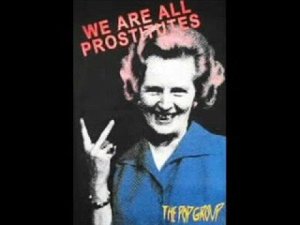
The band’s lifespan was pretty brief, limited to two albums (the debut Y was produced by UK reggae legend Dennis Bovell) and three classic singles – ‘She Is Beyond Good And Evil’ (not about Thatcher, according to Stewart), ‘We Are All Prostitutes’ and ‘Where There’s A Will’, which was released as a double A-side with The Slits’ ‘In The Beginning There Was Rhythm’ in March 1980.

R-196296-1403389558-3690.jpeg

They apparently lost thousands of pounds of revenue by mainly playing benefit gigs for Cambodia and Scrap The Sus (stop and search law). It was a very volatile time and they definitely put their money where their mouth was.

Their last gig before an amicable parting of the ways was the Campaign For Nuclear Disarmament benefit in Trafalgar Square on 26 October 1980 in front of 250,000 people.

Mark Stewart spent the rest of the ’80s pursuing a fascinating solo career, while Gareth Sager and Bruce Smith formed Rip Rig & Panic (later featuring Neneh Cherry on vocals), and Smith has also been PiL’s drummer since the mid-’80s.

The Pop Group’s sound has also been massively influential on a host of punk/funk bands over the last 20 years or so including Radio 4, Primal Scream and LCD Soundsystem.

And guess what – they are back among us again. They released a superb comeback album in 2015, Citizen Zombie, and have played live fairly regularly since 2011. It’s a pleasure to report that the rage and weirdness are very much still there.

But back to ‘Where There’s A Will’. This recently unearthed clip has become a favourite (I love the studious Belgian host attempting to make some sense of this insanity), an antidote for anaemic, safe music everywhere. Not even Chris Morris could have come up with anything more grippingly bizarre.

For much more about The Pop Group and early ’80s music, check out Simon Reynolds’ excellent ‘Rip It Up And Start Again‘.

Story Of A Song: Bill Bruford’s ‘Palewell Park’ (1981)

The 1980s were a pretty good time to be a songwriting drummer; Sheila E, Phil Collins and Don Henley all flourished, and probably a few more too.

Not that master Yes/King Crimson sticksman Bill Bruford had any particular desire to match their commercial standing as the decade got underway. He was quite happy gaining harmonic knowledge (with the assistance of keyboardist Dave Stewart), making sizeable contributions to the percussion community and composing incredible pieces of music like ‘Palewell Park’.

In a way, it was the culmination of his work with the Bruford group which had released three studio albums between 1978 and 1980, two featuring the brilliant Allan Holdsworth on guitar.

Palewell Park, East Sheen, London

Palewell Park, East Sheen, London

This track has a special resonance for me as Palewell Park was a childhood hangout, site of many great cricket, tennis and football games as well as a fair few teenage hijinks. Bruford apparently lived nearby during the piece’s recording at Surrey Sound in Leatherhead (also the studio The Police used for their first two albums) and wanted to write an ode to the area.

Someone on YouTube very aptly described ‘Palewell Park’ as ‘a contemporary piece for piano and bass’. It doesn’t fit comfortably into any genre, but it’s a pretty remarkable composition coming from the pen of a ‘drummer’, and one who doesn’t even feature on his own composition (Stewart played the piano).

Jeff Berlin, Jon Clark, Dave Stewart, Bill Bruford in 1980

Jeff Berlin, Jon Clark, Dave Stewart, Bill Bruford in 1980

The 26-year-old Jeff Berlin lays down one of the great pieces of post-Jaco bass playing. With just a touch of chorus pedal, he sticks to the pretty treacherous melody in the first half and then stretches out to play a fantastic solo over the changes, a total lesson in melody construction, with no gimmicks.

Next up for Bill was a reunion with Robert Fripp and one of the great albums of the ’80s, King Crimson’s Discipline.

The Dude Abides: Johnny Guitar Watson’s Love Jones

johnny guitar watsonWhen it comes to the arts, ‘nobody knows anything’, as screenwriter William Goldman famously claimed.

But the music biz sure knows a good formula when it sees one. And in the late-1970s and early ’80s, formulas didn’t come much more successful than Johnny Guitar Watson’s.

His fusion of funk, blues, disco, jazz and R’n’B even gave Parliament/Funkadelic and Earth, Wind & Fire a run for their money. He was simply one of the coolest musicians ever to walk the planet.

A Texan blues master who influenced many guitarists including Frank Zappa (the two would collaborate regularly in the ’70s and ’80s), Watson relaunched his sound with Ain’t That A Bitch in 1977, a superb marriage of hilarious lyrics, double-tracked vocals, cool Stevie/Sly/Curtis grooves, ambitious horn arrangements and searing guitar solos. It was a big success and Watson spent the rest of the ’70s repeating the formula with minor variations and, to be honest, diminishing returns.

Ain’t That A Bitch hooked me right away. My dad had a knackered old cassette copy which came in a really horrible silver-and-yellow design, but for some reason I was fascinated by it. There was something seriously dodgy about the cover photo, title and…everything, really. But then I listened to it. By the late ’80s, I was getting into Sly, Stevie and The Isleys, so Bitch fitted in like a dream and became an essential soundtrack to summer 1989.

On 1980’s Love Jones, Johnny expanded his sound to include influences from P-Funk, gospel, bebop, bossa-nova, Afro-beat, hip-hop and even country, and the result is one of the weirdest but most interesting albums of his career. A lot of it sounds very rushed, as if his mind wasn’t really on the job, but that sometimes works in its favour!

With hindsight, Johnny should be included alongside Sly, Prince, D’Angelo, Stevie and Lewis Taylor as one of soul music’s finest multi-instrumentalists – on his great albums of the 1970s and early ’80s, he plays all the keyboards, bass, guitars and some drums, as well as producing and arranging.

His keyboard playing gives guys like Ramsey Lewis and Les McCann a run for their money, and he even once recorded a whole album of piano/vocal ballads, 1963’s I Cried For You.

Love Jones kicks off with the infectious ‘Booty Ooty’, powered by the great, unsung drummer Emry Thomas, which adds a touch of P-Funk to Johnny’s classic horn-driven sound.

The title track is a fairly cheesy soul ballad, while ‘Goin’ Up In Smoke’ continues his strand of state-of-the-nation political funk/blues tunes which began with Ain’t That A Bitch‘s title track in ’76. ‘Close Encounters’ is just plain odd, a bossa-nova with some funny lyrics about a mistaken love affair – ‘It was close encounters of the wrong kind’!

His update of ‘Lone Ranger’ is a classic, featuring some outrageous vocal scatting and some nutty electric piano and bass solos. The gospel curio ‘Jet Plane’ has a criminally-out-of-tune bass, badly-recorded keyboards and amateurish drums (presumably played by Johnny), but it still works.

Ditto the seriously weird ‘Children Of The Universe’, a country-rock coming-of-age piece which sounds like The New Seekers backing Sly Stone.

But Love Jones‘s centrepiece is of course the mighty ‘Telephone Bill’, oft cited as one of the first rap tracks. In 1994, Watson was asked if he had anticipated the hip-hop movement:

“Anticipated? I damn well invented it! And I wasn’t the only one. Talkin’ rhyming lyrics to a groove is something you’d hear in the clubs everywhere from Macon to Memphis. Man, talkin’ has always been the name of the game. When I sing, I’m talkin’ in melody. When I play, I’m talkin’ with my guitar. I may be talkin’ trash, baby, but I’m talkin’!”.

Yessir, but more importantly the track features his best guitar solo on record, an amazing mash-up of bebop, blues and funk.

Compared to the lush, meticulously-arranged Ain’t That A Bitch, Love Jones sounds like a series of demos but it still works, like pretty much all of Johnny’s music. He carried on touring and recording right through to his death in 1996. I wish I’d seen him play live. See ya, Johnny.

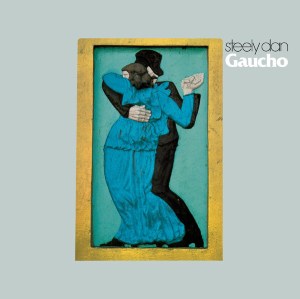
Steve Khan talks about recording Steely Dan’s ‘Gaucho’

steely

When I was about 12 or 13 years old, I was obsessed with my dad’s very old ABC Records cassette of Steely’s Greatest Hits.

It may have been the opening eight bars of ‘Do It Again’ that did it. I never looked back; they quickly became my favourite ‘band’, and remain so to this day.

I heard Gaucho – which turns 35 today – a few years later, maybe in 1986 or ’87, not even knowing of its existence until then. The album knocked me out. I practiced my drums to it every day.

By all accounts, it was a laborious and very expensive record to make, with various obstacles: whole songs were inadvertently erased (‘The Second Arrangement’) and other classics shelved.

Walter Becker endured a serious injury after being hit by a cab and there was even a lawsuit from Keith Jarrett regarding the similarity between the title track and his 1974 composition ‘Long As You Know You’re Living Yours’.

But it all paid off in the end; Gaucho was sumptuously mixed and mastered with songs that were built to last. Guitarist Steve Khan was a key contributor to Gaucho. Along with Larry Carlton, he would seem the perfect player for their later work, combining a jazz sensibility with a great feeling for the blues and also speedy sight-reading skills.

I was delighted to catch up with Steve from his New York base to talk about his role on the album and the ‘Glamour Profession’ session that led to one of the great guitar solos in the Steely canon.

On getting the call to play on Gaucho:

SK: I had played on almost all the tracks for Gaucho (even though I was erased from some, and some tracks didn’t survive), so I was a pretty healthy part of that recording. As to why they thought of me, who the hell really knows? Donald tends to like players who have a jazz sensibility but who also have a bluesiness or soulfulness about their playing. I guess, in his eyes, I fall into that category of possibilities.  I was the last thing to go on ‘Glamour Profession’, just as I was the last one to go on ‘Third World Man’ as well.

‘Glamour Profession’ lead sheet, prepared by Steve Khan. Click to enlarge

On playing the ‘Glamour Profession’ rhythm parts:

SK: The first thing we did was all the rhythm parts. In a sense that was very simple because they just wanted me to double what some kind of synth had already played – probably sequenced – and with perfect time. At about 3:30 in the track, there’s a little four-bar guitar chorale that Donald wanted me to play, so we wrote out the four voices and I played each voice individually, giving each one a touch of ‘soul’ with a little personal phrasing and vibrato here and there. Then, I think that we returned to doing the rest of the rhythm part. Honestly, I don’t recall if I did the rhythm part on my Telecaster Custom or not – when I listen now, there’s a crispness to the sound which leads me to believe that this was the Tele.

On recording the famous ‘Glamour Profession’ solo:

SK: I used my new Gibson ES-Artist (with active electronics) – which is really a 335 – and after that solo, I never used it again – I sold it back to Manny’s Music! In the end, all the fancy things that they can do to guitars are fine but everything comes down to one’s touch, and I’m mostly speaking about the fingertips on the left-hand. If one has a good touch, the music will translate through virtually any amp. Equipment is just a tool.

glampro2

In concept, the solo represents a lot of linear concepts that I had been working on for years. And only in hindsight, many years later, after the publication of my second theory book ‘PENTATONIC KHANCEPTS‘, I hear these kinds of linear ideas at work. Based upon the chord progressions, it all seemed to work perfectly because, in the end, it is a combination of the angular with a bluesy feeling to it – and that’s what Donald and Walter like – with a touch of harmonic sophistication.  I think that the things that I was working on, a long time ago, in terms of other approaches to changing up the normal jazz/bebop-oriented construction of lines, seemed to be very present on ‘Glamour Profession’. If you apply the Pentatonic Khancepts to those chords, you’ll see/hear exactly what I was doing then, mixed in with a healthy dose of blues too.

The horns and the synth lines were already there, so it becomes like playing through a bit of a minefield because you have to dance around those other linear elements. I did one complete take which I actually liked very much. Then, of course, they asked me to do another one. Because of track space, I couldn’t have done more than three of them. Then, thank goodness, I think that we all felt that the first one had the most ‘meat’ to it, and so we would work from that. Then we went back through it. They kept all the phrases that they loved and asked me to try something else in a number of spots. Whether I wanted to or not, it’s still a job and you do what you are asked to do!

For more on Steve’s contribution to Gaucho and the rest of his career, check out his website and this great interview with Leo Sidran.

For much more about Steely Dan, check out ‘Reeling In The Years’ by Brian Sweet and ‘Aja 33 and 1/3’ by Don Breithaupt. 

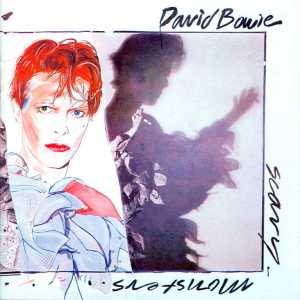
David Bowie: Scary Monsters (And Super Creeps) 35 Years Old Today

bowieRCA Records, released 12 September 1980

10/10

‘Albums of the ’80s’ lists are all the rage these days. Scary Monsters (And Super Creeps) would easily be in the movingtheriver top ten. It might even be in my top one.

It’s a timeless, masterful work which, for me, can only ever be consumed in its totality. It’s also the collection that all subsequent Bowie albums have been measured against. I would put it over and above Low, Ziggy Stardust and Hunky Dory for its sheer consistency.

ScaryMonstersBackCover

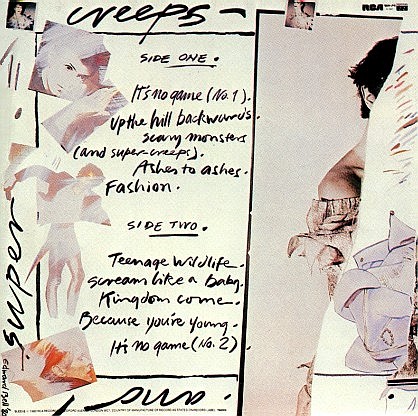
Here’s my case for the defence, track by track:

1. It’s No Game (Part 1)

I’ve previously written about this being one of the great ’80s album intros. Vocally, Bowie channels John Lydon and Peter Hammill to deliver a New York/New Wave anti-fascist tirade that ranks among his great performances. Producer Tony Visconti ‘f***s with the fabric of time’ to create a cavernous, Eventide-drenched mix and guitarist Robert Fripp delivers one of his most unhinged statements. Avant-rock heaven. Adapted from Bowie’s early demo ‘Tired Of My Life‘.

2. Up The Hill Backwards

A brilliant treatise on press intrusion and the wretchedness of celeb culture inspired by Bowie’s ‘dealings’ with the press during his failing marriage, with an ingenious central image of paparazza snapping away at their prey as they shuffle ‘up the hill backwards’. Endlessly catchy with a beautifully-realised unison vocal – the only track in the Bowie canon which doesn’t feature his solo singing.

3. Scary Monsters

Bowie revisits his finest Mockney accent to deliver a bleak, blanked-out, darkly funny tale of semi-stalking. There’s more Phil Spector-style brilliance from Visconti and another Fripp masterclass in balls-out guitar playing. The only minor criticism is that it possibly goes on for about a minute too long.

4. Ashes To Ashes

An instant classic with a very Bowie mix of child-like innocence and creeping malevolence as the hopelessly drug-addicted, world-weary Major Tom drifts off into the ether. Effortlessly superb songcraft with three or four memorable sections, boundary-pushing lyrics (‘Visions of Jap girls in synthesis’!) and a myriad of majestic hooks.

5. Fashion

The lameness of the style wars is in Bowie’s sights this time as he almost mumbles the ironic verse lyrics over a tough New York disco/funk/rock groove. And there’s more barking mad Fripp soloing. Danceable, amusing, timeless. Originally titled ‘Jamaica’ in demo form.

6. Teenage Wildlife

Initially coming across as slightly lumpy and leaden, the track builds and builds in intensity to deliver a powerful message to Bowie’s ‘mythical younger brother’ about keeping a sense of perspective as one gets older. His patented ‘histrionic’ vocal style is superbly realised and drummer Dennis Davis holds it all together with aplomb. Originally titled ‘It Happens Every Day’ in demo form.

7. Scream Like A Baby

Spooky dystopian fable about a future society’s outlawing of homosexuality and other ‘deviant’ behaviour. Bowie’s ingenious stuttering provoked many a schoolyard titter and the weird vocal doppler effects are perfectly realised. Revamped from the Bowie-written/produced ‘I Am A Laser‘ originally recorded by Ava Cherry/The Astronettes.

=bowie

8. Kingdom Come

A superb cover of a track from Tom Verlaine’s debut album, Phil Spector is the obvious influence again with Davis’s booming, overdubbed tom fills and some anthemic, reverb-drenched backing vocals. Majestic, powerful, intriguing. Verlaine was apparently supposed to play guest guitar throughout the album but bowed out at the eleventh hour.

9. Because You’re Young

An ‘advice’ song to his son, Bowie offers the lessons he has learnt and looks back with great poignancy and not a little sarcasm on his carefree, youthful days. Peter Townshend strums along (apparently he arrived at the studio drunk and ready to party, but was stunned to find Visconti and Bowie sitting quietly at the recording desk like ‘two sober, little old men’!) and Bowie delivers a superb, kaleidoscopic lead/backing vocal combo.

10. It’s No Game (Part Two)

Carlos Alomar’s masterly rhythm guitar anchors this reprise, with Bowie doing his best Iggy croon and offering up images of world poverty, media saturation and dunderheaded political/cultural strategies. We hear the multitrack tape spool off its reels at the very end to close one of the great albums of the ’80s or any other decade.

A big nod to Nicholas Pegg.

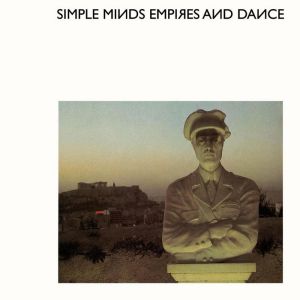
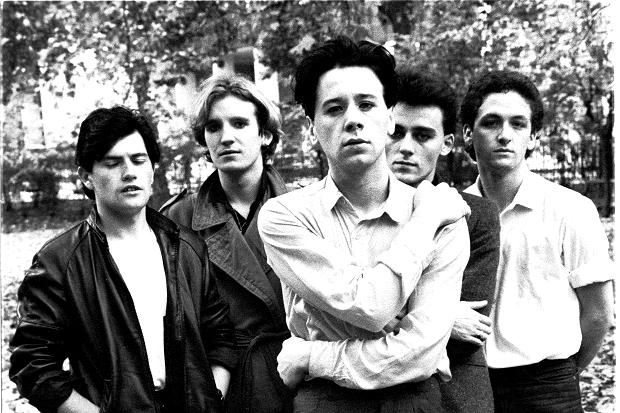
Simple Minds: Empires And Dance

Simple minds

Before their mid-‘80s commercial peak, Simple Minds were an art-rock band par excellence.

They fitted perfectly into the post-punk landscape and on Empires And Dance, their third album, they certainly wore their influences boldly on their sleeve – Kraftwerk, Can, Roxy, Joy Division, Eno, Magazine, Velvet Underground, ‘Lodger’-era Bowie – but combined them exceptionally well.

Musically very strong, with Derek Forbes’ memorable basslines very much to the fore, this uncompromising album combines motorik beats with doomy vocals, Eno-style ambience, jagged post-punk guitar and deliciously sludgy synths.

Jim Kerr’s travelogue lyrics compliment the music perfectly, snapshots of bleak European passport controls, attempted assassinations and wintery landscapes. Producer John Leckie brings his usual spirit of experimentation and lays on the brittle, creeping sense of paranoia.

Simple_Minds

While the one-chord grooves tire a bit on ‘Today I Died Again’, ‘Celebrate’ and ‘Capital City’, the Euro-funk of ‘I Travel’ and ‘This Fear of Gods’ chills the blood. ‘Twist/Run/Repulsion’ is almost an early example of sampling with its random speech, out-of-phase horn blasts and queasy, looped drums. Kerr channels Bowie’s ‘African Night Flight’ with his high-speed rap (though on the demo he took a different approach).

‘Thirty Frames a Second’ and ‘Constantinople Line’ almost approach the work of Throbbing Gristle and Gary Numan with their garish synth tones and forbidding atmospheres. ‘Kant Kino’, named after a Berlin art-house cinema, pits a slight but very catchy Charlie Burchill guitar melody against amplifier hiss, tape echo and synth drone; Eno would surely approve and the track was possibly an influence on U2’s ‘4th Of July’.

The closer ‘Room’ could almost have come from the first Velvet Underground album (though they could have done with playing to a click track; the song almost doubles in speed by the end…).


Empires And Dance peaked at #41 in the UK album charts. It might have gone higher had Arista Records pressed more than just 7,500 copies at a time. The band couldn’t get off that label fast enough (like Iggy Pop).

But Peter Gabriel became a major fan and took them on tour with him throughout October and November 1980, allegedly paying most of their expenses.

Empires And Dance is very interesting album indeed and a great companion piece to Bowie’s Berlin trilogy, Peter Gabriel III and Talking Heads’ Remain In Light.

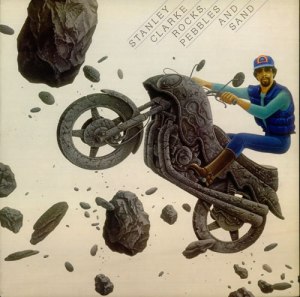
Stanley Clarke: Rocks, Pebbles And Sand

Stanley-Clarke-Rocks-Pebbles-And-543879

In 1979, Stanley recorded the sprawling double I Wanna Play For You which had some brilliant moments but also veered uncomfortably towards disco.

It also featured some outrageous live recordings which suggested he was going in a more ‘rock’ direction, mainly thanks to the sonic possibilities opened up by putting his Piccolo bass (tuned a fifth higher than a standard bass, A to C rather than E to G) through various effects pedals (see correction in the comments section below).

But how would Stanley start off the ’80s? On Rocks, Pebbles and Sand, he thankfully pushed the rock and prog-fusion rather than disco. It also really helps that it sounds very much like a ‘band’ project, apart from funk curio ‘We Supply’ which belongs on a different album altogether.

And what a band it is – Simon Phillips on drums, Charles Icarus Johnson on guitars and Steve Bach on keys. Phillips in particular is a perfect foil for Clarke with his meaty grooves and superchops. Though he was obviously coming from Billy Cobham with his prodigious double-bass playing, expansive tom fills and open-handed style (see below), his grooving on ‘Story of a Man and a Woman Part 2’ is just perfect.

Rocks, Pebbles and Sand‘s opener ‘Danger Street’ sounds like Stanley has been listening to The Who and Van Halen with its big drums, raucous guitar and gargantuan riff. Subtle it ain’t (and one can take or leave Stanley’s vocals), but it really works, mainly due to the mastering and mix – Rocks is one of the best-sounding albums of the era alongside Steely’s Gaucho, Lee Ritenour’s Rit and Zappa’s Sheik Yerbouti.

The duet vocals on ‘Underestimation’, ‘You/Me Together’ and ‘A Story of a Man and a Woman’ might put some people off, but isn’t that female voice familiar? A glance at the liner notes reveals a credit for one ‘Marcy Levy’ on vocals. It turns out to be none other than Marcella Detroit of Shakespeare’s Sister fame, an LA session singer in another life who had recorded and toured extensively with Eric Clapton (co-writing ‘Lay Down Sally’) before working with Stanley.

The funk/disco track ‘We Supply’ sticks out like a sore thumb but features a superb bassline from Louis Johnson and a hilarious spoken word intro from album engineer Dennis MacKay, proclaiming, ‘We supply all your funky needs!’ in the poshest voice you’ve ever heard. Git down and boogie with Dennis…

Stanley had a mixed ’80s to say the least, with a fair few misses but some big hits as well. Rocks is definitely one.


English Snapshot: Peter Gabriel III

peter gabrielSo was my gateway Gabriel album, as it probably was for many teenagers in the 1980s.
But, in 1986, I don’t think I had a clue about his Genesis past or earlier self-titled records. So I went back and checked them out.

The cover artwork snagged me but initially I really struggled with Melt. The deceptively dry, claustrophobic mix, extensive use of processing, Gabriel’s animalistic yelps and the barmy Fairlight sound effects seemed very forbidding compared to So (elements drastically souped-up and ‘normalised’ by the superb 2002 CD remaster).

The opening ‘Intruder’, with its liberal use of flatted-fifth chords and Gabriel’s schizophrenic vocal, was exceptionally unsettling to a teenage lad in leafy south-west London. Forget Black Sabbath, this sounded genuinely dangerous, in a particularly English way.

The question is, of course, what an ostensibly happy, settled, middle-class young man such as Gabriel was doing digging around in the dirt in such spectacular fashion. But thank goodness he did. He extended ‘character’ songwriting – also used to memorable effect by the likes of Randy Newman, Sting, Steely Dan and The Beatles – far beyond the range of Genesis, conjuring up a memorable parade of the bungled and botched operating on the edges of society.

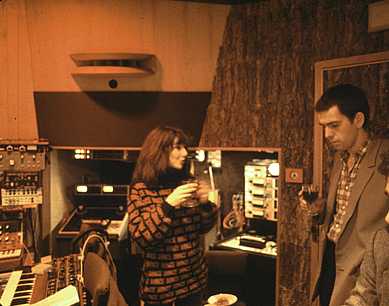
Musically, Gabriel apparently instructed producer Steve Lillywhite and engineer Hugh Padgham that nothing ‘normal’ was acceptable. Hence the famous cymbal ban, the layering of Kate Bush’s ethereal backing vocals and seemingly out-of-control processing and phasing.

kate bush peter gabriel

Kate Bush and PG recording at The Townhouse, London

The album’s themes seem to be the moral trapdoors of late-20th century urban life (mental illness, sexual violence, political assassinations, terrorism, the dehumanisation of war, social isolation).

You could argue that at the time of the Yorkshire Ripper, Bristol riots and IRA bombings, this was the perfect soundtrack.

‘Intruder’ subtly probes the sexual connotations of ‘breaking and entering’, equating a petty criminal’s intrusion with other kinds of violation, suggesting – controversially – some kind of tacit consent or ‘understanding’ by the victim.

On the epic, affecting ‘Family Snapshot’, Gabriel somehow manages to make us feel empathy for a fame-obsessed political assassin, especially in the closing ‘All turned quiet, I’ve been here before…’ section (which It Bites ‘paid homage to’ on fine 1988 B-side ‘Staring At The Whitewash’).

I used to think the protagonist of ‘Lead a Normal Life’ (‘eating with a spoon, they don’t give you knives’) was stuck in a borstal, but now I’m sure it’s far worse than that. And is the narrator of ‘I Don’t Remember’ an imprisoned political dissident or someone in an abusive relationship? It’s certainly not going to end well judging from Gabriel’s indecipherable whispers over the mechanized hum of the Fairlight in the outro, suggesting meek (drugged?) capitulation or even death.

It took me ten years or so to fully appreciate the album. But now it’s by far my favourite work by PG. Some fantastic UK session players play as if their lives depended on it, especially Dick Morrissey on sax and bassist John Giblin. Tony Levin delivers one of the greatest and most influential basslines in rock on ‘I Don’t Remember’ and single-handedly invigorates interest in the Chapman stick.

And, in my opinion, Padgham and Lillywhite have never done better work. Check out their stunning sound design on ‘And Through The Wire’; the mix subtly develops the drums with a little more room reverb in each successive chorus until the explosive last one when Marotta’s snare and Paul Weller’s brutal guitar threaten to destroy your speakers.

And the gradual building of ‘Biko’ and ‘No Self Control’, the latter with some distinctly Steve Reich-inspired marimbas played by Morris Pert, remains an aural treat. This fantastic album still challenges and surprises after all these years. 10/10.