In Defence of David Bowie’s ‘Tonight’

The general critical consensus is that Tonight represents the nadir of David Bowie’s career, the only true stinker in his discography.

It’s been described as a quickie cash-in on the Let’s Dance formula, a concession to his new ‘Phil Collins’ audience and a charity album for Iggy Pop. Only three years after its release, Bowie himself was virtually disowning it.

But it’s a fascinating, occasionally superb collection by arguably the greatest album artist in rock history. David tries out a lot of styles and gets away with most of them. And it could have been a lot worse.

So I’m putting it squarely alongside Heathen, Black Tie White Noise, David Bowie, both the Tin Machine studio albums, hours… and several others in the prodigious second tier of DB albums.
In the summer of 1984, Uncle David was competing with the shiny British New Pop acts of the era – Duran, Wham!, Culture Club, Thompson Twins, Nik Kershaw, Howard Jones, Frankie, Bananarama – and to some extent beating them at their own game: Tonight went straight in at number one in the UK album chart.

But writer Nicholas Pegg made an interesting point about its sound in his superb ‘Complete David Bowie’: David was apparently more taken with the ‘straight’, poppier artists of the era than the edgier acts such as Bronski Beat, The Smiths, The Cure, Marc Almond etc etc.

Tonight took five weeks to record, two weeks longer than Let’s Dance. It was tracked in Quebec, Canada during May 1984, only a few months after the end of the ‘Serious Moonlight’ tour.

Lenny Pickett’s Borneo Horns were retained from the live dates and there were some holdovers from the Let’s Dance sessions: Omar Hakim on drums, Carmine Rojas on bass, Sammy Figueroa on percussion.

But Nile Rodgers wasn’t asked back to co-produce (it’s oft forgotten that David was also a great producer). It was a decision that apparently baffled and disappointed Rodgers. Instead, ex-Heatwave bassist Derek Bramble was brought in on the strength of his work with Lynx, David Grant and Jaki Graham.

He probably hoped he would be the new Nile, but it wasn’t to be. He played some great bass, guitar and synths on the basic tracks but was given the boot only a few weeks into the project. Police/XTC/Peter Gabriel/Genesis man Hugh Padgham – initially only employed as the engineer – was asked to finish off the album as co-producer.

Hugh has since expressed dismay at the choice of songs, saying that a few new Iggy/Bowie compositions were left unfinished (perhaps later used for Blah-Blah-Blah) because Bowie ‘couldn’t be bothered’ to finish them.

It’s hard to disagree – if ‘God Only Knows’, the title track and ‘I Keep Forgettin’ had been replaced by some new tunes, Tonight could have been a corker.

But it ain’t bad. And the critics all pretty much loved it at the time. It may have been a huge shock if you were brought up on Ziggy Stardust and Hunky Dory, but I came in around Scary Monsters. It seemed a natural progression.

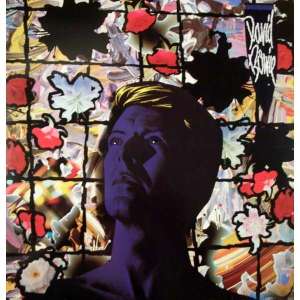
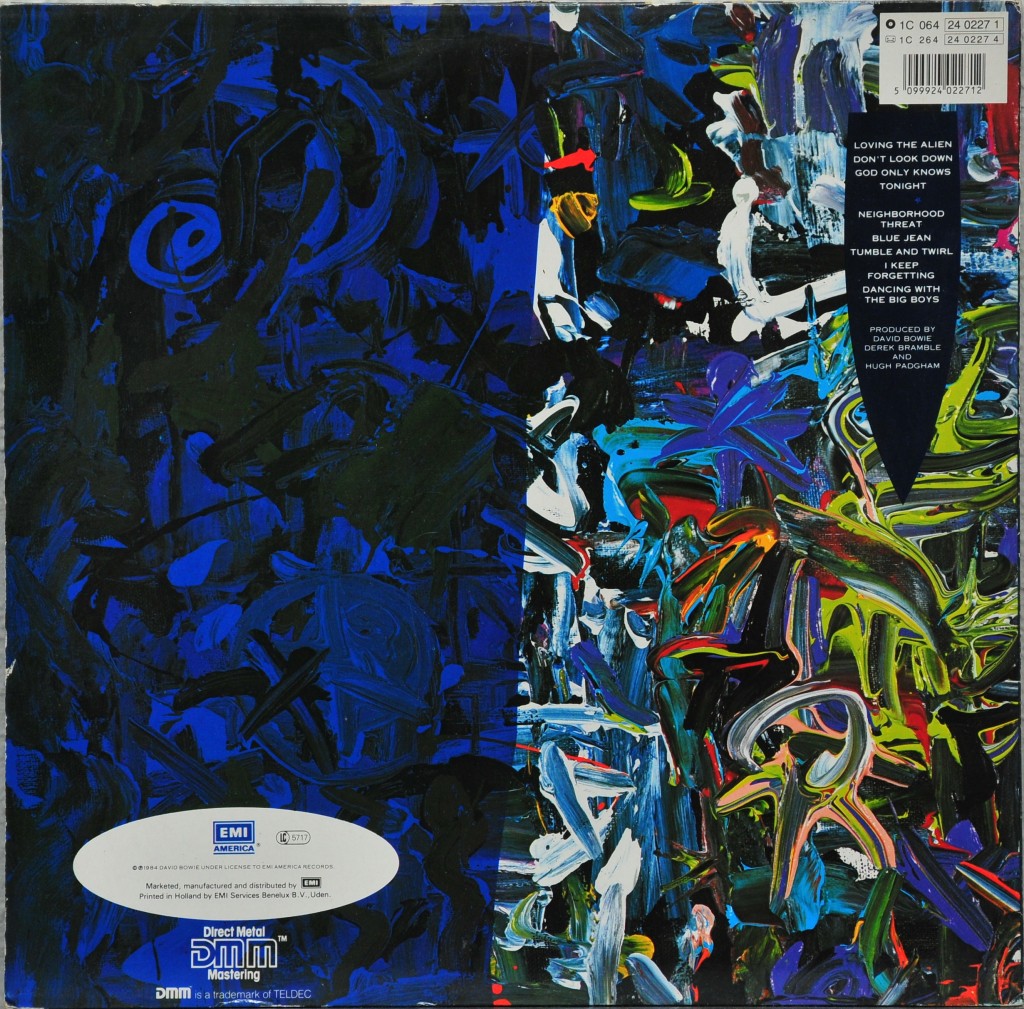
Mick Haggerty’s sleeve design splits opinion too – it’s either a witty Gilbert & George pastiche or a garish bit of mid-’80s tastelessness. Judge for yourself. Oh, and get the 1990 Rykodisc version of Tonight if you can find it rather than the 1999 EMI remaster.

Here’s a quick track-by-track rundown.

1. ‘Loving The Alien’

You can read my full analysis of the song here.

2. ‘Don’t Look Down’

Interesting reggaefied cover of a track from Iggy’s album New Values. Featuring a sublime David vocal, some excellent Bramble bass and a gorgeous horn/synth arrangement embedded in the mix, reminiscent of Gil Evans’ soundworld. Play loud.

3. ‘God Only Knows’

A great David vocal though very curious MOR arrangement of this Brian Wilson composition. Cavernous drums, soaring strings and acoustic guitar high in the mix. Fascinating though only really defensible if viewed as a kind of Scott Walker homage.

4. ‘Tonight’

Shorn of the shock heroin-overdose intro heard on the original from Iggy’s Lust For Life album. But it’s hard to defend this rushed, underwhelming filler which flopped as Bowie’s 1984 Christmas single. Even Omar sounds out-of-sorts on this. But let’s cut them some slack – David helped save Tina’s career. According to her, David dragged the bigwigs of Capitol Records out to see her perform live in New York against their wishes, prompting them to re-sign her.

5. ‘Neighbourhood Threat’

This perky techno-rocker, also originally from Lust For Life, features a fine vocal from David in ‘cyborg’ mode and brilliant drumming from Omar. It works very well but sounds unlike anything else on Tonight. Weirdly, Bowie dismissed it in 1987, saying ‘it wasn’t the right band to do that song. It sounded so tight and compromised.’

6. ‘Blue Jean’

A brief, harmless bit of ‘sexist rock’n’roll’ in Bowie’s words, a portrait of a woman he fancied in a magazine ad. Padgham works his magic on Omar’s drums, there’s some window-shaking sax from Lenny Pickett and Bowie borrows Iggy’s baritone. The first single from the album, it reached UK #6 and US #8 and featured a watchable but very silly long-form video directed by Julien Temple, shown in UK cinemas as support feature to ‘A Company Of Wolves’.

7. ‘Tumble And Twirl’

Another album highlight, co-written by David and Iggy, it’s an effective slice of tropical swing/funk with Mark King’s (uncredited) bass in Stanley Clarke mode, Guy St Onge’s cheery marimba, some sparkling 12-string guitar from Alomar and funny ‘muzak’ bridge with soothing backing vocals. Also some amusing lyrics inspired by Iggy and David’s vacation in Java.

8. ‘I Keep Forgettin’’

The album’s low point, where its ‘happy’, summery, positive feel comes truly unstuck. Electric drums fizz unpleasantly, David hams it up to little effect and the arrangements are more Pebble Mill than Muscle Shoals.

9. ‘Dancing With The Big Boys’

Another Iggy/Bowie co-write, the album closes with a tasty piece of one-chord, horn-based techno-rock flash. A funny lyric that seems to be about American military might: ‘Your family is a football team’. Iggy is very audible on vocals. Arthur Baker also put together an ear-bleeding 12” remix which is worth a listen.

Further reading: ‘Strange Fascination’ by David Buckley

‘The Complete David Bowie’ by Nicholas Pegg

‘Open Up And Bleed’ by Paul Trynka

Marvin Gaye: Midnight Love 35 Years Old Today

marvin

CBS Records, released 1 October 1982

Produced by Marvin Gaye

Recorded: December 1981 – August 1982

Estimated worldwide sales: 2.5 million

Album chart positions: #7 (US) #10 (UK)

Marvin Gaye: ‘I wasn’t going to peddle myself like I was some new kid on the block. I didn’t want to hear about any rejections, so I went about it differently. I decided what I wanted – to be with the biggest and best record company in the world – and I made it happen. No matter what, I couldn’t come up with another art album. After all, CBS was digging me out of a hole, paying off the IRS, Anna (Gordy, his ex-wife), the feds, the whole works. I felt like an old vet, a seasoned ballplayer who’d been traded to another team that still had faith in him. I owed CBS something – at least a couple of grand slams…’

‘Wendy & Lisa’: 30 Years Old Today

Los Angeles, October 1986, just after the Japanese leg of the ‘Parade’ tour.

Prince invites his bandmates Wendy Melvoin and Lisa Coleman to dinner (Lisa will later report in her excellent liner notes for the Wendy & Lisa 2013 reissue that she ‘knew something was up’ as soon as they arrived).

To cut a long story short, they are out. The Revolution is no more.

Lisa: ‘We were like Fleetwood Mac and Sly & The Family Stone rolled into one… I thought we were going to make records together for the rest of our lives.’

But Prince wants to take back his freedom and sex up his act again. Struggling for the right words, apparently he says to Wendy and Lisa: ‘I can’t ask you to wear crotchless panties or nippleless bras…’

After a period of introspection, the ladies get together with other former Revolution member Bobby Z to write a few songs. At this stage, they have no intention of releasing the new material as ‘Wendy & Lisa’.

But once they agree to front the band, a record company bidding war ensues. Huge advances are mentioned. They settle on a ‘big but sensible deal’ with Virgin.

Predictably, the suits are less than turned on by the more musicianly moments on the album, but the ladies are unapologetic, saying that they ‘wanted to show off all the colours in our crayon box’.

So much for the history. How does Wendy & Lisa stack up these days? Apart from some fairly unsavoury drum sounds, pretty well.

The singles ‘Sideshow’ and ‘Waterfall’ are probably the weakest tracks, though the latter has a cracking chorus and was apparently deemed a surefire hit by the record company and musician friends.

But it didn’t much business, not helped by its rather humdrum video. The ladies were not particularly keen to start dancing in videos at this stage of their careers – they wanted to be seen as musicians. As Lisa says in the liner notes: ‘I had paid my showbiz dues with The Revolution.’

But the album works brilliantly when it sticks to the ‘cool chord changes over good beats’ remit, when they genuinely do sound like a mashup of ’80s Joni Mitchell and Prince.

‘Honeymoon Express’ exemplifies this approach, nicking Sly Dunbar’s ‘My Jamaican Guy’ beat and adding a sumptuous melody. The vocal harmony in the chorus is sublime.

‘Light’, ‘Everything But You’ and ‘Chance To Grow’ also succeed in a similar vein. Wendy’s multi-instrumental skills (vocals, guitar, bass, sometimes drums) and Lisa’s impressionistic synth parts mesh perfectly.

‘Song About’ sounds eerily like The Carpenters. Ballads ‘The Life’ and ‘Stay’ have become fan favourites, the former also turning up in an improved Trevor Horn-produced reworking on the soundtrack of Michelle Pfeiffer movie ‘Dangerous Minds’.

The instrumental ‘White’, featuring Tom Scott on soprano and a killer bit of drum machine programming by Wendy, is possibly the standout. Test your speakers out with this one, kids.

Wendy & Lisa – perhaps surprisingly – was not a hit. Lacking a breakout single, it didn’t dent the US top 100 and only scraped to #84 in the UK.

Better Wendy & Lisa albums would follow, but this is an ambitious, arresting debut. All the colours in the crayon box indeed.

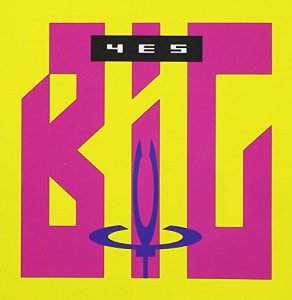
Yes: Big Generator 30 Years On

In the pantheon of rock rhythm sections, bassist Chris Squire would surely have to feature not once but twice – he forged striking partnerships with both Bill Bruford and the underrated Alan White.

Big Generator, released 30 years ago this week, is a brilliant distillation of the Squire/White hook-up.

There are loads of other pleasures too, even though it’s usually mentioned as an inferior, mostly pointless, sequel to 90215.

But for my money it’s the better album – more cohesive, less top-heavy. Big Generator was apparently far from a walk in the park to make though, with band tensions, endless rewrites and remixes. And of course there was pressure to follow up such a huge hit.

Trevor Horn started work on the album in 1985 but left towards the end of recording, leaving guitarist/vocalist/co-writer Trevor Rabin and producer Paul DeVilliers to finish the job.

But you can hear the craft (and money) that went into Big Generator, although it still basically sounds like a band playing live in the studio. This is barmy rock music, full of surprises, made by musicians with unique styles and a wish to take chances. But no matter how complicated the arrangements get, there’s always a logic to them.

Take the title track for example. An excerpt from the ‘Leave It’ 90125 vocal sessions kicks things off. Then Rabin piles into a gargantuan riff (achieved by tuning his low E string down to an A, echoing Squire’s 5-string bass tuning).

White’s snare is tighter than a gnat’s arse and his phrasing is always novel – he’ll often hit the crash cymbal on a ‘one-and’ or ‘three-and’ rather than the standard ‘one’. Then there’s the ridiculous speeding-up snare roll accompanied by manic Rabin shredding and a chorus that sounds a bit like Def Leppard. It’s all in a day’s work for this amazing unit.

‘Rhythm Of Love’, ‘Almost Like Love’ and ‘Love Will Find A Way’ are serviceable, weirdly-funky slices of AOR. The very ’80s-Floyd-style ‘Shoot High Aim Low’ maintains its doomy mood impeccably and features a brilliant Di Meola-esque acoustic guitar solo from Rabin.

The standout for me though is the stunning, ridiculous ‘I’m Running’. Just when you thought they couldn’t crowbar any more into its seven minutes, it chucks in a descanting vocal outro which sounds like something out of Gilbert and Sullivan.

Only a few bits of Jon Anderson whimsy on side two threaten to derail proceedings. But in general Rabin keeps him in check, though presumably to the detriment of their relationship.

Big Generator was nominated for a Grammy and sold well over a million worldwide, making the top 20 in both the US and UK. It’s definitely due a critical reappraisal. So here it is…

John Cale: Music For A New Society 35 Years On

Whatever happened to the psychologically-complex, ‘difficult’ male solo artist?

In the ’70s and ’80s, you couldn’t move for them – Peter Gabriel, Peter Hammill, Lou Reed, David Bowie, John Cale et al.

Reed and Cale particularly seemed to dwell in the murky corners of the male psyche, chronicling alcoholism, jealousy, sexual deviance, anger, loneliness, death.

The latter’s Music For A New Society, released 35 years ago this month, was a case in point. An interesting companion piece to Reed’s own 1982 The Blue Mask, it sometimes seems too personal for public consumption. Cale was clearly in a pretty bad emotional state during recording.

The album’s certainly not for everyone – a lot of it’s not for me – but a few tracks still sound like modern classics. Recorded at New York’s Skyline Studios, it features a novel production style; Cale apparently tracked most of the songs with a full band (including Chris Spedding on guitar), then strategically stripped back the instrumentation, ‘playing’ the faders a bit like a dub producer. The result is a sparse, claustrophobic listen.

‘Thoughtless Kind’ and the superb ‘I Keep A Close Watch’ benefit greatly from this approach. The latter of course featured a very ornate production on Cale’s album Helen Of Troy, but this time sticks to grand piano, Hammond organ, fake harpsichord, snare drum, bagpipes and a few found sounds.

On ‘If You Were Still Around’ (featuring lyrics by Sam Shepard), ‘Damn Life’ and various other tracks, Cale sounds almost beyond help. But the standout for me is the poignant tearjerker ‘Taking Your Life In Your Hands’.

Online theories abound as to the song’s subject matter, but it’s hard to shake the feeling that it concerns a school massacre and the sacrifices made by the teachers and ‘gentlemen in blue’ who saved lives. A dark masterpiece by a sometimes superb chronicler of human nature’s murkier aspects.

John McLaughlin: Music Spoken Here 35 Years On

All great artists with any kind of career longevity have very distinct periods, and John McLaughlin is no exception.

Apart from his mid-’60s output, the early 1980s (let’s face it – the whole of the 1980s… Ed.) is probably his least understood/appreciated era.

McLaughlin had moved to France and formed a new band occasionally known as The Translators featuring a top-class American drummer (Tommy Campbell) and otherwise French unit including his new paramour, the outrageously talented keyboardist Katia Labèque.

His music too had turned away from electric jazz/rock and moved towards a gentler fusion of jazz, classical, blues, flamenco and Latin music, centred around the acoustic nylon-string guitar.

I was a major John completist in the late ’80s/early ’90s but didn’t have a clue Music Spoken Here even existed until chancing upon a vinyl copy in the Shepherds Bush Music & Video Exchange. You’d be hard pushed to find it in any jazz reference book these days; it’s virtually been written out of his discography. Some would say with good reason, but to these ears it’s one of the nuttiest, most piquant albums of John’s career.

At times you can feel him edging again towards the Mahavishnu reunion which happened a few years later in ’84, reaching for the Les Paul on a few cuts and pushing the drums and synths higher in the mix. But in its own way, and considering what else was going on in the jazz world at the time (Wynton, Branford and the Young Lions traditionalists) Music Spoken Here is as shocking an album as The Inner Mounting Flame.

‘Blues For LW’ is the album’s centrepiece, a thrilling, richly-chorded tribute to the Polish activist Lech Welesa with a neat quote from Miles Ahead and completely insane Chick Corea-meets-Rachmaninoff synth solo. ‘Honky Tonk Haven’ is brilliant too, a cacophony of early hip-hop beats, modal keyboards and a killer guitar/synth melody line borrowed from the Shakti track ‘Get Down And Shruti’. You’ve gotta think that Miles would have dug it.

The cover of Egberto Gismonti’s ‘Loro’ may be taken a tad too fast but the arrangement kicks ass. Elsewhere, the album is full of sunny, fresh, cosmopolitan grooves, with frequently outrageous guitar and keyboard playing – the latter way too high in the mix though.

Music Spoken Here was another two fingers up to the purists of the music world, and another artistic success. It reached #24 on the US jazz album chart, a reasonable return but not exactly a big hit for an artist of his magnitude. It’s crying out for a remaster though, one of the muddiest-sounding records of McLaughlin’s career.

Next stop for John was a tour with The Translators, an excellent studio album with Al Di Meola and Paco De Lucia, and then the aforementioned return to Mahavishnu, reuniting with Billy Cobham. Needless to say, that would be another hard sell for the critics…

Guns N’ Roses: Appetite For Destruction 30 Years On

Geffen Records, released 21 July 1987
Approximate worldwide sales: 30 million

Singles released: ‘Welcome To The Jungle’ (US #7, UK #24)
‘Sweet Child O’ Mine’ (US #1, UK #6)
‘Paradise City’ (US #5, UK #6)
‘Nightrain’ (US #93, UK #17)

W. Axl Rose (vocals/co-writer): ‘This record’s gonna sound like a showcase. I sing in five or six different voices, so not one song’s quite like another, even if they’re all hard rock. Sometimes six lines (of lyrics) take two years. It just has to say exactly what I mean…’

Slash (guitar/co-writer): ‘We can sound like AC/DC, the Mahavishnu Orchestra, Aerosmith. We can sound like what’s-his-name, that f***in’ idiot that plays guitar real fast… Al Di Meola…’

1987 was the year rock and metal made a comeback big-time. But Appetite doesn’t really sound like an ’80s album at all. It’s totally different to what Whitesnake, Motley Crue, Poison, Skid Row, Iron Maiden, AC/DC and Def Leppard offered in the same era, but not so different from Aerosmith, early Van Halen, Led Zeppelin, Sex Pistols or The Stones. It’s funky hard-rock rather than metal, with the occasional punky moment, and still sounds superb today.

W. Axl Rose (born William Bailey) was and is one of the all-time great rock frontmen. His vocals stand out: he unleashes the growling, banshee-screeching and brooding baritone, sometimes all in the space of one song.

Then there are the stage moves: the serpentine shuffle, ‘revolving stomp’, the pogo-ing, and the androgynous looks and gift for winding audiences up didn’t hurt either.

Guns were surely the ultimate ’80s Hollywood street band, seriously dangerous both to themselves and others. Signed to Geffen Records in March 1986, there was subsequently a lot of discontent at the label when it dawned on them just what they’d taken on.

One A&R man said: ‘They were having sex with porn stars, openly using hard drugs. Once they arrived at the Geffen office, late for a meeting, with a naked girl wrapped in a shower curtain. There was a real belief at the label that Axl was simply not going to make it out alive. I remember someone at Geffen saying, “We must record everything they do – rehearsals, soundchecks, concerts – because this band is going to be incredibly popular and incredibly short-lived. One of them is going to OD before it’s all over…”’.

Appetite producer Mike Clink (installed after aborted sessions with Paul Stanley of KISS and Sex Pistols engineer Bill Price) was nicknamed ‘That Was It!’ Clink: he preferred first takes if possible, with the band mostly playing live in the studio.

He captures the ferocity of the band, mostly keeping to a fairly basic format: Izzy Stradlin’s guitar panned hard left, Slash panned hard right, Steven Adler’s snare drum of doom (though Geffen apparently wanted to use a session player for the album) and Duff McKagan’s bass in the middle. Appetite was also pretty much the last major rock album mastered for vinyl.

They had built a formidable live following on the West Coast but Guns’ London Marquee shows of the 18, 22 and 28 June 1987 were their European debuts. They had to work. The pressure was on. The first show mostly sucked, with plastic beer glasses and snot raining down on the band, but the second and third gigs were apparently much better.

After Appetite‘s release on 21 July, nothing much happened in the States. Radio pretty much ignored it. MTV didn’t have a video to show. The New York writers thought they were just another hair-metal band from Hollywood.

There was a better reception in England. Kerrang! magazine loved it: ‘Rock is being thrust back into the hands of the real raunch rebels’. (Within a few years, Axl would be berating Kerrang! onstage…)

‘Sweet Child O’ Mine’ (based on Slash’s famous opening riff that was apparently just a ‘joke’ warm-up guitar pattern) pushed the album up to #64 in November 1987. Incredibly, Appetite didn’t hit the #1 spot in the US album chart until 23 July 1988 when Guns were on tour supporting Aerosmith – almost a year to the day after its release.

On 2 August 1988, Axl played live shows in his hometown of Lafayette, Indiana. He was a mega-star, the album was a smash, but he had mixed emotions about returning to the belly of the beast.

‘Don’t look up to him’, one of Bill Bailey’s old Jefferson High School teachers apparently said to some kids watching ‘Sweet Child’ on MTV. ‘He didn’t do well here…’

Further reading: ‘Watch You Bleed: The Saga Of Guns N’ Roses’ by Stephen Davis

Donna Summer (1982)

Geffen/Warner Bros. Records, released 19 July 1982

6/10

It’s understandable that Summer was reluctant to take on Billy Strayhorn’s song ‘Lush Life’.

A morning-after portrait of a failed romance, it’s a remarkable composition for a 16-year-old to write, with elliptical lyrics, few repeat sections and a challenging, endlessly-modulating melody line.

Nat ‘King’ Cole, Sarah Vaughan, John Coltrane/Johnny Hartman and Billy Eckstine all performed notable versions (Strayhorn himself apparently loved the latter).

But, coached through by producer Quincy Jones and keyboardists Greg Phillinganes, Herbie Hancock and Dave Grusin, Summer’s vocals are a knockout. Though the track sounds a bit rushed (Phillinganes would surely like another pass at his synth bass part), her work certainly paid off.

‘Lush Life’ closes Donna Summer, released 35 years old today. Classic singles begin the album and end side one: Grammy-nominated ‘Love Is In Control (Finger On The Trigger)’ and an inspired cover of Jon & Vangelis’s ‘State Of Independence’, the latter featuring an amazing array of guest vocalists.

The problem with Donna Summer is that it’s three classics and a lot of filler. Formula-wise, Quincy seems to be preparing for Thriller – there are many songwriters and a variety of styles.

Springsteen contributes the slightly underwhelming ‘Protection’ and elsewhere there’s a bit too much LM-1 drum machine and a few less-than-memorable choruses.

The album didn’t quite deliver the big hit to propel Summer into the ’80s but reached #20 in the US album charts and #13 in the UK.

Introducing The Hardline According To Terence Trent D’Arby: 30 Years Old Today

Yeau! The headline of Q Magazine’s September 1987 cover feature said it all.

Perrier-quaffing Terence was correctly predicting a phenomenal critical and commercial reaction to his debut album and ready to dish the dirt.

He had done it all on his terms; wrongfooted his record company (who had wanted a slick, current, ‘upwardly-mobile’ soul album) and played the press at their own game. But at what cost?

D’Arby had lived quite a life before becoming a ‘pop star’: he was born in the States, the son of a preacher father and gospel-singing mother, studied journalism in New York, became a half-decent boxer in his late teens, joined the army and was based in Germany throughout most of the ’80s during which time he worked on his music and acquired a manager (a strategy not dissimilar to another ex-army musical maverick, Jimi Hendrix).

Decamping to London in 1985, D’Arby worked on demos with Heaven 17’s Martyn Ware and, after being turned down by several major labels, finally got the nod from CBS.

They pulled off a pre-release masterstroke when D’Arby was block-booked for four weeks running on ‘The Tube’ after a knockout debut live TV performance. To say that there was a buzz about him would be an understatement. The general consensus was: ‘Who the hell is this guy?!’

Hardline still sounds like one of the better debut album of the ’80s or any other decade. From the opening bars of ‘If You All Get To Heaven’, it’s clear that something pretty special and pretty different is going on, though the album inadvertently tapped into the ‘retro-soul’ revival that had built up in the UK over 1986 and 1987 – Ben E King and Percy Sledge had both had number ones in the months before Hardline‘s release, and The Pasadenas, The Christians and various others would bring forth similar grooves in the months to come.

Hardline also reminded critics and audiences alike of some of the great soul vocalists of the ’60s, ’70s and early ’80s – Al Green, Otis Redding, Stevie, Prince, Michael Jackson, James Brown and especially Sam Cooke. All went into the mix but finally D’Arby sounded just like himself.

He peppered ‘Dance Little Sister’ – a track that Prince would have killed for – with some outrageously over-the-top vocals. But, refreshingly, his singing throughout the album ain’t perfect – he’s much more into getting the emotion across and bringing a party vibe to the studio.

‘Sign Your Name’, ‘If You Let Me Stay’ and ‘Wishing Well’ are funky yet accessible (if the latter doesn’t make you move, you’re probably dead), but the a cappella, African-themed ‘As Yet Untitled’ is totally original.

He even takes on Smokey Robinson and emerges unscathed on the closing ‘Who’s Loving You’. He plays a lot of instruments himself and only gets in occasional help when absolutely necessary (including future Skunk Anansie bassist Cass Lewis and Pop Group/PiL drummer Bruce Smith). As such it’s a remarkably cohesive album.

Hardline was a big hit, reaching #1 in the UK, #4 in the US and selling over eight million copies worldwide. D’Arby got the rep of being a ‘difficult’ artist when his follow-up album Neither Fish Nor Flesh missed deadlines and went over budget. Things would probably never be the same again. But we’d always have Hardline.

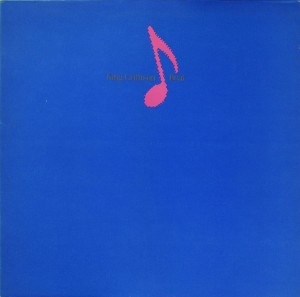
King Crimson: Beat @ 35

If you were to ask fans of 1980s King Crimson why they love the band, lyrics probably wouldn’t be a priority.

But, pushed hard by Robert Fripp and possibly influenced by the 25th anniversary of Jack Kerouac’s ‘On The Road’, Adrian Belew came up with some choice words on Beat, the excellent second album from this remarkable quartet which was released 35 years ago today.

References to the Beat writers abound; ‘Neal and Jack and Me’ concerns Kerouac and his best friend Neal Cassady and mentions several significant Kerouac works; ‘Heartbeat’ is the name of a book written by Cassady’s wife Carolyn about her experiences with the Beats; ‘Sartori In Tangier’ references the Moroccan city where a number of Beats resided; ‘Neurotica’ shares its title with a very influential Beat-era magazine; and presumably ‘The Howler’ refers to Allen Ginsberg’s ‘Howl’.

As the saying goes, you take inspiration where you find it, and Belew had come up with a very handy concept on which to hang the new band improvisations.

Musically, Beat is a brilliant development of the Discipline sound. ‘Neurotica’ and ‘The Howler’ feature some remarkable, unhinged ensemble playing, teetering on total chaos.

On the latter, Bill Bruford delivers intricate patterns on his acoustic/electric kit (with shades of Steve Reich, acknowledged with Bruford’s credit for ‘Drumming’).

Belew’s white-noise guitar outburst is a killer (he repeats the trick on ‘Waiting Man’ and ‘Neal’, extending his palette of sounds from Discipline and sometimes tuning his high E string down to a C).

‘Sartori’ is a superb vehicle for Fripp while ‘Waiting Man’ demonstrates the amazing rhythm dexterity of the band, a development of the ‘Village Music’ concept with Bruford and Tony Levin sharing a tricky 3/4 figure (joined by Belew on drums when they played it live) underneath an expressive vocal performance.

There’s even a noble, painless attempt at a pop hit with ‘Heartbeat’. The only track that outstays its welcome is ‘Requiem’, a fairly dreary investigation of A-minor.

In short, the musical intelligence of this unit was pretty damn scary. But they never neglected a crucial factor: melody. Lesser bands might have built their entire careers on any Beat song.

Not surprisingly, tensions were high during the London recording sessions. Echoing the situation with The Police around the same time, they sought out a producer who might act as peacemaker.

Fripp told writer Anthony DeCurtis in 1984: ‘We tried to get someone from the outside to organise it: Rhett Davies. I think if failed. I would rather have the wrong judgement of a member of the band than the right judgement of someone outside the band.’

Also, Belew was now very much the centre of attention and under pressure to produce melodies and lyrics to order.

According to Bruford’s autobiography, Belew told Fripp to leave the studio after one too many barbs from the bespectacled Wimbornian, who ‘went straight back to Dorset and was silent for three days’. Only some desperate calls from Bruford and manager Paddy Spinks rescued the situation.

In the same 1984 interview as above, Fripp said of ’80s Crimson: ‘I feel I’ve created a field in which other people can discover themselves’. On the evidence of Beat, he did a fine job.