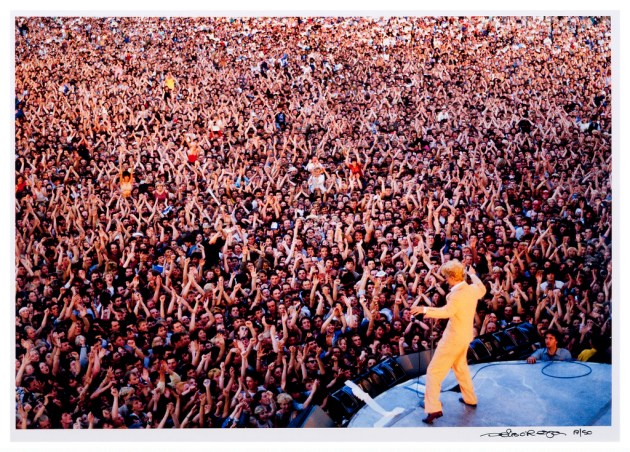
David Bowie, Milton Keynes Bowl, 3 July 1983. Photo by Denis O’Regan
The current London heatwave has sent me back to the summer of 1983 when it seemed like the sun shone every day and the radio was set to ‘fun’, blurting Men At Work, Thompson Twins, Kid Creole, KC and the Sunshine Band, Dexys Midnight Runners and Culture Club.
But Bowiemania trumped them all. In July ’83, all my parents’ friends were dancing to Let’s Dance and David’s Serious (or should that be Sirius?) Moonlight Tour was the hottest ticket in town.
Apologies to Milton Keynes natives, but Londoners of a certain generation will probably always suppress a titter at the mention of the new town’s name (The Style Council didn’t help with their satirical 1984 single ‘Come To Milton Keynes’).
Maybe Bowie tittered a bit too when three Milton Keynes Bowl dates (1/2/3 July 1983) were swiftly added to the tour due to unprecedented demand in the London area (he had already done a night at Wembley Arena and a charity show at the Hammersmith Odeon).
But the gigs were a huge success, and Denis O’Regan’s photo marking the occasion is surely one of the great ’80s music documents.
According to O’Regan, who had unparalleled access to Bowie and his entourage throughout the world tour, David had never been happier: ‘He talked about it being his Phil Collins period but this was heavily in retrospect. At the time, I know he loved it. It was the happiest and most successful he’d ever been’, O’Regan recently told MOJO magazine. Bowie was also making a bit of money at last, freed from dodgy record and management deals.
I haven’t kept many VHS cassettes, but two vids that definitely won’t be hitting the charity shop any time soon are Prince’s ‘Lovesexy Live: Volumes 1 and 2’ (currently unavailable on DVD…).
The Lovesexy tour kicked off 30 years ago this week, on 8 July 1988 at Paris’s Palais Omnisport. The seven-month jaunt, taking in Europe, North America and Japan, was arguably Prince’s greatest ever.
A spectacular in-the-round stage set was designed as a kind of ‘fantasy island’, half a playground and half a dreamscape, with curtains, a mini basketball court, brass bed, swing set and a Ford T-Bird which Prince ‘drove’ around the stage at the start of the show.
The Lovesexy tour band: left to right, Cat Glover, Dr Fink, Boni Boyer, Miko Weaver, Eric Leeds, Prince, Levi Seacer Jr., Matt Blistan, Sheila E
Taped on the last night of the European tour – 9 September 1988, at the Westfalenhalle in Dortmund, Germany – ‘Lovesexy Live’ still makes for a thrilling watch. Firstly, the music: this band could turn on a dime. It’s hard to imagine any other set of musicians from the era pulling off the ‘Adore’/’Jack U Off’/’Sister’ medley. Prince’s guitar playing is at its best, with creamy, delay-drenched distortion and tight, tasty Telecaster.
And of all the ’80s ‘pop’ acts who incorporated jazz into their work, Prince may be the most successful. In collaboration with his superb horn section (Eric Leeds on saxes, Matt Blistan on trumpet), he often went back to the source: Ellington’s ‘Things Ain’t What They Used To Be’ and Charlie Parker’s ‘Billie’s Bounce’ infiltrate ‘Blues In C/If I Had A Harem’, and Blistan occasionally quotes from ‘It Don’t Mean A Thing (If It Ain’t Got That Swing’). Meanwhile Sheila E brings the Bay Area jazz/rock sound so beloved of Prince. Her solo feature is a highlight of his ’80s live work.
Then there’s the ‘story’. The Lovesexy show is structured like one of those old Warner Bros gangster pictures – in the first half (lucky for us), we see an ‘evil’ Prince, seduced by the sins of the flesh and tempted by drugs, money and criminality, giving him an excuse to dust off Black Album standouts ‘Superfunkicalifragisexy’ and ‘Bob George’.
Then there’s punishment, atonement and spiritual conversion. Yes, y’all, the second half of the show is ‘God stuff’. But if you don’t go along with it, the music is enough of a spiritual experience anyway. Anyway, Prince certainly seems genuinely transported during ‘Anna Stesia’ and ‘I Wish U Heaven’.
Europe couldn’t get enough of the tour. There were no less than seven nights at London’s Wembley Arena and a series of famous after-show gigs, particularly at the Camden Palace on 25 July when Mica Paris was picked out from the crowd to sing ‘Just My Imagination’ and Ron Wood joined Prince onstage for a memorable ‘Miss You’.
Ticket sales were not so good in the States (14 September to 29 November) where apparently Prince struggled to sell out many arenas, despite it being his first major tour there for over three years.
But normal service was resumed when the Japan leg kicked off in early February 1989. The last night of the tour on the 13th was apparently an exceptionally emotional one.
When Prince got home to Minneapolis, he commenced work on the ‘Batman’ soundtrack, another project about the duality of man. It’s not hard to see where his head was at as the ’80s drew to a close.
What’s it like seeing ‘your’ band play at a big festival, when only a small proportion of the crowd are fans and most would rather have a chin-wag and quaff cider than listen to the music? Will your band win them over, or at least give a good account of themselves?
It was an interesting experience watching Level 42 under those circumstances last weekend. The Love Supreme Festival was celebrating its fifth birthday, no mean feat for an outdoor ‘jazz’ festival, thriving in a niche marketplace by focusing on the improvising musicians of tomorrow, established genre names and crossover artists whose presence no doubt raises some eyebrows (the other main-stage headliners this year were Earth Wind & Fire, George Clinton and Elvis Costello).
A big festival gig should, on the face of it, be a doddle for a band with as many hits and as much musical credibility as Mark King and his muckers – you knock off a lean, mean hour and get the crowd saying: ‘I’d forgotten about this one!’.
But they did it the hard way this time, kicking off with nobody’s favourite Level 42 song ‘Heaven In My Hands’ then segueing speedily into ‘Dream Crazy’, ‘To Be With You Again’ and ‘It’s Over’. A superb ‘Children Say’, complete with a reference to Coltrane’s ‘A Love Supreme’, got things back on track musically but also seemed lost on the crowd.
King was unsettled. Had he blown it? No. He soldiered on, making some cracks about the World Cup and the Alan Shearer lookalike on trumpet, before ‘Running In The Family’ prompted an outbreak of interpretative dancing from the Brighton teenagers. Secret weapon Mike Lindup sounded in superb voice during ‘Lessons In Love’, ‘Something About You’ and ‘Hot Water’, but, predictably, it was the classic jazz/funk/fusion-era material that gained most traction: ‘Starchild’, ‘Love Games’ and a never-groovier ‘Sun Goes Down (Living It Up)’.
Suddenly the crowd and gig came to life. There could have been much more in that vein. Where was ‘Almost There’, ‘Micro Kid’, ‘Turn It On’, ‘The Chinese Way’, even ’43’, ‘Mr Pink’ or ‘Heathrow’? But when the material was right, the band sounded superb. King’s voice may be past its best but his bass skills have reached new heights. The slapping sometimes lacked precision but his fingerstyle playing goes from strength to strength. He embellished ‘Children Say’, ‘Starchild’ and ‘Sun Goes Down’ with some outstanding modal moves. There’s life in the Isle Of Wight lad yet.
A formula can be a dangerous thing. In Scritti mainman Green Gartside’s case, it was literally dangerous – dangerous to his physical and mental health.
He speaks of their 1988 album Provision with something akin to dread these days, lamenting the three-year recording process (no less than 10 studios are listed in the credits) and then ‘a year of hell’ – his words – promoting it (epitomised by the fairly dire ‘Boom! There She Was’ video).
A full-blown breakdown followed, and he now says he wished he’d had the guts to explore the hip-hop sounds that had begun to enthrall him around ’86/’87.
But, to these ears, Provision is an almost-perfect follow-up to the classic Cupid & Psyche ’85. There’s arguably more cohesion – Gartside and keyboard-playing cohort David Gamson co-wrote and co-produced all tracks (no Arif Mardin this time) and the guest spots from Miles Davis, Roger Troutman and Marcus Miller are expertly placed.
‘Sweetness’ is the word that seems to follows Scritti around. And despite containing two classic ballads (‘Overnite’, ‘Oh Patti’), Provision is unashamedly happy music – all the songs are in major keys – and for me it’s one of the ultimate summer albums (’88 was a great year in this regard, Provision sharing disc space with Thomas Dolby’s Aliens Ate My Buick, Prefab’s From Langley Park To Memphis, Prince’s Lovesexy and Joni’s Chalk Mark In A Rainstorm).
But Green’s lyrics are always subtly subversive. ‘Sugar And Spice’ may be about anal sex or drugs (or both!), ‘Boom’ references Immanuel Kant and a ‘pharmacopoeia’ (dictionary of drugs), amusingly lip-syched by Gartside in the video, while his interest in Marxism is never far from the surface of even the most seemingly-straightforward ‘boy/girl’ song.
And is there a Grammy award for arrangement? If so, Provision should have won. Gamson and Green do some intricate things here with backing vocals (check out ‘Bam Salute’), rhythm guitars and synth syncopation. No-one else has really explored similar areas, including the greats of ’80s R’n’B. No wonder Miles was a bit obsessed with Scritti.
Yes, the songs on side two are a bit too long and possibly point to a dearth of material, and the album could also do with a real drummer (Steve Ferrone, Vinnie Colaiuta?).
Provision missed the top 100 in the States but made the top 10 in the UK (selling over 100,000 copies) and produced one top 20 hit in ‘Oh Patti’. Writer Nick Coleman gave the album a 9/10 rave in the NME, calling its songs ‘sweeties to rot your teeth and detonate your heart’.
Probably best known for his work with guitarist Lee Ritenour on the Rit and Rit 2 albums, Tagg possesses a soulful, velvety voice, pitched somewhere between Stevie Wonder and Donald Fagen (some have also drawn comparisons to David Pack and George Michael).
To these ears, his compositions also sound superior to a lot of similar material. He released three solo albums in the ’70s/early ’80s, the best of which (Dreamwalkin’) was produced by Ritenour.
Tagg was born in Chicago but spent his formative musical years in Holland singing with Dutch bands Rainbow Train and Beehive. Gravitating to LA in the mid-’70s, he embarked on a solo career and joined Ritenour for their successful double act.
But over the last 30 years he’s slowly retreated from public life, mainly devoting himself to writing Christian songs from his Texas base. Let’s go back to that golden time for West Coast music, the early ’80s, and focus on six of Eric’s best from the era.
Warning: the following tunes may contain soothing harmonies, cool chords, smooth melodies…
6. ‘Marianne (I Was Only Joking)’ (1982)
Subtle, mellow composition with a superb vocal, from Tagg’s ‘Dreamwalkin‘ solo LP.
5. ‘Is It You?’ (1981)
Released as a single under Lee Ritenour’s name in April 1981, it reached the dizzy heights of #15 on the US pop charts. A classic slow jam with one of the best middle-eights of the ’80s.
4. ‘Promises Promises’ (1982)
Funky bit of pop/soul with Bill Champlin on back-ups. Wouldn’t have sounded out of place on The Dude or even Thriller.
3. ‘Mr Briefcase’ (1981)
A classic drum performance from Jeff Porcaro on another single from Rit.
2. ‘Marzipan’ (1982)
This gorgeous slice of pop/soul, with a winning set of chord changes in the verse, was recently covered (pretty well) by US neo-soul crooner Eric Roberson.
1. ‘Just Another Dream’ (1982)
Another richly-chorded delight with more than a hint of ‘My Cherie Amour’ about it. Sublime keyboard work from David Foster, a sax solo from Tom Scott and a great arrangement.
Why is Lovesexy probably Prince’s least-heralded, least-mentioned album of the 1980s? Even Dirty Mind, Controversy and Batman seem to get a better rap these days.
The cover photo said it all – this was Prince’s ‘spiritual rebirth’ album, and you were either in or out.
Lovesexy was also a response to his alleged dabbling with psychedelic drugs (apparently taking place on 1 December 1987) that shook him to his core, and also a response to the highly sexualised, uncharacteristically angry Black Album. He once said, ‘I realised that if I released that album and died, that’s what people would remember me for. I could feel this wind and I knew I was doing the wrong thing…’
So Prince shelved The Black Album – Lovesexy was the speedily-recorded, musically-rich antidote. It’s one of the most challenging albums of Prince’s career but also one of the most rewarding. From the opening synth chords and Ingrid Chavez’s brief ‘poetry’, it’s clear that this is something pretty special. And different.
The horn arrangements are downright loopy throughout. Discordant, dissonant. Instruments are layered to sometimes disconcerting effect. Comparisons to Zappa are not inappropriate. Prince also dials in a lot of his spiritual concerns, with God competing against the Devil (or ‘Spooky Electric’), the purity of the spiritual life competing against the sins of the flesh. With a few jokes.
For many, including saxophonist Eric Leeds, the result was a bit of a mess: ‘I thought it was going to be a great album, but when I heard the final mixes, I was very disappointed. I thought he had completely over-produced the music…’
But the savvy so-and-so that Prince was, he was also careful to throw in three of his most irresistible, ‘throwaway’ pop tunes – ‘Alphabet Street’, ‘Dance On’ and ‘I Wish U Heaven’ – and one of the finest ballads of his career, ‘When 2 R In Love’.
At once scary, profound, silly, funny, romantic and outrageous, Lovesexy still sounds fantastic 30 years on. It was Prince’s first UK #1 album and spawned probably the best tour of his career.
I first heard The Redskins’ ‘Bring It Down (This Insane Thing)’ circa 1985 on ‘The Max Headroom Show’ and was seriously impressed.
Listening back more than 35 years on, there are shades of early ’80s punk/funk: Gang Of Four, 23 Skidoo, A Certain Ratio, plus a bit of Dexys/Jo Boxers, courtesy of the spicey horn arrangements.
The lyrics seem fairly revelant in a post-Grenfell world and feature somewhat of a classic opening line, parodying Prime Minister Harold Macmillan’s famous 1957 speech: ‘You’ve never had it so good/The favourite phrase of those who’ve always had it better…’
The band’s break-up as announced in the NME – click to enlarge
The band are a solid, funky little unit and I like singer Chris Dean’s chuckling Melle Mel homage and general swagger – it’s a classic ’80s vocal performance. His Afro-beat-flavoured rhythm guitar playing is pretty good too.
Their Wikipedia entry claims that The Style Council’s Steve White plays drums on this but it doesn’t particularly sound like him. The Redskins burned fairly brightly for four years, starting out as an NME-approved indie act and then graduating to a major-label deal in the classic ’80s style.
They split up after their Anti-Apartheid tour of 1986. ‘Bring It Down’ was their one and only UK top 40 single – a fairly poor return when such blue-eyed-soul inanities like The Blow Monkeys’ ‘It Doesn’t Have To Be This Way’ were just around the corner.
Where are they now? Who knows? No reunion. No sell-out. One near-hit.
Almost 30 years ago to the day, my brother arrived home from a Richmond shopping spree bearing strange cargo – a new Donald Fagen 12” single.
To say that this was a surprise would be an understatement. After all, it was six years since The Nightfly and the late ’80s were generally a Steely Dan wasteland apart from occasional guest spots (China Crisis, Rosie Vela, Love And Money, Yellowjackets).
‘I think we felt that a lot of the energy was missing so we kind of sat out the ’80s,’ Fagen once said.
But, in his book ‘Eminent Hipsters’, he went further, talking about ‘falling apart like a cheap suit’ towards the end of the decade, with panic attacks, antidepressants and shrinks abundant.
But at least he didn’t need the money – ‘What supported me was that when CDs came out at the beginning of the ’80s, people had to buy the albums again.’
Fagen’s movie-producing cousin Mark Rosenberg headhunted him to come up with some music for the film version of Jay McInerney’s celebrated yuppie-in-peril book ‘Bright Lights Big City’. Fagen was typically reluctant but apparently swayed by the quality of McInerney’s writing.
There was also something distinctly Steely-esque about this tale of a disillusioned twentysomething’s descent into a drug-addled, paranoid New York hell. So Fagen fashioned his version of the movie, co-writing the lyric with Timothy Meher.
There are touches of ‘Bonfire Of The Vanities’ and ‘Wall Street’ in there. AIDS too, and ‘American Psycho’ was of course just around the corner.
The opening scene finds our hungover hero lamenting the roar of the Monday-morning garbage trucks. Cut to the floor of the NY Stock Exchange, where our yuppie daydreams about a conquest of the female variety: ‘We cut to this blonde/Dancing on a mirror/There’s no disbelief to suspend….‘
The image brilliantly conjures up Marilyn Monroe on the subway grate. Madonna should also probably come to mind. ‘She’s the concept, more or less, of love in the city at century’s end…‘
Nothing and nobody is real – it’s all pose and high-concept. There’s no hope for redemption either: ‘Nobody’s holding out for heaven‘. Greed is good. But then the mystery blonde is using her ‘pirate radar’ to find a likely escort or – even better – a minor celebrity to latch onto.
But no-one materialises, so you’ll do, although you know you’re only the second choice. But still: ‘Let’s get to the love scene, my friend‘…
Musically, ‘Century’s End’ is yet another brilliant Fagen concoction, initially based around a typical minor vamp and groovy half-time shuffle groove shepherded by Yellowjackets’ ‘Jim’ Haslip on bass and drummer Leroy Clouden (submerged in one or two different bits of rhythm programming).
Michael Brecker and Lew Soloff lead the horn section, and the raft of uncredited backing vocalists sounds like it might include Patti Austin. Gary Katz co-produced the song at Chelsea Sound.
Fagen’s vocals have rarely been better – check out his phrasing in the chorus. The 12” and CD also came with ‘Shanghai Confidential’, a neat little fuzak instrumental starring Marcus Miller on bass and Steve Khan on guitar.
The movie, starring Michael J Fox, stiffed. The casting didn’t help. But ‘Century’s End’ seems to be a bit of a guilty secret in Fagen’s discography, ripe for rediscovery…
‘We’re not worthy!’ It was Wayne and Garth’s catchphrase but it could just as easily have been uttered by Thompson Twins’ frontman Tom Bailey in response to the band’s worldwide fame during 1983 and 1984.
He told Channel Four in 2001 (see below) that, at the peak of their success, he always felt on the verge of being ‘found out’ – an intruder at the 1980s Pop High Table.
And then there was the ignominy of being christened ‘The Thompson Twats’ by that naughty Frankie Goes To Hollywood.
They were being a tad harsh; The Thompson Twats made some great pop in the early ’80s. But Quick Step – released 35 years ago this week – is fiendishly difficult to ‘place’, representing a kind of musical Year Zero.
The only real antecedents seem to be Bowie, Gary Numan and Thomas Dolby (who I can’t believe is not a guest keyboard player on the album – if he is, he’s not credited).
After the Twins’ first two records – when they were a kind of Grebo/agitprop/post-punk outfit – Bailey sacked half the band (including bass ace Matthew Seligman) and formed a lean, mean three-piece (Bailey took care of the music, Alannah Currie and Joe Leeway the image and stage show, though all got songwriting credits).
The final masterstroke was recruiting star Grace Jones/Talking Heads/Robert Palmer producer Alex Sadkin.
The formula worked a treat on Quick Step, recorded at Compass Point Studios on the Bahamas and one of the first albums I loved all the way through. Sadkin plays a blinder, adding loads of percussion, perambulating synths and those much-imitated, elastic bass sounds.
There are so many classic early ’80s pop tunes that it’s almost indecent. Just hearing the intros to ‘Lies’ and ‘Love Lies Bleeding’ makes me want to jump up and down like my 12-year-old self.
‘Watching’ – featuring Grace Jones’ hysterical vocals – and ‘We Are Detective’ are also good clean pop fun. The latter even throws in some Piazzolla-style fake accordion for good measure.
Quick Step & Side Kick was a big hit in the UK, hitting #2. Those anti-capitalist ideals were quickly waylaid. US sales were helped no end when the ever-prescient John Hughes chose ‘If You Were Here’ for a key moment in his 1984 movie ‘Sixteen Candles’, but the Twins didn’t really hit the jackpot in the States until the follow-up album Into The Gap. They even played at Live Aid – in Philadelphia, not London.
N.B. Michael White wrote a really nice, little-known memoir about life in the Twins called ‘Thompson Twin’. He played live keyboards with the band during their pop peak. Spoiler alert: it was not a bed of roses…



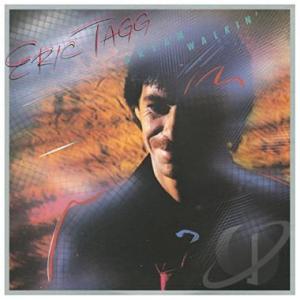 Probably best known for his work with guitarist Lee Ritenour on the Rit and Rit 2 albums, Tagg possesses a soulful, velvety voice, pitched somewhere between Stevie Wonder and Donald Fagen (some have also drawn comparisons to David Pack and George Michael).
 I first heard The Redskins’ ‘Bring It Down (This Insane Thing)’ circa 1985 on ‘The Max Headroom Show’ and was seriously impressed.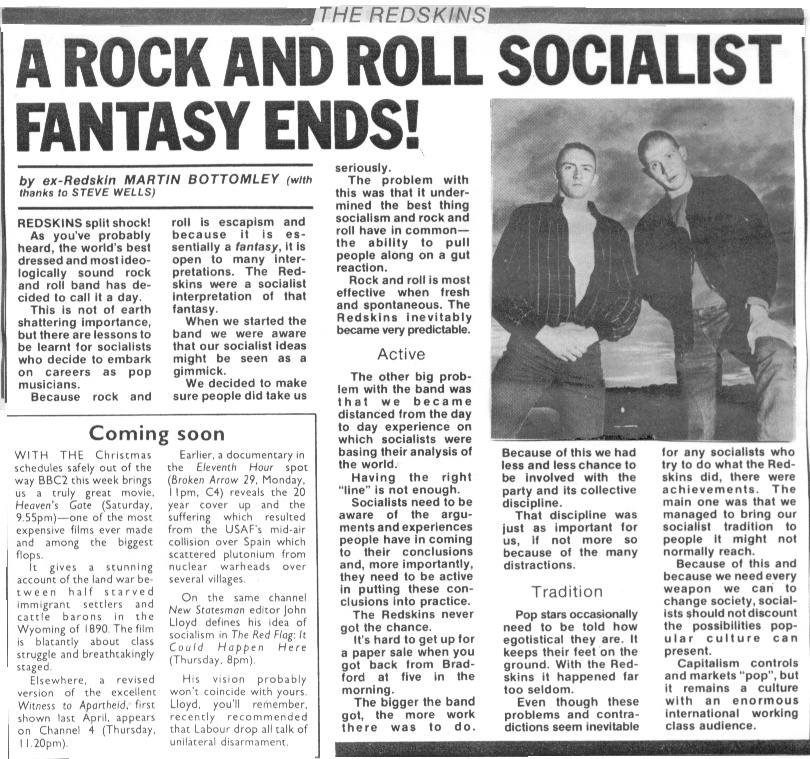
 Almost 30 years ago to the day, my brother arrived home from a Richmond shopping spree bearing strange cargo – a new Donald Fagen 12” single.
 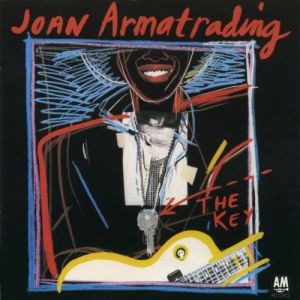 A&M Records, released 28 February 1983

