Jeff Porcaro laid down one of the greatest recorded drum performances of all time on the Toto song ‘Rosanna’, recorded at Sunset Sound in Los Angeles in December 1981.
He had been in the music business for less than a decade but was already being talked up as one of the finest drummers in the world. He was a disciple of Bernard Purdie and John Bonham, those kings of the half-time shuffle, as well as legendary ghost-note masters Jim Gordon and Jim Keltner.
But it’s the way Porcaro brought together all these influences to come up with something totally his own. Recorded by engineer Al Schmitt, ‘Rosanna’ may be the most analysed groove of all time, though Porcaro was always extremely humble about its genesis and execution.
Listening to it in its entirety, raw and uncut without any other accompanying instruments, the performance takes on a whole new meaning. Porcaro’s mastery of time and groove are impeccable. It’s the attention to detail, beyond ‘just’ the placing of the ghost notes and doubles.
Keep in mind also that he had to navigate the band through a tricky, mid-paced track with lots of ‘holes’ – a one-bar rest here, half-a-bar rest there – as well as apeing Jerry Hey’s horn arrangements, first heard at 1:08. It’s fascinating to hear how Porcaro navigates those holes, putting in an extra hi-hat or kick-drum beat to dictate the time to the band (and himself):
According to Schmitt (who deserves much credit for a beautiful sounding kit), ‘Rosanna’ was the first song recorded for Toto IV. Jeff’s part was laid down live with the rhythm section – bass, guitar, two keyboards – and it was the second and final take.
Written by David Paich and released as a single on 1 April 1982, it reached #14 on the Billboard Hot 100 and sold over a million copies. RIP Jeff.
This album was a substantial breath of fresh air when it came out in 1988.
I remember walking into Our Price and hearing Wayne Shorter’s majestic soprano sax over some swooning chord changes and thinking: ‘What the hell is this?!’
It was a relief and total surprise when it turned out to be Stanley’s cover of Mingus’s ‘Goodbye Pork Pie Hat’ (and what a brave choice of track to play in the shop…).
It wasn’t just the Baby Boom rockers who struggled a bit during the 1980s. Stanley started the decade very well with Rocks Pebbles & Sand but then there were a few middling collaborations with George Duke and a very patchy run of albums: Let Me Know You, Time Exposure and Hideaway. 1985’s Find Out had some brilliant momentsthough.
But ITBCOT put Stanley back on the jazz map. Its full-on playing – with admittedly a few late-’80s production values in tow – brought to mind classic ’70s albums Journey To Love and School Days. Drum machines were out: drummers were back in (Ndugu Chancler, John Robinson, Gerry Brown and Stewart Copeland, all of whom play beautifully).
The album also emphasised how much of a singular voice Clarke had now developed on piccolo bass, as distinctive on his instrument as Parker, Miles, Monk or Rollins were on theirs.
‘Working Man’ is an update of ‘Lopsu Lu’ from Stanley’s classic first album and features some ridiculously brilliant soloing leaning very heavily towards John Coltrane’s ‘sheets of sound’ approach.
Gerry Brown stays toe-to-toe with Stanley, providing some spectacularly-unhinged drums, though maybe with a bit too much ’80s ‘gated’ snare for some ears.
My cassette copy of ITBCOT didn’t have any personnel listed on it, so when I first heard ‘Stories To Tell’ I didn’t realise I was getting my first exposure to the extraordinary guitar playing of Allan Holdsworth.
I’m very thankful that Stanley unleashed Holdsworth onto my sensibilities. He delivers some remarkably-fluid playing with a shrill, almost reedy tone. The first and last four bars of his solo are really special. Copeland plays superbly too, with more restraint than usual.
Freddie Hubbard shines on a fine cover of Janet Jackson/Jam and Lewis’s ‘Funny How Time Flies (When You’re Having Fun)’ while Stanley brings the funk with a great take-off of Zapp’s Roger Troutman on ‘I Want To Play For You’.
Elsewhere there are two fun but rather dispensable duets with tapdancer Gregory Hines but they don’t outstay their welcome. Finally, ‘Tradition’ may feature Stanley’s finest recorded playing bar none and highlights a strong John McLaughlin influence (via Coltrane, of course).
In a much-maligned genre of music, ’80s fusion, ITBCOT is a minor classic that deserves critical reappraisal. It also led to a really good period for Stanley – he joined Shorter in Lenny White’s short-lived but intriguing Manhattan Project, and also toured as part of a supergroup with Herbie Hancock, Shorter and Omar Hakim.
One of the many positives of the recent vinyl resurgence is the potential for some decent album covers again.
For a while, it seemed as if the art was being lost.
Back in the ’80s, as the cliché goes, you would generally buy an album, stick it on and then peruse the cover at some length while you listened. The best covers seemed to take on a life of their own.
Budgets were healthy, the musicians cared and you could see the time and effort that went into the work. I particularly liked those covers with a ‘psychological’ aspect, some kind of story or scene, an image that maybe enhanced the lyrical themes of the album.
Here are eleven album covers of the ’80s that still beguile, from the spooky to the decidedly Spielbergian.
13. Donna Summer: She Works Hard For Her Money (1983)
Design: Chris Wharf/Photo by Harry Langdon
12. Scritti Politti: Cupid & Psyche 85 (above)
Design by Keith Breeden/Artwork by Art-O-Matic
11. Pat Metheny/Lyle Mays: As Falls Wichita, So Falls Wichita Falls (1981)
‘Undercover’ is essentially a one-chord groove with powerful lyrics, stinging guitar licks, a memorable hook and notable video.
Though Mick and Keef share a writing credit, the song was apparently largely a Jagger composition, with Richards later saying: ‘Mick had this one all mapped out. I just played on it. There was a lot more separation in the way we were recording at that time. Mick and I were starting to come to loggerheads…’
Guitarist Ronnie Wood concurred but also had reservations: ‘There was a great acoustic version which is the kind of song it should be. The final, polished version may have been Mick’s vision of the song…’
Reading between the lines, Jagger was clearly keen to bring outside players into an increasingly dysfunctional band situation. Recording took place during the summer of 1983 at Compass Point Studios in Nassau, giving Jagger the opportunity of using some great local players, many of whom light up ‘Undercover Of The Night’.
A raft of percussionists including Sly Dunbar, Martin Ditcham, Moustapha Cisse and Brahms Coundoul accompany drummer Charlie Watts on various instruments including bongos, Simmons drum and even a timpani (there are rumours that a complete different version of the song exists featuring a rhythm section of Sly and Robbie). Producer Chris Kimsey also enters into the spirit of things with an ingenious ‘dub’-style arrangement (or is that the work of Brian McGee, credited as ‘editor’ on the vinyl label?).
Jagger claimed that his lyric was heavily influenced by William Burroughs’ 1981 novel ‘Cities Of The Red Night’. The song is a disturbing vision of Latin America’s Dirty War. This was, after all, an era in which thousands of ‘political prisoners’ were tortured and killed in the ESMA detention camp in Buenos Aires, less than a mile from the stadium where the 1978 football World Cup Final was taking place (according to many reports, the cheers of the fans obscured the screams of suffering prisoners).
Excellent documentary ‘The Shock Doctrine’ claims that many torture techniques used by the Chilean and Argentinian junta (including rape and genital mutilation) may have been ‘learned’ in the US-run School Of The Americas. Jagger manages to crystallise many of these disturbing aspects in a powerful lyric:
Hear the screams of Centre 42 Loud enough to bust your brains out The opposition’s tongue is cut in two Keep off the street cos you’re in danger One hundred thousand disparos Lost in the jails in South America
Cuddle up baby, cuddle up tight Cuddle up baby, keep it all out of sight Undercover of the night
The sex police are out there on the streets Make sure the pass laws are not broken The race militia has got itchy fingers All the way from New York back to Africa
All the young men, they’ve been rounded up And sent to camps back in the jungle And people whisper, people double-talk And once-proud fathers act so humble All the young girls they have got the blues They’re heading on back to Centre 42
Down in the bars, the girls are painted blue Done up in lace, done up in rubber The johns are jerky little GI Joes On R&R from Cuba and Russia The smell of sex, the smell of suicide All these sweet things I can’t keep inside
Undercover, all out of sight Undercover of the night
Julien Temple directed the controversial video, shot in Mexico City. As he relayed in the book ‘I Want My MTV’, his dealings with Jagger and Richards gave him a pretty stark insight into the state of their relationship:
‘I wrote an extreme treatment about being in the middle of an urban revolution, and dramatised the notion of Keith and Mick really not liking each other by having Keith kill Mick in the video. I never thought they would do it. Of course they loved it. I went to Paris to meet with the band. Keith was looking particularly unhappy. He was glowering with menace and eventually said, “Come downstairs with me.” My producer and I went down to the men’s room. Keith had a walking stick and suddenly he pulled it apart. The next thing I know he’s holding a swordstick to my throat. He said, “I want to be in the video more than I am.” So we wrote up his part a bit more. That was Keith’s idea of collaboration!’
The video was initially considered too violent for MTV (though they did eventually air an edited version after 9pm) and it was heavily censored when shown on British television, leading to a fractious interview on ‘The Tube’ during which presenter Muriel Gray questioned Jagger and Temple about the extreme content and their motives for making the video.
‘Undercover Of The Night’ was released as the first single from the accompanying Undercover album on 1 November 1983. It got to #9 in the US and #11 in the UK. Not bad. It was their highest chart placing to date.
Considering he was such a huge star and cultural icon, it’s surprising that Prince’s eventful life and sad death has yet spawned so few ‘kiss and tell’ memoirs.
Let’s hope it stays that way. But while his long-time musical partner and one-time fiancée Sheila E certainly doesn’t shy away from sharing her memories of him in her fine autobiography ‘The Beat Of My Own Drum’ (co-written with Wendy Holden), those recollections form only a small part of a very rich, diverse collection of portraits.
After all, Sheila has played percussion and/or drums with some of the all-time greats: Carlos Santana, Herbie Hancock, Marvin Gaye, George Duke, Lionel Richie, Tito Puente, Diana Ross and Billy Cobham, not forgetting her father Pete Escovedo.
But while there are plenty of tasty music biz anecdotes, the book also provides a fascinating portrait of growing up in a mixed-race family (her mother is African-American and father Mexican) in a less-than-salubrious section of Oakland, California.
Sheila paints a rich picture of a seemingly happy childhood based around music, dancing, sports (she is apparently a pretty useful football player), charity and community, with shared cultural references such as The Carpenters (Sheila was hugely inspired by seeing Karen on the TV), Sly and the Family Stone and The Jackson 5, though there also some racial tensions around too.
But then the book goes in a completely different, unexpectedly harrowing direction when she chronicles the sexual abuse suffered as a young girl at the hands of several cousins. The section rivals James Rhodes’ recent book ‘Instrumental’ in its shocking candour.
Thankfully, if anything, the abuse drives her ambition rather than beats her down, though she admits to seeing it as a dark secret that clouds the rest of her life.
There are fascinating anecdotes about travelling to Colombia at the age of just 15 to play percussion with the Latin/fusion supergroup Azteca. Cobham, Duke and Gaye are mainly described in glowing terms, almost as father figures, and she is unexpectedly candid about her romantic and musical infatuations with Santana. There’s also a hilariously mismanaged backstage ‘meeting’ with Diana Ross.
But it’s easy to forget just how unique Sheila’s talent was in the 1980s when she made it as a ‘pop star’. We had never seen a percussionist/singer/dancer triple-threat before, as she herself points out, and Latin celebrities were very rare.
This pop period is grippingly covered in the book, with tales of disastrous video shoots, crazy tour schedules and much celebrity hobnobbing. Escovedo also very nicely juggles the spicy anecdotes with some genuine, intelligent advice for the modern musician, and just enough technical stuff about playing drums and percussion too.
Sheila also discusses her project Elevate Hope Foundation which focuses on music therapy for victims of child abuse, a noble and important program which continues to go from strength to strength.
So if the last quarter of ‘The Beat Of My Drum’ reads more like a self-help book than a famous musician’s autobiography, we can surely cut her some slack. Highly recommended.
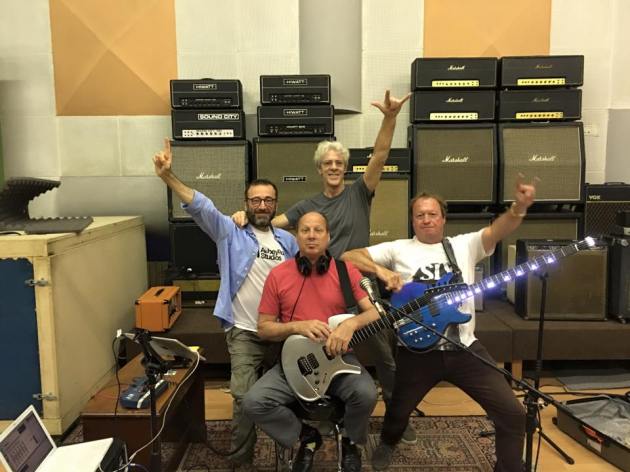
King Crimson, The Police, Level 42: three of the greatest bands of the 1980s, loved by musicians and non-musicians alike.
But, on the face of it, you might be hard-pressed to come up with too many common musical traits between them (barring the fact that both Sting and Level 42’s Mark King are bass/vocal double threats).
That’s what makes the news of an Adrian Belew (Crimson vocalist/guitarist), Stewart Copeland (Police drummer) and King collaboration so exciting.
What’s also exciting is that in these days of ‘distance’ recording, where musicians regularly email each other sound files for embellishment, never needing to be in the same room, the guys are actually in a studio together.
Copeland of course has had a long, fruitful relationship with bassist Stanley Clarke, who happens to be Mark King’s musical hero, so that makes some sense. But Belew is the real curveball (as he usually is – in the best possible way, of course!).
Adrian has kept followers up to date with the project’s conception and recording progress over on his Facebook page:
‘A bit of information about what we’re doing here in Milan. Gizmo is a recording project created by Stewart Copeland and Vittorio Cosma, keyboard player of Elio e le Storie Tese. (You may remember Elio is the band I played a Bowie tribute with on Italian television back in February).
It is their songs and music. They asked me a while back to contribute guitar and maybe some vocals. recently they asked Mark King to join in on bass and vocals as well. It is not a “supergroup” and there are no plans beyond making this record.
I’m enjoying it very much. Great music and great people making music in beautiful Italy. What’s not to like? We have done three of Stewart’s songs so far and they sound awesome. I must admit Stewart’s songs are custom-made for my guitar playing in the same way as Talking Heads songs were.
Full of nooks and crannies ready to be filled with tasty sonic treats, and always a reserved parking spot for a blistering guitar solo from outer space. And it certainly is gratifying when you finish said solos to have everyone in the control room stand up in a rush of applause!’
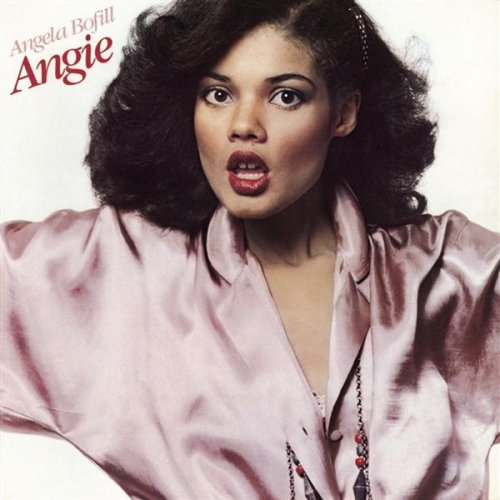
The strand of jazzy soul music developed by artists like Minnie Riperton, Phyllis Hyman, Chaka Khan, Jon Lucien, Al Jarreau, Randy Crawford and Carl Anderson probably reached its commercial apex with Anita Baker’s eight-million-selling 1986 album Rapture.
But perhaps the most underrated singer in that style was Angela Bofill, an ever-present on the US R’n’B charts between 1978 and 1984.
Best known for her sultry ballads and Latin-tinged mid-tempo jazz/soul tracks, I stumbled upon an Angie Best-Of sometime in the early ’90s and have been a fan ever since.
Her voice has a lovely, yearning quality, with power, range, great enunciation and a hint of Whitney Houston about it. But you’ll never hear Bofill’s music on the radio, at least here in the UK, and it’s a shame that she didn’t quite manage that breakthrough pop hit.
Born in the Bronx to a Cuban father and Puerto Rican mother, Bofill studied classical singing at the Manhattan School of Music.
After a tip-off from Latin Jazz flautist Dave Valentin, she was initially mentored by producers Dave Grusin and Larry Rosen, recording her successful first two albums Angie and Angel Of The Night for the fledgling GRP label.
Moving to Arista Records under the supervision of legendary impresario Clive Davis, she worked with some big-name producers throughout the ’80s: George Duke, Narada Michael Walden, Norman Connors and The System (David Frank/Mic Murphy).
Narada particularly seemed a good fit for her, co-writing a few killers such as ‘Tropical Love’ and ‘Too Tough’ and teaming up with future ‘American Idol’ judge Randy Jackson on bass to make a phenomenal rhythm section.
Angela also made a wonderful guest appearance on ‘Where Do We Go’, the standout track from Stanley Clarke’s lacklustreHideaway album of 1986, and there were also interesting duets with Boz Scaggs and Johnny Mathis around the same time.
But her most impressive material was self-penned. ‘You’re A Special Part Of Me’, ‘Gotta Make It Up To You’, ‘Song For A Rainy Day’ (which she also produced), ‘I Try’ (memorably covered by Will Downing in the early ’90s), ‘Accept Me’, ‘Rainbow Inside My Heart’ and ‘Time To Say Goodbye’ are all stand-outs which demonstrate her fine musicianship as well as vocal skills.
It’s a shame her composing, producing and arranging talents were never properly utilised, though she left us with a few classics nevertheless.
Angela made a comeback in the mid-’90s with Love In Slow Motion, a nice album featuring three superb tunes – ‘All She Wants Is Love’, ‘Soul Of Mine’ and the very Janet Jackson/Jam & Lewis-esque ‘Love Changes’ – which matched anything from her ’80s peak.
She also made a notable appearance at the 1998 Montreux Jazz Festival with Billy Cobham and George Duke.
Unfortunately serious illness befell Angela in 2006. Two strokes have limited her recording and live appearances, but she did make a brief return to the stage in 2012: ‘The Angela Bofill Experience’ featured stories from her life and career, with artists such as Maysa Leak, Phil Perry and Melba Moore performing signature songs.
Since then, things have been quiet, but we send good vibes from London. Angie’s certainly not forgotten in these parts.
The general critical consensus maintains that Neil had a rotten ’80s.
He made folk albums, rockabilly albums, synth-rock albums, undercooked Crazy Horse albums and country albums.
But you can’t say he wasn’t prolific, and hey, he’s Neil Young – there’s always something good going on somewhere.
But none of these projects came anywhere near the commercial jackpot, to the extent that his label boss David Geffen sued him for ‘unrepresentative’ product!
But, with the release of 1988’s This Note’s For You, Young was getting back on track. He had returned to the Reprise label of his peak years and was gigging with a hard-hitting ten-piece band The Bluenotes (later changing its name to Ten Men Workin’ after a legal challenge from Harold Melvin) which featured a hot horn section and cracking new drummer Chad Cromwell.
Neil had ten new songs in the can too, veering between two-chord R’n’B stompers and love ballads in the ballpark of his teenage hero Roy Orbison. He was also playing as much if not more lead guitar than he ever had in his solo career, this time in the biting, incisive style of Alberts King and Collins.
Lyrically, the songs were basically about workin’ hard, lookin’ for love, not sellin’ out and havin’ a good time, but with more humour than Bruce or Billy Joel. ‘I’m a married man – respect my happy home!’ he barks on ‘Married Man’.
Neil gave writer Paul Zollo some cool insights into the writing of the song in the book ‘Songwriters On Songwriting’:
‘Oh, I like that song. I think I wrote that in my car. I have a ’54 Caddy limo. I was on my way down from Northern California to play with the Bluenotes. I was on Highway 5. Our driver was listening to tapes and I was playing my guitar…’
Neil’s tremulous voice croons ‘You have changed my life in so many ways’ on ‘Can’t Believe Your Lyin’, and it’s both touching and amusing. ‘Ten Men Workin” and ‘Life In The City’ are driving old-school R’n’B gems while ‘Sunny Inside’ is almost Brian Wilsonesque in its charming naivety.
Then there’s the title track, the standout cut on the album (though it inexplicably fades way too soon). A rum, anti-product-placement protest song which nevertheless manages to mention four big brands (and of course mocks Budweiser’s ‘This Bud’s For You’ campaign), it defiantly has its cake and eats it. It’s also a total blast.
In a delicious irony, the old hippie who had spent most of the ’80s in purgatory made one of the great vids of the decade (winning Video Of The Year at the 1989 Video Music Awards), with notable help from writer Charlie Coffey and legendary director Julien Temple. Temple talked about his motivations for making the video:
‘Beer companies and the like were beginning to take over music. A lot of beer ads were using rock musicians. The line between videos and commercials was blurring. We managed to get banned from MTV and win the Video Of The Year award. That was the peak of my video-making career…’
The clip mostly mocks the series of Michelob beer ads which featured the likes of Genesis, Eric Clapton and Steve Winwood. And it didn’t scrimp on Michael Jackson and Whitney Houston lookalikes.
What’s also notable and totally unprecedented is that Neil decided to use a live take of the song for this video, completely different to the album version. Which major star would have the balls to do that today?
This Note’s For You was not a hit, only reaching #61 in the US album chart. But Neil was laying down a marker for the classic follow-up Freedom. And he had also tapped into something very prescient by focusing on guitar-led soul, blues and R’n’B forms, echoing the resurgence of Clapton, Buddy Guy, John Lee Hooker, Jeff Beck, Albert Collins and Gary Moore, and emergence of hotshots like Jeff Healey and Robert Cray.
DVD commentaries come and go, but among the best I’ve heard is for ‘Sideways’, Alexander Payne’s classic 2004 movie starring Paul Giamatti and Thomas Haden Church.
One scene, set at at the fictitious Frass Canyon winery, opens on the shot of a pale, very sincere acoustic guitarist playing a ‘tender’ ballad. On the commentary, Haden Church mutters: ‘Very Windham Hill-ish’, eliciting a chuckle from Giamatti.
You get the feeling that the term ‘Windham Hill’ is a code for something not entirely positive…
For a brief period in my teens, a cassette copy of An Invitation To Windham Hill was always near the family hi-fi.
It has since become one of those weird, unclassifiable albums that I can’t shake. Why is that? What is this kind of music really about once you subtract the nostalgia?
The Windham Hill label was founded in 1976 by Californian guitarist William Ackerman, who initially used the imprint to sell his own music out of a Palo Alto garage. Just down the road, Steve Jobs was establishing his Apple empire, and guess what: he was a big fan of Windham Hill, as Ackerman later recounted in an interview:
‘Steve fell in love with the aesthetic. All the Apple computers (played) Windham Hill music when you turned them on. It was such an exciting time. Anything seemed possible. People were making dreams come true, and I did feel part of that.’
Early on, the label emphasised solo acoustic instruments, eliciting a ‘back to nature’ vibe. Later, electronic music, contemporary bluegrass, smooth Latin/jazz and Celtic sounds were eased into the mix.
The stark, ‘natural’ style of their album covers was apparently influenced by ECM, as was some of the musical ethos; Keith Jarrett’s Koln Concert and the acoustic guitar work of Ralph Towner, John Abercrombie and Pat Metheny were certainly important to Windham Hill.
Also, in the same way that Jarrett’s album proved a huge sales breakthrough for ECM, a similar thing happened to Windham Hill – George Winston’s Autumn unexpectedly sold over a million copies and changed the label from a modest, regional imprint to nationally-known entity (and Autumn was the first of his seasonal-themed recordings!).
The whole Windham Hill package, both musically and visually, is very ‘white’, very ‘corporate’, very ‘Thirtysomething’. It contributed massively to the mid-’80s popularity of New Age music (and the eventual backlash against it). It also has a lot in common with the Minimalist movement (including geography).
But Ian MacDonald has written persuasively about the infantilising effects of this stuff in his brilliant ‘The People’s Music’:
‘Something happens to people who listen to too much minimalism. They begin to smile facetiously, display a genially indiscriminate omni-tolerance and put their feet on your furniture. Some start wearing dungarees and playing with frisbees’!
There is definitely that element to An Invitation To Windham Hill, but it does also highlight the work of two genuinely excellent artists: Mark Isham and Michael Hedges. Isham has been a first-call soundtrack composer for 30 years now but his 1983 debut album Vapour Drawings is an ambient/electronic classic (more on that to come).
Hedges, who died in 1997, blew guitarists’ minds with the release of his debut album Aerial Boundaries. Thetitle track manages to be both an amazing technical feat (it’s a solo piece for drastically detuned guitar sometimes featuring up to four intertwining melodies, achieved with a mixture of picking, tapping and hammer-ons) and also a substantial composition in its own right.
The other solo guitar tracks by Alex De Grassi and Ackerman are weirdly memorable, as are the solo piano pieces. In fact, the whole album is, and it might make a nice soundtrack to your wine-tasting evening or campfire gathering. Or it might not…
Track listing:
A1 George Winston ‘Thanksgiving’ (3:07),
A2 Alex De Grassi ‘Western’ (4:04),
A3 Mark Isham ‘Love Theme’ (From ‘Mrs. Soffel’) (4:11),
A4 William Ackerman ‘Visiting’ (6:07),
A5 Mark Isham ‘In The Blue Distance’ (4:07),
B1 Shadowfax ‘Angel’s Flight’ (4:00),
B2 Scott Cossu ‘Ohana’ (5:03),
B3 Michael Hedges ‘Aerial Boundaries’ (4:39),
B4 William Ackerman ‘The Bricklayer’s Beautiful Daughter’ (3:50)
B5 George Winston ‘Longing/Love’ (5:11)
‘We’re not in the music space – we’re in the moment space.’ Daniel Ek, CEO/Founder of Spotify, quoted in ‘The Song Factory’ by John Seabrook
Spotify undoubtedly has many things going for it, but its boss’s comment might make many a true music fan take pause. It definitely goes some way to explaining why I’ll be hanging on to my cassettes.
They are anti-moment, demanding patience and time-investment. The famous soliloquy in Nick Hornby’s ‘High Fidelity’ explains the gentle art of compilation construction. Who didn’t try to woo someone with a well-crafted comp?
I’ve still got mutant compilation tapes made 20 years ago which mix up tracks from all kinds of sources: albums hired from the library, albums borrowed from friends, tracks taped from the radio and maybe even a bit of homemade Zappa-style spoken-word weirdness by myself or a few friends.
Then there are the teenage band rehearsals recorded on a brilliant Philips boombox. Wish I still had that. I swear it made better recordings than a lot of digital four-tracks I’ve heard since. And then there’s the cache of gig tapes recorded directly from the sound desk of various London venues. I barely listen to them but there’s no way I’m gonna chuck ’em.
Then there are the official album releases. I like the way they sound slightly different on every player. My favourites are probably the grey and black Warner Bros ones of the late-’70s/early-’80s: to this day, Little Feat’s Time Loves A Hero, The Doobie Brothers’ Livin’ On The Fault Line and John Martyn’s Glorious Fool sound so much better on cassette than on CD, with improved dynamics and top-end.
Cassettes were always subtly subversive too – Malcolm McLaren masterminded his band Bow Wow Wow’s (cassette-only, of course) release of 1980 mini-album Your Cassette Pet as a reaction to the ‘Home Taping Is Killing Music’ protest. He also named their debut single ‘C-30 C-60 C-90 Go!’ in tribute to the humble tape.
And the ‘punk’ element of cassettes has also definitely been picked on by Zack Taylor, director of a new documentary called ‘Cassette’, showing later this month at London’s East End Film Festival. It features the likes of Henry Rollins, Thurston Moore and Ian McKaye waxing lyrical about the format which seems to be enjoying a resurgence in the US – cassette sales are on the up and there are reportedly more cassette-only labels than ever before.

 Jeff Porcaro laid down one of the greatest recorded drum performances of all time on the Toto song ‘Rosanna’, recorded at Sunset Sound in Los Angeles in December 1981.






 So here it is: The Stones’ last great single.
 King Crimson, The Police, Level 42: three of the greatest bands of the 1980s, loved by musicians and non-musicians alike.
  The strand of jazzy soul music developed by artists like Minnie Riperton, Phyllis Hyman, Chaka Khan, Jon Lucien, Al Jarreau, Randy Crawford and Carl Anderson probably reached its commercial apex with Anita Baker’s eight-million-selling 1986 album Rapture.
 DVD commentaries come and go, but among the best I’ve heard is for ‘Sideways’, Alexander Payne’s classic 2004 movie starring Paul Giamatti and Thomas Haden Church.
 ‘We’re not in the music space – we’re in the moment space.’
 movingtheriver.com