‘Pocket’ is hard to define but you know it when you hear it.
Drummers often say that you’re either in the pocket or you ain’t, and as such the expression is mostly used in association with great US groovemasters like Richie Hayward, James Gadson, Bernard Purdie and Andy Newmark.
But ex-Level 42 drummer Phil Gould has been busy over the last 35 years (and a personal musical hero for about 30 of those) laying claim to be the UK’s premier proponent of ‘pocket’, but he has a lot of other weapons in his arsenal too.
Though relatively quiet since leaving Level 42 in 1987 (making a brief return in 1994), Gould pops up on the London live music scene now and again. He also released his first solo album Watertight in 2009.
This 606 gig was very much a Level 42 reunion of sorts featuring keyboards and vocals from Mike Lindup and honorary ‘fifth member’ Wally Badarou, though, in an unexpected but typically generous move from the modest drummer/leader, the focus was very much on excellent vocalists Diana Winter and Sumudu with added support from the superb Yolanda Charles on bass, guitarist Fabio Balestrieri and Alex (son of Phil) Gould on piano and occasional drums.
The opening ‘Madness’ was a reliable portent of things to come, with Gould’s tasty, behind-the-beat groove underpinning some gentle Latin percussion and Mike Lindup’s strong vocals and electric piano. Winter and Sumudu took centrestage for most of the rest of the first set, their voices combining exceptionally well especially on the catchy ‘Supergirl’.
Badarou dusted off a funky, rough-and-ready version of the mid-’80s dancefloor classic ‘Chief Inspector’, adding some piquant synth flavours, while Lindup aired an excellent songwriting collaboration with Billy Cobham and Dominic Miller.
Perhaps predictably though, the highlight of the evening was a nifty run-through of the classic Level 42 instrumental ‘Heathrow’, with Charles powering the band superbly and even supplying a note-for-note rendition of Mark King’s original bass part.
On a difficult day for music, with the earlier announcement of David Bowie’s death, Gould provided an uplifting – if very light – evening with lots of healing sounds, fine vocals, lean grooves and good vibes.
It’s always a pleasure to hear him at the kit, and it’s also always a pleasure to get down to the 606, one of the great hidden gems of the London music scene.
Words are hard to come by today. We pay tribute via one of the most beautiful songs of David’s unparalleled career. Our deepest sympathies to his family, friends and musical collaborators.
When it comes to the arts, ‘nobody knows anything’, as screenwriter William Goldman famously claimed.
But the music biz sure knows a good formula when it sees one. And in the late-1970s and early ’80s, formulas didn’t come much more successful than Johnny Guitar Watson’s.
His fusion of funk, blues, disco, jazz and R’n’B even gave Parliament/Funkadelic and Earth, Wind & Fire a run for their money. He was simply one of the coolest musicians ever to walk the planet.
A Texan blues master who influenced many guitarists including Frank Zappa (the two would collaborate regularly in the ’70s and ’80s), Watson relaunched his sound with Ain’t That A Bitch in 1977, a superb marriage of hilarious lyrics, double-tracked vocals, cool Stevie/Sly/Curtis grooves, ambitious horn arrangements and searing guitar solos. It was a big success and Watson spent the rest of the ’70s repeating the formula with minor variations and, to be honest, diminishing returns.
Ain’t That A Bitch hooked me right away. My dad had a knackered old cassette copy which came in a really horrible silver-and-yellow design, but for some reason I was fascinated by it. There was something seriously dodgy about the cover photo, title and…everything, really. But then I listened to it. By the late ’80s, I was getting into Sly, Stevie and The Isleys, so Bitch fitted in like a dream and became an essential soundtrack to summer 1989.
On 1980’s Love Jones, Johnny expanded his sound to include influences from P-Funk, gospel, bebop, bossa-nova, Afro-beat, hip-hop and even country, and the result is one of the weirdest but most interesting albums of his career. A lot of it sounds very rushed, as if his mind wasn’t really on the job, but that sometimes works in its favour!
With hindsight, Johnny should be included alongside Sly, Prince, D’Angelo, Stevie and Lewis Taylor as one of soul music’s finest multi-instrumentalists – on his great albums of the 1970s and early ’80s, he plays all the keyboards, bass, guitars and some drums, as well as producing and arranging.
His keyboard playing gives guys like Ramsey Lewis and Les McCann a run for their money, and he even once recorded a whole album of piano/vocal ballads, 1963’s I Cried For You.
Love Jones kicks off with the infectious ‘Booty Ooty’, powered by the great, unsung drummer Emry Thomas, which adds a touch of P-Funk to Johnny’s classic horn-driven sound.
The title track is a fairly cheesy soul ballad, while ‘Goin’ Up In Smoke’ continues his strand of state-of-the-nation political funk/blues tunes which began with Ain’t That A Bitch‘s title track in ’76. ‘Close Encounters’ is just plain odd, a bossa-nova with some funny lyrics about a mistaken love affair – ‘It was close encounters of the wrong kind’!
His update of ‘Lone Ranger’ is a classic, featuring some outrageous vocal scatting and some nutty electric piano and bass solos. The gospel curio ‘Jet Plane’ has a criminally-out-of-tune bass, badly-recorded keyboards and amateurish drums (presumably played by Johnny), but it still works.
Ditto the seriously weird ‘Children Of The Universe’, a country-rock coming-of-age piece which sounds like The New Seekers backing Sly Stone.
But Love Jones‘s centrepiece is of course the mighty ‘Telephone Bill’, oft cited as one of the first rap tracks. In 1994, Watson was asked if he had anticipated the hip-hop movement:
“Anticipated? I damn well invented it! And I wasn’t the only one. Talkin’ rhyming lyrics to a groove is something you’d hear in the clubs everywhere from Macon to Memphis. Man, talkin’ has always been the name of the game. When I sing, I’m talkin’ in melody. When I play, I’m talkin’ with my guitar. I may be talkin’ trash, baby, but I’m talkin’!”.
Yessir, but more importantly the track features his best guitar solo on record, an amazing mash-up of bebop, blues and funk.
Compared to the lush, meticulously-arranged Ain’t That A Bitch, Love Jones sounds like a series of demos but it still works, like pretty much all of Johnny’s music. He carried on touring and recording right through to his death in 1996. I wish I’d seen him play live. See ya, Johnny.
Yep, it’s M-M-M-M-Max, scourge of celebrities everywhere and purveyor of surreal one-liners and bizarre stream-of-consciousness meanderings.
Max was created in 1985 by Annabel Jankel (sister of Ian Dury-collaborator Chaz), Rocky Morton and George Stone as a rather eccentric, attention-grabbing ‘talking head’ to present videos (supplied by Chrysalis Records, who co-funded the show) on the burgeoning Channel Four, the fourth terrestrial channel in the UK.
Max was brilliantly played by Matt Frewer, who apparently had to endure over four hours in the make-up chair before each day of filming,
Max was born during the one-off TV feature ‘Max Headroom: 20 Minutes Into The Future’ which aired on 4 April 1985.
He then returned to front two series of ‘The Max Headroom Show’ in 1985 and 1986. The show then moved to the US for two series shown in ’87 and ’88.
People probably either loved or hated Max but this writer was an immediate fan. I even bought the book. Large swathes of his monologues are indelibly etched on my memory. Even today, I can’t hear the words ‘Sebastian Coe’ without thinking of Max’s unique delivery.
I also discovered some good music and vids on his shows too, including Peter Gabriel’s live version of ‘I Don’t Remember’, The Redskins’ ‘Bring It Down’, Donald Fagen’s amazing ‘New Frontier’ vid (directed by Jankel and Morton) and Sid Vicious’s terrifying ‘My Way’ (how did that get onto pre-watershed TV?).
Most of the press attention was aimed at the state-of-the-art computer graphics, the incredible make-up job and bizarre speech patterns.
But, apart from the music vids, what immediately hooked me was his smarmy, gleeful piss-taking. He was kind of a mixture of Fletch and Johnny Rotten. There was also a touch of Dan Aykroyd/Chevy Chase’s smarmy Weekend Update newsreaders on ‘Saturday Night Live’.
Though the show had three regular writers – David Hanson, Tim John and Paul Owen – Frewer apparently improvised a large part of Max’s ramblings. I always assumed Max’s ‘cool guy’ persona was coming from Steve Martin but Frewer claims that he based Max’s shtick on Ted Knight’s hilariously hammy portrayal of Ted Baxter in ‘The Mary Tyler Moore Show’.
Possibly the sections of the show which have the most relevance now are Max’s interviews with stars like Sting (see below), Boy George and David Byrne. Years before Dennis Pennis, he was hilariously detached, if not downright dismissive of their celebrity status. I loved the way he ridiculed Sting’s new ‘jazz’ direction.
Later on, the tables were turned as Max found himself being interviewed on primetime chat shows by David Letterman and Terry Wogan. He calls Letterman ‘Davey-doo’ throughout and seems to be slowly driving him to distraction.
I had a few episodes on video for many years but chucked them out a while ago – a big mistake, as there’s still no sign of a UK DVD. Long live Max!
One of the recurring themes of Randy Newman’s interviews seems to be the question of how long songwriters can maintain high-quality work.
He frequently compares himself to Dylan, Joni Mitchell, Neil Young, Robbie Robertson, Don Henley and Paul Simon, wondering if he’s keeping pace. 1983’s Trouble In Paradise proved that he was certainly keeping up, if not outstripping all of them.
After somewhat of a commercial breakthrough with 1977’s Little Criminals, Randy came seriously unstuck with the 1979 follow-up, Born Again. So a lot was riding on Trouble and it certainly delivered; song for song, it arguably equals Sail Away or Little Criminals.
Randy unleashes a parade of shucksters, hucksters, bigots, junkies and unreliable narrators that would be right at home in a David Mamet play or Coen Brothers movie.
In a neat irony, he also used the cream of the LA session elite (Jeff Porcaro, Jerry Hey, Nathan East, Steve Lukather, various Eagles and Fleetwood Macs) to sugarcoat his short stories; Trouble is one of the best-sounding bad-vibes albums in rock history, alongside Frank Zappa’s Sheik Yerbouti and Steely Dan’s Gaucho.
Randy almost had a second hit single with the deceptively cheery ‘I Love LA’, the Cole Porter-style intro leading into an ironic, ambivalent comment on the American Dream and some of its discontents. ‘Christmas In Cape Town’ is a disturbing portrait of Apartheid-era South Africa apparently written under the influence of Nadine Gordimer’s books.
‘The Blues’ is an amusing duet with Paul Simon poking fun at the plight of the oversensitive singer-songwriter, though Newman has claimed that he regrets writing the song. ‘Mikey’s’ is another amusing portrait of a racist, reactionary douchebag, with our narrator sounding off over a robotic synth-rock backing which seems to be Randy’s pastiche of new-wave rock.
I love the way the narrator comments on the music, bellowing: ‘Didn’t used to be all this ugly music playing all time… Where are we, on the moon? Whatever happened to the old songs? Mikey, whatever happened to the fucking “Duke Of Earl”?’!
The hectoring continues on the hilarious ‘My Life Is Good’, a self-mocking vignette which eavesdrops on the life of an arrogant, rich and famous rock star. Springsteen gets a namecheck and Ernie Watts’ booming impersonation of Clarence Clemons is accompanied by Randy screaming, ‘Blow, big man, blow!’ Pretty weird and pretty funny.
Newman then proves that he’s a master of the gear shift with the inclusion of two devastating ballads, ‘Same Girl’ and ‘Real Emotional Girl’. The former, described by its author as a song about ‘two junkies in love’, is a heartbreaking portrait of lost innocence with a sumptuous string arrangement, indelible melody and sometimes dissonant harmonies. He’s just way ahead of his contemporaries here.
The latter is an uncharacteristically tender portrait of a sensitive, gentle young woman who can’t help but get her heart broken. The middle eight is just sublime. Linda Ronstadt has performed this song from time to time.
‘Miami’, which kicks off side two, is the most musically expansive track on Trouble, featuring a delicious performance from Randy’s favourite drummer Jeff Porcaro, intricate stop-start arrangements and eerie mandolins by Dean Parks.
The two filler tracks on Trouble, ‘Take Me Back’ and ‘There’s A Party At My House’, are buried in the middle of side two, while ‘I’m Different’ is a self-mocking swinger with some lovely close-harmony backing vocals by Jennifer Warnes and Ronstadt.
The closing ‘Song For The Dead’ is a devastating Vietnam War allegory features a mythological (dead?) colonel who has been left behind to say a prayer for his fallen comrades. The song bravely dares to send up a certain kind of American heroism, but still carries a hefty emotional punch.
Trouble In Paradise was not a commercial success, reaching only number 69 on the US album chart. That is a pretty shocking showing from such a major artist and one of the great songwriters.
The failure seemed to chasten Newman – he jumped back into the world of movies, scoring 1984’s ‘The Natural’ and co-writing the screenplay for the Steve Martin/Chevy Chase vehicle ‘The Three Amigos’. Like his friend and frequent collaborator Ry Cooder, it seemed that film work was now funding an increasingly unpopular solo career.
Randy returned as a solo artist in 1987 to make Land Of Dreams, perhaps the only album of his that hasn’t dated well (though he told Paul Zollo in the brilliant book ‘Songwriters On Songwriting‘ that it’s his personal favourite). Then, over a decade later and against all the odds, he released one more near-classic, 1999’s Bad Love, crowning 30 years of songwriting consistency.
He once told the writer Jon Ronson, tongue placed firmly in cheek: ‘My career has been a disappointment to me. I always hoped I’d sell millions of records. There are 40,000 people out there who just love me. But they may be surprised to hear I’ve been aiming beyond them…’
The ’80s certainly has its fair share of duff Christmas tracks, maybe more than most decades, but at least there was a lot of variety.
The Christmas number one suddenly had prestige. Consequently a huge variety of artists tried their luck from Sting, The Eurythmics and U2 to Siouxsie And The Banshees, Jethro Tull and Depeche Mode.
Here are six Christmas singles from the 1980s that I could just about tolerate hearing any time of the year.
6. The Waitresses: Christmas Wrapping (1981)
The New York new-wavers’ charmingly-ramshackle little number has only grown in stature as a seasonal favourite despite not even making the UK top 100 on its December 1981 release.
5. The Three Wise Men: Thanks For Christmas (1983)
XTC in disguise. Andy Partridge came up with this very pleasant but almost totally ignored singalong, unfortunately released smack-bang in the middle of a period when the Swindon three-piece couldn’t get arrested. But what’s really cool about ‘Thanks For Christmas’ is THAT chord change…
4. David Bowie/Bing Crosby: Peace On Earth/Little Drummer Boy (1982)
Just two days on from taping a superb performance of ‘Heroes’ and a duet with Marc Bolan on the ‘Marc’ TV show, Bowie was invited onto Bing’s ‘Merrie Olde Christmas’ to film this great and genuinely surreal clip on 11th September 1977. Apparently the ‘Peace On Earth’ segment of the song was composed on the day of filming (by the show’s music consultants Ian Fraser and Larry Grossman) and rehearsed for only an hour before the cameras rolled – pretty impressive. When finally released as a single in 1982, ‘Peace On Earth/Little Drummer Boy’ peaked at number three in the chart. Was it a subconscious influence on the wistful ‘Fantastic Voyage’ released just over a year later?
3. Jona Lewie: Stop The Cavalry (1980)
Nothing says 1980 to me like this strange little Christmas song (though, according to Lewie, it wasn’t intended as such) which peaked at UK number three, only kept off the top spot by two posthumous John Lennon singles.
2. Band Aid: Do They Know It’s Christmas (1984)
Yes, it’s as over-familiar as an uncle’s Boxing Day bear hug, but it retains some power due to its musical-chairs approach, great Boy George vocals and the lack of a proper chorus. I think it was the first 7” single I actually went out and bought.
1. The Pogues Featuring Kirsty MacColl: Fairytale Of New York (1987)
Only the hardest heart could deny the poignancy of this all-time classic. Written, arranged, played and sung with consummate care, this tale of doomed love in the Big Apple reached number two in December 1987.
Even as a teenager, I picked up something faintly illicit (and excellent) about this band.
A cool friend of my dad’s stuck ‘Attack Of The Fifty Foot Woman’ on a cassette for me alongside Donald Fagen’s The Nightfly and Bill Withers’ Greatest Hits sometime around the late-’80s.
I loved it, though it would take me a good few years to find out who had recorded it. A lot of detective work was called for – The Tubes weren’t exactly big in the UK.
The band’s earlier career had taken them through glam/punk, Spector-style pop and new-wave rock, but The Completion Backward Principle was the first Tubes album produced by David Foster, a gifted Canadian keyboardist who already had a proven track record as a first-call session player, arranger and songwriter.
He had worked extensively on Earth Wind & Fire’s I Am (co-writing the megahit ‘After The Love Has Gone’), Lee Ritenour’s Rit and Boz Scaggs’ Middle Man.
According to most accounts, as a producer he was a pretty hard taskmaster, demanding absolute perfection. He wasn’t above telling a band member to go home early and calling in a name session player in his place (which he frequently did during the recording of Chicago 17).
But the results speak for themselves. The band had made a quantum leap since 1979’s Todd Rundgren-produced Remote Control. Fee Waybill had turned into a pretty damn good singer.
Drummer Prairie Prince is hardly the subtlest player in the world (Jeff Porcaro was surely waiting in the wings) but he’s every bit the human metronome on these songs and plays a blinder on the brilliant ‘Think About Me’.
Maybe ‘Don’t Wanna Wait Anymore’ and ‘Amnesia’ sound more like Chicago than Devo but they are memorable and interesting with great chord changes, while the fairly risqué ‘Sushi Girl’ could have come from Zappa’s You Are What You Is.
‘Let’s Make Some Noise’ even taps into the kind of pop/funk that Let’s Dance took to the bank a few years later. The album is also beautifully recorded, engineered and mastered, sounding superb on my original vinyl copy.
I also love the cover concept. The band’s corporate attire and conservative ‘message’ were apparently a satirical take on Reagan’s inauguration and the rise of motivational business concepts. But the smarter the clothes, the weirder the content, as the Surrealists proved decades before.
According to this interview with Fee Waybill, The Tubes imploded a few years later after The Completion Backward Principle when David Foster suggested that only he, Waybill and a few outside songwriters should compose singles for the band.
He would appear to have a point, that team having co-written ‘Talk To Ya Later’, the Top 40 hit ‘Don’t Want To Wait Anymore’ and the number 10 hit a few years later, ‘She’s A Beauty’.
Waybill believes they might have become as big as Foreigner or Journey had they taken Foster’s advice, but it wasn’t to be – the rest of the band vetoed the suggestion and Waybill first left in 1985 after the disastrous Rundgren-produced Love Bomb.
However, they have continued to be a successful live band to this day. I loved seeing them in 2000 at the much-missed London Astoria. Talk to ya later…
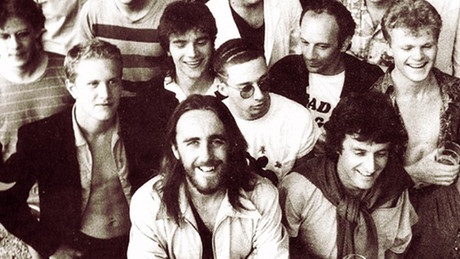
Anyone who got into jazz in the 1980s must surely have a soft spot for the legendary anarcho-big band Loose Tubes.
I saw them play live sometime around 1986 in one of those great community-run London venues (Logan Hall? Shaw Theatre? Camden Arts Centre?) that appeared quickly, burnt brightly and then disappeared.
I don’t recall much about the music but do remember the crowd; the jazz revival was in full flight so there were lots of very hip people wearing chinos, black polo-necks and sometimes even berets dancing unashamedly.
Then, a bit later, Loose Tubes played on Saturday-evening primetime TV wearing very loud clothes, dancing idiotically and generally clowning around with the audience. It was youthful and different and gave Big Band Jazz a much-needed makeover.
Of course there’s always the chance that some people just didn’t think of their music as ‘jazz’ at all, and their clowning may well have put a lot of potential punters off. But the band probably weren’t too bothered about that.
In a way, the Loose Tubes could only have originated in the ’80s, emerging as it did from composer and educator Graham Collier‘s community big band workshops.
There was no ‘leader’ per se (although keyboards/French horn man Django Bates was occasionally seen conducting in very syncopated sections) and any member of the band was free to submit compositions.
Consequently, Loose Tubes’ music touched on anything that took its composers’ fancy – samba, heavy metal, folk, Weather Report-style fusion, flamenco, Hi-Life, blues, reggae, free jazz.
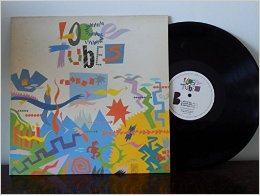
Their first self-titled album came out in the summer of 1985 and it was a really nice distillation of their sound (and featured one of my favourite UK drummers, Nic France, who left soon after the recording to join Working Week).
Django Bates’ composition ‘Yellow Field’ remains a classic. The followup Delightful Precipice is probably their best known album, and the final studio recording was 1988’s Teo Macero-produced Open Letter.
It was probably a miracle that such a huge band lasted as long as it did (six years) but Loose Tubes was also a superb career springboard for Bates, saxophonists Iain Ballamy, Julian Arguelles and Tim Whitehead, guitarist John Parricelli, flautist Eddie Parker, drummers Nic France/Steve Arguelles and ‘bone man Ashley Slater, all of whom are going strong today.
And guess what – they reformed in 2014, playing concerts at the Cheltenham Jazz Festival, Brecon Jazz Festival and a sold-out week at London’s Ronnie Scott’s. Two live album have also recently been released, Sad Afrika and Dancing On Frith Street, both of which featured music from their original farewell gig at Ronnie’s in September 1990.
It Bites go Metal? Nearly. A brave attempt to break the US? Possibly.
Even Kerrang! magazine took notice of this one. Riff-heavy, blues-based rock was making a big comeback on the late-‘80s UK music scene, typified by the success of Thunder, The Quireboys, Gun and Little Angels.
The gifted Cumbrian four-piece came up with a neat twist and produced their heaviest album yet in Eat Me. But they could never completely jettison their penchant for brilliant pop hooks, colourful instrumentation and intricate arrangements.
Francis Dunnery’s guitar playing was leaner, meaner and more direct than before, with a stronger blues flavour; Hendrix and Clapton were touchstones now rather than Holdsworth and Gambale.
The song and performance were paramount. He talked glowingly of David Sylvian and The Blue Nile in interviews. Producer Mack brought the big drum sound and ban on reverb. Dick Nolan expanded the grooves with his new six-string bass.
There were three near-hits (‘Still Too Young To Remember’, ‘Underneath Your Pillow’, ‘Sister Sarah’). Roger Dean provided the album cover concept/graphics/masks, possibly a weird move for a band trying to escape the Prog tag. It was red rag to a bull for the NME who ran a sarcastic mini-interview with Dunnery at the time which barely mentioned the band’s music.
First single ‘Still Too Young To Remember’ was Classic Rock of an early-‘70s vintage, sounding more like Family, Cat Stevens or Free than Genesis or Marillion. Virgin flogged it mercilessly with not one but two re-releases but there was still no sign of a hit.
I remember excitedly rushing out to the buy the 12” version one beautiful spring day in 1989. Its superb B-side ‘Vampires’ features one of Dunnery’s most outrageous guitar solos. Other fine B-sides of the time include ‘Bullet In The Barrell’ and ‘Woman Is An Addict’ which features a killer whole-tone Nolan/Dunnery riff.
As the ’80s turned into the ’90s, It Bites were shaping up to be one of the bigger live draws in British rock – they embarked on three tours in the space of a year, selling out the Hammersmith Odeon and impressing everyone. A glorious night at the old Town And Country Club featured on the ‘Meltdown’ TV show.
They played extensively in Japan and toured the States with Jethro Tull. The feeling in the Virgin camp was that the fourth album would deliver the big hit they were striving for. Too heavy for pop but too pop for metal? Too good for the charts? Suddenly, despite the lack of singles action, it didn’t seem to matter too much.
But the cracks were starting to show – Dunnery was reportedly a barely-functioning alcoholic whose self-loathing tendencies led to sublimely pissed-off guitar solos but more often than not wound up the rest of the band – especially the equally gifted yet far more docile John Beck (Dunnery recently said in a Classic Prog interview that they had very different ‘energy levels’), often leading to some thrillingly edgy onstage duels but also some resentment.
Decamping to Los Angeles to write songs for the fourth album proved a career move too far – Beck, Dalton and Nolan refused to work with Dunnery who was AWOL periodically throughout the sessions. The band splintered and that was that, despite a brief reunion of the original line-up the early noughties.
It’s fascinating to imagine what might have been if they’d been able to hold on a bit longer and harness the creative tension between Beck and Dunnery. The breakup was a sad end to one of the most prodigious groups of musicians in the ‘80s pop pantheon.
I don’t recall seeing this excellent band on TV or hearing them on the radio back in 1989/1990.
To this day, I don’t really know what they look like and don’t want to know. Though their debut single ‘Can’t Be Sure’ was released in January 1989 and reached just #45 in the singles charts, it ended the year as number one in John Peel’s Festive Fifty. The track also has a weird prog connection – it was (excellently) co-produced by Ray Shulman, a founding member of Gentle Giant.
‘Can’t Be Sure’ and its attendant classic album Reading, Writing And Arithmeticnow seem redolent of a far gentler time, an era of hope and innocence, pre-Grunge and Britpop. For that reason, along with the Cocteaus’ Heaven Or Las Vegas, they’re quite hard to listen to now but no less powerful. The Sundays were also arguably a very influential band on many inferior acts (The Cranberries, The Corrs etc etc).


 Yep, it’s M-M-M-M-Max, scourge of celebrities everywhere and purveyor of surreal one-liners and bizarre stream-of-consciousness meanderings.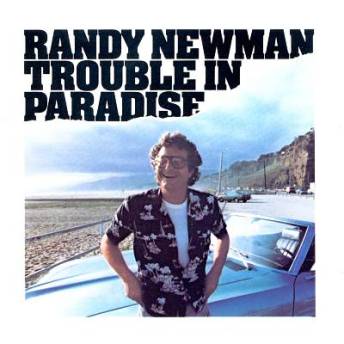
 Crimbo, eh, readers?