1980s Rock/Pop Acts I Should Like But Don’t

Everyone knows a few: those acts that got great reviews, named some of your favourite bands as influences and sold a few records in the process, but there was just something about their music that you couldn’t hack.

Maybe it was their vocals, their outlook, their politics, their songwriting, or a mixture of all four.

Well I know some too. Here’s a totally subjective, wildly judgemental – no offence intended – list of 1980s pop and rock artists who leave me cold, despite most being critical and commercial successes. Believe me, I’ve tried. Like they could care less…

King’s X
My muso mates waxed lyrical about their tricky riffs and tight musicianship but I’ve never got beyond the guy’s not very good singing, their weirdly unmemorable songs and rather naff pomp-rock tendencies.

World Party
Perpetually spoken about in hushed tones of reverence when I was at college but their music singularly failed to grab, despite the Beatles/XTC/Prince influences, possibly due to Karl Wallinger’s rather wimpy voice. See also: Crowded House, REM, Waterboys

The Blow Monkeys
Somehow got filed under the ‘sophistipop’ banner courtesy of their flirtation with ‘slinky’ grooves and soul influences, but for me Dr Robert’s absurd voice and the lack of songwriting imagination never got them past first base. See also: Kane Gang, Simply Red, Johnny Hates Jazz, Black, The Big Dish.

Marillion
Decade-ending Season’s End had some brilliant moments but for me most of the Fish era was a succession of quite badly-played/badly-sung rip-offs of Gabriel-era Genesis. It Bites did it better and added some much-needed pizzazz and groove. See also: IQ, Jadis, Tony Banks/Chris Squire/Mike Rutherford solo albums…

Deacon Blue
I liked the soppier/poppier elements of their debut album Raintown but the game was up when the truly irritating ‘Wages Day’ and ‘Real Gone Kid’ swept the airwaves at the end of the decade. They took Prefab Sprout’s basic concept to the bank whilst shaving off the weird edges.

Paul McCartney
Sheer melodic brilliance time and time again of course, but for me his 1980s work generally flatters to deceive, outside of a few random favourites (‘Pipes Of Peace’, ‘Once Upon A Long Ago’). Yes, even the album he did with Elvis Costello (of whom more below…).

The Style Council
Only a musical moron would deny the power of ‘You’re The Best Thing’ and ‘Walls Come Tumbling Down’ and you have to admire Paul Weller’s songcraft, politics, guitar playing and ability to laugh at himself, but generally it was hard to shake off the naffness. Mick Talbot must take a lot of the blame…

Mick Jagger
He employed some of my favourite producers and musicians (Jeff Beck, Sakamoto, Bill Laswell, Herbie Hancock, Doug Wimbish, Simon Phillips etc. etc.) but failed to produce even one memorable or interesting single or album track during the 1980s. See also: Pete Townshend, Eric Clapton, Nick Heyward, Jerry Harrison

Pages
This yacht rock supergroup had a great singer (Richard Page) and sh*t-hot musicians (Vinnie Colaiuta, Jay Graydon, Jeff Porcaro, Steve Lukather etc.) but the songs weren’t strong or memorable enough. See also: most of Toto, Mr Mister

Elvis Costello
Weirdly his ‘Less Than Zero’ was one of the first singles I loved as a kid, but his desperation to be a serious ’80s ‘artist’ fell on deaf ears despite the fact that he obviously knew a lot of chords and retained some of that new-wave angst (but even I couldn’t resist his fine run of 1990s form, from the superb ‘London’s Brilliant Parade’ to Bacharach). See also: The Cars, The The, Squeeze.

Van Morrison
To my ears his 1980s music is like Joni Mitchell and John Martyn without the melodic/harmonic/lyrical depth, apart from the sublime ‘Rave On John Donne’. People tell me he always uses great bands though, but they often barely register…

Todd Rundgren
I’m more of a fan of his 1980s producing work (Pursuit Of Happiness, XTC etc) than his solo music. Never bought into this whole ‘he’s a genius’ thing, save the wonderful ‘The Verb To Love’ – but that’s from the 1970s, innit…? See also: Lenny Kravitz.

Depeche Mode
Yes they’ve got a few pop hooks, the Mute Records cred and ‘edgy’ image but never been able to shake off an ineffable naffness for me. And despite being ‘synth pioneers’, they didn’t seem to push the sonic envelope much in the 1980s at all. ‘Everything Counts’ was superb though and I got on board later with Ultra. See also: Kraftwerk, New Musik, Visage, Ultravox, New Order, Howard Jones

Pink Floyd
If you want to put me to sleep, put on any of Pink Floyd’s 1980s work. Bring back Syd. See also: Fleetwood Mac, Pink Floyd solo projects, except Nick Mason’s Fictitious Sports, which is brilliant…

Bad Brains
Dub/thrash/funk pioneers and a huge influence on bands I really like such as Living Colour, Fishbone and 24-7 Spyz, but their music seems a little amateurish to me and, again, their singer was not blessed with a great set of pipes (unlike the singers of bands above).

Housemartins
Fondly remembered until you actually hear those singles again – ‘Build’, ‘Happy Hour’, ‘Caravan Of Love’. Annoying, a bit puny, and apparently the more irritating side of the C-86 generation.

The Jesus and Mary Chain
Bowie summed them up well for me: ‘I tried the Jesus and Mary Chain but I just couldn’t believe it. It’s awful! It was so sophomoric – like the Velvets without Lou. I just know that they’re kids from Croydon! I just can’t buy it…’

The Most Bafflingly Popular Live Acts Who Came Of Age During The 1980s

We’ve all done it – surveyed an ad for an upcoming gig and said of a band: ‘Whoa – they’re playing not one but THREE nights at Wembley/wherever?!’.

Some acts who thrived in the 1980s have effortlessly sidestepped the nostalgia circuit to maintain a huge live following, able to tour under their own steam every four or five years and sell out arena gigs. They might lose a founder member here or gain a strange recruit (Reeves Gabrels in The Cure?!) there but basically seem to go from strength to strength.

How do they do it? Who exactly are their fans? After 40-plus years of service, who forks out 70 quid every three or four years to see their favourite band at the nearest enormo-dome? Here, in no particular order, we round up the usual suspects. We’re obviously not talking about those plucky little cult acts of the 1980s. There’s a crucial missing bit in the musical brain of yours truly which would help me understand the enduring popularity of these headliners.

Variously, we will find acts who once upon a time were self-confessed haters of live performance; those who are like the Rolling Stones of 1980s pop, pedalling their tried-and-tested formula despite not writing anything decent for 30 years; those who have lost a vital frontperson, but carried on anyway. And the acts who – inexplicably – are massive in the USA despite doing middling business in the place of their birth.

Who’s who? You decide… Other suggestions are very welcome.

16. Pet Shop Boys

15. Genesis/Mike & The Mechanics

14. ELO

13. Tears For Fears

12. Depeche Mode

11. Simply Red

10. The Cure

9. Metallica

8. Iron Maiden

7. Def Leppard

6. Bon Jovi

5. Motley Crue

4. Duran Duran

3. U2

2. Queen

1. New Order

1980s ‘Classics’ I Don’t Need To Hear Again (AKA The Bland Files)

Noel Coward famously noted the strange potency of ‘cheap’ music.
There was certainly a lot of cheap, potent music around in the 1980s.

But as the nostalgia industry has grown, so has the dossier of seemingly ‘untouchable’ ’80s pop songs, tracks that are staples of daytime radio but, to many ears, lack distinctive grooves, beguiling melodies or interesting hooks.

If you were being cruel, you might say it’s music for people who don’t really like music. And, weirdly, it mostly comes from established, experienced campaigners who have a lot of other strings to their bow. But we only ever seem to hear one or two of their songs.

Here are those overplayed tracks that always have me reaching for the ‘off’ switch but have retained a weird grip on radio programmers for over 30 years. We consign them to Room 101, here and now, never to be heard again…

Dire Straits: ‘Walk Of Life’/’Money For Nothing’

Yazz: ‘The Only Way Is Up’

King: ‘Love And Pride’

Whitney Houston: ‘I Wanna Dance With Somebody’

Tina Turner: ‘Simply The Best’

The Beautiful South: ‘Song For Whoever’

Spandau Ballet: ‘Through The Barricades’

Dream Academy: Life In A Northern Town

Anything by The Proclaimers

Anything by Texas

Chris Rea: ‘The Road To Hell’

Sade: ‘Your Love Is King’/’Smooth Operator’

Steve Winwood: ‘Higher Love’

Mike And The Mechanics: ‘The Living Years’

Anything by Fleetwood Mac

The Cars: ‘Drive’

Mental As Anything: ‘Live It Up’

Soul 2 Soul: ‘Back To Life’

Anything by U2 apart from ‘Pride (In The Name Of Love’)’ or ‘The Unforgettable Fire’

Cyndi Lauper: ‘Time After Time’

Depeche Mode: ‘Personal Jesus’

Talking Heads: ‘Road To Nowhere’

Tracy Chapman: ‘Fast Car’

Anything by Tom Petty

Simply Red: ‘Holding Back The Years’

Prince: ‘When Doves Cry’

Womack & Womack: ‘Teardrops’

Anything by Duran Duran except ‘Notorious’ or ‘Skin Trade’

Anything by Bon Jovi

Culture Club: ‘Karma Chameleon’

Anything by Pet Shop Boys except ‘Suburbia’

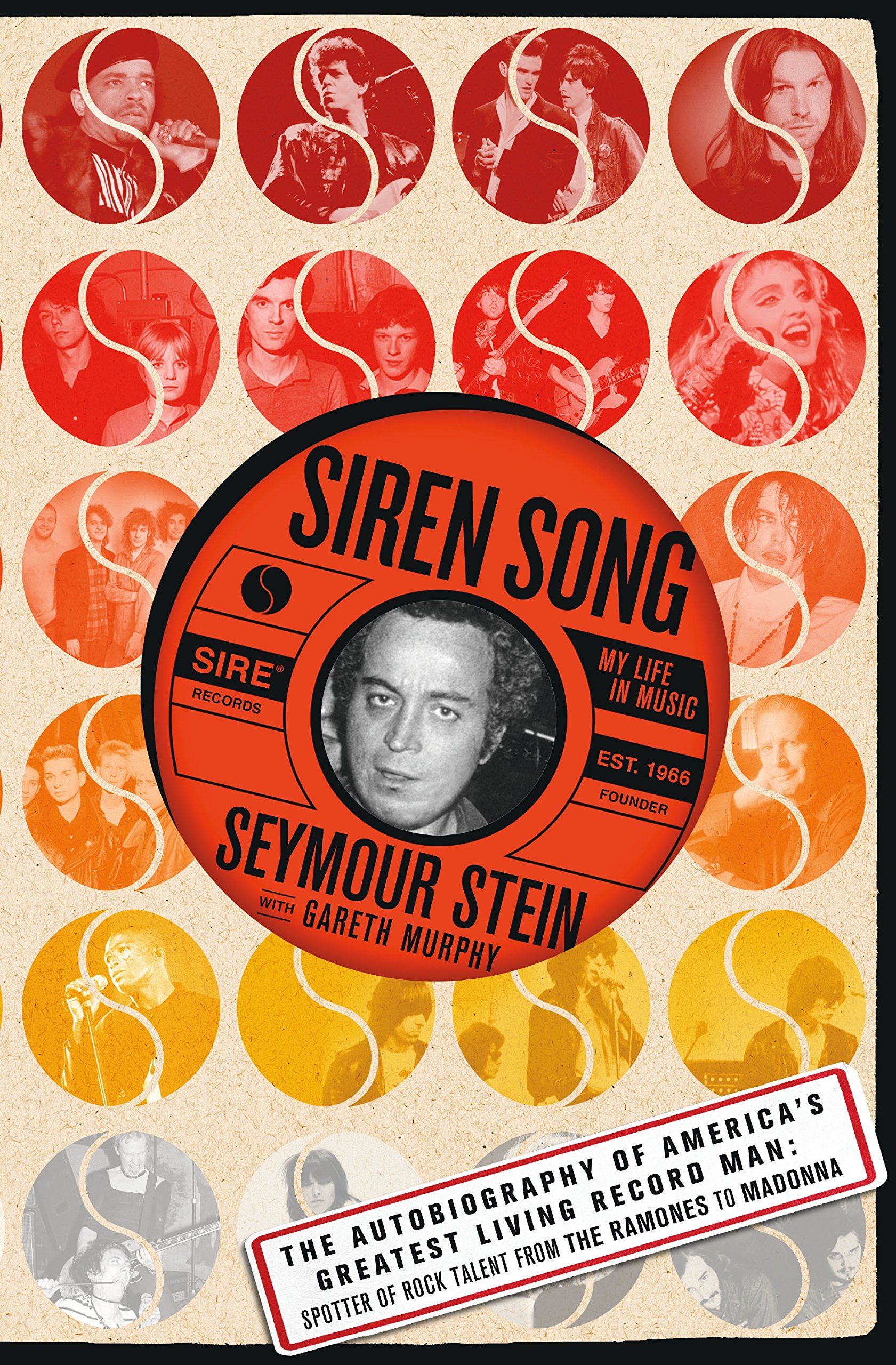
Book Review: Siren Song by Seymour Stein

One thing you could never say about the man born Seymour Steinbigle: he’s led a dull life. And his new autobiography ‘Siren Song’ is anything but a dull book.

Born in a down-at-heel corner of Brooklyn, he did his time at Billboard, Tin Pan Alley, CBGB and Studio 54 and either discovered or nurtured Madonna, Talking Heads, k.d. lang (who calls him ‘the man with the golden ears’), Ramones, Depeche Mode, Erasure, Ice-T, Soft Cell, Squeeze, The Smiths, The Cult (by now you’ll be gleaning that he’s somewhat of an Anglophile), Lou Reed and Brian Wilson, all via his imprint Sire Records (which he co-founded with Richard Gottehrer).

So far, so common Rock Snob knowledge. And there’s no question that ‘Siren Song’ is a great resource for those who want to know about the making of and/or music-biz machinations behind some of the great modern pop/rock albums: Fear Of Music, Like A Virgin (complete with fascinating gossip about Nile Rodgers’ business dealings), My Life In The Bush Of Ghosts, The Queen Is Dead, Ramones, New York. 

And then there are the fascinating tales of Stein signing Madonna from his hospital bed, visiting Talking Heads’ weird Long Island City loft and stalking Jethro Tull. He also writes superbly about the early ’80s music scene, when electro, hip-hop, Afro-beat, indie, new wave, reggae and post-disco combined to produce arguably the greatest ever pop period.

But two aspects separate ‘Siren Song’ from other similar tomes: Stein’s sheer love of music and his penchant for a pithy – but seldom tawdry – one-liner. On his lack of musical knowledge: ‘It’s usually better not to know the disgusting secrets of how the sausage got made.’

On David Byrne’s quirkiness: ‘He was someone I’d always support even if he wanted to make a concept album about toothpicks.’ On seeing Depeche Mode live for the first time: ‘They were four kids poking synths in a dump in the English suburbs.’ On the future of music: ‘Labels will always be needed, because only maniacs like me are insane enough to roam the globe, trawling through miles and miles of sh*t to just every now and then pick out a tiny diamond.’

Stein writes powerfully about the AIDS epidemic and the ramifications of being a gay man living a ‘straight’ life in the ’70s and ’80s (he had a wife and two daughters during the period). He superbly explains the timeless appeal of English guitar bands to Americans.

The prologue is also a classic, describing what it means to love music and the joys, perils and sacrifices involved (especially if you’re coming from a working-class family) with seeking a career in A&R (artist and repertoire, or, in Stein-speak, people and songs).

‘Siren Songs’ is an unexpected gem and highly recommended.

Siren Song’ by Seymour Stein and Gareth Murphy is published by St Martin’s Press.

Claudia Brucken @ Bush Hall, 12 March 2015

where_else_acpsc1Ex-Propaganda/ACT vocalist (and, dare we say, ’80s icon?) Claudia Brucken has enjoyed a real career renaissance in the last decade.

Her recent studio albums have featured collaborations with members of Heaven 17, Depeche Mode, Erasure and OMD, and new release Where Else is a very strong record of torch songs which foregrounds fine melodies and an unexpected ’60s pop influence.

West London’s plush, intimate Bush Hall was the perfect venue for this classy, deceptively low-key return to the London stage. With a minimalist red-curtain backdrop and versatile two-man backing band, Claudia began the gig seated but moved through the gears with consummate ease.

downloadHer vocals sounded rich and round, a big improvement on the last London gig two years ago, and it was also great that she kept audience banter to an absolute minimum, a lesson to some younger artists who seem desperate to pass the time of day.

Where Else was played pretty much in sequence as is the current way, and what’s clear is that the new songs are stark and slight but very catchy, with attractive, slow-burning melodies.

To go along with the string synths, piano and digital beats, there was generally an unmistakable Zombies/Colin Bluntstone influence on the new material too, with some distinctly Doors-style keyboards thrown in for good measure.

The resplendent, still striking ‘Duel’ (which my companion very adroitly pegged as the sound a-Ha had vainly aimed for throughout their career) and ‘P-Machinery’ were saved for the rapturously-received encores, and a rousing cover of Bowie’s ‘Everyone Says Hi’ was perfectly judged.

The gig was crying out for a real drummer though (paging Neil Conti) to add more of the human element, but budgets are budgets.

If all her stars are aligned, Brucken might yet enjoy an Everything-But-The-Girl-style sleeper hit. What seems unlikely is any kind of Secret Wish 30th anniversary tour; she seems very happy and musically fulfilled where she is right now.