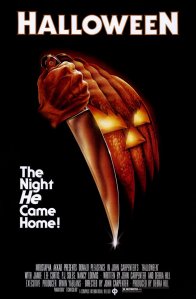
The Cult Movie Club: Halloween (1978/1982) Revisited (with spoilers)

John Carpenter’s classic horror movie ‘Halloween’ enjoyed its nationwide British TV premiere on 5 February 1982* (reportedly much to Mary Whitehouse’s chagrin).

It’s etched upon your correspondent’s memory. My parents recorded it onto VHS and my uncle thought it would be a laugh to show it to my brother and I. Instead it scared the hell out of me. But it’s remained a favourite movie over the years.

(And that premiere was edited for TV – watching the full version now, it’s always a shock when Michael Myers/The Shape admires his ‘handiwork’ after the kitchen murder, a moment that was cut from the original showing…).

It’s interesting that Carpenter’s work is still pretty much go-to Halloween horror fare for British terrestrial TV. Sky Arts celebrated the day with ‘The Fog’ while the Beeb have been showing ‘Halloween’ for a few weeks now.

And watching it again recently 45 years after my first viewing, it still proved itself a stone-cold classic – and offered up a few new insights:

The odd/inexplicable lines of dialogue
Carpenter and co-writer Debra Hill generally do a great job but there are still lines that baffle, maybe due to the actors’ delivery. Three from Laurie (Jamie Lee Curtis): ‘Well, kiddo, I thought you outgrew superstition’ and ‘The old girl scout comes through again’ and ‘What’s the boogieman?’ Maybe ‘What IS the boogieman?’ (with an emphasis on the ‘is’) would have been better…

‘Sexualised’ Jamie Lee in the second half?
In the first half of the movie, Laurie wears she wears a long skirt, bobby socks and cardigan, maybe a rather clever bit of character ‘motivation’ for Michael Myers/The Shape – Laurie possible reminds him of the sister that he murdered (there’s no evidence that Laurie and Michael are related in ‘Halloween’ – that silly idea only came later…). But in the second half of the film, she’s arguably ‘sexualised’ with tight blouse and tight jeans – better equipped to face her demons?

The massive influence of Hitchcock’s‘Psycho’
Obviously it was a coup to cast Jamie Lee, daughter of Janet Leigh. And Donald Pleasence’s character is named ‘Sam Loomis’ after a character from ‘Psycho’. Then there’s that brilliant tracking shot that follows Jamie Lee towards the ‘haunted house’, and Laurie’s entry into the ‘bedroom of horrors’ where evil lurks, as it does in ‘Psycho’. There’s also rather an effective use of a staircase, as in ‘Psycho’ where Martin Balsam meets his grisly end. Also it seems Carpenter wanted to do for cars what Hitchcock did for showers – see below.

The strange moving shape
Check it out – while Lindsey is watching ‘The Thing’, a weird shadow moves behind her in the corner of the room. For UK readers, it’s at 45:20 on iPlayer. Possibly camera shadow? Possibly not…

Illogical plot points
How does The Shape/Michael Myers get into the car to murder Annie (Nancy Loomis)? Carpenter makes a big deal of showing us that the car door’s locked – Annie then goes to get the keys – but when she returns it’s unlocked. Did he have a key? Then there’s the trowel locking the kitchen door when Laurie tries to escape the ‘haunted house’ (in the shooting script it is ‘key-locked’). Also why does it take Sam Loomis (Pleasence) so long to spot Michael’s car when he’s staking out the Myers house in the middle of the night?

The Shape/Michael Myers’ inhumanity
The naturally mild-mannered and sensitive Carpenter saw a lot of scary stuff growing up in the Bible Belt South, and it informed his writing. It’s clear he invested something absolutely immoral into The Shape, but it has precedents in the head baddie played by Frank Doubleday in ‘Assault On Precinct 13’ – shocking inhumanity and a reluctance to die, even when shot and stabbed a few times…

*Reportedly ‘Halloween III: Season Of The Witch’ got the biggest audience of all the UK ‘Halloween’ premieres though, 11 million when shown on the Beeb in 1986…

The Crap Movie Club: Robert Altman’s ‘The Room’ (1987)

Robert Altman, director of ‘Gosford Park’, ‘The Player’, ‘Nashville’ and ‘The Long Goodbye’, ‘doing’ Nobel Prize-winning playwright Harold Pinter?
It could have worked. Two shrewder observers of human nature there have seldom been. But Altman’s 1987 take on Pinter’s 1957 debut play ‘The Room’ was a bona fide stinker. A car crash.

It doesn’t even warrant a single mention in Michael Billington’s rigorous Pinter biography.

Though a couple of Altman’s ‘80s films are well-regarded now (‘Fool For Love’, ‘Come Back To The Five And Dime, Jimmy Dean, Jimmy Dean’), the great director was mainly forced to scrabble around for one-off deals during this period, probably cursed by the critical mauling handed out to his 1980 version of ‘Popeye’.

‘The Room’ certainly continued Altman’s reputation as a provocateur par excellence. In ‘Altman On Altman’, he claimed it came about when the TV network ABC offered him carte blanche to film any stage play he wanted.

His choice of ‘The Room’ amazed, annoyed and confused them, as did his casting of Annie Lennox, Julian Sands and Linda Hunt.

The suits had a point. Hunt, best known for her Oscar-winning role in ‘The Year Of Living Dangerously’, is nothing less than a disaster in the film. Her London accent is appalling and she fudges the key line: ‘That’s this room.’

The emphasis should be on ‘this’, not ‘room’. You wonder why co-star Donald Pleasence didn’t raise any objection.

Lennox’s beauty beguiles but the Eurythmics star doesn’t deliver a classic performance. As for Sands, you only ever expect over-the-top weirdness from him and he doesn’t surprise here, suffice it to say that his Cockney accent is also a travesty.

Pleasence – predictably – is the only actor who emerges with any credibility, his turn a fidgety comic masterpiece. You wonder what he said privately about this mess to Pinter (they were good friends).

Altman shot ‘The Room’ back-to-back with another Pinter play (and equally appalling/must-see) ‘The Dumb Waiter’, starring John Travolta during his career doldrums. They were shown on American TV separately during the 1987 holiday season and then given a theater run as a double bill under the banner of ‘Basements’.

The lack of critical or commercial success didn’t surprise anyone. But Altman seemed to like it that way. He didn’t get out from under until 1992’s ‘The Player’.

It was a long, cold 1980s for the great director…

Harold Pinter @ 90, The Caretaker @ 60

Playwright, actor, activist and poet Harold Pinter, who died on Christmas Eve 2008, would have been 90 years old today.

I couldn’t let 2020 pass without marking that fact and celebrating the 60th anniversary of ‘The Caretaker’.

When I started my English Literature ‘A’ Level at the end of the 1980s, theatre had barely appeared on my radar. I’d seen some Shakespeare, Webster, Sheridan, maybe a bit of Alan Ayckbourn, Willy Russell and John Godber, mostly on school trips. Nothing really hit home.

But then my excellent teacher Hugh Epstein introduced us to ‘The Caretaker’. Needless to say, it was like no other play I’d read before. This was the language of the West London streets that I knew. The play’s themes covered familiar territory too.

Pinter’s legendary, hilarious piss-taking was evident from early on – mainly courtesy of the Mick character – but there was something else coming through loud and clear, something heroic, empathetic, charitable, even noble. I was gripped and it began a love affair with Pinter’s work that has lasted almost 30 years.

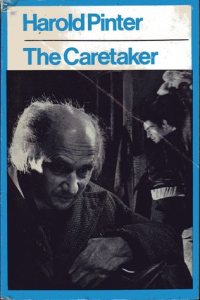
‘The Caretaker’ premiered on 27 April 1960 at The Arts Theatre in London, and starred Donald Pleasence, Alan Bates and Peter Woodthorpe. It was a big hit, Pinter’s breakthrough play after a difficult experience with ‘The Birthday Party’. An excellent movie, starring Pleasence, Bates and Robert Shaw, was made in 1963, shot in Hackney and adapted by Pinter himself:

There are so many other great London Pinter memories, many involving his acting performances in his own plays: ‘No Man’s Land’ at The Almeida, ‘The Collection’ and ‘The Hothouse’ at the Richmond Theatre. Also Ian Holm in ‘Moonlight’ at The Comedy Theatre and Michael Gambon’s turn as Davies in ‘The Caretaker’ at the same venue.

Of course he wasn’t only a playwright, actor and poet. A cursory look at his public appearances now – especially those in the last 20 years of his life, when he received the Nobel Prize In Literature and spoke passionately at various rallies – suggests that there are very few public figures around these days with his kind of gravitas. He was known to be prickly – aren’t we all – but also exceptionally generous, as he was to this writer.

He’s much missed. Happy birthday Harold. And enormous thanks to Hugh Epstein who brought ‘The Caretaker’ to life.

Further reading: George Cole’s Betrayed: The Story Of Harold Pinter’s Betrayal

Mark Batty’s About Pinter

Michael Billington’s The Life And Work Of Harold Pinter