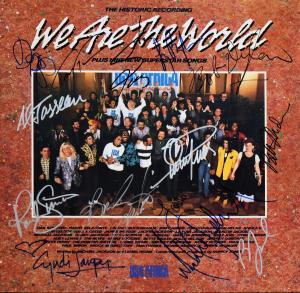
USA For Africa: We Are The World @ 40

Released 40 years ago this month and officially the fastest-selling single in American music history, USA For Africa’s ‘We Are The World’ shifted over 20 million copies and raised a huge amount of money for African famine relief.

Co-written by Michael Jackson and Lionel Richie during a few sessions at the former’s house in Encino, the song divides opinion but only the hardest heart could fail to be moved by its recording (even if one can definitely feel the vibe of some major agent/star power – no arriving in the manager’s battered old car for this lot…).

It brought together a fairly astonishing cast list of the great and good. And, inadvertently, it also arguably represented a last gasp for classic 1980s R’n’B and yacht rock.

The basic track was recorded at Kenny Rogers’ Lion Share Studios on 22 January 1985 with king-of-the-cross-stick John ‘JR’ Robinson on drums, bassist Louis Johnson and pianist Greg Phillinganes, closely monitored by a huge press corps, co-producers Quincy Jones and Michael Omartian and engineer Humberto Gatica. According to Robinson, all the musicians were sight-reading a chart and a click track was used, and they didn’t do more than two takes.

A few days later, Lionel sat down with Quincy and vocal arranger Tom Bahler to prep who would sing which lines (the decision was also made to mainly record vocals live and ‘in the round’ with no or at least very few ‘punch-ins’, unlike ‘Do They Know It’s Christmas’). All the major vocalists were then sent a copy of the basic track featuring Jackson’s guide vocal and with an enclosed letter from Lionel.

The featured singers then assembled at A&M Studios at around 9pm on Monday 28 January, most arriving after the American Music Awards (which Richie hosted). Notable absentees: Madonna (who was apparently bumped in favour of Cyndi Lauper), Prince (check out Duane Tudahl’s superb book for the details), George Benson, Dolly Parton, Donna Summer, Michael McDonald, Pat Benatar, Rod Temperton, Stevie Nicks, Joni Mitchell, Billy Idol? And is it odd that Smokey Robinson didn’t sing a solo line?

The complete footage of the recording session is still fascinating. We see how some of the biggest names in music history found different ways of preparing. Steve Perry waits for his line with eyes shut, looking down, listening intently. Diana Ross does just the opposite.

Bob Geldof gives a stirring pep talk and Stevie Wonder brings in two Ethiopian women to address the singers, moving many to tears. It’s hard not to be touched by Stevie, Kenny Rogers, Dionne Warwick, Diana, Steve Perry, Ray Charles and Cyndi Lauper’s vocals. But Harry Belafonte, Ray Charles, Bob Dylan and Bruce Springsteen seem to get the most respect from the assembled stars.

Other observations: Brucie – who had finished the latest leg of the Born In The USA tour the night before – looking like Judd Nelson in ‘The Breakfast Club’. Al Jarreau struggling throughout. Lionel the team player. Stevie giggling like a naughty schoolkid when Quincy gets annoyed. James Ingram hiding behind Kenny Rogers after a boo-boo.

Paul Simon twice saying to Rogers: ‘Can I help?’ Lauper sharing vocal tips with Kim Carnes. MJ holding hands with Diana and Stevie. Quincy and Stevie rehearsing with Bob Dylan. Stevie and Ray Charles using their braille machine. Quincy reading the score as he conducts the soloists, and his witty asides: ‘Who you gonna call?’ etc.

It looks like they recorded the first half of the song first (up to and including Daryl Hall) and then spent some time on the middle eight with Huey Lewis, Lauper and Carnes.

How does it sound now? Phillinganes’ piano playing is a pleasure to hear, typically tasty and gospel-inflected. But the track is inundated with synths – no less than four players are credited, including David Paich and Steve Porcaro from Toto – and probably why it reminded many of a Pepsi ad.

And it’s odd that the song features no guitar, though Prince offered to play a solo – Quincy reportedly told Prince’s manager Bob Cavallo: ‘I don’t need him to play guitar, we got f*ckin’ guitars’!
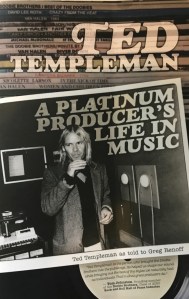
Book Review: A Platinum Producer’s Life In Music by Ted Templeman (as told to Greg Renoff)

You should never judge a person by their name.

movingtheriver assumed Ted Templeman – a favourite producer back in the day courtesy of his work with Van Halen, Little Feat, Doobie Brothers and more – was your typical seasoned/grizzled rock’n’roll journeyman.

But nothing could be further from the truth. Reading his enjoyable memoir (and looking at the cover), he turns out to be a mild-mannered jazz drumming prodigy turned pretty-boy frontman with late-‘60s baroque pop band Harpers Bizarre.

His story takes us from post-war Santa Cruz, California, to the upper echelons of the US music biz during boom time, when Templeman was a house producer for Warner Bros. (alongside Gary Katz, Michael Omartian, Jay Graydon and Lenny Waronker), becoming one of the wealthiest and best respected record execs of his era.

We learn about his youth studying the Cool School jazzers, then his pop band Harpers Bizarre gets signed by Warners and he’s mentored by Waronker, quickly learning what A&R actually means – choosing the right songs for the artist and assessing their commercial strengths and weaknesses. He also witnesses first-hand the weird action around the Doors, Beach Boys and Phil Spector.

But he quickly realises he’s not cut out for fronting a band, and moves on to being Warner Bros’s tape listener, hanging around Frank Sinatra sessions and getting the nod from Waronker to produce his pet project, the Doobie Brothers.

Then there are some fascinating sections on working with Van Morrison – he sees the frustrations of being a co-producer at first hand when they release the ‘wrong’ mix of ‘Tupelo Honey’. But he also sees Morrison’s more humorous side – during the recording of the live album It’s Too Late To Stop Now, Ted, sitting in the mobile studio outside The Rainbow, hears Van frequently saying, ‘Didja get that, Ted?’ into the mic between songs.

Templeman forges a long-term relationship with his engineer Donn Landee and starts working with Little Feat. He sparks a great friendship with their mainman Lowell George and is fascinated to find that he is a model airplane fan. But when pushed, Lowell claims he’s just learning about them so he he can fly in drugs from Mexico. He also learns a lot about drums working in Sunset Sound studio 1 with Richie Hayward.

Then there’s recording Carly Simon on Another Passenger, and her relationship with James Taylor, before Templeman first comes across Van Halen via a concert in Pasadena. They quickly become his second obsession, though he’s deeply unsure about Dave Lee Roth’s vocals and general attitude (the book is full of strikingly honest reflections, and he’s quick to admit when he’s wrong).

The main chunk of the book deals with recording Van Halen, from the classic debut to the painfully laboured 1984. He even confesses to initial scepticism about ‘Jump’, kvetching to Eddie: ‘I signed a heavy metal band’! But he somehow enlists Eddie to guest on rollerskating freak Nicolette Sheridan’s ‘Can’t Get Away From You’.

Templeman eventually becomes a great fan of Lee Roth, though advises him not to leave Van Halen and try to be a movie star (though still ends up producing Crazy From The Heat). He also worries about getting Sammy Hagar into VH, suggesting they change their name to Van Hagar, and refuses to produce 5150.

There’s an amusing meeting with Prince at Sunset Sound and the Purple One’s reaction to Templeman’s suggestion that Quincy Jones produce Purple Rain. And then there’s Allan Holdsworth, a Warner Bros. signing coming via Eddie Van Halen’s recommendation. Eddie and Templeman are contracted to co-produce Road Games, but Holdsworth refuses to allow them in the studio together while he’s recording! A baffled Eddie bows out, and then Holdsworth demands that a few tracks feature vocals against Templeman’s best advice (of course Allan has his own take on the Road Games debacle…).

The mild-mannered Michael McDonald is a regular character in the book, uncharacteristically going ballistic for not getting co-writing credit for Van Halen’s ‘I’ll Wait’. We learn about Aerosmith drummer Joey Kramer’s opinion of Templeman’s work on their comeback album Done With Mirrors, and Eric Clapton’s reaction to being told that his guitar tone sucks.

The last section of the book regards Templeman’s work on the ‘Wayne’s World’ soundtrack and then losing his job at Warners, leading to depression and alcoholism.

It’s one of those rare music books that takes you right into the process of trying to get quality, commercial performances from some of the biggest stars in the music business, and it’s full of good advice about producing/arranging and interesting musical/technical observations.

Sadly though, its message may fall on deaf ears these days when Pro Tools and bedroom recordings are all the rage, musicianship less so, but still it’s a fun, informative look at the peak of the studio scene. Highly recommended.

Sounds Like Steely Dan?

They are of course the pop/jazz masters whose harmonic and lyrical sophistication have had the critics purring since 1972.
They’ve also often been described as ‘influential’. But is that true? Does any other music sound remotely like Steely Dan?

In the 1980s, the term ‘Steely Dan-influenced’ was bandied about particularly in relation to British bands of the ‘sophisti-pop’ variety: The Big Dish, Style Council, Everything But The Girl, Curiosity Killed The Cat, Hue & Cry, Sade, Swing Out Sister, even Prefab Sprout and Deacon Blue.

More recently, it’s The High Llamas, Athlete, Mark Ronson, Toy Matinee, The Norwegian Fords, Mayer Hawthorne, State Cows and even Pharrell.

None really sound like Steely. Sure, they show off some slick grooves, jazzy solos and nice chord changes. But they also generally scrimp on the hooks, harmonic sophistication, production values and soulful, distinctive vocals which characterise Becker and Fagen’s oeuvre.

However, there are random tracks over the years – by artists one wouldn’t necessarily have predicted – that have seemingly ‘cracked the code’. Here’s a smattering, not all necessarily from the ’80s. More suggestions welcome if you can think of any.

10. Billy Joel: ‘Zanzibar’
Lush production (Phil Ramone), cool chords, great arrangements, biting Fagenesque vocals, quirky lyrics and nice guitar from Steely regular Steve Khan. Also featuring two kick-ass solos by trumpet/flugelhorn legend Freddie Hubbard.

9. The Stepkids: ‘The Lottery’
Underrated American psych-soulsters deliver jazzy weirdness, a nice groove, oblique lyrics, cool chords, memorable hooks and a distinctly Fagen-like croon from vocalist Tim Walsh.

8. The Tubes: ‘Attack Of The 50ft Woman’
The bridge and backing vocals always remind me of Steely, and I’m sure the boys would also appreciate the ‘50s B-movie lyric concept and ‘easy listening’ middle eight.

7. Danny Wilson: ‘Lorraine Parade’
The Dundonians’ superb debut is full of Dan-ish moments but this (sorry about the sound quality) could almost be an outtake from Katy Lied. See also the B-side ‘Monkey’s Shiny Day’.

6. Frank Gambale: ‘Faster Than An Arrow’
The Aussie guitar master swapped the chops-based fusion for this slick, lushly-chorded, Steely-style shuffle. Gambale sings, plays piano and guitar and also wrote the excellent horn chart.

5. Maxus: ‘Nobody’s Business’
The AOR supergroup came up with this standout in 1981. Jay Gruska’s vocals and Robbie Buchanan’s keys particularly stand out as Steely-like.

4. Cliff Richard: ‘Carrie’
More than a hint of ‘Don’t Take Me Alive’ in the chorus, lovely production and Cliff does a neat Fagen impression throughout. And hey, isn’t that ‘Mike’ McDonald on backup? (No. Ed.) Apparently co-songwriter Terry Britten was a huge Steely fan (as Cliff told this writer during a live radio interview circa 2008).

3. Boz Scaggs: ‘We’re Waiting’
Steely regulars Michael Omartian, Victor Feldman, Jeff Porcaro and Chuck Findley contribute to this enigmatic cracker which could almost be an Aja outtake. The oblique lyrics possibly relate to Hollywood in some way. See also Boz’s ‘Gimme The Goods’ which sounds suspiciously like ‘Kid Charlemagne’.

2. Tina Turner: ‘Private Dancer’
This Mark Knopfler-written gem pulls off the Steely tricks of simple melody/elaborate harmony and a risqué lyrical theme. There’s also more than a touch of ‘FM’ in the intro riff. Knopfler was always a big Dan fan and of course guested on ‘Time Out Of Mind’. See also Dire Straits’ ‘Private Investigations’ whose outro bears more than a passing resemblance to ‘The Royal Scam’.

1. Christopher Cross: ‘I Really Don’t Know Anymore’
From one of the biggest-selling debut albums in US chart history, this features the production/piano skills of Omartian, backing vocals from McDonald and a majestic guitar solo by Dan legend Larry Carlton. See also ‘Minstrel Gigolo’ from the same album.

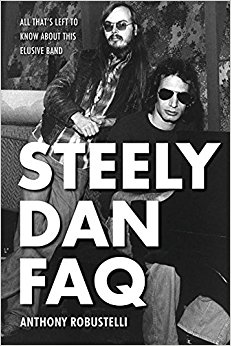
Book Review: Steely Dan FAQ by Anthony Robustelli

The general consensus seems to be that there’s relatively little published analysis of Steely’s work. But is that accurate?

Brian Sweet’s ‘Reelin’ In The Years’ was uncritical but biographically exhaustive; Don Breithaupt’s Aja book was excellent on The Dan’s musical methods; while ‘Revolution In The Head’ author Ian MacDonald wrote briefly but evocatively about Gaucho, included in his gripping ‘The People’s Music’ collection.

And then of course there are the intriguing, sometimes amusing ‘geek’ websites Fever Dreams and The Steely Dan Dictionary.

So it seems there’s actually quite a lot out there, but all the same I was intrigued when ‘Steely Dan FAQ (All That’s Left To Know About This Elusive Band)’ appeared recently. Is there anything left to ‘know’?

The first thing to say about the book is that it’s hard to know exactly which ‘frequently asked questions’ it’s answering – it’s structured more in the style of Omnibus Press’s old ‘Complete Guides’ series, with chapters on individual albums containing summaries of each song.

Then there are some extra sections dealing with Steely’s early days, their concert history, session players and solo projects. But, despite its rigid structure and a lack of any input from the two protagonists, ‘Steely FAQ’ comes up with some nice surprises.

Robustelli is particularly good on Dylan and The Beatles’ influence on Becker and Fagen’s songs. There’s the odd musical detail which hits the spot (during ‘Show Biz Kids’, I’d never noticed that guitarist Rick Derringer references Elliott Randall’s famous ‘Reelin’ In The Years’ solo after the ‘They got the Steely Dan t-shirts’ line) and there are some excellent, rare photos throughout.

Steely in all their scuzzy glory circa 1973. From left: Jim Hodder, Walter Becker, Denny Dias, Jeff ‘Skunk’ Baxter, Donald Fagen

The book is good too on the recent history of the Dan (though musically it’s an era I generally struggle with), with everything you’d ever need to know about the albums and tours since the 1990s.

There’s also a great chapter on cover versions, many of which I’d never heard (including Earl Klugh, The Pointer Sisters, Howard Jones, Dave Valentin, Grover Washington Jr. – approach them at your peril…).

On the minus side, musical/lyrical analysis is often scant and/or inaccurate – Michael Omartian’s solo piano outro on ‘Throw Back The Little Ones’ is described as ‘discordant’; the song ‘Pretzel Logic’ is summarised as ‘their first shuffle’ (what about ‘Reelin’ and ‘Bodhisattva’?) and the tutti line that kicks off ‘Parker’s Band’ is falsely characterised as a ‘dissonant chord’.

It’s weird too that Robustelli doesn’t mention the websites listed above and pretty much ignores their (sometimes) excellent lyrical analysis in his song summaries.

But, in the end, the success of such a book is measured by whether it takes you back to the music with a fresh ear; ‘Steely Dan FAQ’ certainly does that, despite its shortcomings and rather matter-of-fact style. It’s well worth chucking into your holiday bag this summer.

‘Steely Dan FAQ’ is published by Backbeat Books.