Walk Of Life (2)
Money For Nothing (4)
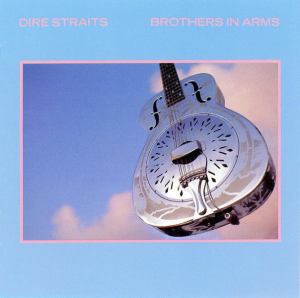
Brothers In Arms (16)
So Far Away (20)
Your Latest Trick (26)
Whilst enjoying Mark Knopfler’s considerable guitar skills and knack for writing cinematic ballads (‘Romeo And Juliet’ and ‘Private Investigations’ would probably make my top 20 songs of the ’80s), Dire Straits’ mega success has generally puzzled me.
Knopfler always seemed a Bob Dylan/Randy Newman/Donald Fagen kind of guy – subtle, intelligent and wry/wary – but Straits’ mostly meat-and-potatoes rock music told another story.
But Brothers In Arms hit at exactly the right time on its release in 1985; its digital sheen, beautifully-crafted songs, tasty drumming (Omar Hakim, except on ‘Walk Of Life’ and ‘Money For Nothing’) and mastery of various styles (ZZ Top-style boogie, roots rock, jazzy pop) created an ’80s perfect storm. It’s so much part of the furniture that it’s almost beyond criticism.
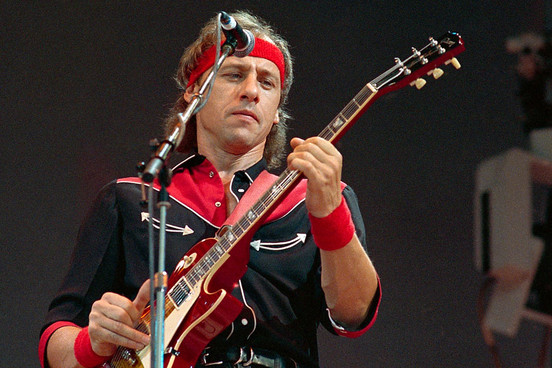
Mark Knopfler at Live Aid, 13 July 1985
Knopfler’s laidback, post-Dylan vocals are a great antidote to all those oversingers of the ’80s (and right up to the present day).
On ‘So Far Away’ and ‘Walk Of Life’, his pitching is not perfect and his phrasing throwaway, but the overall effect is pleasing possibly because it’s such a contrast to the super-slick production and playing.
And he shows himself again to be a brilliant ballad writer – ‘Your Latest Trick’ carries on from where ‘Private Dancer’ and ‘Private Investigations’ left off, a noirish classic featuring a famous sax break by Michael Brecker just as memorable as ‘Careless Whisper’ (for better or worse!).
‘Why Worry’ and the title track (apparently Knopfler’s response to the Falklands War) are timeless epics. I found myself unexpectedly very moved listening again to the latter the other day. In fact, I was surprised how generally downbeat the album was, not having heard it for a good few years.
Brothers In Arms outsold both Michael Jackson releases (Bad and Thriller) to be the UK’s best-selling non-greatest hits album of the ’80s, spending 14 weeks at number one. Surely a big reason for its success was that it was heavily promoted as a digital recording and as such was perfectly suited to the new CD format.
The fact that it was the ‘test CD of choice’ for yuppies on the lookout for new hi-fi equipment must have been a delicious irony for Knopfler and Straits manager Ed Bicknell, given the lyrics to ‘Money For Nothing’. There were even rumours that at the time other artists were struggling to get their albums pressed onto CD due to the overwhelming demand for Brothers In Arms.
In the UK, despite decent chart success (six top 40 singles), China Crisis have always had what you might call an image problem – they’ve never quite been able to shake off an almost imperceptible naffness.
Is it because of their name? Because their first hit was the extremely wimpy ‘Christian’? Because they were neither doomy enough for the post-punk crowd nor cosmopolitan enough for the New Romantics?
Or maybe because they had the dubious honour of being playlisted by Alan Partridge? (Actually, they were played by Partridge’s nemesis Dave Clifton, Ed.)
Steely Dan co-conspirator Walter Becker didn’t think they were too shabby though, apparently requesting a meeting with the Liverpudlians after he heard the nuclear-themed ‘Papua’ from their second album, 1983’s Working With Fire And Steel. He was intrigued by their obtuse lyrics, they liked the cut of his jib and apparently got on like a house on fire.
Becker signed on as producer and was summoned to Parkgate Studios near Battle, Sussex, to begin work on Flaunt The Imperfectionwhich would turn out to be CC’s biggest success to date. Flaunt reached 9 in the album chart and stayed in the UK top 100 for 22 weeks.
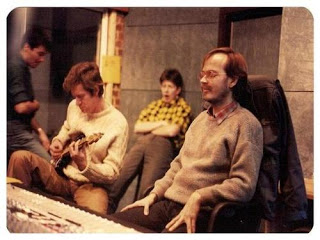
China Crisis and Walter Becker, Parkgate Studios, 1985
With the steady hand of legendary Stones/Sly/Hendrix engineer Phill Brown onboard too, the album featured two infectious top 20 UK hits, ‘Black Man Ray’ and ‘Wake Up (King In A Catholic Style)’.
Well worth checking out too is the ‘Black Man Ray’ B-side ‘Animalistic’ which shows that the lads were also flirting with a variation on Britfunk in their spare time.
Apart from the singles, there are a host of other treats on this album, not least the drumming of the late Kevin Wilkinson. He was a big drumming hero in my teenage years. He’s very close to a British Jeff Porcaro or Carlos Vega, a tasteful groovemaster with a few chops too.
Gazza Johnson’s basslines are catchy and memorable and the songwriting is solid throughout, only ‘Wall Of God’ and ‘Blue Sea’ lacking strong choruses. Then there’s Becker’s top-draw production. He ‘Fagenizes’ Gary Daly’s excellent vocals (usually double-tracked with a touch of delay) and shows off his arranging skills with subtle synth/guitar layering and brooding horns.
In particular, ‘Strength Of Character’, ‘You Did Cut Me’, ‘Bigger The Punch I’m Feeling’ and ‘Gift Of Freedom’ bear his fingerprints, the latter featuring some Gil Evans-esque woodwinds.
China Crisis followed up Flaunt with 1986’s What Price Paradise, a massive misfire wherein producers Clive Langer and Alan Winstanley inexplicably tried to turn them into Madness (If I remember rightly, the Q review of the album ended with the phrase ‘File under: Victim Of A Cruel Medical Experiment’!). But the band reunited with Walter Becker on the excellent Diary Of A Hollow Horse four years later.
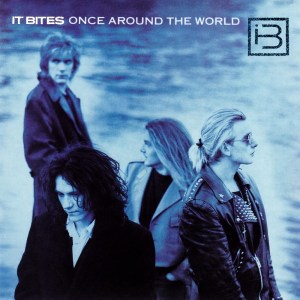
Everyone has their favourite summer music and the brilliant Once Around The World is an album I always turn to at this time of year.
It’s a feast of resplendent chord changes, audacious song structures, good grooves, blistering lead guitar lines and uplifting, unusual melodies.
As a music-mad 15-year-old, this was the album I was really waiting for. I had recently become slightly obsessed by their debut The Big Lad In The Windmill and couldn’t wait to hear what the talented Cumbrian four-piece would come up with next.
For some reason, I didn’t buy OATW on its first week of release, but my schoolmate Jem Godfrey did. I would badger him for details in the playground. Me: ‘Are there any instrumentals on it?’ Jem: ‘No.’ Me: ‘What’s it like then?’ Jem: ‘It’s bloody brilliant, just get it!’
In 1988, the world didn’t need a dose of beautifully-recorded, full-on prog lunacy, but they got it anyway and the UK music scene was all the better for it. There were murmurs of a ‘prog revival’ at the time but It Bites (and to a certain extent Marillion) were streets ahead of the pack because they blended superb musicianship with great hooks and catchy songs.
Hats off to Richard Branson and Virgin for throwing some money at this album because it turned out to be classic prog’s last hurrah. Mainly recorded at The Manor in Oxfordshire (where rumour has it singer/guitarist Francis Dunnery gained access to Richard Branson’s bountiful wine cellar on the band’s first night of recording with disastrous consequences…), OATW is essentially one side of beautifully-produced pop/rock songs (mainly helmed by Virgin prog survivor Steve Hillage), and another of completely brilliant, barmy prog/pop pieces.
The Manor
‘Midnight’ and ‘Kiss Like Judas’ are lean, mean, well-crafted pop/rock songs with good hooks and meaty grooves, but both just missed the UK Top 40.
‘Plastic Dreamer’ fits an unbelievable amount of material into its four minutes, including a vocal harmony section that would make Roy Thomas Baker drool, a stunning guitar solo from Dunnery, some spooky Alice In Wonderland atmospherics and preposterous lyrics (very much inspired by Peter Gabriel’s Genesis output).
They repeat the trick on ‘Hunting The Whale’ and make good use of the Manor swimming pool in the process. The 14-minute title track, whilst owing a few licks and lyric ideas to Genesis’s ‘Supper’s Ready’, is nevertheless astoundingly ambitious and brilliantly realised considering it was recorded in the same year as Kylie’s ‘I Should Be So Lucky’.
(There are other nods to early Genesis throughout the album: the last few minutes of ‘Old Man And The Angel’ brilliantly revisits the rhythm games of ‘The Battle Of Epping Forest’; the main hook of ‘Hunting The Whale’ is very similar to Steve Hackett’s ‘Dancing With The Moonlit Knight’ central riff; the middle-eight of ‘Midnight’ uses Tony Banks’ opening chords to ‘Watcher Of The Skies’.)
They could play all this stuff live too, and with great elan (they played the whole of OATW at the much-missed London Astoria circa May 1988, and I also caught them a few months before that at Brunel University). Their range and ability was simply stunning.
John Beck’s keyboard textures have possibly dated a bit in comparison with what, say, Trevor Horn and David Sylvian were doing with synths at the time (though his voicings and arrangement ideas are always inventive), but people often forget what an amazing rhythm section (Dick Nolan on bass, Bob Dalton on drums) It Bites had.
There’s a ‘swing’ there that suggests that they were always influenced by much more than just progressive rock, and Dunnery’s guitar playing and vocals have incredible bite. Here’s some great footage of them recording the title track:
Though It Bites were turning into a very popular live draw throughout Europe, the album stalled at #43 in the UK – a big surprise and disappointment to the band. The lads’ music subsequently took a heavier direction, but OATW is the standout in their short but excellent career, showing off a brilliant band at its peak.
I was a late starter when it comes to Prince, too young to get the sexual/spiritual absolutism of Purple Rain.
The one that really hooked me was 1986’s Parade, but these days I’d cite Around The World In A Day as my favourite Prince album.
It was released just ten months after Purple Rain, a serious statement of intent and a good indication of how prolific he was at the time.
Prince unveiled the first release on his new Paisley Park label at an uncomfortable listening party on 21 February 1985 in the LA offices of Warner Bros attended by 15 to 20 Warners executives, plus Joni Mitchell and Prince’s father, all of whom sat on the floor.
Apparently the general reaction from the suits was: how the hell are we gonna sell this?
For me, ATWIAD is prime Prince, when he was tapping into jazz, psychedelia and even classical music. But, perhaps surprisingly, the main influence is gospel.
Prince screams his way through the morality tales of ‘The Ladder’ and ‘Temptation’ with just as much intensity as Al Green, Bob Dylan or Bobby ‘Blue’ Bland.
I also hear a lot of late-’70s Joni in the more experimental tracks such as the intense ‘Temptation’ and sublime ballad ‘Condition Of The Heart’ – he’s not scared to leave a lot of space for lengthy piano and guitar improvisations. This is the first Prince album where you can add ‘arranger’ to his list of musical gifts.
Much of Around The World In A Day actually predates Purple Rain. The title track, ‘Pop Life’, ‘Temptation’ and ‘Paisley Park’ were all recorded in early ’84, while the other songs were put together during the Purple Rain tour.
While the album is credited to ‘Prince And The Revolution’, only ‘America’ and ‘The Ladder’ feature the full band. The rest is a one-man-band operation with guests here and there.
Any album which contains the classic singles ‘Paisley Park’, ‘Raspberry Beret’, ‘Pop Life’, the title track and ‘America’ has to work. Only ‘Tambourine’ now sounds suspiciously like filler, despite Prince’s spirited impersonation of Sheila E’s drum style.
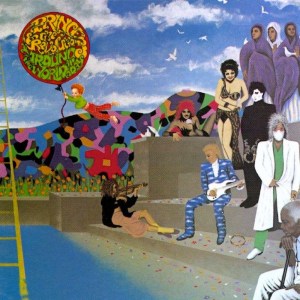
And we’ve got to mention Doug Henders’ sumptuous cover art. He explained the concept to writer Per Nilsen: ‘Most of the figures are characters in the songs, but some of the people are parts of Prince so they’re all somewhat autobiographical.’
Prince insisted on zero promotion for the album – no singles, no press or TV ads. This was totally unheard of in the mid-1980s.
Even so, Around The World In A Day went to #1 in the US album chart on 1 June 1985, just 20 weeks after Purple Rain had completed its 24-week run at the top. It eventually sold over three million copies in the US.
With Purple Rain, Prince had shown Warner Bros that he could mix it with the biggies – Springsteen, Hall and Oates, Madonna and Michael Jackson. But now he was battling to do things his way.
While this stance produced arguably his best music, it also drove a wedge between him and Warners leading up to the ‘SLAVE’ debacle of 1994/1995.
But it was also, thankfully, a battle he won, producing an astonishing output of work between Purple Rain and Batman which rivals any five-year run in pop history.
Singles Released:
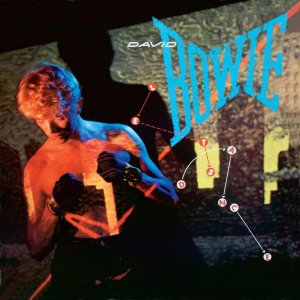
‘Let’s Dance’ (#1)
‘China Girl’ (#2)
‘Modern Love’ (#2)
‘Cat People (Putting Out Fire)’ (#26)
Bowie on Let’s Dance: ‘At the time, it was not mainstream. It was virtually a new kind of hybrid, using blues-rock guitar against a dance format. There wasn’t anything else that really quite sounded like that at the time. So it only seems commercial in hindsight because it sold so many. It was great in its way, but it put me in a real corner in that it fucked with my integrity! It was a good record, but it was only meant as a one-off project. I had every intention of continuing to do some unusual material after that. But the success of that record really forced me, in a way, to continue the beast. It was my own doing, of course, but I felt, after a few years, that I had gotten stuck…’
The ’80s were positively dripping with fine debut albums but equally cursed with a lot of substandard sophomore efforts.
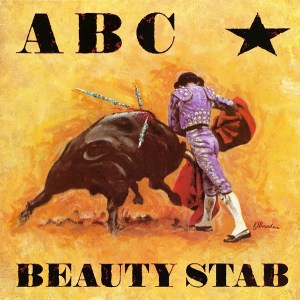
As the music biz cliché goes, you have your whole life to come up with your first album but only six months to make the followup. ABC could hardly have got it more right with their 1982 debut Lexicon Of Love, a ravishing collection of string-drenched, post-disco torch songs, but they came seriously unstuck with Beauty Stab a year later.
Seen as ‘ABC go heavy metal’ by much of the music press at the time of release, these days Beauty Stab just sounds like a pretty tuneless but beautifully-produced rock/pop album with the odd ‘political’ lyric and barmy moment thrown in (the jazz-waltz interludes in ‘Love’s A Dangerous Language’, cacophonous finale to ‘That Was Then’, atonal strings that kidnap ‘Bite The Hand’, Martin Fry’s rhyming couplets throughout…).
Though not exactly heavy metal, the guitar playing is pretty unreconstructed throughout and seems to be searching in vain for some Fripp-style insanity. And the album is thankfully graced with Roxy/Lennon/Sly drummer Andy Newmark, whose playing is lovely, especially on the very Avalonesque ‘If I Ever Thought You’d Be Lonely’. Co-producer and future Art Of Noise member Gary Langan does a great job too, in the main eschewing ‘80s production values in favour of a dry, ballsy mix and some strikingly original touches.
The problem is, for all its undoubted craftsmanship, amusing lyrics and faux grittiness, the album is short on memorable choruses. ‘Hey Citizen’, ‘King Money’ and ‘Power Of Persuasion’ have classic ABC hooks but fail to deliver catchy B-sections.
A quick survey of the track titles and it’s almost impossible to remember a chorus, save the opening ‘That Was Then…’, and that spells trouble. Unsurprisingly the album works best when the guitars simmer down a bit and Fry’s vocals take centre stage, as on ‘By Default By Design’ and fine state-of-the-nation closer ‘United Kingdom’.
Commercially, Beauty Stab was not an outright disaster, reaching #12 in the UK album chart and selling over 100,000 copies, but it was a big disappointment after such a successful debut. Acclaimed music writer Simon Reynolds even went as far as to call it ‘one of the great career-sabotage LPs in pop history’.
In late-1983, Britain was turning its back on back on guitars and kitchen-sink lyrics; glamour and fun were back in, typified by Wham!, Howard Jones, Culture Club, Spandau Ballet, Duran Duran, even Bowie – all of whom cashed in on the vibe and musical exuberance of Lexicon Of Love. At the end of the year, Fry famously burnt his gold suit in protest.
Circa 1988, my schoolmate Seb stuck a few tracks from The Flat Earth (possibly ‘Screen Kiss’ and ‘Mulu’) at the end of the Lovesexy tape he did for me.
I was smitten – I needed as much music as possible by this guy. I’ve since bought the albums several times on various formats.
On Earth, Dolby deliberately downplays the ‘zany’ image and creates an atmospheric, beautifully arranged, largely introspective collection.
He covers various styles (funk, lounge jazz, synth rock, World), mastering all with an incredible consistency of mood, production and songwriting.
My mates and I also loved his habit of incorporating seemingly-random clips of audio into/between his songs, like the spoken word outbursts from the likes of Robyn Hitchcock.
The title track came from an unused jam originally intended for Malcolm McLaren’s Trevor Horn-produced Duck Rock album. Its lilting South African melody (reminiscent of ‘Obtala’ from Duck Rock) and confessional lyrics signalled a new maturity in Dolby’s style, continuing with the majestic ‘Screen Kiss’ featuring excellent, much imitated fretless bass work from Matthew Seligman.
Techno-rocker ‘White City’ should be covered by someone. Dolby himself masters the art of the cover version with his take on Dan Hicks’s ‘I Scare Myself’ featuring a gorgeous muted trumpet solo by guitarist Kevin Armstrong who, according to Dolby’s liner notes, had never played the instrument before the recording.
And the album closer ‘Hyperactive’ (originally written for Michael Jackson, fact fans) is actually a bit out-of-place on the largely downbeat Earth but it’s a fun, funky, irresistible little pop song, perfect to send you out into the night with a smile.
Dolby is a brilliant painter of pictures with sound, relentlessly using audio fragments to augment melodic and lyrical ideas (check out the extraordinary tree-falling which pops up throughout the title track and also the typewriters which pepper ‘Dissidents’).
But these songs would also work beautifully played with just an acoustic piano accompaniment, as his recent solo tours have demonstrated.
Of course, over here in Blighty, the music press were a bit suspicious of Dolby’s technical mastery and obvious musicianship, though The Flat Earth reached a respectable #14 in the UK album chart, #35 in the US.
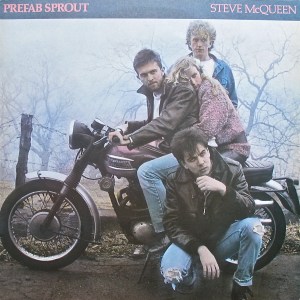
Dolby followed up The Flat Earth by playing keyboards with David Bowie at Live Aid (alongside Seligman and Armstrong), forming occasional project Dolby’s Cube with George Clinton, Lene Lovich and the Brecker Brothers and producing both Prefab Sprout’s triumphant Steve McQueen and Joni Mitchell’s underrated Dog Eat Dog.
Phonogram/Mercury Records, released 25 February 1985
Recorded at The Wool Hall, Beckington, Somerset, and the Hammersmith Odeon, London
Produced by Chris Hughes
Peaked at #2 in the UK album chart
Remained in the UK Top 10 for over six months and the Top 40 for over a year
Reached #1 in the US album charts
Bassist/singer/co-writer Curt Smith explained the album’s title in a 1985 interview:
“The title was my idea. It’s a bit perverse but then you’ve got to understand our sense of humour. The ‘Big Chair’ idea is from this brilliant film called Sybil about a girl with 16 different personalities. She’d been tortured incredibly by her mother as a child and the only place she felt safe, the only time she could really be herself was when she was sitting in her analyst’s chair. She felt safe, comfortable and wasn’t using her different faces as a defence. It’s kind of an ‘up yours’ to the English music press who really fucked us up for a while. This is us now – and they can’t get at us anymore…”
In the slipstream of Live Aid, when Stock, Aitken and Waterman ruled the charts, house and techno were warming up and ‘indie’ (Housemartins, Smiths, Cure) was thriving, this gifted pop/prog four-piece from Cumbria crept under the radar and even managed to secure a big hit with their second single ‘Calling All The Heroes’.
It Bites blended their influences – Gabriel-era Genesis, Weather Report, Yes, Japan, Level 42, Steve Arrington, George Benson – superbly, creating an excellent debut and minor hit album.
My mate Nige and I loved The Big Lad. The soundtrack to our after-school games of pool would either be Sting’s Bring On The Night or this, and I quickly grew to love its pristine production, challenging song structures, brilliant guitar playing and cool chord sequences.
As a teenager, I’d listen to it on my Walkman very loudly while studying David O’Connor’s superb, enigmatic cover art or reading Stephen King’s Christine… What larks.
Singer/guitarist Francis Dunnery once labelled The Big Lad ‘nutter’s music’, an apt description when you listen to songs like ‘Turn Me Loose’ and ‘I Got You’ which are almost pop but then pull the carpet from under your feet with bizarre, brilliant, extravagant middle sections and Dunnery’s off-mic vocal histrionics.
Producer Alan Shacklock – once the guitarist in Babe Ruth and future helmer of Chesney Hawkes’ ‘The One And Only’ – delivers a vibrant, state-of-the-’80s sound, with huge, gated drums and punchy bass.
It Bites’ early career as a souped-up pop covers band served them well – melody and groove are their priorities, and of course they were always a superb live act too.
Dunnery was (and is) also a very underrated Brit guitar hero whose playing could consistently deliver the sound of surprise with fluid legato, furious speed picking, dissonant intervals and whammy-bar abandon.
His solo on ‘You’ll Never Go To Heaven’ is a thrilling marriage of Allan Holdsworth and John McLaughlin and one of the great bits of over-the-top playing in Brit Rock.
He also delivered marvellously insane breaks on the Michael Jackson-meets-Duran Duran ‘Wanna Shout’ and barmy soft-rock ballad ‘Cold, Tired and Hungry’. Also worth checking out is B-side ‘Strange But True’ which, in its full version, becomes a vehicle for Dunnery’s increasingly demented solos.
‘Calling All The Heroes’ is actually a pretty good distillation of It Bites’ sound with Bob Dalton’s ingenious ‘reverse’ tom fills, Dunnery’s excellent melodies, John Beck’s intricate keyboards and Dick Nolan’s super-tight bass playing.
It was their only big hit though; other singles ‘All In Red’ and ‘Whole New World’ were catchy pop tunes with interesting instrumental flourishes and inventive vocal harmonies but neither troubled the charts.
The music magazines of the time generally ignored It Bites. If they did get a mention, it was generally to mock their unfashionably-superb musicianship or lack of London street-cred.
I remember Dunnery making an emotional pre-song announcement onstage at a London Astoria gig in 1988 lambasting the ‘trendy’ music press.
The Big Lad wasn’t a huge hit but did just well enough, peaking at #35 in the UK. It Bites were up and running and their best was yet to come.
Hardcore fans alert: a very nice person has posted all the Big Lad demos on YouTube.
I came across a review of Meet Danny Wilson in Q magazine which drew comparisons between Gary Clark’s voice and Donald Fagen of Steely Dan’s (spot-on).
That was enough incentive for a massive Steely fan like me to check it out. I wasn’t disappointed. Meet Danny is one of the most arresting, original debut albums of the ’80s, and it stands up extremely well today.
I would annoy my school friends bigging up the album and trying to get it played during art lessons – to no avail. U2, Simple Minds, The The, Fleetwood Mac and INXS couldn’t be usurped. But my enthusiasm was slightly justified when the gorgeous ‘Mary’s Prayer’ was finally a big hit at the third attempt (UK number 3, US number 23).
Danny Wilson shared a love of jazz, the Great American Songbook and Steely Dan with contemporaries Hue and Cry, Swing Out Sister, Sade and various other late-’80s acts, but (fortunately?) Meet Danny Wilson doesn’t sound remotely like any of them.
Gary graciously answered my questions in the middle of a very busy period of travelling, writing and recording. We talked about the inspiration behind the timeless ‘Mary’s Prayer’ single, hanging out with Billy Mackenzie, the golden age of Virgin Records and busking on transatlantic flights…
MP: Could you give a quick summary of how you started making music as Danny Wilson with your brother Kit (keyboards) and Ged Grimes (bass)?
GC: Ged was at school with me and clearly one of the most talented kids so we naturally gravitated towards each other and stayed together from the school band stage all the way through to Danny Wilson. Kit is my younger brother. When Ged and I returned from London we wanted to re-think the band and Kit, in our absence, had grown into a formidable musician, writer and singer so he was a natural choice to bring onboard.
What were the musical influences that went into the pot for Meet Danny Wilson? Any contemporary mid-’80s artists?
Well, I really found my voice as a writer when I stopped trying to sound contemporary. Ged and I spent three years in London living in a squat, gigging and trying to get a record deal and it seemed like the labels wanted us to sound like what was already on the radio at that time. If you can remember radio in 1984/85, everything was super- polished, super-quantised and very synthesised. Even guitars all tended to be layered in multi-effects. I very consciously decided to go in the opposite direction and return to my musical roots; all the music I loved was devastatingly unfashionable at the time. Off the top of my head, the main influences for that album were not contemporary at all: Sinatra, Bacharach and David, Jimmy Webb, Becker and Fagen, Tom Waits, a little bit of Hall and Oates, heavy dollops of the Great American Songbook and a ton of soundtrack records.
How did Danny write songs? Were all the tracks co-written or did you provide the blueprints?
I wrote all of the songs on that album and they were all written and mostly demoed prior to recording. The only exception I recall is finishing ‘Five Friendly Aliens’ at the piano in Puk studios after we’d started recording the rest of the album.
How did you come to be signed to Virgin? Were you fans of the label beforehand?
We played a gig in a bar in Edinburgh and a music journalist called Bob Flynn was there. He wrote a review in NME that literally changed our lives. The review was so good and the band were so unknown that the record labels who had systematically rejected us only months before were calling Bob asking how they could get in touch with the band. We had really served our time in the trenches live and in the studio so we were really ready for it when it came. The next gig we did in Edinburgh was packed and half of the audience were A&R and publishers from London. We literally had the choice of every major label and almost signed to Warners. In the end, a mixture of Virgin’s reputation as an artistic label, their sheer passion for the music and their willingness to give us complete artistic control won the day.
Can you remember your inspiration for ‘Mary’s Prayer’ and where you wrote it?
Yes, I wrote it in the squat in London quite a few years before it was released. My friend, the songwriter Ali Thomson, loaned me a Roland Juno 60 synth and I just switched on the first preset and immediately played the verse chords without thinking (they’re all white notes!). The melody and a large chunk of the first verse lyric came to me instantly. I liked it but couldn’t get a chorus that did the verse justice and it took about another year of me coming back to it until I finally hit on the chorus.
How did you come to include Lester Bowie’s Brass Fantasy on the album? Definitely not an obvious choice of special guests! Weren’t they signed to Virgin at the time?
They were signed to ECM. The Virgin connection came later through us. Howard Gray (later of Apollo 440) was producing the first half of our album at Puk. They had an incredible system in there and we liked to blast records on the big speakers at the start of the day and at the end of the night with some fine Elephant beers for refreshment. Digital was in its infancy and ECM were making some of the first records that could be legally labelled ‘DDD’ which meant ‘recorded, mixed and mastered without leaving the digital domain’. Howard played us Lester’s ‘I Only Have Eyes For You’ one of those nights as an example of how great this process could sound and we all fell instantly head over heels in love. By sheer mind-bending coincidence, we saw that Lester Bowie’s Brass Fantasy were playing Copenhagen when we were still in Denmark. We went to the gig, one of the greatest live shows I have ever seen, and accosted Lester afterwards. It’s a little-known fact that because of budget restrictions, Ged, Kit and I busked our fare on a very early Virgin Atlantic flight to New York so we could be there for the sessions! Pre-9/11, of course… But we actually got free flights for entertaining the passengers in mid-air.
Your amazing vocal on ‘You Remain An Angel’ always reminded me of The Associates’ Billy Mackenzie – were you a fan and did you know him at all?
Well, thank you. I’m a huge fan of Billy’s work but I can honestly say that The Associates were nowhere near my mind when we did that song. There is a B-side called ‘Living To Learn‘ that has a huge Associates influence. Billy and I are from the same home town, Dundee in Scotland, and I got to know him a little. We would all hang out at a place called Fat Sam’s cocktail bar where they played great music and had great live acts passing through. We saw some amazing bands in their infancy back then. Billy was always so wonderful, charming and encouraging to me.
Meet Danny Wilson has a really pleasing mix of acoustic instrumentation and late-’80s technology – was there any pressure to be ‘produced’ and make a very modern-sounding record? I have a B-side version of ‘Aberdeen’ that was subtitled something like ‘The Way It Should Have Been‘…
No. Virgin were great like that. I think they understood that we had just as much chance commercially by being true to ourselves as we would have had conforming to some blueprint of what radio sounds like. I wish that vision was more prevalent in the music business today. I will say that although we used the most up-to-date technology available at the time, we didn’t use it to sound modern but to get what was in our heads onto the recording. On ‘Aberdeen’, for instance, we used a Fairlight to get the trumpet and string sounds but the production is probably more ’60s in tone than ’80s. That B-side was an interesting one; we had made a very early stripped back Portastudio demo of that song before the album and it had a certain beatboxy charm that we all kind of harked back to. The tape was lost so that B-side was our attempt to recreate that vibe. Never a great idea!
How do you feel about Meet Danny Wilson and its place in the 1980s musical landscape now?
I feel pretty much the same as at the time. It’s very me, very honest, very heartfelt and, just like me, doesn’t fit in anywhere. Exactly what we were going for, I suppose.
What are you working on at the moment?
I’m always writing and recording with other artists. That’s what I do these days and have a whole heap of stuff in the pipeline but aside from that I’ve just written the music with John Carney (Once, Begin Again) for his next movie (‘Sing Street’) which I’m very, very excited about. As it happens, he got in touch with me because Meet Danny Wilson was a record his brother had turned him onto as a young kid growing up in Dublin in the ’80s. That neatly brings this interview to a lovely, rounded conclusion so I’d better shut up now!