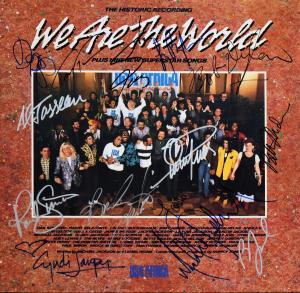
USA For Africa: We Are The World @ 40

Released 40 years ago this month and officially the fastest-selling single in American music history, USA For Africa’s ‘We Are The World’ shifted over 20 million copies and raised a huge amount of money for African famine relief.

Co-written by Michael Jackson and Lionel Richie during a few sessions at the former’s house in Encino, the song divides opinion but only the hardest heart could fail to be moved by its recording (even if one can definitely feel the vibe of some major agent/star power – no arriving in the manager’s battered old car for this lot…).

It brought together a fairly astonishing cast list of the great and good. And, inadvertently, it also arguably represented a last gasp for classic 1980s R’n’B and yacht rock.

The basic track was recorded at Kenny Rogers’ Lion Share Studios on 22 January 1985 with king-of-the-cross-stick John ‘JR’ Robinson on drums, bassist Louis Johnson and pianist Greg Phillinganes, closely monitored by a huge press corps, co-producers Quincy Jones and Michael Omartian and engineer Humberto Gatica. According to Robinson, all the musicians were sight-reading a chart and a click track was used, and they didn’t do more than two takes.

A few days later, Lionel sat down with Quincy and vocal arranger Tom Bahler to prep who would sing which lines (the decision was also made to mainly record vocals live and ‘in the round’ with no or at least very few ‘punch-ins’, unlike ‘Do They Know It’s Christmas’). All the major vocalists were then sent a copy of the basic track featuring Jackson’s guide vocal and with an enclosed letter from Lionel.

The featured singers then assembled at A&M Studios at around 9pm on Monday 28 January, most arriving after the American Music Awards (which Richie hosted). Notable absentees: Madonna (who was apparently bumped in favour of Cyndi Lauper), Prince (check out Duane Tudahl’s superb book for the details), George Benson, Dolly Parton, Donna Summer, Michael McDonald, Pat Benatar, Rod Temperton, Stevie Nicks, Joni Mitchell, Billy Idol? And is it odd that Smokey Robinson didn’t sing a solo line?

The complete footage of the recording session is still fascinating. We see how some of the biggest names in music history found different ways of preparing. Steve Perry waits for his line with eyes shut, looking down, listening intently. Diana Ross does just the opposite.

Bob Geldof gives a stirring pep talk and Stevie Wonder brings in two Ethiopian women to address the singers, moving many to tears. It’s hard not to be touched by Stevie, Kenny Rogers, Dionne Warwick, Diana, Steve Perry, Ray Charles and Cyndi Lauper’s vocals. But Harry Belafonte, Ray Charles, Bob Dylan and Bruce Springsteen seem to get the most respect from the assembled stars.

Other observations: Brucie – who had finished the latest leg of the Born In The USA tour the night before – looking like Judd Nelson in ‘The Breakfast Club’. Al Jarreau struggling throughout. Lionel the team player. Stevie giggling like a naughty schoolkid when Quincy gets annoyed. James Ingram hiding behind Kenny Rogers after a boo-boo.

Paul Simon twice saying to Rogers: ‘Can I help?’ Lauper sharing vocal tips with Kim Carnes. MJ holding hands with Diana and Stevie. Quincy and Stevie rehearsing with Bob Dylan. Stevie and Ray Charles using their braille machine. Quincy reading the score as he conducts the soloists, and his witty asides: ‘Who you gonna call?’ etc.

It looks like they recorded the first half of the song first (up to and including Daryl Hall) and then spent some time on the middle eight with Huey Lewis, Lauper and Carnes.

How does it sound now? Phillinganes’ piano playing is a pleasure to hear, typically tasty and gospel-inflected. But the track is inundated with synths – no less than four players are credited, including David Paich and Steve Porcaro from Toto – and probably why it reminded many of a Pepsi ad.

And it’s odd that the song features no guitar, though Prince offered to play a solo – Quincy reportedly told Prince’s manager Bob Cavallo: ‘I don’t need him to play guitar, we got f*ckin’ guitars’!

Book Review: Le Freak by Nile Rodgers

One of the few musical blessings of the last decade was Nile Rodgers’ career reinvention.

But the future had looked pretty bleak at the outset of 2010, with serious illness virtually putting paid to his live career and no new studio product in sight.

Then of course there was a well-received guest spot on Daft Punk’s ‘Get Lucky’ and a glorious concert reboot of the Chic brand, which went from strength to strength as the decade progressed.

So it seems a good time to revisit ‘Le Freak’, Nile’s 2011 memoir (and it accords nicely with my current early-’80s NYC obsession).

The focus on gigging during the last decade has been a distinct volte face for a guitarist/songwriter/producer best known for his studio work with Chic, Diana Ross, Madonna, David Bowie, Sister Sledge, Johnny Mathis and Al Jarreau.

Chic were to disco what Steely Dan were to rock, bringing jazz chords, complex arrangements and subtly subversive lyrics to the top of the charts, but it’s easy to forget how out of fashion they were in the early ’80s, as ‘Le Freak‘ grippingly outlines.

But it’s also that rare thing for a music memoir, arguably at its best when it steers away from the music. Rodgers was born to a 14-year-old jazz-loving mother in late-1950s New York City, and his early life was a jaw-dropping sequence of underage sex, drug addiction and bohemian excess on all levels.

His stepfather Bobby, a heroin-addicted beatnik, nicknamed the asthmatic Rodgers ‘Pud’, short for ‘pudding pie’, and used to reprimand him thus: ‘Pud. Dig yourself.’

Soon, both parents were junkies, and Rodgers turned to TV, movies, truancy and illicit substances, finding his own brotherhood of Puerto Ricans and Italians in Greenwich Village. Rodgers brilliantly captures the flavour of this bohemian underground and black music scene that flourished in the big cities of the US in the ‘60s.

There are tales of studying jazz harmony with legendary pianist Dr Billy Taylor, an early gig with the ‘Sesame Street’ house band and notable cameos from Thelonious Monk, Lenny Bruce, Timothy Leary and Jimi Hendrix. Later his Harlem Apollo debut sees Rodgers being chased around the stage by a crazed Screamin’ Jay Hawkins.

With musical soulmate, bassist Bernard Edwards, he toured the Chitlin’ Circuit playing the soul, jazz and R’n’B hits of the day, returning to New York to see that dance culture was taking over.

Their Big Apple Band quickly became Chic, a black fusion of Roxy Music and KISS, and although Chic quickly became synonymous with the disco movement, their roots in jazz, rock and R’n’B and desire to always include a Deep Hidden Meaning (or DHM) in their lyrics always kept them at some remove from the likes of the Bee Gees.

But things take a turn for the worse when the scene that embraced Chic suddenly implodes and gives way to New Wave, and Nile is brutally candid about his embarrassment that his band (and first solo album) can’t get arrested. Not in David Bowie’s opinion, though, and the extended riff on the making of Let’s Dance is essential reading for any fan of that album.

The passage on the passing of his musical brother Edwards while on tour with a reformed Chic is also moving and perfectly judged, encapsulating Rodgers’ philosophy of music and life.

All in all, ‘Le Freak’ is a fast-moving, well-written, original account of the life of a self-confessed ‘half-hippie, half Black Panther’, and a must for anyone with even a passing interest in black music over the last 50 years.

Rodgers has also intimated that there may be a second volume on the way – yes please. Grace Jones, Mick Jagger, Paul Simon, Jarreau, Mariah Carey, Robert Plant, the B-52s and David Lee Roth are only mentioned in passing, and it would be good to get the full story of Chic’s live renaissance.

Moonlighting: Cybill Shepherd, Bruce Willis & Al Jarreau

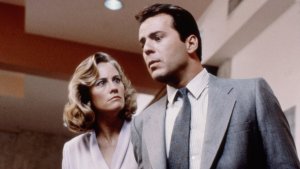
Bruce Willis as David Addison, Cybill Shepherd as Maddie Hayes in ‘Moonlighting’

What music delivers a headrush of nostalgia, makes you feel everything’s for the best in this best of all possible worlds and we’re not all going to hell in a handbasket?

For me, it’s the short reprise of the ‘Moonlighting’ theme that used to play over the end credits, featuring Toots Thielemans’ (citation needed… Ed.) harmonica swooping gorgeously over swooning strings.

It shouldn’t be any surprise that Lee Holdridge’s title song (with lyrics added later by Al Jarreau) was reminiscent of an old standard in the Porter/ Gershwin mould. After all, the TV show, which ran in the States and on the BBC from 1985 to 1989, most assuredly harked back to the romantic comedies and private-eye noirs of the ’30s and ’40s.

Co-star Cybill Shepherd, upon reading the script for the pilot episode, apparently called it a ‘Hawksian comedy’ (as in ‘Bringing Up Baby’/’His Girl Friday’ director/writer Howard Hawks), an influence of which creator/co-writer Glenn Gordon Caron was fairly unaware. He had instead been focusing his energies on lampooning the in-vogue detective shows of the early ’80s, one of which (‘Remington Steele’) he’d helped usher into existence.

‘Moonlighting’ made a star out of Bruce Willis and reignited Cybill Shepherd’s career, though she was apparently an exceptionally reluctant contributor and not a huge fan of her male co-star.

For the part of David Addison, Willis apparently had to audition not once but 11 times, and even then almost lost the role until a lone female NBC executive said (in front of a cadre of other male execs): ‘He looks like a dangerous f*ck’!

I was hooked on ‘Moonlighting’ in the mid-’80s, helped no doubt by a teenage crush on Shepherd. I watched two eps again recently – the pilot, which seemed overlong and clunky, and the absolutely superb ‘A Womb With A View’, the big-budget Season 5 curtain-raiser first transmitted in December 1988.

Gleefully jumping the shark, it has an exuberant, self-referential song-and-dance number (‘A chance for critics to scoff and sneer’), a chubby Willis in a diaper playing Shepherd’s unborn child, and some startling, creative visuals.

It also brought home how the show always assumed the audience was smart, rather than most modern TV which assumes it’s dumb. And the production values were super high, even though the pressure was on – they had to make around 17 x 50-minute episodes per season.

But back to the music. I’m partial to the original version of the theme song with its cool rhythm guitars and JR Robinson drums, but not so keen on Al’s re-recording with producer Nile Rodgers which – rather incredibly – made the UK top 10.

The Curse Of 1986?

The critical consensus: 1986 was the worst music year of the decade, perhaps of any decade. But is that true?

There was certainly a vacuum between the end of New Pop/New Romanticism and the Rock Revival of ’87.

Add in the one-hit-wonder merchants, TV soap actors, Europop poseurs, musical-theatre prima donnas, jazz puritans and Stock Aitken & Waterman puppets who hit paydirt towards the end of the decade.

Also most pop records just didn’t sound good. The drums were too loud, the synths were garish, ‘slickness’ was the order of the day. Perhaps nothing emphasised these factors as much as The Police’s disastrous comeback version of ‘Don’t Stand So Close To Me’.

But listen a little harder and 1986 seems like a watershed year for soul, house, go-go, art-metal, John Peel-endorsed indie and hip-hop. Synth-pop duos were back on the map, the NME C86 compilation was a lo-fi classic and there were a handful of groundbreaking jazz/rock albums too.

So here’s a case for the opposition: a selection of classic singles and albums from 1986. Not a bad year after all…

Paul Simon: Graceland

Stump: Quirk Out

David Bowie: ‘Absolute Beginners’

Mantronix: Music Madness

PiL: Album

Rosie Vela: ‘Magic Smile’

George Michael: ‘A Different Corner’

Eurythmics: ‘Thorn In My Side’

Al Jarreau: L Is For Lover

XTC: Skylarking

Duran Duran: ‘Skin Trade’

George Benson: ‘Shiver’

Erasure: ‘Sometimes’

Cameo: ‘Candy’

Chris Rea: On The Beach

Europe: ‘The Final Countdown’

David Sylvian: Gone To Earth

OMD: ‘Forever Live And Die’

The Real Roxanne: ‘Bang Zoom’

The The: Infected

Half Man Half Biscuit: ‘Dickie Davies Eyes’

Anita Baker: Rapture

Michael McDonald: ‘Sweet Freedom’

Prince: Parade

Talk Talk: The Colour Of Spring

Luther Vandross: Give Me The Reason

Pet Shop Boys: ‘Suburbia’

Chaka Khan: ‘Love Of A Lifetime’

Gabriel Yared: Betty Blue Original Soundtrack

The Pretenders: ‘Don’t Get Me Wrong’

Janet Jackson: Control

Run DMC: Raising Hell

Beastie Boys: Licensed To Ill

Miles Davis: Tutu

Iggy Pop: Blah Blah Blah

Courtney Pine: Journey To The Urge Within

George Clinton: ‘Do Fries Go With That Shake’

Talking Heads: ‘Wild Wild Life’

Kurtis Blow/Trouble Funk: ‘I’m Chillin”

The Source ft. Candi Staton: ‘You Got The Love’

Gwen Guthrie: ‘Ain’t Nothing Going On But The Rent’

The Housemartins: ‘Happy Hour’

Peter Gabriel: So

Mike Stern: Upside Downside

Steps Ahead: Magnetic

It Bites: The Big Lad In The Windmill

Memorable Gigs Of The 1980s (Part Two)

Check out the first selection of memorable gigs here.

9. David Sanborn Band/Al Jarreau @ Wembley Arena, November 1984
We were sitting high up behind the stage with a great view of two of the great modern American drummers: Steve Gadd (with Sanborn) and Ricky Lawson (with Jarreau). To be honest, my parents and I left in the middle of Al’s set but Sanborn was fantastic with Marcus Miller and Hiram Bullock running amok on the huge Arena stage. The saxophonist was at his commercial peak here and probably could have headlined the show.

8. Marc Almond @ The London Palladium, 12 October 1986
I have no idea why I was at this gig but it was a genuine eye-opener. Almond was long past his pop fame and seemed to be acting out his own private, Berlin-inspired drama. Looking at the footage today, I’m still not sure if it’s brilliant or total sh*te.

7. Miles Davis @ Hammersmith Odeon, 21 April 1982
I remember someone shouting ‘Turn the guitar down!’ Poor Mike Stern wasn’t the critics’ flavour of the month and Miles was obviously exceptionally ill, but the gig was unforgettable. One of my first and very best. I saw Miles three or four times during the ’80s but this was the bomb for sheer atmosphere and occasion.

6. Robert Palmer @ Hammersmith Odeon, 25 September 1988
There really isn’t anyone around these days like the much-missed Robert with his gravelly voice, weirdly cosmopolitan compositions and ever-present smirk. He had a highly-drilled, sh*t-hot band with him at the Hammie Odeon too featuring Frank Blair on bass and Eddie Martinez on guitar. The gig started with a five-minute Dony Wynn drum solo which fair blew the minds of my brother and I.

5. Yes/No People @ Limelight, 9 September 1986
I think this gig was part of what was then known as the Soho Jazz Festival. There was a lively crowd of ‘jazz revival’ hipsters and rare-groove fans – this was my first taste of an underground scene that was quickly building momentum. DJ Baz Fe Jazz kicked off with some Blue Note post-bop (yes, people actually danced to that stuff) and then Yes/No People featured Steve Williamson on sax and the cracking Mondesir brothers (Mark and Mike) rhythm section. The band only lasted a year or so but nearly dented the charts with their ‘Mr Johnson’ single.

4. John McLaughlin/Mahavishnu Orchestra @ Hammersmith Odeon, 12 July 1984
The sign on the door said ‘Billy Cobham will not be appearing’ – heartbreaking to me at the time (McLaughlin apparently dumped Billy just a week before the tour). But Danny Gottlieb sat in with some style and John rattled off some outstanding licks in black shirt and black headband. It was bloody loud too. It was the first time many British fans had seen him since Mahavishnu Mark 1 days and as such there was a big hippie turnout.

3. Bill Withers @ Hammersmith Odeon, 18 September 1988
From memory, Bill spent most of the gig sitting at the front of the stage, talking about his life and career while Pieces Of A Dream accompanied with gentle jazz/funk. Bill wore a sweater and golfing slacks and seemed incredibly old, more Val Doonican than Sly Stone.

2. Weather Report @ Dominion Theatre, 26 June 1984
The duels between keys man Zawinul and drummer Omar Hakim were spellbinding. This was clearly the dog’s b*ll*cks. Well, it was better than Duran Duran anyway. Omar’s huge shades, trash-can cymbal and big grin linger in the memory.

1. Level 42 @ Wembley Arena, 12 January 1989
Level again, but this time for all the wrong reasons. We were in the back row of the dreaded Arena, and the band were flogging their substandard Staring At The Sun album. The audience reaction to the ‘new stuff’ was distinctly subdued. After a contractually-obliged encore of ‘The Chinese Way’, Mark King returned to the stage alone. ‘You ‘ad a good night?’ he bawled. The audience erupted. ‘Well, you can all go and f**k off home then’, deadpanned the thunder-thumbed one. Reply – and further encore – came there none…

Bubbling under:

Mike Stern/Bob Berg Band @ Town & Country Club, November 1989

Will Downing @ Hammersmith Odeon, 20 November 1988

Coltrane Legacy (Alice/Ravi Coltrane, Reggie Workman, Rashid Ali) @ Logan Hall, 10 July 1987

Ry Cooder @ Hammersmith Odeon, 27 May 1982

Bill Frisell @ Town & Country Club, 24 April 1989

Ornette Coleman/Prime Time @ Town & Country Club, 28 August 1988

Were you at any of these concerts? Let us know your memories.

The Wackiest Guitar Solos Of The 1980s

eddie_van_halen_at_the_new_haven_coliseum_2Pop music has always featured its fair share of brilliantly ‘inappropriate’ instrumental solos, from the (uncredited) honking tenor break on Frankie Lymon & The Teenagers’ ‘Why Do Fools Fall In Love’ and Tony Peluso’s brilliant fuzz-guitar feature on The Carpenters’ ‘Goodbye To Love’ to Jeff ‘Skunk’ Baxter’s unreconstructed rampage through Donna Summer’s ‘Hot Stuff’.
And then of course there are the jazz solos that occasionally enhance ‘pop’ material – Sonny Rollins lighting up the Stones’ ‘Waiting On A Friend’, Ronnie Ross’s memorable break on Lou Reed’s ‘Walk On The Wild Side’ and Phil Woods/Wayne Shorter/Pete Christlieb’s tasty leads on some of Steely Dan’s best work.

In the ’80s, there was a lot of demand for the wacky solo, often thrown in to pep up some pretty light/fairly inconsequential material. One in particular really set the benchmark for the decade, and it’s naturally where we start our rundown…

6. Michael Jackson – ‘Beat It’ (Solo by Eddie Van Halen)
Eddie’s shock-and-awe break was a perfect distillation of all his trademark techniques: lightning-fast picking, close-interval tapping routines, whammy-bar divebombs and even a cheeky Jimi Hendrix ‘All Along The Watchtower’ homage.

5. Michael Sembello – ‘Maniac’ (1983)
Sembello, hitherto best known as a very able jazz/R’n’B session player for the likes of Stevie Wonder, David Sanborn and George Duke, unleashed this overblown post-‘Beat It’ solo (starting at 2:50) which sounds like it belongs to a completely different song. Maybe he should have stuck to the jazz and R’n’B…

4. Bros – ‘Chocolate Box’ (Solo by Paul Gendler)
Gendler was a respected UK-based session player (and member of Modern Romance!) before getting the call from the Goss boys. He tosses off a Francis Dunnery-esque, way-too-good-for-the-charts solo at 2:40 on this wafer-thin but very catchy single.

3. Europe – ‘The Final Countdown’ (Solo by John Norum)
This song is obviously crying out for a widdly guitar solo, but Norum’s brilliant Malmsteen-esque playing goes beyond the call of duty even by the standards of a mid-’80s hair-metal band.

2. Al Jarreau – ‘Telepathy’ (Solo by Nile Rodgers)
Nicely set up by Steve Ferrone’s wrongfooting half-bar drum fill, Nile plays all the notes he knows and a few more too in this seriously weird but rather brilliant harmonized/double-tracked break (starting at 2:05) from the L Is For Lover album.

1. Allan Holdsworth – ‘In The Mystery’ (1985)
Jazz/rock guitar genius Holdsworth inexplicably saved some of his wackiest solos for vocal-based, ‘commercial’ material. This one is fairly astonishing and, arguably, totally wasted on the song… (Bassist Jimmy Johnson also deserves a mention for his frenetic, Red-Bull-sponsored performance.)

Kelis, Al Jarreau, Michael Gregory Jackson & ‘Blurred Lines’: Does Pharrell Have Form?

KelisSo it’s official – Pharrell Williams and Robin Thicke ripped off Marvin’s ‘Got To Give It Up’ when they wrote ‘Blurred Lines’ in just one hour (though Thicke denies having any input into the writing of the song).

And The Guardian reports that Pharrell’s ‘Happy’ may now be in the Gaye family’s sights too due to its alleged similarity to ‘Ain’t That Peculiar’.

Trumpet player, composer and blogger Nicholas Payton has also written eloquently and passionately about the whys and wherefores of the ‘Blurred Lines’ case.

But maybe all of this shouldn’t be surprising – Pharrell seems to have previous. Let’s investigate the track ‘Roller Rink’ from Kelis’s 1999 album Kaleidoscope which, according to the credits, was co-written by Pharrell, Chad Hugo and Kelis:

Now compare that with ‘No Ordinary Romance’, credited to Michael Gregory, which features on his 1983 album Situation-X and also Al Jarreau’s L Is For Lover from 1986, both produced by Nile Rodgers:

Kelis/Pharrell/Chad haven’t even bothered to change key. They’ve just ‘replayed’ Gregory’s original. Their version arguably comes up a better top-line melody in the verses, but the chorus just lifts the catchy synth motif from both the Gregory and Jarreau versions.

Michael+Gregory+Jackson+michaelgregory2

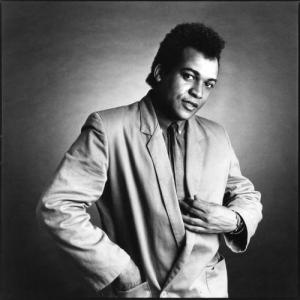
Michael Gregory Jackson circa 1983

Michael Gregory Jackson was a first-call guitarist in the New York avant-garde jazz scene during the mid-’70s. Later in the decade, he reinvented himself as a singer-songwriter and did a pretty job of it, his 1987 solo album What To Where (sadly not currently available on streaming platforms) getting rave reviews in Q Magazine and a few other influential rags at the time.

My 1999 Kaleidoscope CD credits state that ‘Roller Rink’ was ‘written by K Rogers/P Williams/C Hugo’, with no mention of Gregory Jackson’s name or sample permissions etc. So one wonders how much publishing income he has been denied, though Kaleidoscope wasn’t a huge hit album and ‘Roller Rink’ wasn’t released as a single.

We continue to follow this story with great interest.

(Update, May 2023: Michael Gregory Jackson has written his own article in response to the above – read it here.)