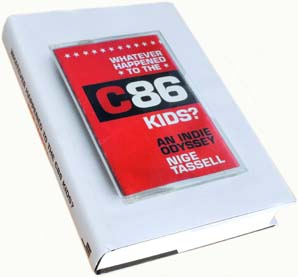
Book Review: Whatever Happened To The C86 Kids? by Nige Tassell

In 1986, legendary mag NME issued a famous cassette compilation called C86.

Arguably it defined a musical generation, bringing together figureheads of the burgeoning British indie scene from Primal Scream to Bogshed, Stump to The Pastels.

The NME’s timing could hardly have been better – in 1986, ‘indie’ music was beginning to get a sound of its own, John Peel was entering his imperial phase as a Radio 1 presenter, the music press was right on board and independent labels were springing up all over the shop.

The cassette had a huge impact, but did it have an impact on the bands? And what are they up to these days? Nigel Tassell’s hugely enjoyable book tracks them all down and hears their stories.

Some, like Half Man Half Biscuit, The Wedding Present, Primal Scream and Fuzzbox are still going strong, others, like The Soup Dragons and The Bodines burnt brightly for a few years. Other band members ended up as social workers, bike shop owners, solicitors, driving instructors.

The result is a friendly, mostly uplifting tome, a bit like one of those old VH1 ‘Bands Reunited’ shows in book form. A few themes emerge: the major labels sniffing around; Peel Sessions; the ‘name’ producer enlisted for that unsuccessful second album; Alan McGee/Creation Records.

But this is not a tale of rampant egos and prima donnas – it’s all refreshingly low-key (with the possible exception of the chapter on Primal Scream) with a side order of provincial British history too.

Like or loathe the music on C86, this book also perfectly captures the never-to-be-repeated thrill of first getting together in the teenage bedroom and trying to write and rehearse songs. Inadvertently, it’s also a sad comment on the loss of music in pubs and clubs across this isle of noises.

Tassell’s brisk, chatty style may divide opinion, but it’s entirely appropriate for a mostly heartwarming companion piece to Giles Smith’s ‘Lost In Music’ and Nick Duerden’s ‘Exit Stage Left’, outlining the pros and cons of youthful musical obsession. Highly recommended.

Tassell discusses ‘Whatever Happened To The C86 Kids’ in this interview.

The Movers & Shakers Of 1980s Music: Their Real Names Revealed

Captain Sensible, AKA…

During the punk era, musicians often chose stage names so that the dole office wouldn’t identify them from album covers or gigs.

One wonders how much of an issue that was for Gordon Sumner, Paul Hewson and David Evans, AKA Sting, Bono and The Edge, but you never know.

But as the 1980s wore on and the post-punk era became the hip-hop era, a whole new generation of rappers, DJs, producers and musicians felt the need to create pseudonyms.

But what did their mums call them? Here, for your dubious pleasure, are some of the most intriguing real names of 1980s pop, rock, hip-hop, indie and jazz (this page will be updated regularly).

It’s fair to assume that most probably don’t like being reminded of these, for various reasons. YOU go taunting Ice-T with his real name (Tracy Marrow). But, on the other hand, kudos to The Cure’s Robert Smith for not using a pseudonym…

Thomas Dolby: Thomas Morgan Robertson

John Peel: John Ravenscroft

Jonathan King (impresario and DJ): Kenneth King

Suggs (Madness frontman): Graham McPherson

Cher: Cheryl Sarkisian

Iggy Pop: James Osterburg

Buster Bloodvessel (Bad Manners frontman): Douglas Trendle

Jona Lewie (‘Stop The Cavalry’/’In The Kitchen At Parties’ singer): John Lewis

Chaka Khan: Yvette Stevens

David Essex: David Cook

Elton John: Reginald Dwight

Cliff Richard: Harry Webb

Roxanne Shante (rapper): Lolita Shante Gooden

The Real Roxanne (rapper): Adelaida Martinez

Scott Walker: Noel Scott Engel

Green Gartside (Scritti Politti frontman): Paul Julian Strohmeyer

Terminator X (Public Enemy DJ): Norman Rogers

Jet Black (Stranglers drummer): Brian Duffy

W. Axl Rose: William Bruce Rose Jr.

Divine: Glenn Milstead

Henry Rollins: Henry Garfield

MC Lyte: Lana Moorer

Kate Bush: Catherine Bush

Sun Ra: Herman Blount

Sade: Helen Folasade Adu

Adam Ant: Stuart Goddard

Ozzy Osbourne: John Michael Osbourne

Genesis P-Orridge (Throbbing Gristle/Psychic TV frontperson): Neil Megson

Cosey Fanni Tutti (Throbbing Gristle co-founder): Christine Newby

Jamaaladeen Tacuma (Ornette Coleman bassist): Rudy McDaniel

Howard Devoto (Magazine singer/solo artist): Howard Trafford

Wilko Johnson: John Wilkinson

Jah Wobble: John Wardle (named by a drunken Sid Vicious, whose real name is John Ritchie…)

Prairie Prince (Tubes/XTC drummer): Charles Lempriere Prince

Sydney Youngblood (‘If Only I Could’ singer): Sydney Ford

Yazz (‘The Only Way Is Up’): Yasmin Evans

Belouis Some (‘Imagination’ singer): Neville Keighley

Hollywood Beyond (‘What’s The Colour Of Money’ singer): Mark Rogers

Tommy Vance (legendary DJ): Richard Anthony Crispian Francis Prew Hope-Weston

Melle Mel: Melvin Glover

John Martyn: Iain McGeachy

Tom Verlaine (Television frontman): Thomas Miller

Johnnie Walker (DJ): Peter Dingley

Kim Wilde: Kim Smith

Midge Ure: James Ure

Elvis Costello: Declan MacManus

Adrian Belew: Robert Steven Belew

Princess (London soul singer of ‘Say I’m Your Number One’ fame): Desiree Heslop

Dweezil Zappa: Ian Donald Calvin Euclid Zappa (The LA hospital nurse wouldn’t let Gail and Frank name him ‘Dweezil’ so FZ named him after his early collaborators Ian Underwood, Captain Beefheart, Carl Schenkel and ‘Motorhead’ Sherwood. Dweezil’s name was legally changed when he was five years old.)

Mick Mars (Motley Crue guitarist): Robert Alan Deal

John Foxx: Dennis Leigh

Trugoy (De La Soul rapper): David Jolicoeur

Cheryl Baker (Bucks Fizz vocalist): Rita Crudgington

Grandmaster Flash: Joseph Saddler

Kidd Creole (Furious Five rapper): Nathaniel Glover

KRS-One: Lawrence Parker

Pauline Black (Selecter singer): Belinda Magnus

Siouxsie Sioux: Susan Ballion

Geddy Lee: Gershon Eliezer Weinrib

Sebastian Bach (Skid Row singer): Sebastian Bierk

Marilyn (‘Calling Your Name’ singer): Peter Robinson

Don Was (Was Not Was co-founder/superstar producer): Don Fagenson

Falco (‘Rock Me Amadeus’ one-hit wonder): Johann Holzel

Steve Severin (Siouxsie and the Banshees bassist): John Bailey

Budgie (Siouxsie drummer): Peter Clarke

Dave Vanian (Damned singer): David Lett

Lydia Lunch: Lydia Koch

Flavor Flav: William Drayton

LL Cool J: James Smith

Tone Loc: Anthony Smith

Bonnie Tyler: Gaynor Hopkins

Yngwie Malmsteen: Lars Lannerback

Young MC: Marvin Young

Ice Cube: O’Shea Jackson Sr.

Shakin’ Stevens: Michael Barratt

Donna Summer: LaDonna Gaines

Captain Sensible: Raymond Burns

Rat Scabies (Damned drummer): Christopher Millar

Vanilla Ice: Matthew Van Winkle

MC Hammer: Stanley Burrell

DJ Kool Herc (hip-hop pioneer): Clive Campbell

Duke Bootee (hip-hop pioneer): Edward Fletcher

Afrika Bambaataa: Lance Taylor

Nikki Sixx (Motley Crue bassist): Franklin Ferrana

Skip McDonald (On-U Records/Sugar Hill guitarist): Bernard Alexander

Billy Idol: William Broad

Bill Wyman: William Perks

Fish: Derek Dick

Fee Waybill (Tubes vocalist): John Waldo

Billy Ocean: Leslie Charles

Posdnuous (De La Soul rapper): Kelvin Mercer

Maseo (De La Soul rapper): Vincent Mason Jr.

Chris De Burgh: Christopher Davidson

Kool Moe Dee: Mohandas Dewese

Dee C Lee (Style Council vocalist/’See The Day’ solo artist): Diane Sealey

Steve Strange (Visage frontman/Blitz pioneer): Stephen John Harrington

Youth (Killing Joke bassist/superstar producer): Martin Glover

Geordie (Killing Joke guitarist): Kevin Walker

Doug E Fresh: Douglas Davis

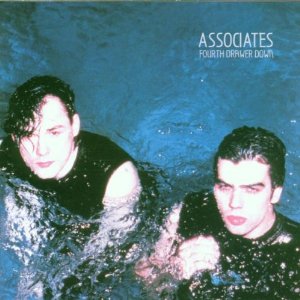
Associates: Fourth Drawer Down 40 Years On

The Associates gave good title: ‘Tell Me It’s Easter On Friday’, ‘Kitchen Person’, ‘White Car In Germany’, ‘Q Quarters’, ‘No’, ‘Those First Impressions’, ’18 Carat Love Affair’, ‘Nude Spoons’, ‘Party Fears Two’ etc. etc.

The first four of those tracks appeared on Fourth Drawer Down, released 40 years ago this weekend.

Mostly co-produced by 19-year-old Flood (Depeche Mode, U2), it was a collection of the increasingly bizarre singles released by the ‘band’ during 1981, all of which featured strongly on the Independent charts.

The Associates were yet another impressive 1980s pop duo, at least in their early incarnation. Billy Mackenzie was arguably the greatest singer of the post-punk era, while Alan Rankine was a key guitarist (and talented multi-instrumentalist) alongside John McGeoch, Charlie Burchill, Will Sergeant et al.

They were also arch music-biz pranksters, years before The KLF, good-looking, talented lads milking the record companies for all they were worth. Newly departed from Fiction Records, with ex-Cure bassist Michael Dempsey in tow, the three spent 1981 holed up in their St John’s Wood flat by day and Willesden’s Morgan (later Battery) Studios by night.

If taken in an amount just over their recommended dose, Quiet Life (also an ‘influence’ on David Sylvian/Japan?) health tablets would give a nice buzz, found in the ‘fourth drawer down’ of their bedroom cabinet.

It was a hedonistic, musically expansive period. Experimentation was king. It wasn’t unusual to see Billy singing down a vacuum tube or through tracing paper, while Rankine occasionally applied a water-filled balloon to his guitar strings.

Vintage synths were layered with dulcimer, xylophone, early drum machines, ‘funky’ bass and mad fuzz-toned guitar. It was a brittle, lo-fi sound, influenced by Bowie, Roxy, Sparks, Ennio Morricone and John Barry, quite insane in places.

The scary, majestic ‘White Car In Germany’ was the logical conclusion to all of that icy, post-Heroes Euro-grandeur, but is it a pastiche? ‘Lisp your way through Zurich/Walk on eggs in Munich’, croons Billy. It’s impossible to say, but that’s part of the fun.

The brilliant ‘Q Quarters’ is strongly reminiscent of Scott Walker’s ‘70s/’80s soundworld, and comes complete with Billy’s coughing solo. Superbly chaotic ‘The Associate’ is invaded by a screaming fit and what sounds like a major vacuum-cleaner malfunction.

Some of it may remind one of early Cocteau Twins (particularly Mackenzie’s strident vocals and oblique lyrics), early Suede and the work of Frankie Goes To Hollywood and Propaganda from later in the decade (Trevor Horn apparently almost produced a solo Mackenzie album around 1987, sadly yet another what-if in this gifted artist’s short life).

Less than a year later, aided by some more streamlined material, Warners money and the excellent producer Mike Hedges (who also worked on ‘White Car In Germany’ and ‘The Associate’), they spent nine months as bona fide pop stars in the UK.

But nothing ever sounded as singular as Fourth Drawer Down. And don’t miss out on the wacky B-sides, newly added to the remastered 2-CD version. Also worth checking out is their extraordinary Peel Session from April 1981.

Further reading:

‘The Glamour Chase’ by Tom Doyle

‘Rip It Up’ by Simon Reynolds

The Curse Of 1986?

The critical consensus: 1986 was the worst music year of the decade, perhaps of any decade. But is that true?
There was certainly a vacuum between the end of New Pop/New Romanticism and the Rock Revival of ’87.

Add in the one-hit-wonder merchants, TV soap actors, Europop poseurs, musical-theatre prima donnas, jazz puritans and Stock Aitken & Waterman puppets who hit paydirt towards the end of the decade.

Also most pop records just didn’t sound good. The drums were too loud, the synths were garish, ‘slickness’ was the order of the day. Perhaps nothing emphasised these factors as much as The Police’s disastrous comeback version of ‘Don’t Stand So Close To Me’.

But listen a little harder and 1986 seems like a watershed year for soul, house, go-go, art-metal, John Peel-endorsed indie and hip-hop. Synth-pop duos were back on the map, the NME C86 compilation was a lo-fi classic and there were a handful of groundbreaking jazz/rock albums too.

So here’s a case for the opposition: a selection of classic singles and albums from 1986. Not a bad year after all…

Paul Simon: Graceland

Stump: Quirk Out

David Bowie: ‘Absolute Beginners’

Mantronix: Music Madness

PiL: Album

Rosie Vela: ‘Magic Smile’

George Michael: ‘A Different Corner’

Eurythmics: ‘Thorn In My Side’

Al Jarreau: L Is For Lover

XTC: Skylarking

Duran Duran: ‘Skin Trade’

George Benson: ‘Shiver’

Erasure: ‘Sometimes’

Cameo: ‘Candy’

Chris Rea: On The Beach

Europe: ‘The Final Countdown’

David Sylvian: Gone To Earth

OMD: ‘Forever Live And Die’

The Real Roxanne: ‘Bang Zoom’

The The: Infected

Half Man Half Biscuit: ‘Dickie Davies Eyes’

Anita Baker: Rapture

Michael McDonald: ‘Sweet Freedom’

Prince: Parade

Talk Talk: The Colour Of Spring

Luther Vandross: Give Me The Reason

Pet Shop Boys: ‘Suburbia’

Chaka Khan: ‘Love Of A Lifetime’

Gabriel Yared: Betty Blue Original Soundtrack

The Pretenders: ‘Don’t Get Me Wrong’

Janet Jackson: Control

Run DMC: Raising Hell

Beastie Boys: Licensed To Ill

Miles Davis: Tutu

Iggy Pop: Blah Blah Blah

Courtney Pine: Journey To The Urge Within

George Clinton: ‘Do Fries Go With That Shake’

Talking Heads: ‘Wild Wild Life’

Kurtis Blow/Trouble Funk: ‘I’m Chillin”

The Source ft. Candi Staton: ‘You Got The Love’

Gwen Guthrie: ‘Ain’t Nothing Going On But The Rent’

The Housemartins: ‘Happy Hour’

Peter Gabriel: So

Mike Stern: Upside Downside

Steps Ahead: Magnetic

It Bites: The Big Lad In The Windmill

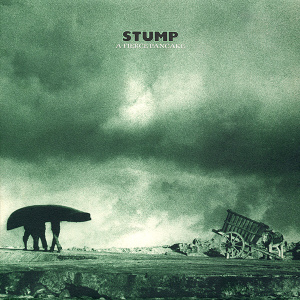
Stump: A Fierce Pancake 30 Years Old Today

The general consensus seems to be that Anglo/Irish late-1980s band Stump didn’t quite ‘make it’.

But maybe we should probably be thankful that they stayed together for as long as they did. They released one great mini album (Quirk Out) and just one full-length one, A Fierce Pancake (currently not on streaming platforms due to a contractual disagreement).

Released 30 years old today, the latter is probably in my 1980s top 10, and reportedly one of Faith No More/Mr Bungle frontman Mike Patton’s favourites too.

It was never going to be easy: the drummer (Rob McKahey) sounded like he belonged in Beefheart’s Magic Band or Ornette Coleman’s Prime Time, the fretless bassist (Kev Hopper) was into sampling, Pere Ubu and Brand X, the guitarist (Chris Salmon) sounded like a cross between Hank Marvin and Adrian Belew and brilliant frontman/lyricist (the late Mick Lynch) was more than likely to engage in a bit of onstage belly dancing.

But it somehow works. A Fierce Pancake is dedicated to the life and works of physician/psychoanalyst Wilhelm Reich and writer Flann O’Brien. It was released on Ensign Records, mainly known for breaking Irish acts like Sinead O’Connor and the Waterboys.

Recording sessions at Hansa in Berlin were apparently long and difficult – original producer Holger Hiller jumped ship halfway through and then ‘stabilising influence’ engineer Stephen Street got summoned away to work with Morrissey.

But the album’s sometimes hilarious (‘Bone’, ‘Charlton Heston’, ‘Chaos’, ‘Eager Bereaver’), sometimes touching (‘Alcohol’, ‘Boggy Home’) and always musically interesting, kind of a cross between Viz magazine and XTC. It’s a shame that they couldn’t maintain the John Peel-endorsed momentum of their early days. Their manager persuaded them to call it a day after a disastrous Camden Electric Ballroom gig supported by The Blue Aeroplanes on 21 December 1988.

A Fierce Pancake hadn’t come close to recouping its costs and the Rave scene was in full flow. It was all over, barring a one-off comeback gig in May 2015.

For more on the band, check out this excellent podcast.

Fuzzbox: Self! Self! Self!

fuzzbox_big_bangThe 1980s are littered with bands who started out with the noblest of indie intentions, but then got seduced and/or corralled into major-label action.

And they didn’t come much more indie than We’ve Got A Fuzzbox And We’re Gonna Use It, the Birmingham-born-and-bred, all-female, John Peel-endorsed quartet which formed in 1985.

By 1988, though they had enjoyed a lone top 40 single, you probably wouldn’t have put much money on them making a claim for serious stardom. But against all odds, they spent most of 1989 as proper pop stars.

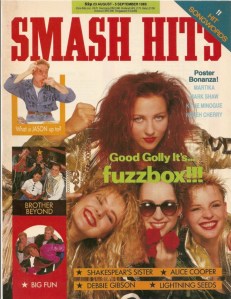
fuzzbox-smash-hits

Too young to appreciate their early stuff, I had only ever known their ‘pop’ period. But I hadn’t thought about them for over 25 years until the other day when I heard their 1989 single ‘Self’ on Absolute 80s.

I was immediately impressed and intrigued; an irresistible slice of post-Frankie, everything-but-the-kitchen-sink pomp-pop, ‘Self’ features swooning synths, powerhouse drums, strident, Claudia Brucken-esque vocals, a brilliant chorus and even a saucy Brian May guitar solo. How did they do that?

It was all so different back in ’86. Their first UK single, a double A-side of ‘XX Sex’ and ‘Rules And Regulations’, appeared on Vindaloo Records and reached number 41 in March of that year. In December, debut album Bostin’ Steve Austin was released, spawning hilarious first UK Top 40 single ‘Love Is The Slug’.

Further single releases included ‘Rocking With Rita (Head To Toe)’, featuring a version of ‘Itsy Bitsy Teenie Weenie Yellow Polka Dot Bikini’ on the B-side, and even a cover of ‘Spirit In The Sky’.

Clearly a change of direction was needed. Apparently it was WEA A&R gurus Rob Dickins and Bill Drummond who masterminded the band’s assault on the charts, recommending a shortening of their name to Fuzzbox, bringing in songwriter Liam ‘Walk Like An Egyptian’ Sternberg, putting more focus on lead singer Vickie Perks and recruiting session keyboard player Andy Richards to produce the Big Bang album.

Richards’ credentials were exemplary – prior to ’89 he had played on no less than eight ’80s UK number ones: Frankie’s ‘Relax’ and ‘Two Tribes’, George Michael’s ‘Careless Whisper’, Chris De Burgh’s ‘Lady In Red’ and the Pet Shop Boys’ ‘It’s A Sin’, ‘Always On My Mind’ and ‘Heart’. He had also recently produced Prefab Sprout’s ‘Hey Manhattan’.

And, in the short-term, Richards did a sterling job – Big Bang went top 5 and Fuzzbox were pop stars. Three singles from the album got into the top 30 – the infuriatingly-catchy Sternberg co-writes ‘Pink Sunshine’ and ‘International Rescue’ as well as ‘Self’. But the fourth single, a cover of Yoko’s ‘Walking On Thin Ice’, flopped, as did later stand-alone single ‘Your Loss My Gain’. Warners pulled the plug, probably prematurely.

But the story doesn’t end there. Fuzzbox made a comeback in 2010 with a spiffing cover of M’s ‘Pop Muzik’ but sadly lost founding member Jo Dunne in October 2012. After a brief hiatus, they reformed again in 2015 and have just finished touring with The Wonder Stuff. Their YouTube channel claims they are officially the most successful British all-female band. Dispute it at your peril…