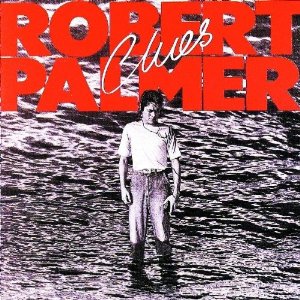
Robert Palmer: Clues 40 Years On

If in 1979 you’d been asked to draft a list of key 1970s artists most likely to go ‘new-wave’, Robert Palmer would surely have been near the bottom.

After all, he spent most of the decade as a kind of sophistifunk Bryan Ferry, with his ‘problematic’ album covers and Little Feat-inspired grooves.

1979’s Secrets had shown glimpses of ‘rock’, but Clues, released 40 years ago this week, went the whole hog. And, along with 1978’s Double Fun, it’s probably his most consistent album and definitely worth a reappraisal.

There are good omens in the liner notes – a Talking Heads guest appearance here, a Gary Numan song there, Compass Point mixmaster general Alex Sadkin (Nightclubbing etc.) on knob-twiddling duties, Free’s Andy Fraser on bass. And Clues delivers big-time, exploding out of the speakers and clocking in at just over half-an-hour (it must sound great on vinyl).

It’s buoyed by two superb singles, ‘Looking For Clues’ and ‘Johnny And Mary’, the former scraping into the UK top 40 (shockingly, Robert only had SIX top 40 singles during the 1980s…). But there are other treats throughout: ‘Sulky Girl’ sounds curiously like Low-era Bowie, with its histrionic vocals, unhinged guitars, processed drums and barrelhouse piano.

The Beatles cover ‘Not A Second Time’ is excellent (with a new second verse), as is the Numan contribution ‘I Dream Of Wires’. When Gary’s synths squelch into action, it’s a great moment, as is the funky fanfare in the middle. And no-one but Palmer could have pulled off the minimalist Township swing of ‘Woke Up Laughing’, featuring a brilliant, polyrhythmic vocal performance.

If Good Drum Sounds are your thing, Sadkin delivers a masterclass here. I’ll be amazed if anyone can point to a better-recorded 1980s kit than on album-closer ‘Found You Now’, played by the excellent Dony Wynn (who he?).

Clues was, perhaps surprisingly, not a big success in the UK, making just #31. Nor did it go down too well in the US, peaking at #59. But it was a big hit in France, Sweden and the Netherlands.

Robert generally gets a bad rap these days, maybe due to those album covers (despite glowing character references in Phill Brown’s ‘Are We Still Rolling’ and Guy Pratt’s ‘My Bass And Other Animals’), and he seldom gets the ‘career overview’ treatment in the rock monthlies.

But he was actually married to the same woman for 28 years (from 1971 to 1999) and had two kids. A private man and music fan through and through, he died of a heart attack in 2003 at the age of just 54.
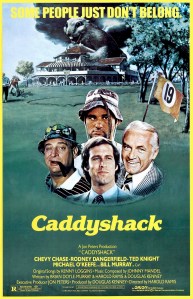
The Cult Movie Club: 17 Things I Didn’t Know About ‘Caddyshack’

‘Caddyshack’, the cult comedy released 40 years ago this month, has been a favourite since I accidentally came across it on TV sometime in the late 1980s.
It now seems an almost forgotten and/or strangely ‘forbidden’ movie despite some cult status amongst golfers and hardcore fans of National Lampoon and ‘Saturday Night Live.’

With a corking cast of Rodney Dangerfield, Chevy Chase, Bill Murray, Ted Knight and Cindy Morgan, its basic pitch is ‘”Animal House” at a country club’, but for me it’s a funnier movie than John Landis’s 1978 hit.

It’s chaotic, unhinged, poorly structured, hard to follow, mostly improvised and won’t win any woke awards, but many scenes still make me chuckle like a teenager. In particular, Chase and Murray’s monologues and druggy non-sequiturs.

Directed by Harold Ramis (‘Groundhog Day’) and shot at Rolling Hills Country Club (now Grand Oaks) in Florida during September and October 1979 , ‘Caddyshack’ is ostensibly a coming-of-age story concerning amateur caddy Danny Noonan (Michael O’Keefe).

On release, the critical reception was unsurprisingly poor but it did pretty good business ($40 million against a $6 million budget), if proving a bit too weird for any kind of ‘Animal House’ action.

But, like most Hollywood movies of the era, there are a myriad of ‘what ifs’ and surprising revelations around its making. Here are just a few:

17. The bishop struck by lightning after shouting ‘Rat farts!’ (Henry Wilcoxon) was a silent-movie star back in the 1920s, working in several Cecil B DeMille films.

16. ‘Caddyshack’ was Rodney Dangerfield’s movie debut.

15. Bill Murray (Carl Spackler) was the last actor to be cast, and his totally unscripted role was initially only supposed to be a cameo.

14. Ted Knight (Judge Smails) was an Emmy-winning star of the legendary ‘Mary Tyler Moore Show’ TV show in the 1970s.

13. Bill Murray and Chevy Chase (Ty Webb) were sworn enemies during the shoot due to some bad-mouthing in the press after Chevy had left ‘Saturday Night Live’. Their famous improvised scene was a last-minute addition after the studio insisted they appear on screen together.

12. Cinematographer Stevan Larner had previously worked on Terrence Malick’s ‘Badlands’.

11. Recently-departed, legendary composer/arranger Johnny Mandel (‘Theme From M*A*S*H’, Steely Dan’s ‘FM’) wrote the incidental music for the movie.

10. Mickey Rourke was first choice for the Danny Noonan role but turned the producers down at the final hour.

9. ‘Caddyshack’ was Harold Ramis’s directorial debut.

8. Co-writer and National Lampoon legend Doug Kenney died in strange circumstances soon after the film was released.

7. The pitch (‘Animal House’ in a country club) was given the green light by Orion studio bosses before they had seen any kind of story outline or screenplay.

6. The co-writers’ original idea was to make the film all about the teenage caddies (maybe that would have made for better box office… Ed.)

5. Cindy Morgan (Lacey Underall) was a DJ in Chicago before becoming an actress.

4. Bill Murray was actually a greenskeeper as a young man, and his elder brother Ed was a champion caddie.

3. Danny Noonan’s large Irish-Catholic family was based on the Murray family.

2. The whole cast stayed in the same hotel throughout the shoot – and partied heartily.

1. Bill Murray’s shenanigans with the gophers was a last-minute idea – initially there had only been one scene with a fake gopher (the one where Rodney Dangerfield shouts ‘Hey, that kangaroo just stole my ball!’).

The Brecker Brothers: Live And Unreleased

Horn sections – they sure divide opinion, especially in the ‘pop’ realm.

Some people just cannot stand all of that pomp and circumstance, while others get turned on by a hot, punchy chart.

But like ’em or hate ’em, some great records just wouldn’t be the same without the horns: The Teardrop Explodes’ ‘Reward’ for example.

But who are the most-recorded sections of all time? You’d get very short odds on The Brecker Brothers, comprising Michael on tenor and Randy on trumpet, occasionally augmented by David Sanborn on alto too.

They graced hundreds of recordings before Michael’s death in 2007, including Parliament’s ‘Chocolate City’, Todd Rundgren’s ‘Hello It’s Me’ and Dire Straits’ ‘Your Latest Trick’. Under their own name, seven studio albums showcased a really cool sound with funky grooves and intricate harmony, somewhere between Stevie Wonder and Steely Dan.

And now they’ve been given the full-on archive treatment, a new Live And Unreleased album featuring a complete two-hours-plus gig with no edits or overdubs, recorded in Hamburg on 2nd July 1980.

This is a really impressive package, a beautifully-recorded double with extended liner notes by Bill Milkowski and additional, amusing memories from Randy Brecker.

The sh*t-hot band includes Neil Jason on bass (familiar to fans of Roxy Music’s Flesh & Blood and Avalon), Barry Finnerty on guitar (most famous for a short stint with Miles Davis), Mark Gray on keys and Richie Morales on drums.

The material is a mix of BB favourites like ‘Squids’, ‘Sponge’, ‘Some Skunk Funk’, ‘Straphanging’, ‘I Don’t Know Either’ and ‘East River’. Pleasingly, these are pretty faithful to the original studio versions tempo-and-arrangement-wise, but there’s also a big emphasis on extended solos and one-chord vamps.

It’s also clear that, by 1980, Michael was giving Randy a serious run for his money on the composing front – his tunes and sometimes extraordinary solos dominate proceedings, particularly on the sprightly ‘I Don’t Know Either’ and ‘Tee’d Off’.

Finnerty gets a hell of a lot of solo time but is generally pretty characterless compared to other Brecker-approved studio guitarists (Hiram Bullock, Steve Khan), while Gray is excellent but too low in the mix.

Morales is rock-solid but, again, fairly anonymous compared to other Brecker favourites Steve Jordan, Terry Bozzio, Steve Gadd and Harvey Mason (hardly surprising, since they are three of the all-time greats…). Jason, with his big, buoyant, funky sound, is the star of the rhythm section.

As usual, ‘Some Skunk Funk’ makes for fascinating listening – the funk/fusion standard has become a kind of test piece for drummers (Harvey Mason, Billy Cobham and Terry Bozzio all had memorable cracks at it, offering subtly different readings). Morales has a good go here but again lacks the invention and drive of the aforementioned.

So: three-and-a-half stars for the music, five for the package. It’s definitely worth immersing oneself in it on vinyl or CD, helped by Randy’s witty between-song comments.

It’s a really strong live album with some great performances, and exemplifies an interesting period for jazz/rock when good grooves and extended solos took precedence over technical chops. Even if you can’t stand horn sections…

Frank Zappa: ‘I Don’t Wanna Get Drafted’ 40 Years On

Recently, I was pleased and very surprised to hear a youngish (30s?) sales assistant playing Zappa’s Apostrophe while guarding the till at a local charity bookshop.

A quick and enjoyable conversation led us to agree that of all the major music figures who emerged during the ’60s and ’70s, FZ may be the least respected/understood these days.

You’ll seldom see a major piece about him in the heritage rock magazines, and the family estate keep a close eye on such, but if you do, it’ll probably focus on the ‘golden’ era – i.e. the late 1960s.

Many were turned off by Zappa’s unapologetic, un-PC lyrical stance as the ’70s turned into the ’80s. But his musical intelligence is beyond question and pretty much unprecedented in the ‘rock’ era.

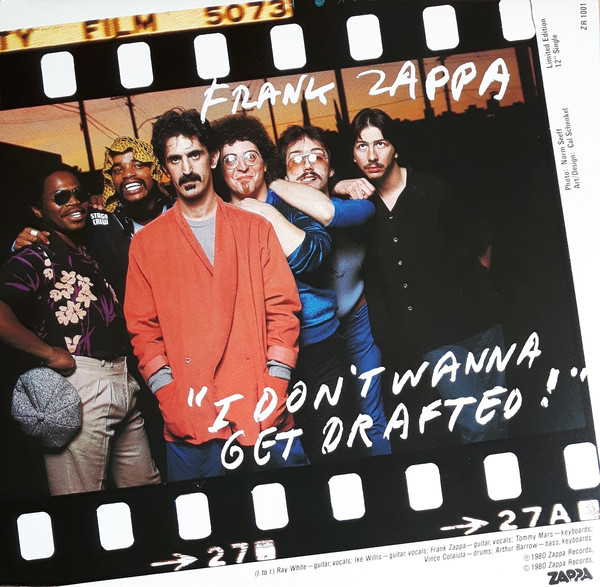
Frank kicked off the decade with the release of the stand-alone ‘I Don’t Wanna Get Drafted’ single, recorded on 16 and 17 February 1980 at Ocean Way in Los Angeles and released 40 years ago this month. A satirical comment on the draft policy of the Carter administration, it was the first product issued on his own Barking Pumpkin label – and reached #3 in the Swedish singles chart!

The single kicked off an incredibly busy decade for FZ. Two major albums – Francesco Zappa and Thing-Fish – were even released on the same day in 1984. Then there were the two albums of guitar solos (one triple and one double), three major orchestral works and hundreds of instrumental pieces for the Synclavier. Not forgetting many other studio/live albums, compilations, and two books, ‘Them Or Us’ and ‘The Real Frank Zappa Book’, though both contained some previously-published material.

In the live arena, Zappa embarked on major tours in 1980, 1981, 1982, 1984 and 1988. Now that he, Miles Davis and Joe Zawinul are gone, it’s hard to imagine that any other major artist will ever again play such virtuosic, challenging music in front of large crowds, whilst also blooding young musicians in the process. Author Ben Watson memorably described FZ’s final 1988 tour as ‘the wildest and most speculative music…heard in rock arenas since the days of Cream, Hendrix and the Mothers Of Invention’.

One of the only pleasures of lockdown has been discovering some ’80s FZ works I hadn’t heard (Francesco Zappa, London Symphony Orchestra Vols. 1 and 2) via Charles Ulrich’s excellent book ‘The Big Note’.

What struck me again is the lack of sentimentality in his music (off the top of my head, only three ’80s tracks feature those major-seventh chords: ‘I Don’t Wanna Get Drafted’, ‘Jumbo Go Away’ and ‘Jesus Thinks You’re A Jerk’), something else that seems to drive ‘rock’ critics crazy.

It ain’t all good, but the best of Zappa’s ’80s output is absolutely superb, and it really pays to have a root around in his discography. I’ve tried to separate the wheat from the chaff here. There’ll never be anyone like FZ again.

London Lockdown Circa 1980: ‘Babylon’ & ‘Breaking Glass’

One of the few positives of this lockdown may be investigating your local area more than usual, courtesy of the ‘permitted’ (approved by UK government) daily walks.

And if London is your manor, the mostly-silent, near-empty streets may just take you back to the city of your youth, when car ownership was relatively rare and there was plenty of room to kick a football or swing a cricket bat – mainly for sporting purposes, you understand.

Joking aside, London felt pretty edgy at the turn of the ’80s. Youth subcultures fought each other, and the police fought them. Some parts of the city had barely moved on from the Victorian era. There were great swathes of wasteland, still reeling from World War 2 bombs. Tube trains and stations were often deserted and you might even get a slap (there didn’t seem to be many knives around) if you wandered into the ‘wrong’ neighbourhood (hello Gary Bates…). This great bit of archive TV from 1982 sums up the era very well:

It was a London also accurately captured by feature films like ‘The Long Good Friday’, ‘Babylon’, ‘The Clash: Rude Boy’, ‘DOA’, ‘The Great Rock’n’Roll Swindle’ and ‘Breaking Glass’, all released 40 years ago. ‘Babylon’ was illuminated by sumptuous photography by legendary Brit cinematographer Chris Menges (‘Kes’, ‘The Mission’, ‘The Killing Fields’), capturing rundown, turn-of-the-decade Lewisham, south-east London, site of a notorious August 1977 battle between the National Front and 10,000 protestors.

All of these films accurately capture the energy of inner-city life during the late-’70s and early-’80s, and the pressures of young people living at the sharp end of recession, racism and unemployment. Also ever-present is the constant theme of music-business skullduggery and police brutality. But it’s all shot through with healthy doses of humour and humanity, particularly throughout ‘Babylon’.

For all the benefits of ‘gentrification’ and the corporate restructuring of the capital, true Londoners of a certain age probably feel a tinge of nostalgia about the time when they seemed to own the streets, when there were many secrets to be found in the city’s nooks and crannies – for better or worse.

The Cult Movie Club: John Carpenter’s ‘The Fog’ 40 Years On

What with ‘The Lighthouse’ and ‘Bait’, you can’t move for nautically-themed movies at the moment.

But it’s arguable whether either are as effective as John Carpenter’s ‘The Fog’, released 40 years ago today.

But then I’m biased: aside from Carpenter’s ‘Halloween’ and ‘American Werewolf In London’, it was one of the first scary movies I was allowed to watch in my teenage years, and subsequently inspired a dodgy short horror novel of my own (‘The Ghost Of The Drowned Sailor’…).

Revisiting it this week for the first time in ages, it delivered all sorts of treats though these days is scarcely mentioned alongside ‘Halloween’, ‘Assault On Precinct 13’ and ‘The Thing’ in the list of bona fide Carpenter classics.

Shot mainly in coastal California around Point Reyes, Bodega Bay and Inverness, ‘The Fog’ was a brave move on Carpenter and producer/co-writer Debra Hill’s part, following up ‘Halloween’ by mostly eschewing the slasher format (it’s interesting to note that both ‘The Shining’ and ‘Friday The 13th’ were released two months later, in May 1980) in favour of a seemingly old-fashioned ghost story inspired by a trip to Stonehenge and the writings of Edgar Allan Poe.

This attempt at a different kind of movie caused problems when Carpenter’s original cut was deemed too moody and not supplying the requisite scares for post-‘Halloween’ sensibilities.

Many scenes were re-shot and some new ones added just a few months before release, including the opening ghost story, ‘Close Encounters’-style scene-setting and top-of-the-lighthouse finale. The music and sound effects were also reworked.

Watching the 2002 DVD edition, the first thing I noticed is the gorgeous lighting and camerawork. Its sharp, crisp colours and composition are a great testament to the lab technicians (heralded by Carpenter on his DVD commentary) and director of photographer Dean Cundey, who has since gone on to be one of the premier DPs in Hollywood.

The impressive miniature/model work, widescreen lenses and evocative coastal locations give a lot of bang for relatively little buck (‘The Fog’ was eventually brought in at just over $1 million). ‘The Fog’ also benefits from an excellent central performance from Adrienne Barbeau as the Hawksian, Bacall-voiced DJ Stevie Wayne (and spinner of Steely Dan-approved big-band and light jazz/fusion tunes).

She and co-writer Debra Hill manage to root the hokum in a credible, sympathetic, rounded character. It’s also great fun to see Janet Leigh appearing in the same movie as her daughter Jamie Lee Curtis, and Nancy Loomis delivers her usual amusingly insouciant line readings.

Effects man extraordinaire Rob Bottin features as head ghost Blake, heading up a very rock’n’roll-looking bunch of ghouls, though arguably the movie would have benefitted from a little less ‘show’ and a little more ‘tell’ in the last 20 minutes. Seeing Blake in plain sight at the end is always a bit of a disappointment, despite the glowing red eyes.

But editors Charles Bornstein and Tommy Lee Wallace deserve much credit for building tension in the last third with shrewd, snappy cutting (sometimes seamlessly between studio/location shots). Carpenter’s excellent soundtrack cribs a little from Michel Legrand’s famous score for ‘The Go-Between’ but has some marvellous sections, particularly during Barbeau’s ‘look for the fog’ closing speech (obviously very influenced by a similar ending to Howard Hawks’ ‘The Thing’).

‘The Fog’ was a hit (despite Siskel and Ebert’s stinking review, see below), earning around $20 million against its $1 million budget. It was a lot of fun to revisit it again, and looks like just the low-budget horror classic I always remembered it to be, with more imagination and storytelling elan than 99% of other genre offerings.

Happy birthday to a true cult classic. Now, what’s that sound? Who’s rapping on my door at this hour? Goddamn kids… They won’t like finding me at home…

Story Of A Song: Iggy Pop’s ‘Play It Safe’ (1980)

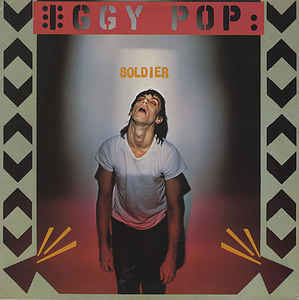
Soldier, released 40 years ago this month, was seen by Iggy’s paymasters Arista as a great opportunity for mainstream acceptance.

The Idiot and Lust For Life were now distant memories, and the label’s new head of A&R Tarquin Gotch and big boss Clive Davis were ‘taking an interest’, in Coen Brothers-speak a la ‘Barton Fink’.

As band (including ex-Pistol Glen Matlock and ex-XTC keyboard man Barry Andrews) and crew assembled at the legendary/infamous Rockfield Studios in south Wales, producer and fellow ex-Stooge James Williamson was feeling the pressure, apparently at times brandishing a bottle of vodka in one hand and loaded pistol in the other.

The Soldier sessions were long and laborious. No-one seemed to be steering the ship. Iggy was bored, brooding in deepest Monmouthshire.

Then, one night, the proverbial saloon doors swung open and David Bowie swanned in with trusty assistant Coco Schwab. The mood changed instantly. Iggy lightened up and the old megawatt smile returned.

Around the dinner table, Bowie told the story of John Bindon, friend of the Krays, one-time Led Zeppelin bodyguard, part-time actor, alleged lover of Princess Margaret and possessor – also allegedly – of an unnaturally large appendage.

Iggy was fired up. Next morning, he and Bowie jumped into the studio and cooked up an ironic rumination on the lure of the criminal world, with some choice quotes lifted almost verbatim from Bowie’s monologue.

Originally titled ‘I Wanna Be A Criminal’, it featured a classic Bowie descending chord sequence, icy synths and a superb vocal from Iggy.

Fellow Arista signings Simple Minds, hard at work recording their album Empires And Dance in the studio next door, were enlisted to provide amusing faux-Cockney backing vocals (you can also hear Bowie over the talkback mic at the song’s outset).

Some of the more libellous words about Bindon and Princess Margaret were later excised (Bowie apparently sidled up to Iggy at New York’s Mudd Club in early 1980 and begged him not to include them) and the song was finally released as ‘Play It Safe’, possibly Iggy’s self-conscious comment on his loss of nerve.

But he still mustered a brilliantly insane ad-lib towards the end:

Rockin’ and reelin’ like Al Capone
Slippin’ and slidin’ like Joey Gallo
Movin’ and groovin’ with the Son Of Sam
Splish splash, I was Jim Jones!

Bowie had once again inspired his friend to create some of his best – if hardly commercial – work, and the best track on Soldier (though I also have a soft spot for ‘I’m A Conservative’).

The album stalled at #62 in the UK chart and made a one-week appearance at #126 in the US, hardly a success in terms of making Iggy a mainstream concern. He stuck around on Arista for one more record, the forgettable Party.

Predictably, it was Bowie who would again inspire Iggy four years later to create his most effective album of the 1980s: Blah-Blah-Blah.

Prince: Dirty Mind/Controversy

Picture the scene: It’s August 1980 at Warner Bros Records’ Los Angeles HQ. Prince’s manager Steve Fargnoli is playing the suits his charge’s new demos.

Both the artist and his manager want to release these rough recordings as the next album.

Fargnoli hits the play button, and these lyrics crawl out over a peppy – but distinctly lo-fi – new-wave groove:

I was only sixteen but I guess that’s no excuse
My sister was thirty-two, lovely and loose
She don’t wear no underwear
She says it only gets in her hair…

Major labels often – quite rightly – take a lot of flak, but Warner Bros deserves credit for taking on Dirty Mind (released 8 October 1980) and Controversy (released 14 October 1981).

It was a brave move by Prince too, an incredible volte face after it looked like he might be going down a big-budget, soft-rock/disco rabbit hole. Just compare the Prince and Dirty Mind covers: it was definitely one in the eye for Reagan’s new, ultra-conservative regime.

I first heard these albums circa 1988 via a compilation tape made by my schoolfriend Seb. I already knew and loved Parade and Sign O’ The Times but these older songs sounded like they’d been sent down from a different planet. I didn’t pay much attention to lyrics in those days but sensed something very odd going on.

In the Dirty Mind/Controversy era, Prince’s main modus operandi seems to be: shock at all costs. It’s a novel approach, because if he can express himself completely freely, and then deliver such a classic, ‘throwaway’ rock song like ‘When You Were Mine’, you never know what’s going to come next. Cue a long, great career.

Recorded very quickly during summer 1980 at his rather ramshackle home studio in Lake Minnetonka, Minneapolis (the drum kit apparently sat in a puddle of water surrounded by sand bags), Dirty Mind has more in common with the B-52s, Elvis Costello, Blondie and The Cars than it does Earth, Wind & Fire or REO Speedwagon.

It’s nasty, brutish and short. And of course what struck me listening to it again after five or six years, it’s remarkably stripped down compared to a great deal of modern music – hardly surprising when nearly all the noises are made by Prince. Only ‘Head’, ‘Partyup’ and ‘Uptown’ outstay their welcome, underwhelming grooves with slight vocal performances (though the former became a great live track).

My old vinyl version of Controversy sounds absolutely great. Of course it helps that the album’s only 37 minutes long, and also there’s a lot more bottom-end this time. On a decent turntable, various details emerge like the scuzzy synth bass escaping from the left channel during the Lord’s Prayer on the title track (can you guess it’s a Prince album yet?) and some low-octave backing vocals throughout.

It’s also a totally schizophrenic album again, with the title track and ‘Sexuality’ laying down a kind of free-love/free-speech manifesto, two rockabilly tunes (one a message to Reagan), a graphic seduction ballad and synthetic funk tune (‘Private Joy’) which marks Prince’s first use of the Linn LM-1 drum machine.

Weirdly, none of these songs made the PMRC’s Filthy 15 list. But they still sound totally fresh, especially the unclassifiable stuff like ‘Dirty Mind’, ‘Annie Christian’, ‘Jack U Off’, ‘Sexuality’ and ‘Ronnie Talk To Russia’.

Prince toured Dirty Mind and Controversy extensively, and there were three particularly infamous gigs during the period: his London debut at The Lyceum on 2 June 1981 and the two shows supporting The Rolling Stones at the Los Angeles Memorial Coliseum on 9 and 11 October 1981.

The Cult Movie Club: Seems Like Old Times (1980)

It seems a bit weird to describe ‘Seems Like Old Times’ as a cult movie when everything about it screams ‘Hollywood’: co-stars Chevy Chase and Goldie Hawn, screenwriter Neil Simon, ‘Mary Tyler Moore’/’Cosby Show’ director Jay Sandrich, Columbia Pictures (this was one of the first movies they made after the David Begelman embezzlement scandal).

But it’s a cult movie in that it now seems completely forgotten. I probably would never have come across it unless I’d happened upon it on TV one afternoon.

I stuck it on a VHS and wish I still had it, because it’s one of Chevy’s funniest films and an interesting companion piece to ‘Caddyshack’. 1980 was a good year for Steely Dan’s first drummer.

‘Seems Like Old Times’ is clearly modelled on the great Hollywood screwball comedies of the ’30s and ’40s. Even the title comes from a popular song written in 1945 (sung by Diane Keaton in ‘Annie Hall’).

Chase stars as a falsely-accused bankrobber who takes refuge at his ex-wife’s Beverly Hills ranch. There are ‘unresolved issues’ in their relationship, not to mention the suspicions of Hawn’s new husband Charles Grodin. The sparks fly and the one-liners come thick and fast.

Hawn, Chase and Grodin

Chase channels Cary Grant at his zaniest, Hawn is fairly adorable and has some great comic moments, and they have a decent chemistry. Grodin (who I was amazed to read was Razzie-nominated for this performance) excels in the role he always seems to play, a control freak seemingly on the edge of a nervous breakdown, while Robert Guillaume and Harold Gould lampoon the Reaganite elite almost as effectively as Ted Knight in ‘Caddyshack’.

Simon writes loads of memorable secondary characters too: TK Carter is funny as Chester (though the part wouldn’t win any ‘woke’ points these days) and Yvonne Wilder is great as Mexican maid Aurora (ditto). The locations are gorgeous, with a striking helicopter shot over the opening credits along the Southern California coast.

I love Marvin Hamlisch’s theme tune too, sounding a bit like Herb Alpert jamming with Billy Joel (with Marcus Miller on bass?). And the cheap, slushy, ridiculous last five minutes get me every time.

‘Seems Like Old Times’ is a film that you can just let wash over you – you’re in the hands of experts. Indeed it sometimes feels a bit too professional. It was a reasonable hit but proved a bit of a career dead end for Chase, who pretty much eschewed the ‘romantic lead’ pictures from here on in. A shame. His dead-eyed buffoonery and surprisingly subtle charm take him and the film a long way.

The Crap Movie Club: Heaven’s Gate (1980)

It’s difficult to view a film like ‘Heaven’s Gate’ these days shorn of all the hoo-ha that accompanied its troubled production and disastrous cinematic release (outlined in the definitive book and documentary ‘Final Cut‘).

But let’s give it a try. It was of course the notorious movie that destroyed United Artists and pretty much ended the New Hollywood ideal of director-as-auteur; the $44 million turkey which grossed just $1.2 million at the box office.

Writer/director Michael Cimino went looking for ‘the poetry of America’ in his film about the Johnson County War of 1896, when the Wyoming Stock Growers’ Association decided that new settlers – mainly poor, immigrant homesteaders – were stealing cattle, decreeing that 125 of these so-called thieves be hunted down and either hung or shot.

Though Cimino’s film ends with a battlefield bloodbath (including many horses in apparent physical peril which led him into a further unwanted lawsuit), history records that ‘only’ two people lost their lives in the Johnson County War.

But, defending his screenplay and movie to the end, Cimino clung steadfastly to one of his directing/writing credos: ‘I use history freely’.

But, historical license aside, how much of a turkey is ‘Heaven’s Gate’ really? Can any movie starring Kris Kristofferson, Jeff Bridges, Christopher Walken, Brad Dourif, Mickey Rourke, Sam Waterston, John Hurt and Isabelle Huppert really be such a dog?

Yes. ‘Heaven’s Gate’ is that special kind of crap movie, the indulgent folly that spews elongated scenes out all over the place in the hope that something will stick.

Vilmos Zgismond’s camerawork is of course gorgeous; grainy and sepia-tinged, frequently reminiscent of the era’s stills photography. The movie frequently delivers the awesome image, including one famous panning shot across immense smokestack chimneys and hoards of wandering, displaced immigrants.

The Oxford-filmed opening graduation ceremony is also plush, striking and gloriously evocative.

Jeff Bridges. Isabelle Huppert and Kris Kristofferson

But then there’s the inaudible dialogue and strange, schizoid reaction shots. As the film progresses, Kristofferson becomes more and more inactive and dramatically impotent, while Bridges, Dourif, Hurt and Rourke are chronically underused.

Huppert is virtually incomprehensible in a fairly thankless role (turned down by every major female star of the era including Jane Fonda and Diane Keaton).

Cimino’s war metaphor in ‘The Deer Hunter’ was Russian roulette, but this time it’s endless cock-fighting, waltzing and rollerskating.

He clearly feels that the film says something important about America’s treatment of its poor and disenfranchised (and it’s certainly interesting viewing that aspect through modern eyes), but unfortunately the scenes of political wrangling/bargaining are interminable.

Pauline Kael memorably said that it was easy to think about what to leave out of ‘Heaven’s Gate’ but hard to think what to leave in. That’s the impression left with this writer too.

Quite frankly, apart from the stunning photography, one of the few pleasures watching the film again was spotting the gorgeous Rosie (‘Roseanne’ in the credits) Vela’s small but important cameo (see below). ‘Magic Smile’ indeed.