35 years ago this weekend, French synth pioneer Jean-Michel Jarre played two concerts in an area of East London known as Docklands, next to the River Thames.
Destination Docklands took place in October 1988 on a huge, somewhat dilapidated site known as the Royal Victoria Docks, the largest of the three Royal docks in the borough of Newham (the area was completely refurbished a few years later).
Both the Saturday and Sunday concerts were reportedly attended by 100,000 people. There were fireworks, lasers, choirs, dancers and a Hank Marvin guest spot. My dad spontaneously drove us out to Woolwich on the Saturday evening (quite a journey from South-West London) and unsuccessfully tried to get us in, though I distinctly remember the thrill of seeing the lasers and fireworks in the sky.
Brilliantly, the second night (beset by torrential rain and high winds) was filmed by Mike Mansfield, the director best known for his hilarious ‘Cue The Music’ clips on late-night ITV. His documentary makes for fascinating, funny viewing today, most of the (rather ‘eccentric’…) musicians having to be shadowed by umbrella-holding extras.
Jarre seems to enjoy it, though, quipping: ‘Frogs like rain!’ However it’s questionable how much of this music was played live, if any…
Did you go to either of the concerts? Let us know your memories below.
Late July 1976: if you were a British jazz/rock fan, all roads led to the legendary Hammersmith Odeon in West London.
The Billy Cobham/George Duke Band opened three nights of music, followed by John McLaughlin’s Shakti and then the headliners Weather Report. The encores often featured members of all three fusion supergroups.
So how apt that a reformed Shakti should appear at the same venue almost exactly 47 years on. And what a relief that they chose the Hammersmith Odeon (it’ll always be the Odeon to me, I can’t call it the ‘Apollo’…) to kick off this hugely anticipated 50th anniversary tour rather than the predictable Barbican or Royal Festival Hall. Accordingly, this was not your usual ‘jazz’ crowd after a little ‘culture’ – it was a vocal, refreshingly multicultural audience.
An attempt to marry ‘Western’/blues-influenced timbres with both North/South Indian rhythmic/melodic approaches, Shakti released three albums between 1976 and 1978, then reformed as Remember Shakti in 1998 for three more tours and subsequent live albums.
For this iteration, promoting brand new album This Moment, 81-year-old guitar master McLaughlin was joined by regular collaborators Zakir Hussain on tabla, Shankar Mahadevan on vocals and Selvaganesh Vinayakram on sundry percussion, plus youthful new recruit Ganesh Rajagopalan on violin.
There was combustive interplay on the opener ‘5 In The Morning, 6 In The Afternoon’, McLaughlin going back to his youth with some potent blues licks, bringing to mind his playing on Miles’s ‘Right Off’. Is he using an amp again, after years of firing his guitar straight through the PA?
An exquisite ‘Zakir’ came with heartfelt words from John to his friend. ‘Anna’, described as a ‘golden goldie’ by Hussain, featured flawlessly-played classical Indian lines and a brilliantly fluid solo from Rajagopalan.
John’s guitar gained a little more distortion in time for the violinist’s composition ‘Mohanam’, and by the middle of the gig he was in his element, dropping in references to ‘Lila’s Dance’ and Lee Morgan’s ‘The Sidewinder’. New track ‘Bending The Rules’ even saw John inject a lick from his 1980s classic ‘Florianapolis’. ‘Sakhi’ and ‘Lotus Feet’ were very touching, and some incendiary konnakol percussion duels closed the show on ‘Finding The Way’.
There was light and shade, fury and meditation at this excellent gig – the only downside was the incessant filming with mobile phones. Is there no privacy/immediacy at these larger concerts? The Shakti story continues. Who would have predicted that five years ago? Their tour continues through Europe and into the US during August. Don’t miss.
We’ve all done it – surveyed an ad for an upcoming gig and said of a band: ‘Whoa – they’re playing not one but THREE nights at Wembley/wherever?!’.
Some acts who thrived in the 1980s have effortlessly sidestepped the nostalgia circuit to maintain a huge live following, able to tour under their own steam every four or five years and sell out arena gigs. They might lose a founder member here or gain a strange recruit (Reeves Gabrels in The Cure?!) there but basically seem to go from strength to strength.
How do they do it? Who exactly are their fans? After 40-plus years of service, who forks out 70 quid every three or four years to see their favourite band at the nearest enormo-dome? Here, in no particular order, we round up the usual suspects. We’re obviously not talking about those plucky little cult acts of the 1980s. There’s a crucial missing bit in the musical brain of yours truly which would help me understand the enduring popularity of these headliners.
Variously, we will find acts who once upon a time were self-confessed haters of live performance; those who are like the Rolling Stones of 1980s pop, pedalling their tried-and-tested formula despite not writing anything decent for 30 years; those who have lost a vital frontperson, but carried on anyway. And the acts who – inexplicably – are massive in the USA despite doing middling business in the place of their birth.
Who’s who? You decide… Other suggestions are very welcome.
Hue and Cry: brothers Pat and Greg Kane. Photo by Phil Guest.
Some artists in the 1980s pop firmament (Paul Weller, Everything but the Girl, Simply Red) got away with marrying ‘aspirational’ music with supposed ‘socialist’ principles.
But Hue and Cry (brothers Pat and Tom Hanks-lookalike Greg Kane) had a tougher time. After their first two years of hits (‘Labour Of Love’, ‘Looking For Linda’, ‘Violently’), somehow their marriage of Sinatra-meets-Steely music and ‘political’ lyrics started to seriously wind people up in the age of grunge and Britpop.
Their 1988 album Remote (featuring an astonishing lineup of guest players including Michael Brecker, Tito Puente, Roy Ayers and Ron Carter) is certainly a desert-island disc but, by their third collection, 1991’s low-key Stars Crash Down, the momentum had been lost, typified by a famous hatchet job in Q magazine’s 100th edition begging them to split up (‘Britain’s Most Hated Band’!) – though it’s oft forgotten that the Melody Maker, NME, Sounds and Smash Hits quite liked them during their pop peak.
Since then, Radio 1’s loss has been Radio 2’s gain. The brothers Kane have ploughed on, recording the occasional album, generally eschewing the 1980s ‘nostalgia’ tours in favour of regular, relatively low-key live work. The duo format seems to be suit them very well – see 1989’s excellent Bitter Suite – and it’s been their preferred modus operandi over the last 20 years or so.
This Pizza Express gig was your correspondent’s first time seeing them live for 35 years, and anticipation was quite high, though I don’t exactly have happy memories of their 4 December 1989 gig at Hammersmith Odeon complete with ‘wacky’ horn section and less-than-stellar musicianship.
It’s not enough for 1980s acts to just play live now – the audience wants stories, and these boys have some good ones. But first Pat – in excellent voice throughout – laid down the gig’s house rules: 1. Things will only progress at a stately pace. 2. If you DON’T film our best songs and post them on twitter, you’re out.
Pat revealed that two of their early singles were written as a result of ‘being educated by a triumvirate of feminists at Glasgow University from 1981 to 1984’: indeed ‘I Refuse’ and ‘Violently’ were revelatory here. ‘Looking For Linda’, meanwhile, concerning a ‘Northern powerhouse’ who has never revealed herself to the Kane brothers since the song’s success, was a winner but missed a few neat chord changes/modulations from the original.
Their penchant for winding people up – gleefully acknowledged by Pat – emerged with new song ‘Everybody Deserves To Be Loved’ which sounded like The Blue Nile doing EDM, and there were less than essential covers of ‘Black And Gold’ and ‘Take Me To Church’.
But their best songs were harmonically-interesting, subtle explorations of adult relationships. Comparisons with Bacharach and David’s work wouldn’t be out of order. ‘Long Term Lovers Of Pain’, the ‘comeback’ single from Stars Crash Down, might just have been a Deacon Blue-style hit, but their luck had run out by then.
‘Just Say You Love Me’ and ‘Pocketful of Stones’ sounded every inch like modern standards, while excellent new song ‘Heading For A Fall’ borrowed verses from ‘The Message’ and ‘Inner City Blues’ – ‘three for one!’ trumpeted Pat.
The Kane brothers ended with a medley of ‘Shipbuilding’ and ‘The Man With The Child In His Eyes’, showcasing Pat’s rich, expressive voice to great effect. While Hue and Cry’s catalogue is unlikely to reach the critical heights of those songs’ classic status, this enjoyable gig shone a light on some underrated gems well worth discovering/rediscovering. There’s life in the duo yet.
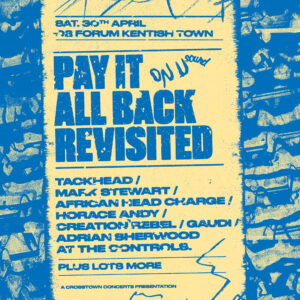
This was a twice-rescheduled London gig, initially designed to celebrate the 40th anniversary of On-U Sound Records.
And what a line-up was brought together to celebrate mixmaster general (and birthday boy) Adrian Sherwood’s iconic dub/funk/post-punk/industrial indie label (motto: ‘disturbing the comfortable, comforting the disturbed’): Creation Rebel, African Head Charge, Tackhead and Mark Stewart & The Maffia.
And what a pleasure to hear this music in a big hall, in front of a near-sell-out crowd. There were no half-measures here – this was an ageless performance from all the artists, and, refreshingly, also bone-crunchingly loud. Club gigs are all well and good but sometimes you need to hear this stuff in full effect.
Augmented by a striking set of projected visuals, taking in everything from Malcolm X to 1980s CND marches (On-U always championed agents of protest), Creation Rebel and Head Charge fused slow dubs and occasional bursts of metal guitar.
But the real draw was the return of Tackhead, their first London date for 14 years, and they didn’t disappoint – drummer Keith LeBlanc always swings even when tied to drum machines and loops, playing with dynamics and a killer right foot.
If there’s a greater contemporary rhythm section than him, bassist Doug Wimbish and guitarist Skip McDonald, I haven’t heard it – and these guys are not young any more. Joined by sermonising vocalist Bernard Fowler, they unleashed tracks taken mainly from their 1989 Friendly As A Hand Grenade album, excellent versions of ‘Stealing’, ‘Tell Me The Hurt’, ‘Mind At The End Of The Tether’, ‘Ticking Time Bomb’, and a brilliant take on ‘White Lines (Don’t Do It)’.
Mark Stewart, skulking around at the back of the stage for most of the Tackhead set, then took the mic, seriously pissed off with the state of the world – and who can blame him? He laid into ‘Hysteria’, ‘Liberty City’, ‘Passcivecation Program’ and ‘Resistance Of The Cell’ with the intensity of a man who knows everything he predicted 40 years ago has come to pass, but also found time to lead the crowd in a verse of ‘Happy Birthday’ for Sherwood.
Then, gig over and job done, Stewart was soon spotted in the stalls, chinwagging with fellow travellers. As he once said, the On-U audience is just as interesting as those on stage. Great gig.
I wasn’t sure I was going to write about this but Bowie came to me in a dream a few days ago and said I must! I’m under orders…
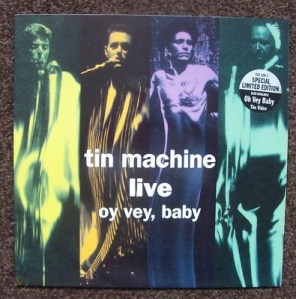
30 years ago this month, on 17 February 1992, Tin Machine played their last ever gig at the NHK Hall in Tokyo. It was the final date of the ‘It’s My Life’ tour.
It had been a period of ups and downs – ups in late October 1991 when Bowie proposed to Iman Abdulmajid in Paris, downs due to the drug problems of one band member (with the initials HS).
Some people never ‘forgave’ Bowie for TM but for many others the band represented his ’80s rehabilitation. I was fascinated from the get-go and for my money it spawned a fair share of classic David (sometimes co-written with Reeves Gabrels) songs: ‘I Can’t Read’, ‘Under The God’, ‘Amazing’, ‘Baby Universal’, ‘You Belong In Rock’n’Roll’, ‘Amlapura’, ‘Shopping For Girls’, ‘Goodbye Mr Ed’.
And it’s doubtful we would have got that brilliant Buddha Of Suburbia/1. Outside/Earthling triptych without TM.
Bowie agreed: ‘Once I had done Tin Machine, nobody could see me any more which was the best thing that ever happened, because I was back using all the artistic pieces that I needed to survive and imbuing myself with the passion that I had in the late seventies.’
True to his word, the band lasted three albums, though Bowie hinted it may have gone on longer had drug problems not reared their ugly heads. But it’s still hard to get hold of the last two records (Tin Machine II, Oy Vey Baby).
Here’s the second, penultimate night at the NHK on 6 February 1992. The sound quality is superb, though the audio cuts out completely around 45 minutes in and doesn’t return.
Gabrels sounds great, Bowie (sporting a ‘Rock Against Racism’ T-shirt) does too and there are some nice bits of ‘amateurism’ including several fudged song openings (Bowie’s guitar tech has very kindly turned down the volume of his 12-string before the start of the gig!). Some of this material was used for the final album Oy Vey Baby.
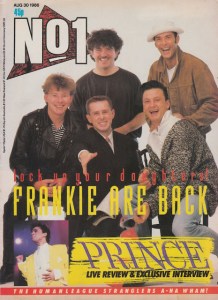
35 years ago today, on 12 January 1987, Frankie played the first of two nights at Wembley Arena on their final European Tour.
It’s oft forgotten that, even at their commercial peak, they played live. A lot. In fact they were on the road pretty much non-stop between autumn 1984 and summer 1985. And, make no mistake, they were decent musicians.
It’s not surprising they were so eager to show that they could cut it live. ‘Relax’ and ‘Two Tribes’ were mainly made in the control room by Trevor Horn and associates (Steve Lipson, JJ Jeczalik, Anne Dudley, Gary Langan, Andy Richards et al).
And vocalist Holly Johnson was getting most of the publishing royalties (fair enough, his Reagan-baiting lyric for ‘Two Tribes’ is brilliant: ‘Cowboy number one/A born-again, poor man’s son/On the air America/I model shirts by Van Heusen/Working for the black gas…’).
As Holly told NME in November 1983: ‘We were wary of being Trevor’s puppets at first but as soon as we met him that all went out of the window. He’s just a human being. He’s that little guy that used to be in The Buggles’!
So, initially at least, there wasn’t much bad feeling – they occasionally even let Uncle Trevor play live with them, as in this excellent performance on ‘The Tube’ from June 1984, augmented by Luis Jardim on percussion, a couple of keyboard players (wearing interesting shorts) and an extra guitarist (names please?):
According to (ZTT strategist/sleevenote-writer/A&R man) Paul Morley, Horn and his label boss/ manager/wife Jill Sinclair were convinced Frankie could break America, becoming something like The Village People! After all, ‘Relax’ made #10 in the US pop charts.
But surely the Sex Pistols is a better comparison (Frankie as punk’s last gasp? There’s a whole book there…). After all, Horn had just worked with – and hugely admired – Malcolm McLaren. For his part, Horn allegedly hoped the band would split up after ‘The Power Of Love’, their third UK number one in December 1984.
But Frankie didn’t split up. Instead, on their US tour of 1985, they would often open their set with Springsteen’s ‘Born To Run’. In the new Bruce-obsessed/Reagan-blessed America, this didn’t go down too well…
By 1986/1987, the thrills and spills had gone but Frankie had drastically improved as musicians and became a very slick live unit. They toured second album Liverpool extensively, using a lot of pre-recorded backing tracks and retaining an extra keyboard player and guitarist.
The very good quality tape of the first Wembley gig is well worth listening to. The crowd seems made up of screaming teenage girls and there are excellent versions of ‘The Power Of Love’ and ‘Two Tribes’.
‘Maximum Joy’ becomes a whole new thing even if the rest of the Liverpool material doesn’t deviate much from the album. And it’s always a laugh hearing Holly’s laconic between-song banter.
Rumour has it that backstage after this first Wembley gig the band had the mother of all fall-outs. But somehow they got through their 1987 European tour, and found time to play again on ‘The Tube’ for the last time (Faith No More were definitely watching, at least from a sartorial point of view).
Maybe they could they have carried on but it didn’t seem enough to be a ‘good band’ any more – people wanted events, sensations. Also Holly was itching for a solo career, still smarting at the terrible deal the band had signed with ZTT.
Legendary producer/engineer Glyn Johns has worked with many of the biggies (The Beatles, Led Zep, The Stones, The Who), but arguably his most important task was putting together the Action for Research into Multiple Sclerosis (ARMS) concerts on Ronnie Lane’s behalf.
For the London iteration – taking place at the Royal Albert Hall on 20 September 1983 – Johns opened his address book and assembled a tremendous lineup of Brit greats: Jimmy Page, Eric Clapton, Jeff Beck, Steve Winwood, John Paul Jones, Andy Fairweather-Low, Bill Wyman, Kenney Jones, Charlie Watts.
The whole concert is worth watching and occasionally superb (check out Clapton’s versions of ‘Lay Down Sally’ and ‘Cocaine’), but Beck’s set is particularly fascinating. It was three years since his (superb) last studio album There And Backand he hadn’t played a major gig for almost that long.
A clearly under-rehearsed band did their best with the RAH’s famously dodgy ‘rock’ sound (despite Beck’s gorgeous stereo delay, if you’re listening on headphones/speakers), not helped by drummer Simon Phillips being set up about 20 yards behind the rest of the group!
But it’s a great success, mainly through the musicians’ sheer force of will and Beck’s outrageous playing (check out his solo on ‘Led Boots’). The Tony Hymas/Fernando Sanders/Phillips rhythm section is terrific, and there’s even a funny version of ‘Hi Ho Silver Lining’ featuring Beck’s reluctant vocals alongside Winwood and Fairthweather-Low.
Just over 20 years later, on 24 June 2004, Beck was back at the Albert Hall for his 60th birthday gig, and I had a good seat. His live outings were much more common at this point; recently he’d played Hyde Park and also celebrated 40 years in the music biz at the Royal Festival Hall with John McLaughlin and The White Stripes.
But this concert was particularly notable for featuring enigmatic keyboard genius Jan Hammer, one-time Mahavishnu member and chief collaborator with Beck on Wired and There And Back. Making up the numbers were the phenomenal Mondesir brothers: Mike on bass, Mark on drums.
Beck hardly seemed to have aged. Wearing black jeans and black vest, he stalked the stage like a born showman, exchanging grins and winks with Hammer, occasionally punching the air to emphasise a musical flourish.
However, things started a little uncertainly; ‘Freeway Jam’ and ‘Star Cycle seemed leaden. But by the time Beck roared into ‘Big Block’, the energy level of the band had gone up two or three notches.
Old favourites ‘Goodbye Pork Pie Hat’, ‘Where Were You’ and ‘Blue Wind’ seemed to mean little to the Albert Hall audience but the long-hairs reacted more positively to Beck’s most recent work from albums like You Had It Coming and Who Else?.
There were some unintentionally amusing Tap-esque moments too, like the big-screen footage of Jeff’s souped-up hot rods during ‘Big Block’ and the cloud of dry ice which almost engulfed him during ‘Goodbye Pork Pie Hat’.
For the encore, Ronnie Wood sauntered on to play a charmingly ramshackle version of The Meters’ ‘Cissy Strut’. Two old rockers from Surrey playing a funky New Orleans anthem? That’s the majesty of fusion!
So, while they’re still around, let’s cherish El Becko and the best of British. (And I can’t believe this is the first time I’ve featured Jeff – one of my all-time musical heroes – on this website. Better late than never.)
In an interview, Randy Newman once talked about how, on his self-titled debut album, he tried to use the orchestra rather than the drums to ‘move things along’.
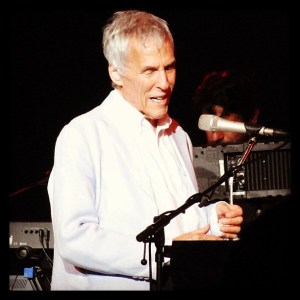
It was impossible not to think about that while watching Burt Bacharach’s triumphant Hammersmith gig last night, featuring a large band and huge string section.
This is music relying on texture, melody and counterpoint – it’s the world of Pet Sounds and Oliver Nelson’s The Blues And The Abstract Truth, with barely a guitar lick or drum fill.
Every chord has a flavour and intention – but few of the voicings are quite how you remembered them. ‘I’ll Never Fall In Love Again’, ‘This Girl’s In Love With You’ and ‘Alfie’ were elliptical and mysterious last night, with beautiful, ‘floating’ harmony.
Joss Stone treats any stage like her backyard, totally at ease, barefooted and gorgeous. And if she did a great job on the melodic, medium-paced material (‘Walk On By’, ‘Wishin’ And Hopin”, ‘Say A Little Prayer’), sometimes there was a ‘screechy’ element to her voice when improvising on the slower tracks.
And some may have found her between-song ‘chats’ with Burt a little mawkish. But to be fair he did tell some good stories, particularly the one about being inspired by Ursula Andress – not his then-wife Angie Dickinson – to write ‘The Look Of Love’ for the original ‘Casino Royale’ movie.
And though Hal David’s name was only mentioned once by Bacharach, the lyricist’s influence hung heavy over proceedings. It came to mind just how brilliantly he evoked the nooks and crannies, the high stakes, of all romantic relationships, particularly when one party is looking for the door.
The inclusion of some more recent stuff was a revelation to this writer, particularly a couple of fervent – though musically gentle – anti-Trump songs, and the remarkable Elvis Costello co-write ‘This House Is Empty Now’, with its stratospheric middle eight and an excellent vocal from John Pagano.
‘On My Own’ and ‘Close To You’ were reinvented as spine-tingling, slow-motion ballads, even slower than the originals, while Josie James’ powerful take on ‘Anyone Who Had A Heart’ got the biggest ovation of the evening. Such is Bacharach’s range as a songwriter, you kept hoping he would throw in a few more outliers, ‘Arthur’s Theme (Best That You Can Do)’ or ‘Love Power’.
But ‘That’s What Friends Are For’ was the perfect closer, sending us out into that good night with a smile (though it was odd that Joss didn’t return for a final song).
One left the gig uplifted but also, truth be told, emotionally spent. Still, it was a weird, wonderful, affecting two hours of pop music. And you try to tell the kids these days…
If this was John’s final London gig, what a way to go out.
Though the audience’s response was at times reverential and/or strangely undemonstrative, the outpouring of emotion at the conclusion was heartfelt and seemed to come as quite a shock to the performers too.
It’s hard to think of another ‘jazz’ band which has endured for so long with the same personnel as The 4th Dimension. This unit (McLaughlin – guitars, Gary Husband – keyboards/drums, Etienne M’Bappe – bass, Ranjit Barot – drums) has toured the world and elsewhere since 2010, playing a fiery mix of jazz, rock, blues, Indian, old-school R’n’B and industrial.
Tonight was no exception, though there was a much larger dose of spiritual jazz than usual, courtesy of not one but two Pharoah Sanders covers: ‘The Creator Has A Master Plan’ and ‘Light At The Edge Of The World’. You could take or leave the slightly dodgy band singing, but the message of love and understanding was powerful and still relevant.
One can also take or leave John’s guitar tone these days (sometimes one wishes for a far less ‘refined’ sound), but his playing sounded back to its brilliant, fluid, lyrical best tonight, a little like his return to the electric in 1978 after the long acoustic sojourn in Shakti.
And if the mood of the evening’s music was generally uplifting, with new takes on the frenetic modern classic ‘Hijacked’, Mahavishnu favourite ‘Trilogy’ and raunchy ‘Echoes From Then’, ‘Gaza City’ was heartfelt and touching, a lament for a lost place.
Just a few gripes: one occasionally hankered after another soloing foil for John, an L Shankar or Gary Thomas; this music asks a hell of a lot from Husband and Barot. Also, listening to the latter’s ‘hit everything all the time’ ethos (though his konnakol vocal/rhythmic interludes are always fascinating), one realised what a tasteful, selective drummer Dennis Chambers had been during the ’90s organ trio/’Heart Of Things’ era.
John started the evening heralding a slight return not to Great Britain but to ‘Great Brexit’, and ended it with a gentle: ‘You’re all one. Thank you’. A powerful, important concert, especially if we don’t see him on a British stage again.

 35 years ago this weekend, French synth pioneer Jean-Michel Jarre played two concerts in an area of East London known as Docklands, next to the River Thames.
 We’ve all done it – surveyed an ad for an upcoming gig and said of a band: ‘Whoa – they’re playing not one but THREE nights at Wembley/wherever?!’.
 This was a twice-rescheduled London gig, initially designed to celebrate the 40th anniversary of On-U Sound Records.
 I wasn’t sure I was going to write about this but Bowie came to me in a dream a few days ago and said I must! I’m under orders…
 35 years ago today, on 12 January 1987, Frankie played the first of two nights at Wembley Arena on their final European Tour.

 In an interview, Randy Newman once talked about how, on his self-titled debut album, he tried to use the orchestra rather than the drums to ‘move things along’.
  If this was John’s final London gig, what a way to go out.
