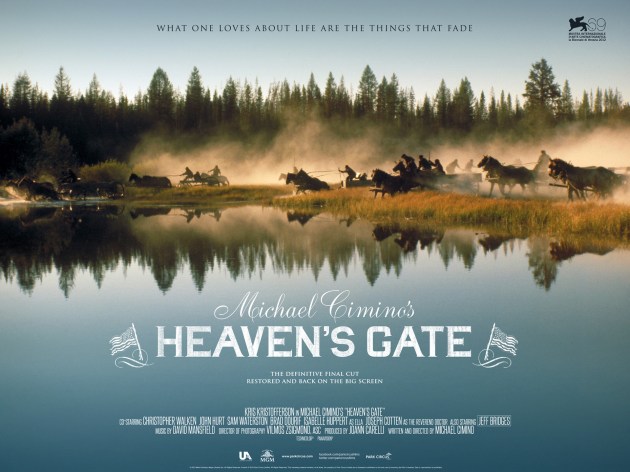
The Crap Movie Club: Heaven’s Gate (1980)

It’s difficult to view a film like ‘Heaven’s Gate’ these days shorn of all the hoo-ha that accompanied its troubled production and disastrous cinematic release (outlined in the definitive book and documentary ‘Final Cut‘).

But let’s give it a try. It was of course the notorious movie that destroyed United Artists and pretty much ended the New Hollywood ideal of director-as-auteur; the $44 million turkey which grossed just $1.2 million at the box office.

Writer/director Michael Cimino went looking for ‘the poetry of America’ in his film about the Johnson County War of 1896, when the Wyoming Stock Growers’ Association decided that new settlers – mainly poor, immigrant homesteaders – were stealing cattle, decreeing that 125 of these so-called thieves be hunted down and either hung or shot.

Though Cimino’s film ends with a battlefield bloodbath (including many horses in apparent physical peril which led him into a further unwanted lawsuit), history records that ‘only’ two people lost their lives in the Johnson County War.

But, defending his screenplay and movie to the end, Cimino clung steadfastly to one of his directing/writing credos: ‘I use history freely’.

But, historical license aside, how much of a turkey is ‘Heaven’s Gate’ really? Can any movie starring Kris Kristofferson, Jeff Bridges, Christopher Walken, Brad Dourif, Mickey Rourke, Sam Waterston, John Hurt and Isabelle Huppert really be such a dog?

Yes. ‘Heaven’s Gate’ is that special kind of crap movie, the indulgent folly that spews elongated scenes out all over the place in the hope that something will stick.

Vilmos Zgismond’s camerawork is of course gorgeous; grainy and sepia-tinged, frequently reminiscent of the era’s stills photography. The movie frequently delivers the awesome image, including one famous panning shot across immense smokestack chimneys and hoards of wandering, displaced immigrants.

The Oxford-filmed opening graduation ceremony is also plush, striking and gloriously evocative.

Jeff Bridges. Isabelle Huppert and Kris Kristofferson

But then there’s the inaudible dialogue and strange, schizoid reaction shots. As the film progresses, Kristofferson becomes more and more inactive and dramatically impotent, while Bridges, Dourif, Hurt and Rourke are chronically underused.

Huppert is virtually incomprehensible in a fairly thankless role (turned down by every major female star of the era including Jane Fonda and Diane Keaton).

Cimino’s war metaphor in ‘The Deer Hunter’ was Russian roulette, but this time it’s endless cock-fighting, waltzing and rollerskating.

He clearly feels that the film says something important about America’s treatment of its poor and disenfranchised (and it’s certainly interesting viewing that aspect through modern eyes), but unfortunately the scenes of political wrangling/bargaining are interminable.

Pauline Kael memorably said that it was easy to think about what to leave out of ‘Heaven’s Gate’ but hard to think what to leave in. That’s the impression left with this writer too.

Quite frankly, apart from the stunning photography, one of the few pleasures watching the film again was spotting the gorgeous Rosie (‘Roseanne’ in the credits) Vela’s small but important cameo (see below). ‘Magic Smile’ indeed.

Crap Lyrics Of The 1980s (Part Two)

I thought I had unearthed all of the decade’s stinkers in movingtheriver.com’s extensive first round-up.

Boy was I mistaken. And I feel pretty confident that there will be many more to highlight as the weeks, months and years roll by.

So here we go again with some more logic-defying, ill-conceived, harebrained – and sometimes just plain weird – song lyrics of the 1980s. China Crisis obsessives: look away now…

Most of my friends were strangers when I met them
BROS: ‘I Quit’

I watch you crumble/Like a very old wall
BROS: ‘I Owe You Nothing’

‘He’s lost in a maze/Of difficultays’
BILL BRUFORD: ‘Gothic 17’

‘Start your journey/Early or maybe later’
KING: ‘Love And Pride’

Why do you do that poor man thing/Why do you do that poor man/All of my life it’s as sharp as the bigger the punch I’m feeling’
CHINA CRISIS: ‘Bigger The Punch I’m Feeling’

‘Work in my world/Put up for sale/You buy you me/I buy me you’
CHINA CRISIS: ‘The Highest High’

This wreckage I call me/Would like to frame your voice’
GARY NUMAN: ‘This Wreckage’

I was walking in the park/Dreaming of a spark’
MARILLION: ‘Lavender’

‘Take on me/Take me on’
A-HA: ‘Take On Me’

We made our love on wasteland/And through the barricades’
SPANDAU BALLET: ‘Through The Barricades’

All we want is our lives to be free/If we can’t be free then we don’t want to be we’
CURIOSITY KILLED THE CAT: ‘Free’

‘If I was you/If I was you/I wouldn’t treat me the way you do’
EIGHTH WONDER: ‘I’m Not Scared’

Words don’t come easy to me/How can I find a way/To make you see I love you?’
FR DAVID: ‘Words’

‘I’m young and free and single/I just want to mingle with you, lady’
SUNFIRE: ‘Young Free And Single’

Can’t complain/Mustn’t grumble/Help yourself to another piece of apple crumble’
ABC: ‘That Was Then But This Is Now’

Hello, hello, hope you’re feeling fine/Hello, hello, hope you’re feeling mine/Hello, hello, hope you’re feeling time’
NICK HEYWARD: ‘Whistle Down The Wind’

A motivated, liquidated nightmare/Like a baby with a laser on a rocking chair’
IT BITES: ‘Black December’

Here is my heart/Waiting for you/Here is my soul/I eat at chez nous
YES: ‘Love Will Find A Way’

We’re talking away/I don’t know what to say/I’ll say it anyway/Today is another day to find you’
A-HA: ‘Take On Me’

Swing Out Sister: It’s Better To Travel 30 Years Old Today

Though they emerged as a quintessentially-1980s pop act, Swing Out Sister had impeccable post-punk credentials.

Keyboardist Andy Connell had played with Factory Records-signed A Certain Ratio before SOS, drummer Martin Jackson had previously worked with Magazine and The Chameleons while singer Corinne Drewery had sung back-up with Working Week amongst others.

The result was a musically-rich, very commercial take on the self-contained recording ‘project’ in the Yazoo/Scritti/Steely mould. But Swing Out Sister’s USP was taking influences from the mid-’80s UK jazz revival and filtering them through ’60s pop and the burgeoning House scene.

Young tyro Paul Staveley O’Duffy, fresh from his work with Hipsway, was brought in to produce – an inspired choice. He recruited Pat Metheny/Frankie/ABC arranger Richard Niles for the horns/strings and mobilised the UK session elite (Wix, Guy Barker, Luis Jardim, John Thirkell, Gavin Wright, Chris Whitten, Jakko et al).

It’s Better To Travel was a fascinating mashup of jazz, early house, ZTT techno-flash and pop. First, the jazz. It’s all over the album: ‘After Hours’ has a melody line straight out of Joe Zawinul’s ‘In A Silent Way’. The verse of ‘Communion’ borrows liberally from Miles Davis’s ‘Milestones’ (and sounds a bit like Sade being produced by Trevor Horn) and also has an instrumental break reminiscent of Weather Report’s ‘Teen Town’.

‘Twilight World’ and ‘Fooled By A Smile’ are cracking pop songs with dynamic horns, memorable string arrangements and hints of Dusty and Bacharach. ‘Breakout’ may be one of the more irritating hits of the late ’80s (making the top 10 hit in both UK and US) but musically it’s far superior to the usual ’80s chart fare.

‘Surrender’ still sounds fantastic today, a modal dancefloor track with intricate backing vocals, epic strings and a cool Guy Barker trumpet solo. It was also another top 10 hit (UK #7).

Minor tracks ‘Blue Mood’ and ‘It’s Not Enough’ are more synth-pop than pure-pop, but still very likable, and It’s Better To Travel closes with a dramatic instrumental (‘Theme’) which channels John Barry’s memorable movie scores.

O’Duffy also does a sterling job with the mix: it’s very easy on the ear, not too loud or bassy. It’s music that breathes. It’s Better To Travel was one of the best pop debuts of the 1980s and also a big hit, making #1 in the UK charts.

Swing Out Sister waited a couple of years to release their followup, by which time they’d mainly ditched the house and jazz influences in favour of a far more poppy sound. But It’s Better To Travel still produces a very pleasant contact-high for summer 1987 – good days, good days, as Derek Smalls once said.

Jonathan Demme (1944-2017)

Reading obituaries of director Jonathan Demme, who has died from cancer aged 73, it struck me how many memorable scenes his films spawned.

Born in Baldwin, Long Island, his early career was mentored by B-movie pioneer Roger Corman.

When Demme broke into Hollywood he never lost sight of his early exploitation influences and zany sense of humour; even ‘serious’ fare like ‘Silence Of The Lambs’ and ‘Philadelphia’ was hijacked by sundry in-jokes and bizarro guest stars including Corman, Chris Isaak and George A Romero.

Demme’s sets were famous for being fun places to work, and that’s borne out by the bonhomie and improvisatory vibe present in many of his films.

He was clearly a friend of musicians, frequently using music in his movies as symbol of collaboration or even spiritual release (writer David Bowman memorably described ‘Stop Making Sense’ as ‘a three-act play documenting the spiritual journey of a hapless white guy trying to “get down”’!).

Apparently Demme sat down with each original member of Talking Heads before filming ‘Stop Making Sense’ and asked them, ‘How do you see me doing this?’ It’s hard to imagine Brian De Palma doing that.

As a live-music documentarian, Demme let the viewer get to know each performer as if they were a character in a movie with the use of long, lingering shots, a world away from the clichéd, fast-cutting MTV style.

So, in tribute to a modern master, here are a few memorable moments from Demme films, in chronological order:

6. ‘Stop Making Sense’ (1984)

5. ‘Something Wild’ (1986)

4. ‘Swimming To Cambodia’ (1987) (swearing alert)

3. ‘Married To The Mob’ (1988)

2. ‘Philadelphia’ (1993)

1. ‘Rachel Getting Married’ (2008)

Frank Zappa: Ship Arriving Too Late To Save A Drowning Witch 35 Years Old Today

This is the first Zappa album I ever bought.

It was a cheapo Fame Records/EMI cassette edition. Before Ship, I had only heard choice cuts courtesy of a friend’s career-spanning compilation.

I was going to say that Ship was not the ideal album to start with, but actually with hindsight it probably was; it’s maddening, brilliant, tawdry, overblown – basically a microcosm of Zappa’s ’80s output.


Ship ditched the lush, multi-tracked sound of 1981’s You Are What You Is in favour of a no-reverb, claustrophobic mix featuring Chad Wackerman’s busy drums, blaring synths, in-your-face bass and loads of wacky guitar processing.

Opening track ‘No Not Now’, concerning the sexual dilemmas of a long-distance truck driver, is a six-minute disaster area that would surely test the patience of even the most diehard Zappa fan.

‘Valley Girl’ placed killer new-wave rock around daughter Moon’s hilarious vocal exclamations. It was a typically bold, spontaneous and very successful career move by FZ resulting in a timely hit single (peaking at #32 in the US).

But we then unfortunately segue into ‘I Come From Nowhere’, a fairly unlistenable track about the inanity of TV personalities with a ghastly vocal performance by Roy Estrada over an uninvolving, sub-Men At Work riff.

But side two of Ship demonstrates all that’s essential about ’80s Zappa. It should really be heard in its totality. The title track is surely one of his career highlights, a unique, surrealistic 12-minute salvo featuring spoken-word, ‘scatting’, a great rock guitar solo over a grinding 9/8 vamp, a blizzard of avant-garde piano/percussion and even a quote from Stravinsky’s ‘Rite Of Spring’ (of course also a piece about ritual sacrifice).

‘Envelopes’ is a brief but brilliant through-composed tribute to Conlon Nancarrow featuring close-interval, player-piano perversions, while ‘Teenage Prostitute’ is the R-rated version of ‘Valley Girl’, a hellish vision of Hollywood’s underbelly complete with ‘Peter Gunn’ riffs, intricate marimba and operatic vocals by Lisa Popeil.

I was in. I would immediately go back/forward and investigate FZ’s career in more detail. Next up was Sheik Yerbouti, the first CD I ever bought and probably my favourite Zappa album.

Ry Cooder: The Slide Area 35 Years Old Today

Gavin Lambert’s 1959 book ‘The Slide Area’ was a collection of inter-related stories about a group of Hollywood’s lonely losers.

His theme was that California’s natural phenomena made ‘normal’ behaviour virtually impossible.

‘The Slide Area’ obviously rang a bell with Ry. His 1982 album of the same name also featured an array of characters not exactly thriving in the Dream Factory.

But it also turned out to be almost the complete opposite of Cooder’s commercial breakthrough, 1979’s slick, sparkling, digitally-recorded Bop Til You Drop.

The Slide Area sounds like what it is – a rough-and-ready band, often audibly cued by Cooder, playing songs of varying quality live in the studio with minimal, if any, overdubs.

‘Which Come First’, ‘Yes It’s Me And I’m Drinking Again’ and ‘Mama Don’t You Treat Your Daughter Mean’ are incredibly loose, with some bum notes and tentative moments left in. Ry’s vocals are similarly raw but full of passion. On ‘Mama…’ he sounds a bit like Bobby ‘Blue’ Bland.

Drummer Jim Keltner is uncharacteristically hyperactive, speeding up drastically on almost every song (definitely no click tracks involved with this album), but full of creativity on what sounds like a homemade kit with timbale, double kick drums, a trash can and a few different snares.

Cooder composes a lot more than on recent albums and even co-writes an ’80s classic with Keltner, ‘UFO Has Landed In The Ghetto’, which finds time to gently lampoon disco, rap and funk with references to the Bee Gees and George Benson.

But perhaps predictably the three cover tunes are the standouts: a Tex-Mex version of Curtis Mayfield’s ‘Gypsy Woman’, funky take on Dylan’s ‘I Need A Woman’ and a gloriously arse-over-tit ‘Blue Suede Shoes’.

But The Slide Area also marked the end of an era. Americana, roots music and blues were out, synths and drum machines were in.

It was the end of the sort of albums Little Feat, Van Dyke Parks, the Doobie Brothers, Bonnie Raitt, Randy Newman and Ry made with Warner Bros and the beginning of the sort of albums Madonna, Pat Benatar and Laura Branigan were making.

Live, it was a different matter – Ry was still a big draw in 1982, playing legendary gigs at the Hammersmith Odeon (my dad took me to one night, maybe my first ever major gig) and big shows all over Europe. But that too proved a false economy.

‘Someone yelled “Think of the money!” from the audience (during a 1977 Hammersmith Odeon gig). I’d like to show him my bank balance. I could never make a dime doing anything. I came back to California in debt. I’d make a record and I’m broke cos they’re not making any money, they don’t sell. I said, to hell with it,’ Ry told Q Magazine in 1987.

It was back to the movie soundtracks. For a while…

Laurie Anderson: Big Science 35 Years On

The 1980s were littered with ‘novelty’ hits but perhaps none was more unexpected – or more powerful – than Laurie Anderson’s John Peel-endorsed, eight-minute UK #2 ‘O Superman (For Massenet)’.

Massenet was a French composer, whose aria ‘Ô Souverain, ô juge, ô père’ (‘O Sovereign, O Judge, O Father’) appeared in the 1885 opera ‘Le Cid’.

‘O Superman’ was totally hip at the time, a slice of NYC avant-garde post-punk appearing in the slipstream of Talking Heads’ ‘Once In A Lifetime’.

David Bowie was a big fan, covering the song during his 1997 Earthling tour. It still sounds unique and pretty hip today, even managing to throw in a little ode to Philip Glass with its brief, circular melodic motif that appears a few times.

A live performance of ‘O Superman’ was recorded in New York City in the week following the 9/11 attacks, and later appeared on the album Live In New York.

In this context, certain lyrics seem to take on greater significance: ‘Here come the planes/They’re American planes/Smoking or non-smoking?’ But Anderson has intimated that the song was inspired by watching television news reports of the Iran hostage crisis of 1979/80.

‘O Superman’ came from Anderson’s performance art/music piece ‘United States I-IV’, and was initially released as a single on the indie One Ten label. When it quickly sold out of its initial run of 1,000 copies, Warners picked it up and also asked for a whole album of music from the show.

What about the rest of Big Science? Not having heard it for a few years, I approached it with trepidation. But there was no need – ‘From The Air’ and ‘Sweaters’ (‘I no longer love the way you hold your pens and pen…cils’) are still very funny, but also oddly disquieting.

Lyrically, Big Science – like the performance piece it comes from – seems to be satirising the rebirth of American ‘heroism’ and industrial might of the Reagan era.

Anderson often speaks with (and mocks) the ‘voice of authority’, someone who, as she later said in an interview, is ‘either a shoe salesman or someone who wants to sell you an insurance policy you don’t want or need’ (now who does that remind you of…).

But there’s always a clash between this technological brave new world and spiritual binds that hold us together – family (‘O Mom and Dad…’), folklore and tradition.

The title track rams home the point with its ‘primitive’ percussion and vocals that sound vaguely like Native American chanting. ‘O Superman’ also does it with its initial focus on a piece of new technology – an answering machine – and then more metaphysical concerns (justice, God, love).

As the 1980s wore on, Anderson’s studio albums possibly suffered from being right on the ‘technological cutting edge’, but Big Science revels in simple acoustic/electric juxtapositions – some Velvet Underground drums here, an analogue synth, Vocoder or Harmonizer there, plus sax, percussion and treated violin.

Occasionally it would be nice to hear an instrumental solo, maybe someone of the NYC-art-rock-approved school such as Shankar or Jon Hassell, but generally Anderson keeps it simple and maintains a very assured minimalist musical style throughout.

Big Science slightly outstays its welcome, its last two tracks quite a stretch, but overall still sounds like a vital piece of work from a major, treasured artist.


Allan Holdsworth (1946-2017)

With the sad death of Allan Holdsworth, we have lost another guitar great and one of the UK’s most singular musicians.
There’s an old muso cliché that seems to lend itself to guitarists more than other players – ‘he/she’s a musician who just happens to play the guitar’.

It certainly applies to Allan. He came up with an entirely original soundworld, feted by the likes of Eddie Van Halen, Frank Zappa, Joe Satriani, Steve Vai and John McLaughlin.

From a young age, Holdsworth always revered horn players – particularly Cannonball Adderley, Charlie Parker, Eric Dolphy, John Coltrane and Michael Brecker – above guitarists, but, given a guitar by his father as a teenager, decided to pursue his love of music using that tool. In doing so, he revolutionised the instrument, fashioning a unique legato technique.

The aim was a smooth, soaring sound which lent itself to horn-like improvisation, allowing him to play fiery, exciting solos with huge intervallic leaps. His chord work was underrated and equally innovative, using close-interval voicings and ridiculously large stretches. He came up with an entirely personal series of ‘chord scales’, loathing standard chord shapes and even calling them ‘disgusting’ on his instructional video!

The first time I heard Allan’s playing was his extraordinary solo on Stanley Clarke’s ‘Stories To Tell’ from the album If This Bass Could Only Talk, but it took me a while to identify him since my cassette didn’t list the personnel… To my ears, it was just a remarkable solo; I didn’t even particularly ‘hear’ it as a guitar.

In the late 1980s, as I started reading various American muso mags, Allan’s name popped up frequently – it was time to explore his career in more depth. In the early to mid-1970s, he guested with Soft Machine, Nucleus, Tempest and Gong. Master drummer Tony Williams came calling, and he hot-footed it over to New York for 18 months of recording and touring with the New Lifetime band.

He then joined Bill Bruford in one of the greatest ever fusion units alongside Jeff Berlin and Dave Stewart, then formed prog supergroup UK with Bruford, Eddie Jobson and John Wetton (playing a legendary solo on ‘In The Dead Of Night’). He also forged a brief but fruitful musical relationship with violinst Jean-Luc Ponty.

An early solo album, 1976’s Velvet Darkness, was virtually disowned by Allan despite featuring Narada Michael Walden on drums and Alphonso Johnson on bass. But he spent the 1980s embarking on a far more fruitful solo career.

Endorsed by Eddie Van Halen and Frank Zappa, mainstream success beckoned in the mid-’80s, but a high-profile Warner Bros contract came and went very briefly with only an EP Road Games to show for it.

It didn’t hold him back though; in fact it led to probably his most commercially successful period – Metal Fatigue, Atavachron and Sand were all important statements.

The period between 1988 and 1994 was arguably Allan’s peak – superb solo albums like Secrets, Then!, Hard Hat Area and Wardenclyffe Tower came out and he contributed striking guest spots to albums by Level 42 (Guaranteed), Stanley Clarke and Chad Wackerman (Forty Reasons). He was even lured to share the stage with Level for a month-long Hammersmith Odeon residency in 1990.

Like fellow ex-pats Richard Thompson and Morrissey, he made California his home, moving there in the early 1980s and forging valued musical relationships with Vinnie Colaiuta, Jimmy Johnson and Scott Henderson.

Henderson spoke of his incredible generosity in the studio. Drummer Kirk Covington – who recorded with Allan on the ‘standards’ album None Too Soon – reported that sessions at his home studio were always curtailed at 7pm at which point Allan would hand out pints of his home-brewed cask ale.

The complexity of his style meant that Allan influenced relatively few guitarists, though for my money Henderson and Francis Dunnery adapted some of his techniques to great effect. Fellow Yorkshireman John McLaughlin once said, ‘I’d steal everything Allan was doing if only I could figure out what he was doing!’

I saw Allan several times in concert; at the Bloomsbury Theatre, Jazz Cafe, Ronnie Scott’s, Queen Elizabeth Hall and twice with Level 42 at Hammersmith. He was notoriously self-critical, but to my ears achieved a remarkable consistency in the live context.

A 12-CD career-spanning box set The Man Who Changed Guitar Forever has just been released on Manifesto Records. Allan was also working on a long-awaited new studio album at the time of his death. He spoke about both projects in this recent podcast.

Farewell to a master. We won’t see his like again.

Allan Holdsworth, guitarist and composer, born 6 August 1946, died 15 April 2017

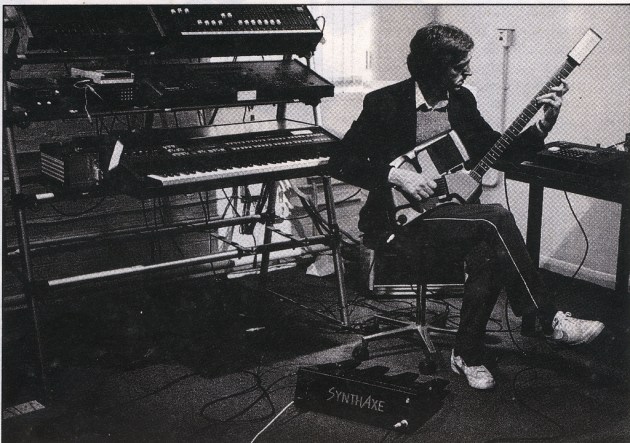
Allan, Chad Wackerman and Jimmy Johnson in concert

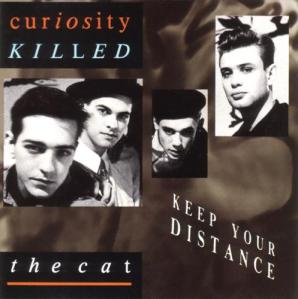
Curiosity Killed The Cat: Keep Your Distance 30 Years On

If you’d taken a walk along London’s King’s Road in the summer of 1987, chances are you would have seen a lot of lads who looked just like Curiosity Killed The Cat; jeans from Dickie Dirts in Westbourne Grove, black polo neck, white T-shirt or Fred Perry, bomber jacket or cardigan, loafers or Doc Martens, and a flat-top haircut with a bit of gel.

Certainly most of the girls at my school fancied Curiosity. But then there was the music. You knew they had raided their parents’ cool record collections – they had a bit of Sly & Robbie, Trouble Funk, Robert Palmer, Dr John, Michael McDonald and Chic in there, also a large dollop of Little Feat.

Singer Ben Volpeliere-Pierrot had a light, attractive baritone voice, some eccentric dance moves and ‘relaxed’ stage patter. Drummer Migi Drummond and bassist Nick Thorpe definitely knew where ‘one’ was, and the band rounded out their sound with some fine horn and percussion arrangements.


Curiosity were the slightly sloaney South-West London lads who found the funk, probably the most musically accomplished of ’80s ‘teenybopper’ bands.

They formed in 1984 from the ashes of Twilight Children, a post-punk band originally formed by Drummond and Thorpe. Offered studio time by family friend Eric Clapton, they cut a number of demos and quickly got the attention of businessman/impressario Peter Rosengard, who became their manager.

Curiosity played their first gig at London’s Embassy Club in December 1984 and quickly picked up quite a big live following. After co-writing ten tracks with session keyboardist Toby Andersen, they were snapped up by Phonogram/Mercury Records in summer 1985 after a considerable bidding war.

Simply Red/Crusaders/Randy Crawford/Sly and the Family Stone producer Stewart Levine was selected to rescue their debut album after aborted sessions with Sly & Robbie, Paul Staveley O’Duffy and Culture Club’s Roy Hay.

First single ‘Misfit’ stiffed in August 1986, even though its video featured early champion Andy Warhol (who writes amusingly about Curiosity in his diaries). But ‘Down To Earth’ crashed into the top 10 soon after and Keep Your Distance went straight into the UK album charts at number one in April 1987, and also made the US top 60.

A rereleased ‘Misfit’ then hit the UK top 10, and the Staveley O’Duffy-produced ‘Ordinary Day’ was a further hit. A fourth single, the Sly & Robbie-helmed ‘Free’, missed the top 40 entirely, possibly because its chorus featured one of the most hare-brained lyrical couplets of the decade.

But apart from Keep Your Distance‘s singles – all of which stand up pretty well these days – the album’s deep cuts showcase what the band were all about: the rather lovely ‘Red Lights’ and shimmering ‘Know What You Know’ are a winning fusion of Sade and Little Feat.

Andersen was dumped by the band just three months after the album’s release. He kvetched about it to Q Magazine in the December 1987 issue, saying ‘I suppose it could have been down to looks…’ Ben V-P disagreed, saying Andersen’s replacement ‘was just a better player’. What did Toby do after Curiosity? A Discogs search doesn’t reveal much beyond a few sessions for Belouis Some.

Curiosity’s impact was sudden, but their success short-lived. Why? Sacking a key songwriter and then waiting two years to release a follow-up didn’t help. Also their good looks and immediate success skewed record company expectations which would subsequently be almost impossible to fulfil, and also possibly blunted their musical potential.

Who knows what else they could have achieved? With a bit of luck and better guidance, they might have developed into a Simply Red-style crossover soul/funk band, if that’s what they wanted to do. Still, they departed the 1980s with two very decent studio albums and some memorable gigs.

XTC: Skylarking Uncovered

It’s only natural that a young(ish) man’s fancy should turn to Skylarking at this time of year.

And though I must have listened to it tens of times, Steven Wilson’s new instrumental mix uncovers many of the album’s sonic secrets.

Though lead songwriter/vocalist Andy Partridge had a somewhat ‘strained’ relationship with producer Todd Rundgren, this version demonstrates once and for all that Todd played a blinder on Skylarking, as arranger, sound designer, occasional keys player and backing vocalist.

And the others (Dave Gregory, Colin Moulding, Prairie Prince, sundry guest players) weren’t too shabby either.

Things to listen out for: the charmingly ramshackle 12-string guitars and Mellotron underpinning ‘Summer’s Cauldron’, the dramatic cello gracenotes that punctuate ‘Grass’, Partridge’s Stax-flavoured guitar and Todd’s synths on ‘That’s Really Super Supergirl’, Gregory’s superb piano on ‘Ballet For A Rainy Day’ and ‘Season Cycle’ and intricate guitar on ‘Earn Enough For Us’, the mad mariachi trumpets that kick off ‘Big Day’, Prairie’s subtle drums on ‘Mermaid Smiled’, and…well, you get the idea.

It seems unlikely that this will appeal to any but the most hardcore XTC fans, but who knows? The top-notch songcraft and synaesthetic textures may even draw in some new punters.