King Crimson: Beat @ 35

If you were to ask fans of 1980s King Crimson why they love the band, lyrics probably wouldn’t be a priority.

But, pushed hard by Robert Fripp and possibly influenced by the 25th anniversary of Jack Kerouac’s ‘On The Road’, Adrian Belew came up with some choice words on Beat, the excellent second album from this remarkable quartet which was released 35 years ago today.

References to the Beat writers abound; ‘Neal and Jack and Me’ concerns Kerouac and his best friend Neal Cassady and mentions several significant Kerouac works; ‘Heartbeat’ is the name of a book written by Cassady’s wife Carolyn about her experiences with the Beats; ‘Sartori In Tangier’ references the Moroccan city where a number of Beats resided; ‘Neurotica’ shares its title with a very influential Beat-era magazine; and presumably ‘The Howler’ refers to Allen Ginsberg’s ‘Howl’.

As the saying goes, you take inspiration where you find it, and Belew had come up with a very handy concept on which to hang the new band improvisations.

Musically, Beat is a brilliant development of the Discipline sound. ‘Neurotica’ and ‘The Howler’ feature some remarkable, unhinged ensemble playing, teetering on total chaos.

On the latter, Bill Bruford delivers intricate patterns on his acoustic/electric kit (with shades of Steve Reich, acknowledged with Bruford’s credit for ‘Drumming’).

Belew’s white-noise guitar outburst is a killer (he repeats the trick on ‘Waiting Man’ and ‘Neal’, extending his palette of sounds from Discipline and sometimes tuning his high E string down to a C).

‘Sartori’ is a superb vehicle for Fripp while ‘Waiting Man’ demonstrates the amazing rhythm dexterity of the band, a development of the ‘Village Music’ concept with Bruford and Tony Levin sharing a tricky 3/4 figure (joined by Belew on drums when they played it live) underneath an expressive vocal performance.

There’s even a noble, painless attempt at a pop hit with ‘Heartbeat’. The only track that outstays its welcome is ‘Requiem’, a fairly dreary investigation of A-minor.

In short, the musical intelligence of this unit was pretty damn scary. But they never neglected a crucial factor: melody. Lesser bands might have built their entire careers on any Beat song.

Not surprisingly, tensions were high during the London recording sessions. Echoing the situation with The Police around the same time, they sought out a producer who might act as peacemaker.

Fripp told writer Anthony DeCurtis in 1984: ‘We tried to get someone from the outside to organise it: Rhett Davies. I think if failed. I would rather have the wrong judgement of a member of the band than the right judgement of someone outside the band.’

Also, Belew was now very much the centre of attention and under pressure to produce melodies and lyrics to order.

According to Bruford’s autobiography, Belew told Fripp to leave the studio after one too many barbs from the bespectacled Wimbornian, who ‘went straight back to Dorset and was silent for three days’. Only some desperate calls from Bruford and manager Paddy Spinks rescued the situation.

In the same 1984 interview as above, Fripp said of ’80s Crimson: ‘I feel I’ve created a field in which other people can discover themselves’. On the evidence of Beat, he did a fine job.

Frank Zappa: Ship Arriving Too Late To Save A Drowning Witch 35 Years Old Today

This is the first Zappa album I ever bought.

It was a cheapo Fame Records/EMI cassette edition. Before Ship, I had only heard choice cuts courtesy of a friend’s career-spanning compilation.

I was going to say that Ship was not the ideal album to start with, but actually with hindsight it probably was; it’s maddening, brilliant, tawdry, overblown – basically a microcosm of Zappa’s ’80s output.


Ship ditched the lush, multi-tracked sound of 1981’s You Are What You Is in favour of a no-reverb, claustrophobic mix featuring Chad Wackerman’s busy drums, blaring synths, in-your-face bass and loads of wacky guitar processing.

Opening track ‘No Not Now’, concerning the sexual dilemmas of a long-distance truck driver, is a six-minute disaster area that would surely test the patience of even the most diehard Zappa fan.

‘Valley Girl’ placed killer new-wave rock around daughter Moon’s hilarious vocal exclamations. It was a typically bold, spontaneous and very successful career move by FZ resulting in a timely hit single (peaking at #32 in the US).

But we then unfortunately segue into ‘I Come From Nowhere’, a fairly unlistenable track about the inanity of TV personalities with a ghastly vocal performance by Roy Estrada over an uninvolving, sub-Men At Work riff.

But side two of Ship demonstrates all that’s essential about ’80s Zappa. It should really be heard in its totality. The title track is surely one of his career highlights, a unique, surrealistic 12-minute salvo featuring spoken-word, ‘scatting’, a great rock guitar solo over a grinding 9/8 vamp, a blizzard of avant-garde piano/percussion and even a quote from Stravinsky’s ‘Rite Of Spring’ (of course also a piece about ritual sacrifice).

‘Envelopes’ is a brief but brilliant through-composed tribute to Conlon Nancarrow featuring close-interval, player-piano perversions, while ‘Teenage Prostitute’ is the R-rated version of ‘Valley Girl’, a hellish vision of Hollywood’s underbelly complete with ‘Peter Gunn’ riffs, intricate marimba and operatic vocals by Lisa Popeil.

I was in. I would immediately go back/forward and investigate FZ’s career in more detail. Next up was Sheik Yerbouti, the first CD I ever bought and probably my favourite Zappa album.

Ry Cooder: The Slide Area 35 Years Old Today

Gavin Lambert’s 1959 book ‘The Slide Area’ was a collection of inter-related stories about a group of Hollywood’s lonely losers.

His theme was that California’s natural phenomena made ‘normal’ behaviour virtually impossible.

‘The Slide Area’ obviously rang a bell with Ry. His 1982 album of the same name also featured an array of characters not exactly thriving in the Dream Factory.

But it also turned out to be almost the complete opposite of Cooder’s commercial breakthrough, 1979’s slick, sparkling, digitally-recorded Bop Til You Drop.

The Slide Area sounds like what it is – a rough-and-ready band, often audibly cued by Cooder, playing songs of varying quality live in the studio with minimal, if any, overdubs.

‘Which Come First’, ‘Yes It’s Me And I’m Drinking Again’ and ‘Mama Don’t You Treat Your Daughter Mean’ are incredibly loose, with some bum notes and tentative moments left in. Ry’s vocals are similarly raw but full of passion. On ‘Mama…’ he sounds a bit like Bobby ‘Blue’ Bland.

Drummer Jim Keltner is uncharacteristically hyperactive, speeding up drastically on almost every song (definitely no click tracks involved with this album), but full of creativity on what sounds like a homemade kit with timbale, double kick drums, a trash can and a few different snares.

Cooder composes a lot more than on recent albums and even co-writes an ’80s classic with Keltner, ‘UFO Has Landed In The Ghetto’, which finds time to gently lampoon disco, rap and funk with references to the Bee Gees and George Benson.

But perhaps predictably the three cover tunes are the standouts: a Tex-Mex version of Curtis Mayfield’s ‘Gypsy Woman’, funky take on Dylan’s ‘I Need A Woman’ and a gloriously arse-over-tit ‘Blue Suede Shoes’.

But The Slide Area also marked the end of an era. Americana, roots music and blues were out, synths and drum machines were in.

It was the end of the sort of albums Little Feat, Van Dyke Parks, the Doobie Brothers, Bonnie Raitt, Randy Newman and Ry made with Warner Bros and the beginning of the sort of albums Madonna, Pat Benatar and Laura Branigan were making.

Live, it was a different matter – Ry was still a big draw in 1982, playing legendary gigs at the Hammersmith Odeon (my dad took me to one night, maybe my first ever major gig) and big shows all over Europe. But that too proved a false economy.

‘Someone yelled “Think of the money!” from the audience (during a 1977 Hammersmith Odeon gig). I’d like to show him my bank balance. I could never make a dime doing anything. I came back to California in debt. I’d make a record and I’m broke cos they’re not making any money, they don’t sell. I said, to hell with it,’ Ry told Q Magazine in 1987.

It was back to the movie soundtracks. For a while…

Laurie Anderson: Big Science 35 Years On

The 1980s were littered with ‘novelty’ hits but perhaps none was more unexpected – or more powerful – than Laurie Anderson’s John Peel-endorsed, eight-minute UK #2 ‘O Superman (For Massenet)’.

Massenet was a French composer, whose aria ‘Ô Souverain, ô juge, ô père’ (‘O Sovereign, O Judge, O Father’) appeared in the 1885 opera ‘Le Cid’.

‘O Superman’ was totally hip at the time, a slice of NYC avant-garde post-punk appearing in the slipstream of Talking Heads’ ‘Once In A Lifetime’.

David Bowie was a big fan, covering the song during his 1997 Earthling tour. It still sounds unique and pretty hip today, even managing to throw in a little ode to Philip Glass with its brief, circular melodic motif that appears a few times.

A live performance of ‘O Superman’ was recorded in New York City in the week following the 9/11 attacks, and later appeared on the album Live In New York.

In this context, certain lyrics seem to take on greater significance: ‘Here come the planes/They’re American planes/Smoking or non-smoking?’ But Anderson has intimated that the song was inspired by watching television news reports of the Iran hostage crisis of 1979/80.

‘O Superman’ came from Anderson’s performance art/music piece ‘United States I-IV’, and was initially released as a single on the indie One Ten label. When it quickly sold out of its initial run of 1,000 copies, Warners picked it up and also asked for a whole album of music from the show.

What about the rest of Big Science? Not having heard it for a few years, I approached it with trepidation. But there was no need – ‘From The Air’ and ‘Sweaters’ (‘I no longer love the way you hold your pens and pen…cils’) are still very funny, but also oddly disquieting.

Lyrically, Big Science – like the performance piece it comes from – seems to be satirising the rebirth of American ‘heroism’ and industrial might of the Reagan era.

Anderson often speaks with (and mocks) the ‘voice of authority’, someone who, as she later said in an interview, is ‘either a shoe salesman or someone who wants to sell you an insurance policy you don’t want or need’ (now who does that remind you of…).

But there’s always a clash between this technological brave new world and spiritual binds that hold us together – family (‘O Mom and Dad…’), folklore and tradition.

The title track rams home the point with its ‘primitive’ percussion and vocals that sound vaguely like Native American chanting. ‘O Superman’ also does it with its initial focus on a piece of new technology – an answering machine – and then more metaphysical concerns (justice, God, love).

As the 1980s wore on, Anderson’s studio albums possibly suffered from being right on the ‘technological cutting edge’, but Big Science revels in simple acoustic/electric juxtapositions – some Velvet Underground drums here, an analogue synth, Vocoder or Harmonizer there, plus sax, percussion and treated violin.

Occasionally it would be nice to hear an instrumental solo, maybe someone of the NYC-art-rock-approved school such as Shankar or Jon Hassell, but generally Anderson keeps it simple and maintains a very assured minimalist musical style throughout.

Big Science slightly outstays its welcome, its last two tracks quite a stretch, but overall still sounds like a vital piece of work from a major, treasured artist.


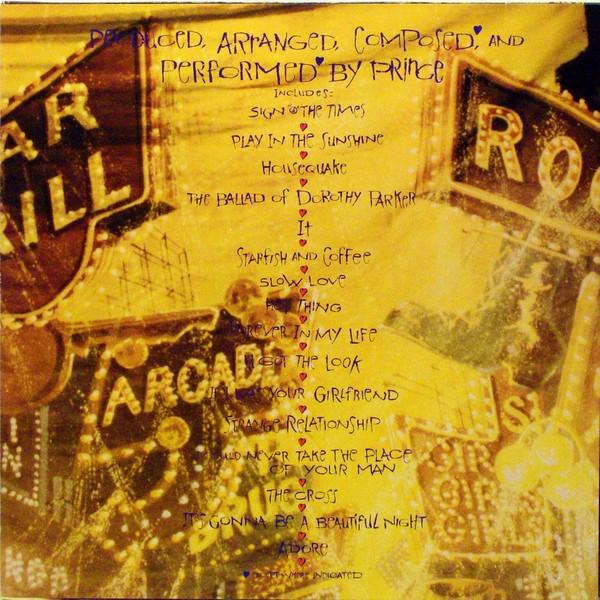
Prince: Sign ‘O’ The Times 30 Years Old Today

Paisley Park/Warner Bros, released 30 March 1987

Album chart position: #6 (US), #4 (UK)

Singles released: ‘Sign O’ The Times’ (#3 US, #10 UK)
‘If I Was Your Girlfriend’ (#67 US, #20 UK)
‘U Got The Look’ (#2 US, #11 UK)
‘I Could Never Take The Place Of Your Man’ (#10 US, #29 UK)

At the time of Sign O’ The Times’ release, the general critical consensus seemed to be that it was a great double album but, shorn of a few tracks, would have made a sensational single album. But what the press probably didn’t know was that Prince had actually intended to release a triple album.

He believed the three-record set Crystal Ball would have been be a huge artistic statement after a relatively disappointing 1986, but the idea scared the hell out of Warner Bros and also his manager Bob Cavallo. Prince was reluctantly forced to back down.

The tracks intended for Crystal Ball but later abandoned for Sign O’ The Times were ‘Rebirth Of The Flesh’, ‘Rockhard In A Funky Place’, ‘The Ball’, ‘Joy In Repetition’, ‘Shockadelica’, and ‘Good Love’ (all hoovered up from two other aborted album projects, Dream Factory and Camille).

But even after Prince removed these, he was still left with a 16-track double album, a brilliant mix of the sacred and profane, and a record which many fans believe was his finest hour.

The famous title track was recorded on 15 July 1986 in a single ten-hour session at LA’s Sunset Sound. Prince was experimenting with a new piece of kit – the Fairlight sampler/synth – but characteristically made the technology swing in a way that no other artist could.

The track also demonstrates his love of space; it’s essentially just a minimalist blues featuring a three-note melody line, some sampled drums/bass and a bit of electric guitar. Listening again on the day after the Westminster Bridge ‘terrorist’ attack of 23 March, the song’s lyric also seems as relevant now as it was in 1987:

Hurricane Annie ripped the ceiling of a church and killed everyone inside
You turn on the telly and every other story is tellin’ you somebody died
Sister killed her baby cos she couldn’t afford to feed it
And we’re sending people to the moon
In September my cousin tried reefer for the very first time
Now he’s doing horse, it’s June

It’s silly, no?
When a rocket ship explodes
And everybody still wants to fly
Some say a man ain’t happy
Until a man truly dies

‘Play In The Sunshine’ and ‘Housequake’ are pure party pop – it’s scarcely believable that Prince alone could generate such a raucous studio atmosphere with only Susannah Melvoin’s backing vocals, a few guests and Eric Leeds’ sax for company. The latter also represents his first recorded attempt at hip-hop (unless you count the brief ‘rap’ in ‘Girls & Boys’), typically supplying something usually missing from the genre: humour.

‘The Ballad Of Dorothy Parker’, recorded in Prince’s Minneapolis home studio on 15th March 1986, may be his most psychedelic recording, the soundtrack to a dream with seemingly-spontaneous musical moments that no one else could have created. He demonstrates his mastery with the LM-1 drum machine and, vocally, sets up a novel ‘Greek chorus’ effect.


‘Forever In My Life’ takes a melody line very similar to Sly And The Family Stone’s ‘Everyday People’ (and maintains Sly’s key of G) but again demonstrates Prince’s remarkable sense of space and also features another extraordinary backing vocal arrangement.

The heartfelt lyric was written when he believed he would settle down with fiancée Susannah Melvoin (twin sister of Wendy) – sadly it wasn’t to be.

‘It’, another bold experiment with the Fairlight, returns to the cold, sexualised world of 1999, while ‘Hot Thing’ is its flipside, a funky, James Brown-inspired one-chord romp with some great Leeds tenor sax.

‘If I Was Your Girlfriend’ (another song about Susannah/Wendy), ‘Strange Relationship’ (another big nod to Sly), ‘It’s Gonna Be A Beautiful Night’, ‘Starfish And Coffee’, ‘U Got The Look’ and ‘I Could Never Take The Place Of Your Man’ are just brilliantly performed, beautifully written pop tunes with dashes of psychedelia and soul.

According to engineer Susan Rogers, Prince was very influenced by Kate Bush’s Hounds Of Love during the recording of SOTT, the track ‘Cloudbusting’ a particular favourite. Other songs showed contemporary influences too – ‘Adore’ was apparently Prince’s response to the popularity of Luther Vandross’s Give Me The Reason and Patti Labelle’s The Winner In You, and it also hugely influenced the neo-soul movement, particularly D’Angelo’s ballad style.

‘U Got The Look’ – the last song recorded for Sign O’ The Times on 21 December 1986 – was apparently inspired by Robert Palmer’s ‘Addicted To Love’.

Sign O’ The Times sold 1.8 million copies in the US, a very similar number to Parade. Some believed the slightly disappointing sales were due to the choice of ‘If I Was Your Girlfriend’ as the second single; it is strange that ‘U Got The Look’ didn’t get the nod. But if Prince’s popularity was levelling out in the States, it was growing across Europe.

Lou Reed: The Blue Mask 35 Years Old Today

61doi8e-mvl-_sl1050_Humour: it’s not something often associated with Lou Reed, even though he filled up much of 1978’s Live: Take No Prisoners with breakneck Lenny Bruce-style banter.

But a listen to ‘The Gun’, ‘Underneath The Bottle’ or ‘Waves Of Fear’ from The Blue Mask – released 35 years ago today – always cheers me up; there’s just something so uncensored, unapologetic and even cathartic about his worldview, and of course an element of ‘there but for the grace of God…’

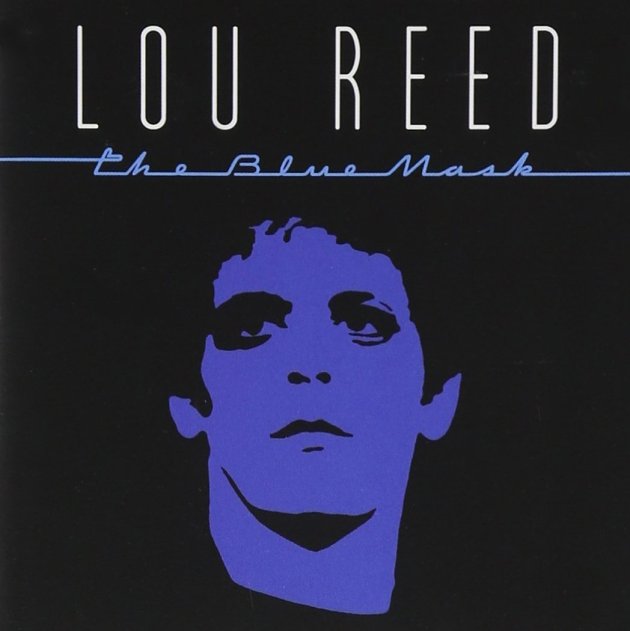
Newly married to Sylvia Morales (who also designed the striking album cover), recently clean and apparently the happiest he’d ever been, the more extreme cuts from the album seem to point towards some of the sacrifices Reed had made for this new life, and/or the fears that it could all go pear-shaped at any moment. Maybe falling in love just scared the hell out of him.

He had put together possibly the finest band of his career (Robert Quine on guitar, Fernando Sanders on bass, Doane Perry on drums). Gone were the perky, ‘funky’ tones of 1980’s Growing Up In Public – now it was time to return to two guitars, panned hard-left and hard-right, voice, bass and drums. The whole album has a gorgeous, ambient mix – Rudy Van Gelder would have approved.

‘Women’ is magnificent – Sanders plays some charming countermelodies on fretless while Lou eulogises: ‘A woman’s love can lift you up/And women can inspire/I feel like buying flowers and hiring a celestial choir/A choir of castratis to serenade my love/They’d sing a little Bach for us and then we’d make love.’

‘Waves Of Fear’, a coruscating portrait of alcohol DTs, plays out like a deleted scene from ‘The Lost Weekend’. In the extended outro, as Reed riffs viciously, Quine’s manic solo flaps around like a dying fish. ‘Underneath The Bottle’ also focuses on the booze to gripping and sometimes amusing effect: ‘Things are never good/Things go from bad to weird/Hey, gimme another scotch with my beer.’

The title track is a Burroughsian jaunt through torture, pain and self-loathing, while ‘The Gun’ seems to represent the worst possible situation between a man and woman: ‘A man…carrying a gun/And he knows how to use it/Nine millimetre Browning/Let’s see what it can do/Tell the lady to lie down/I want you to be sure to see this,’ croaks Lou over a gentle two-chord vamp and superb Sanders bass.

‘Average Guy’ brings back the lightness, a mock-heroic look at Lou’s new life: ‘Average in everything I do/My temperature is 98.2.’ ‘The Day John Kennedy Died’ is a classic piece of modern Americana, a fable of lost innocence: ‘I dreamed I was young and smart and it was not a waste/I dreamed that there was a point to life and to the human race.’

‘No redemption, no salvation… My characters just squeeze by’, Reed told the NME in 1983. Dylan rates him as one of the great lyricists and The Blue Mask offers many reasons why. The band sounds pretty damn great too but was sadly short-lived – apparently Lou couldn’t stand Perry who fled to Jethro Tull pretty soon after the recording. Quine lasted a little longer but was also soon on his way.

The Blue Mask only reached number 167 on the US album chart and didn’t even register in the UK – a pretty dire state of affairs for such an influential artist. The ’80s were not going to be easy on Lou.

XTC: English Settlement 35 Years Old Today

r-1455277-1313625163-jpegVirgin Records, released 12 February 1982

Produced by Hugh Padgham and XTC

Recorded at The Manor, Oxfordshire, October/November 1981

Working titles: Rogue Soup, Motorcyle Landscape, World Colour Banner, Explosion Of Flowers, Knights On Fire

Album Chart position: #5 (UK), #48 (US)

Singles released: ‘Senses Working Overtime’ (UK #10)
‘Ball And Chain’ (UK #58)
‘No Thugs In Our House’ (did not chart)

Andy Partridge (vocals, guitar, keyboards, percussion, co-composer): ‘We spent the summer of 1981 rehearsing at Terry “Fatty” Alderton’s Tudor Rehearsal Studio and it was very sweaty. All the Swindon heavy rock bands would rehearse there, drink cider and piss in the corner. Terry (Chambers) had forgotten how to drum. He had spent the early summer working on a building site and when he set up his drum kit it was more like scaffolding. He was just useless (but apparently improved pretty quickly… Ed.). I forced him to buy a new snare drum and timbale. I bought a Yamaha acoustic. It opened up possibilities for new sounds where the live arrangements mattered less. I’d become unhinged a couple of times on tour and wanted a break. The album cover (by Ken Ansell)? I think it was just that we were fascinated with the Uffington Horse. The Americans thought it was a duck…’

Dave Gregory (guitar, keyboards, backing vocals): ‘I’d always dreamed about owning a 12-string Rickenbacker but it had seemed like a frivolous folly until now. I fell totally in love with the sound. English Settlement was a watershed record for us. We’d made a couple of guitar records and then the acoustic side came out. It was definitely a progression. There weren’t too many songs, just not enough time…’

Colin Moulding: (vocals, bass, keyboards, percussion, co-composer): ‘I bought a fretless bass. I thought it would fit in with the acoustic stuff we were doing but it was impossible on tour. You have to have a flair for playing something without frets and I haven’t. As soon as the lights went out…the rest is history…’

For much more info on English Settlement, check out Neville Farmer’s book ‘XTC Song Stories’.

Classic Rock’s 100 Greatest Albums Of The ’80s: First Impressions

_57I’m a sucker for a ‘best albums of the 1980s’ list.
Classic Rock magazine have just published their ‘real’ top 100, focusing on under-the-radar records by both well-established and cult artists.

The countdown features a fair few critics’ favourites – Peter Gabriel 3, Lou Reed’s New York, David Bowie’s Scary Monsters (And Super Creeps), Talking Heads’ Remain In Light, The Police’s Synchronicity, Roxy Music’s Avalon. No major surprises there.

Then there are the slightly left-field choices that would possibly scrape into my top 100 too (Living Colour’s Vivid, PiL’s Album, Brian Wilson’s self-titled debut, Billy Idol’s Rebel Yell, Genesis’s Duke, Neil Young’s Freedom, Robbie Robertson’s self-titled debut, David Lee Roth’s Skyscraper).

There are the slightly puzzling choices from established artists – Tom Waits’ Frank’s Wild Years, Yes’s Drama, Red Hot Chili Peppers’ Uplift Mofo Party Plan, Rolling Stones’ Tattoo You, Van Halen’s Women And Children First, Faith No More’s Introduce Yourself and Aerosmith’s Done With Mirrors.

And then there’s a whole raft of albums by artists I’ve long meant to check out. So I gave them a spin. I didn’t make much headway with Dead Kennedys, Billy Squier, Zodiac Mindwarp, John Mellencamp, Gun, Sea Hags, Green On Red, Queensryche, Georgia Satellites, Enuff Z’Nuff and King’s X, but here’s some stuff that did make an impression – very surprisingly, in most cases:

#86: Steve Perry’s Street Talk (1985)
I’ve always respected the Journey man’s voice but was unaware of his solo career until I heard this super-catchy single (whose video even throws in a bit of ‘Spinal Tap’ self-parody).

#84: Michael Bolton’s Everybody’s Crazy (1985)
The sound of Michael McDonald fronting ZZ Top.

#55: Gary Moore’s Corridors Of Power (1984)
Included for the extraordinary first two minutes: scary chops from a guitar great.

#38: Pink Floyd’s The Final Cut (1983)
You’d be hard pressed to call it a great voice and the casual racism grates but Waters emotes effectively on this beautifully-produced, evocative album opener.

#3: Def Leppard’s High ‘N’ Dry (1981)
One for audiophiles everywhere: producer ‘Mutt’ Lange works his magic again.

I won’t give away the number one…but you can check out the full top 100 albums here.

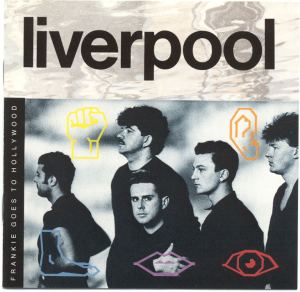
Frankie Goes To Hollywood: Liverpool 30 Years Old Today

frankie_1309776451It’s well known that FGTH’s deal with ZTT was one of the worst recording contracts in pop history (outlined in embarrassing detail in vocalist Holly Johnson’s ‘A Bone In My Flute’ autobiography).

But the band were already starting to show signs of subordination by late 1984 – they refused to record the Velvet Underground’s ‘Heroin’ as the B-side to ‘The Power Of Love’, part of ZTT ideas man Paul Morley’s bizarre plan* to get the label’s acts to write a history of pop through cover versions.

FGTH also scuppered ZTT’s plan for them to star in a sci-fi movie which was to be scripted by Martin Amis and directed by Nicolas Roeg (actually, that sounds brilliant…).

The band then insisted that they actually play on their second album Liverpool rather than let session players lay down the basic tracks, a request that seems to have been granted. Guest players this time were few and far-between, and it’s quite hard to identify Trevor Rabin, Steve Howe and Lol Creme.

Sensing trouble, Trevor Horn took the role of ‘executive producer’ and passed production duties over to the gifted Stephen Lipson, who clearly had his work cut out. A schism was opening up between Holly Johnson and the rest of the band, or ‘The Lads’, as he dubbed them (Lipson discusses the making of Liverpool in this excellent podcast).

Tensions were also running high in the UK – by mid 1986, unemployment had topped three million and anti-Thatcher feeling had reached its peak. Oxford University refused her an honorary degree. So the frivolity and epicurean excesses of Welcome To The Pleasuredome were definitely out.

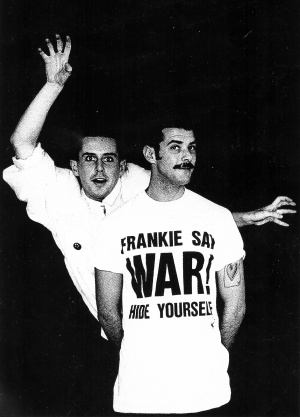
frankie_say_war_hide_yourself-_t-shirt

Holly Johnson and Paul Rutherford

Still, Liverpool is a sumptuous-sounding album, with immense care taken over recording, mixing and mastering – apparently to the tune of a whopping £760,000.

It stands up pretty well today especially if taken as a separate entity to Pleasuredome, even if the songs – not surprisingly – are not as memorable as the debut’s.

Lipson pulls out all the stops, playing some superb fuzz-toned lead guitar, particularly on ‘Maximum Joy’ and ‘Rage Hard’, and piecing together an album of musically-rich, prog-influenced hard rock.

Synth players Andy Richards and Peter-John Vettese contribute intriguing intros and outros, often involving backing vocalist Betsy Cook too.

And though Liverpool is obviously a more ‘serious’ album than Frankie’s debut, there are still amusing spoken-word inserts in broad Scouse (‘In the common age of automation, where people might eventually work ten or twenty hours a week, man for the first time will be forced to confront himself with the true spiritual problems of livin”!).

‘Warriors Of The Wasteland’, ‘Rage Hard’ and ‘Kill The Pain’ are tough techno-rock tracks which wouldn’t have sounded out of place on It Bites’ debut album. ‘Rage Hard’ was also subjected to a fantastically overblown extended mix featuring Pamela Stephenson (doing her best Thatcher impersonation?) taking us on a tour of the 12” single.

‘Maximum Joy’ is superb; pure ZTT bliss, while ‘Lunar Bay’ is also brilliant, balls-out prog/pop in the style of Propaganda’s A Secret Wish.

‘For Heaven’s Sake’ is a completely barmy anti-Thatcher ballad (‘She should buy us all a drink’) in queasy 6/8 time, featuring a melody that wouldn’t be out of place in a classic Broadway musical, some Native American chanting by Holly and a weird music-hall middle section.

‘Is Anybody Out There’ is a fitting end to Frankie’s recording career, a majestic, distinctly Suede-like ballad (the guitar solo is totally Bernard Butler) with some beautiful Holly vocals and a subtle Richard Niles string arrangement.

The album was not a commercial disaster, reaching #5 in the UK album chart and the top 10 in many other European countries, but a disappointing #88 in the US. And Thatcher still had four years left in Downing Street.

*Morley’s influence was apparently running amok, evidenced by Liverpool‘s fairly ridiculous liner notes (‘Best wishes to Stan Boardman’) and a choice of album title that suggested he was pretty certain the band would soon be returning to their hometown, banished from pop’s high table. Holly apparently hated the title…

King Crimson: Discipline @ 35

crimson-cover14 April 1981: King Crimson – or Discipline, as they are currently named – are rehearsing new material in deepest Dorset.

But all is not well. Guitarist/de facto leader Robert Fripp is getting seriously ticked off with Bill Bruford’s drumming.

He outlines the pertinent issues in his diary (available to read in the remastered CD’s liner notes):

Bill is really getting to me, so I’m trying to understand how he works:
1. He’s a very busy player and doesn’t enjoy playing sparsely.
2. His parts have lots of fills and major changes of texture.
3. His fills are dramatic ie., they shock.

So Fripp comes up with some suggestions for Bruford:

1. Repeat yourself.
2. Take your time.
3. Leave room.
4. Listen to everybody else.
5. Develop a new set of clichés.
6. Develop a new vocabulary of drum sounds.
7. Listen to the sound of what you play.

Bruford’s autobiography outlines his general attitude to these instructions. But he gamely meets Fripp halfway and adapts his style accordingly, laying off the hi-hats, ride and crash cymbals unless absolutely necessary and adding a set of Octobans, a China cymbal and a few electric drums to his kit.

There are other Fripp stipulations. The music’s high frequencies should be saved for the electric guitar (Fripp was perhaps influenced by the ‘rules’ set by Peter Gabriel for his groundbreaking third album) and the 16th notes usually played by the hi-hat or ride cymbal should also now be the guitarists’ responsibility.

The formula was set. And one of the great albums (and bands) of the ’80s was born.

There was something very exciting in the air around late ’70s/early ’80s rock. The talk was all of ‘village music’ – an African concept wherein each player’s contribution is vital but only a small part of the mighty whole.

Talking Heads’ Remain In Light, Brian Eno/David Byrne’s My Life In The Bush Of Ghosts, David Bowie’s Lodger, Japan’s Tin Drum and Gabriel III showed how ‘world’ influences could integrate with ‘rock’ to thrilling effect.

Discipline – released 35 years ago today – fits in very neatly with those albums.

Musical references might come from Mozambique, Java, China, Bali or South Africa, or from the soundworlds of Karlheinz Stockhausen, Glenn Branca, Philip Glass and Steve Reich.

Like Talking Heads, King Crimson filtered these influences through a New York art-rock/post-punk perspective but, arguably, no one integrated them more successfully.

Fripp and Bruford recruited Adrian Belew (who chose Crimson over Talking Heads) and Tony Levin in New York. Belew had grown into an incredibly assured vocalist – according to Bruford, he was literally incapable of singing out of tune – and master of unusual guitar textures. His solos featured tones and approaches never heard before.

Levin had already played bass with a plethora of heavyweights including Paul Simon, John Lennon and Gabriel, and had also just turned down an invitation to join Weather Report at the beginning of 1981.

He unleashed a new weapon for the Crimson gig – the ten-stringed Chapman Stick, played by tapping or ‘hammering on’ (heard to great effect during the opening of ‘Elephant Talk’).

Back in the mid-’80s, my brother and I used to peruse Discipline‘s liner notes for clues as to the powerful and mysterious music therein. We didn’t have a clue what a ‘Stick’ was, concluding wrongly that it must be the slightly synthetic woodblock sound heard throughout ‘The Sheltering Sky’ and title track (I’m still not sure what that sound is – maybe a ‘triggered’ Bruford hi-hat?).

Tony Levin and Chapman Stick

Tony Levin and Chapman Stick

The band wrote an hour of new material fairly quickly and toured modestly in the UK during April and May 1981, calling themselves Discipline.

The album of the same name was recorded over the summer at Island’s Basing Street Studio in Notting Hill (later Trevor Horn’s Sarm complex) with producer Rhett Davies, fresh from helming Roxy Music’s Flesh And Blood.

By September, pleasantly surprised by the quality of music in the can, Fripp was issuing a lengthy (and fairly incomprehensible) press release explaining why the band would henceforth be known as King Crimson.

As Bruford says in his book, ‘For a couple of years at the beginning of the ’80s, we were the right band in the right place at the right time – not to get hits, but to do useful, fascinating and right work.’

He also says that the Crimson drum stool was one of the three best rock gigs in the last few decades of the 20th century, naming the other two as Gabriel and Frank Zappa.